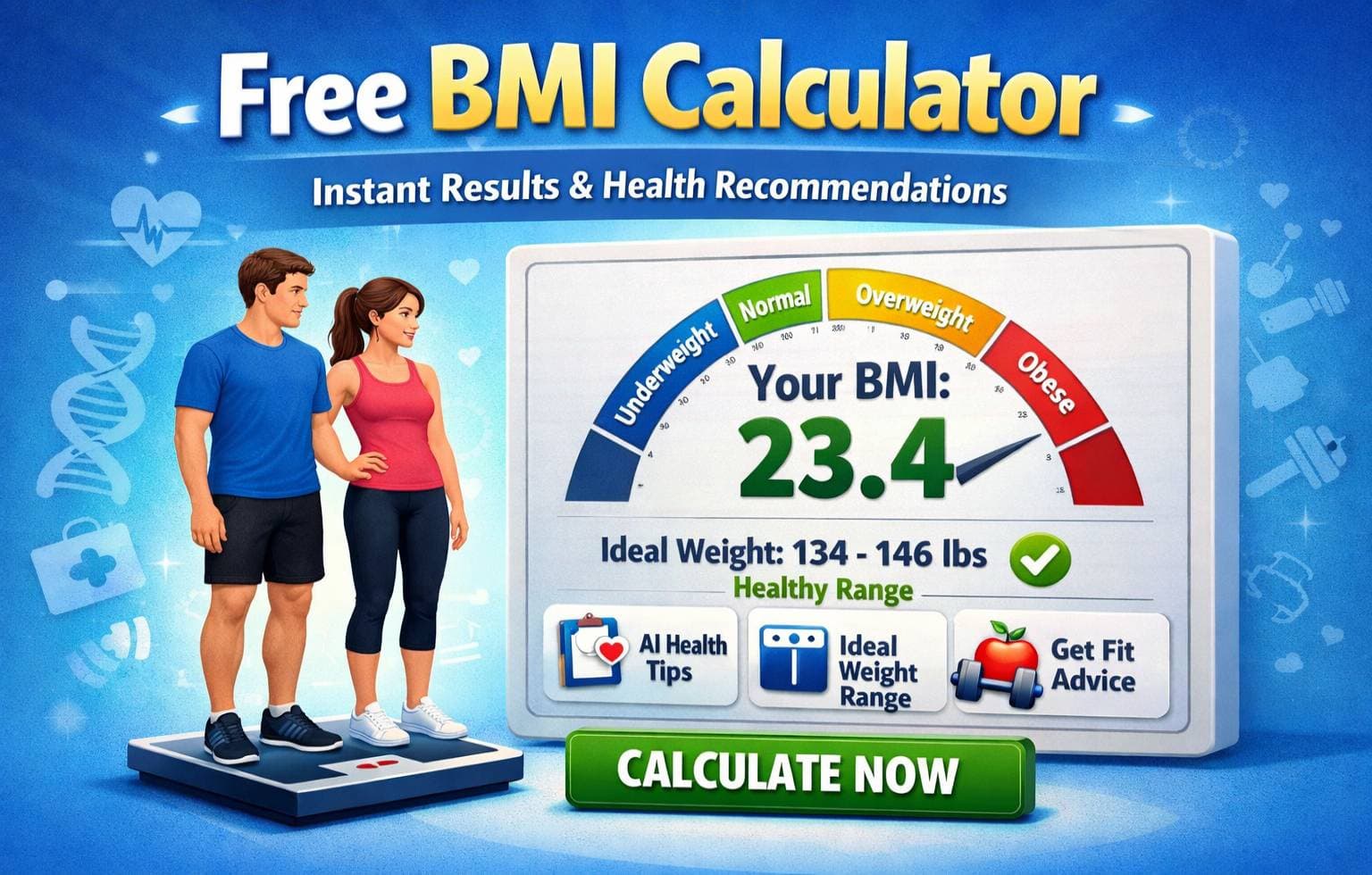
BMI Calculator: Free Body Mass Index Tool with AI Results
Free Calculator
BMI Calculator
Table of Contents
Free BMI Calculator: Calculate Your Body Mass Index Instantly
Understanding your body composition is a crucial step toward better health. A BMI Calculator is one of the simplest and most accessible tools for assessing whether your weight falls within a healthy range for your height. In this comprehensive guide, we'll explore everything you need to know about BMI calculators, from how they work to their limitations and benefits.
Quick Summary: A BMI Calculator provides instant results to help you understand your body mass index category—whether you're underweight, normal weight, overweight, or obese. While it's a useful screening tool, BMI should be considered alongside other health indicators for a complete picture of your health.
What is BMI (Body Mass Index)?
Body Mass Index, commonly known as BMI, is a numerical value derived from your height and weight. Developed in the 19th century by Belgian mathematician Adolphe Quetelet, BMI has become a standard screening tool used worldwide by healthcare professionals to categorize individuals into different weight categories.
The BMI formula is straightforward and has been validated by the World Health Organization (WHO) and the Centers for Disease Control and Prevention (CDC):
BMI Formula:
• Metric: BMI = weight (kg) / [height (m)]²
• Imperial: BMI = [weight (lb) / height (in)²] × 703
Understanding BMI Categories
Once you calculate your BMI, the number falls into one of several categories that indicate potential health risks. Here's the standard classification according to the World Health Organization:
| BMI Range | Category | Health Implications |
|---|---|---|
| Below 18.5 | Underweight | May indicate malnutrition, eating disorders, or other health issues |
| 18.5 - 24.9 | Normal Weight | Generally associated with lowest health risk |
| 25.0 - 29.9 | Overweight | Increased risk for certain health conditions |
| 30.0 - 34.9 | Obesity Class I | Moderate risk for obesity-related conditions |
| 35.0 - 39.9 | Obesity Class II | High risk for serious health conditions |
| 40.0 and above | Obesity Class III | Very high risk; immediate medical attention recommended |
How to Use a BMI Calculator
Using a BMI calculator is remarkably simple, especially with modern online tools that provide instant results. Here's a step-by-step guide:
- Enter Your Weight: Input your current weight in either kilograms or pounds, depending on the calculator's settings.
- Enter Your Height: Provide your height in centimeters, meters, or feet and inches.
- Get Instant Results: The calculator will immediately display your BMI value and category.
- Review Recommendations: Many advanced BMI calculators, including AI-powered versions, provide personalized health recommendations based on your results.
- Determine Your Ideal Weight Range: The calculator will typically show you the weight range considered healthy for your height.
Try Our Free BMI Calculator Now →
Benefits of Using a BMI Calculator
BMI calculators offer several advantages that make them popular among both healthcare professionals and individuals monitoring their health:
Quick Health Assessment
Within seconds, you can get a baseline understanding of where you stand in terms of weight categories. This immediate feedback can be motivating for those starting their health journey.
Easy to Use
Unlike complex body composition tests that require specialized equipment, a BMI calculator only needs two simple measurements: your height and weight. This makes it accessible to everyone, anywhere, at any time.
Tracking Progress
Regular BMI calculations allow you to monitor changes over time. Whether you're working toward weight loss, gain, or maintenance, tracking your BMI provides measurable goals and visible progress. Consider also using our Calorie Calculator to track your daily energy needs.
Health Risk Screening
BMI serves as an initial screening tool to identify potential weight-related health risks. Studies published in the National Institutes of Health (NIH) have shown correlations between higher BMI ranges and increased risk of conditions such as type 2 diabetes, cardiovascular disease, and certain cancers.
Cost-Free
Online BMI calculators are completely free and require no special equipment beyond a scale and a way to measure your height. This makes it an economical health tool for everyone.
Limitations of BMI
Important Note: While BMI is a useful screening tool, it's not a diagnostic tool and has significant limitations. Always consult with healthcare professionals for comprehensive health assessments. Resources like the Mayo Clinic provide additional guidance on BMI interpretation.
Despite its widespread use, BMI has several well-documented limitations that you should understand:
Doesn't Distinguish Between Muscle and Fat
BMI cannot differentiate between lean muscle mass and body fat. Athletes and bodybuilders with high muscle mass may be classified as overweight or obese despite having low body fat percentages. For a more accurate assessment, consider using our Body Fat Percentage Calculator.
Doesn't Account for Fat Distribution
Where you carry your weight matters significantly for health. Central or abdominal obesity (excess fat around the midsection) carries higher health risks than peripheral fat distribution. BMI doesn't measure or account for this important distinction. Try our Waist-to-Hip Ratio Calculator for additional insights.
Age and Sex Variations
BMI uses the same calculation for adults regardless of age or sex, though body composition naturally changes with age and differs between males and females. Older adults may have more body fat for the same BMI compared to younger adults.
Ethnic Differences
Research published in The Lancet has shown that different ethnic groups may have varying health risks at the same BMI levels. For instance, Asian populations may face increased health risks at lower BMI values compared to European populations.
Not Suitable for Everyone
BMI calculations are not appropriate for:
- Children and adolescents (who require age and sex-specific percentile charts)
- Pregnant or breastfeeding women
- Athletes with high muscle mass
- Elderly individuals with muscle loss
- People with certain medical conditions affecting weight or height
Beyond BMI: Complementary Health Measurements
For a more complete picture of your health, consider using BMI alongside these additional measurements:
Waist Circumference
Measuring your waist provides insight into abdominal fat levels. According to the National Heart, Lung, and Blood Institute, a waist circumference over 40 inches (102 cm) for men or 35 inches (88 cm) for women typically indicates increased health risk, regardless of BMI.
Waist-to-Hip Ratio
This ratio compares your waist measurement to your hip measurement and helps assess fat distribution. Calculate yours with our Waist-to-Hip Ratio Calculator.
Body Fat Percentage
Measuring actual body fat percentage through methods like bioelectrical impedance, DEXA scans, or skinfold measurements provides more accurate information about body composition than BMI alone. Use our Body Fat Calculator for estimates.
Basal Metabolic Rate (BMR)
Understanding how many calories your body burns at rest can help with weight management goals. Check out our BMR Calculator to learn more.
AI-Powered BMI Calculators: The Next Generation
Modern BMI calculators have evolved beyond simple number crunching. AI-powered health calculators now offer:
- Personalized Recommendations: Based on your specific results, age, and health goals
- Trend Analysis: Track your BMI over time and identify patterns
- Goal Setting: Receive customized weight goals and timelines
- Nutritional Guidance: Get dietary suggestions tailored to your BMI category
- Exercise Recommendations: Discover appropriate physical activities for your current fitness level
How to Improve Your BMI
If your BMI calculation indicates you're outside the normal range, here are evidence-based strategies to work toward a healthier weight:
For Weight Loss (If Overweight or Obese)
- Create a Calorie Deficit: Consume fewer calories than you burn through a combination of dietary changes and increased physical activity. Use our Calorie Calculator to determine your needs.
- Focus on Whole Foods: Emphasize vegetables, fruits, lean proteins, whole grains, and healthy fats as recommended by Harvard Health
- Increase Physical Activity: Aim for at least 150 minutes of moderate-intensity exercise per week according to CDC guidelines
- Practice Portion Control: Be mindful of serving sizes and avoid oversized portions
- Stay Hydrated: Drinking water can help manage appetite and support metabolism
- Get Adequate Sleep: Poor sleep is linked to weight gain and difficulty losing weight
- Manage Stress: Chronic stress can lead to emotional eating and weight gain
For Weight Gain (If Underweight)
- Increase Calorie Intake: Focus on nutrient-dense, calorie-rich foods
- Eat More Frequently: Consume five to six smaller meals throughout the day
- Include Healthy Fats: Add nuts, avocados, olive oil, and fatty fish to your diet
- Strength Training: Build muscle mass through resistance exercises
- Avoid Empty Calories: Choose nutritious foods over low-nutrient, high-calorie options
- Consult a Professional: Work with a registered dietitian to ensure healthy weight gain
Medical Advice: Before starting any significant diet or exercise program, especially if you have existing health conditions, consult with your healthcare provider. Resources like The Academy of Nutrition and Dietetics can help you find qualified professionals.
Common BMI Calculator Questions
How often should I calculate my BMI?
For general monitoring, calculating your BMI once a month is sufficient. If you're actively working on weight loss or gain goals, you might check weekly or bi-weekly. However, focus on trends over time rather than daily fluctuations.
Is BMI accurate for children?
Standard adult BMI calculations are not appropriate for children under 18. Children should use BMI-for-age percentile charts that account for age and sex. The CDC provides specialized calculators for children and teens.
Can BMI predict my health future?
While BMI can indicate increased risk for certain conditions, it's not a crystal ball. Many factors influence health outcomes, including genetics, lifestyle, diet quality, physical activity levels, and other health markers. BMI is just one piece of the puzzle.
What's the difference between BMI and body fat percentage?
BMI is calculated from height and weight, while body fat percentage measures the proportion of your body weight that comes from fat tissue. Body fat percentage provides more detailed information about body composition. Learn more with our Body Fat Calculator.
Making the Most of Your BMI Calculator Results
Once you've calculated your BMI, here's how to use that information effectively:
- View It as a Starting Point: Your BMI is one data point, not the complete story of your health. Use it to start conversations with healthcare providers and to begin assessing your wellness journey.
- Consider the Context: Take into account your personal circumstances, such as your fitness level, muscle mass, and overall health history when interpreting your BMI.
- Set Realistic Goals: If changes are needed, aim for gradual, sustainable improvements rather than dramatic short-term results. A loss of 1-2 pounds per week is generally considered healthy and maintainable.
- Track Multiple Metrics: Combine BMI with other measurements available in our health calculator suite like waist circumference, energy levels, and fitness improvements.
- Seek Professional Guidance: If your BMI indicates potential health concerns, schedule an appointment with a healthcare provider for a comprehensive evaluation.
The Future of BMI and Health Assessment
Healthcare is evolving, and so are the tools we use for health assessment. While BMI remains a valuable screening tool, new technologies and approaches are emerging:
- 3D Body Scanners: Provide detailed body composition analysis and measurements
- Wearable Technology: Tracks continuous health data including activity levels, heart rate, and sleep patterns
- Genetic Testing: Offers insights into individual metabolic factors and health predispositions
- AI Health Assistants: Provide personalized health recommendations based on comprehensive data analysis
However, the simplicity and accessibility of BMI calculators ensure they'll remain relevant as a first-line screening tool for years to come.
Conclusion: Your Health Journey Starts Here
A BMI calculator is a powerful, accessible tool that provides valuable insights into your weight status and potential health risks. While it has limitations and shouldn't be the only measure of your health, it's an excellent starting point for understanding where you are on your wellness journey.
Whether you're looking to maintain your current healthy weight, lose a few pounds, or gain weight safely, regular BMI calculations can help you track your progress and stay motivated. Combined with other health metrics from our comprehensive suite of health calculators, professional medical advice, and a commitment to healthy lifestyle choices, your BMI results can guide you toward better health outcomes.
Remember, health is not just about numbers on a scale or a BMI chart. It's about how you feel, your energy levels, your ability to enjoy life, and your overall wellbeing. Use BMI as one tool among many in your health toolkit, and always prioritize sustainable, healthy habits over quick fixes or extreme measures.
Ready to calculate your BMI? Use our free, instant BMI calculator to get started on understanding your body mass index today. With AI-powered recommendations and comprehensive results, you'll have the information you need to make informed decisions about your health.
Explore More Health Tools
Enhance your health monitoring with our complete suite of calculators:
- Pregnancy Calculator - Track your pregnancy journey
- Heart Rate Calculator - Monitor your cardiovascular health
- Macro Calculator - Calculate your macronutrient needs
- View All Health Calculators - Browse our complete collection
Disclaimer: This article is for informational purposes only and is not intended as medical advice. BMI calculations and the information provided here should not replace professional medical consultation. Always consult with qualified healthcare providers regarding your specific health concerns and before making significant changes to your diet or exercise routine.
Medical References: This article references information from reputable sources including the World Health Organization (WHO), Centers for Disease Control and Prevention (CDC), National Institutes of Health (NIH), and peer-reviewed medical journals. For the most current medical guidance, please consult with healthcare professionals.
Related Calculators
Try these free calculators related to this article:
In-Depth Guides
Dive deeper with our comprehensive guides on this topic:
Frequently Asked Questions
Our Methodology
All calculator content on CalculatorApp.me is reviewed by subject-matter experts, cross-referenced with official sources, and updated regularly for accuracy. Our formulas and data are verified against industry standards and government publications.
Priya Sharma
Verified AuthorHealth Science Researcher
Priya is a health science researcher with 10+ years translating clinical research into practical health tools. She oversees the accuracy of health, fitness, and nutrition calculators on CalculatorApp.me, cross-referencing CDC guidelines, WHO recommendations, and NIH research. Fact-checker at CalculatorApp.me.
Found this helpful? Share it!
Stay Updated
Get notified when we launch new calculators and features.
No spam. Unsubscribe anytime.