The New BMI Formula by Trefethen: Is It More Accurate Than the Standard BMI?
Free Calculator
BMI Calculator
Table of Contents

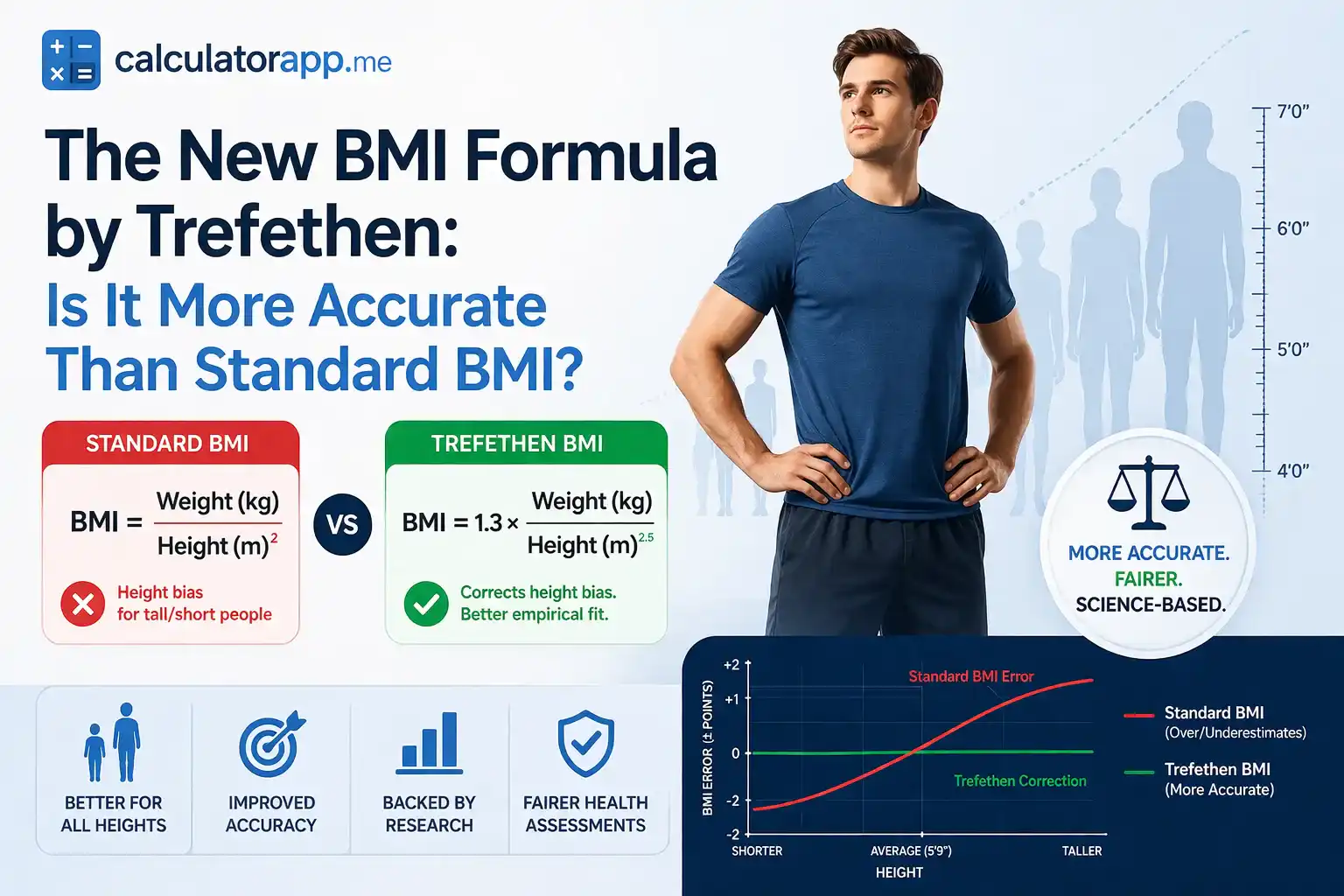
Standard BMI formula vs. Trefethen New BMI formula — the key difference is the height exponent: 2 versus 2.5 (Source: CalculatorApp.me)
This article is part of our complete BMI & Health Metrics Guide, which covers healthy weight ranges, BMI limitations, and better alternatives in depth.
If you have ever calculated your Body Mass Index and felt the result did not match reality — you are not alone, and you are not wrong. The standard BMI formula has a known mathematical flaw that systematically skews results for tall and short people. The new BMI formula by Nick Trefethen, an Oxford University mathematician, corrects this flaw with a simple but targeted adjustment to the exponent. Before we go further, check your current BMI now with our BMI Calculator — and by the end of this guide, you will understand why that number may be misleading you.
Want the two formulas side by side at every height? See our new BMI vs old BMI comparison for a quick decision guide.
If you are shopping around for a tool, we also tested and ranked the best free BMI calculators of 2026.
⚡ Key Takeaways — TL;DR
- Standard BMI uses height² — this overestimates BMI for tall people and underestimates for short people.
- Nick Trefethen (Oxford, 2013) proposed: New BMI = 1.3 × weight(kg) ÷ height(m)^2.5
- Imperial: New BMI = 5734 × weight(lbs) ÷ height(inches)^2.5
- The correction can shift BMI by 1.5–2.0+ points for people over 6ft or under 5ft 3in.
- No major health organization (WHO, CDC, NHS) has officially adopted it as of 2026.
- Both formulas share the same core limitation: they cannot distinguish fat from muscle.
What Is the Standard BMI Formula — and What Is Wrong with It?
Health systems worldwide have relied on the standard BMI formula since the World Health Organization adopted it in 1995. Belgian mathematician Adolphe Quetelet originally developed it in the 1830s, and the equation looks like this:
If you want to see this formula applied to your own measurements right now, our BMI Calculator does the calculation in seconds and gives you your category, ideal weight range, and AI-powered health context. For a complete guide to the standard formula, read our full article: How to Calculate BMI: The Complete Guide.

BMI distortion by height: how the standard h² formula systematically overestimates BMI for tall people and underestimates it for short people (CalculatorApp.me)
The Height-Squared Problem
Quetelet designed the squaring of height in the denominator because taller people weigh more. In theory, weight should increase proportionally in three dimensions — suggesting a cubic (h³) relationship. However, Quetelet found that in practice, weight in human populations scales roughly with h², not h³.
In practice, however, real-world scaling is not strictly quadratic. Research and mathematical analysis show:
- The standard formula tends to overestimate BMI for tall people (above 6'0" / 183 cm) — it penalizes them by dividing by a larger number than their body dimensions justify.
- The standard formula tends to underestimate BMI for short people (below 5'3" / 160 cm) — the divisor shrinks below what their body volume warrants.
Who Is Nick Trefethen? The Mathematician Behind the New Formula

Nick Trefethen — Professor of Numerical Analysis at the University of Oxford and Fellow of the Royal Society (Illustration)
Nick Trefethen is a Professor of Numerical Analysis at the University of Oxford and a Fellow of the Royal Society. His contributions to numerical mathematics — including matrix algorithms, spectral methods, and approximation theory — have earned international recognition. He is not a physician — and that is the point.
Trefethen approached BMI not as a health metric but as a mathematical expression, and he found that the formula's underlying equation lacked precision. In January 2013, he published a letter in The Economist proposing a revised formula with a corrected exponent. His argument was clear: the standard BMI uses h², but the actual empirical relationship between height and weight in human populations sits closer to h^2.5. Therefore, he argued, the formula should reflect that.
That said, Trefethen has never claimed his formula is the definitive solution to all of BMI's limitations. He described it as a more mathematically accurate version of the same type of tool — a population-level weight-for-height index — not a replacement for individualized health assessment.
For a deeper look at what BMI misses entirely — and which metrics to track instead — read why BMI is flawed and what to use instead. Women should also see our BMI guide for women, since healthy body-fat benchmarks differ from men at the same BMI.

Timeline of BMI formula development: from Quetelet's 1830s index to Trefethen's 2013 mathematical correction (CalculatorApp.me)
The New BMI Formula: Explained in Full

Standard BMI vs Trefethen New BMI — infographic comparison of both formulas and why the correction matters (CalculatorApp.me)
Metric Version
Imperial Version (US)
In concrete terms, two key differences separate this formula from the standard version:
- The exponent on height changes from 2 to 2.5. This is the core mathematical correction. By using 2.5 instead of 2, the formula accounts more accurately for the empirical relationship between height and body mass. If you need to compute h^2.5, use our Exponent Calculator — it handles fractional powers.
- Trefethen adds a scaling constant (1.3 in metric / 5734 in imperial). This constant recalibrates the output so the new formula produces numbers in the same approximate range as standard BMI — meaning the established categories (Underweight <18.5, Normal 18.5–24.9, Overweight 25–29.9, Obese 30+) still apply without modification.
What the BMI Categories Still Mean with the New Formula
| New BMI Range | Category | Health Risk Level |
|---|---|---|
| < 18.5 | Underweight | Moderate–High |
| 18.5 – 24.9 | Normal Weight ✓ | Low (optimal) |
| 25.0 – 29.9 | Overweight | Moderate |
| 30.0 – 34.9 | Obese Class I | High |
| 35.0 – 39.9 | Obese Class II | Very High |
| 40.0+ | Obese Class III | Extremely High |
New BMI vs. Standard BMI: Side-by-Side Calculation Examples
Real examples illustrate the difference most effectively. Verify any of these using our Scientific Calculator, which supports fractional exponents through its x^y function.

Standard BMI vs. Trefethen BMI results compared across different heights — the correction matters most at height extremes (CalculatorApp.me)
| Standard BMI | Trefethen BMI | |
|---|---|---|
| Calculation | 90.7 ÷ 1.93² | 1.3 × 90.7 ÷ 1.93^2.5 |
| Result | 24.4 | 22.8 |
| Category | Normal Weight | Normal Weight |
| Difference | — | 1.6 points lower |
In this case, both formulas agree on Normal Weight. However, Trefethen confirms this with a wider margin — useful context near category boundaries.
| Standard BMI | Trefethen BMI | |
|---|---|---|
| Result | 24.9 | 23.1 |
| Category | Normal Weight (barely) | Normal Weight ✓ |
| Difference | — | 1.8 points lower |
| Standard BMI | Trefethen BMI | |
|---|---|---|
| Result | 26.0 | 24.1 |
| Category | Overweight ❌ | Normal Weight ✅ |
| Standard BMI | Trefethen BMI | |
|---|---|---|
| Result | 21.7 | 23.1 |
| Category | Normal Weight | Normal Weight |
| Difference | — | 1.4 points higher |
For shorter people, Trefethen nudges the result upward — correcting the underestimation of the standard formula.
| Standard BMI | Trefethen BMI | |
|---|---|---|
| Result | 25.2 | 25.3 |
| Category | Overweight | Overweight |
| Difference | — | Only 0.1 points apart |
Who Benefits Most from the Trefethen BMI Formula?

Why BMI misjudges tall athletes: height bias compounds the muscle-mass problem. The Trefethen formula corrects the height component (CalculatorApp.me)
Tall Adults (Over 6'0" / 183 cm)
This group benefits most from the correction. The standard BMI systematically overestimates BMI for tall people. A 6'4" person who is healthy and lean may receive an "overweight" label despite maintaining a proportional, healthy body composition. For that reason, combining the Trefethen BMI with a Body Fat Calculator gives a fuller picture of actual health risk.
Short Adults (Under 5'3" / 160 cm)
The standard formula may slightly underestimate BMI for short adults. For a short person carrying excess fat, standard BMI may classify them as "normal weight" even when excess fat elevates their metabolic risk. The Trefethen formula corrects this upward, providing a more accurate risk signal.
Tall Athletes and Fitness Enthusiasts

Athletic men's BMI classifications: most elite athletes are labelled "overweight" or "obese" by standard BMI. The Trefethen formula partially corrects the height component of this misclassification (CalculatorApp.me)
Tall athletes face a double disadvantage: height inflates their BMI result (height bias), and muscle mass also inflates it (muscle-blind limitation). The Trefethen formula addresses the height component. Athletes should combine Trefethen BMI with their Ideal Weight Calculator and One Rep Max Calculator to track performance alongside body metrics.
The Science Behind Height Scaling: Why 2.5 Instead of 2?
The choice of 2.5 as the exponent is not arbitrary — empirical observation of how body mass scales with height across large, diverse populations supports it.
The Theoretical Debate: h², h^2.5, or h³?
To understand the reasoning, consider a purely geometric standpoint: weight would scale with h³ if bodies scaled proportionally in all dimensions. However, tall people are not scaled-up versions of short people — they tend to have narrower proportions relative to their height. The actual weight-for-height scaling therefore falls somewhere between h² and h³.
Quetelet empirically found scaling closer to h² in 19th-century European populations. Trefethen, using modern datasets and numerical analysis, found the empirical scaling closer to h^2.5. Neither is a universal truth, but 2.5 fits modern, diverse populations more accurately.
What Research Says About the Exponent
A 2000 analysis by the Diverse Populations Collaborative found the optimal exponent varies between populations — typically 2.3 to 2.7 — supporting 2.5 as a better central estimate than 2.0. A 2016 study in PLOS ONE examining over 4,000 individuals found that using an exponent between 2.3 and 2.5 improved the correlation between the index and measured body fat percentage compared to the standard exponent of 2.
Criticisms and Limitations of the New BMI Formula
Criticism 1: It Still Cannot Distinguish Fat from Muscle
However, the Trefethen formula corrects height-scaling but does nothing about the core limitation of all weight-for-height indices: they treat all body mass as equivalent. A powerlifter and a sedentary person of the same height and weight get the same Trefethen BMI. For a true fat-versus-muscle assessment, use our Body Fat Calculator — no expensive equipment required.
Criticism 2: The Scaling Constant Is Arbitrary
Trefethen chose the constant of 1.3 to match the output range of standard BMI, preserving the existing thresholds. No guarantee exists that 18.5/25/30 suit the new formula — researchers calibrated those thresholds for the original equation, not this corrected version.
Criticism 3: Limited Clinical Validation
The standard BMI has decades of epidemiological research linking BMI ranges to disease incidence and mortality. The Trefethen formula lacks this validation trail. Its mathematical logic is sound, but clinical adoption requires longitudinal evidence that does not yet exist at scale.
Criticism 4: The Correction Is Only Meaningful at Height Extremes
As the examples above demonstrate, for people of average height, both formulas produce nearly identical results. Switching formulas delivers less population-level benefit than the headline finding suggests.
Criticism 5: No Major Health Organization Has Adopted It
The WHO, CDC, and NHS all still use the standard formula. Changing a global standard requires consensus building, guideline revision, and practitioner education — more than a correct equation.
How the Trefethen BMI Compares to Other Body Composition Metrics

BMI categories and associated health risks — the Trefethen formula changes which category some people fall into, especially at height extremes (CalculatorApp.me)
| Metric | Corrects Height Bias? | Distinguishes Fat vs. Muscle? | Cost / Access |
|---|---|---|---|
| Standard BMI (h²) | No | No | Free |
| Trefethen BMI (h^2.5) | Yes ✓ | No | Free |
| Waist-to-Height Ratio | N/A | No | Free |
| Body Fat % (Navy method) | N/A | Yes (estimated) | Free |
| DEXA Scan | N/A | Yes (gold standard) | Moderate cost |
The Best Multi-Metric Approach
Combine these tools for the most complete picture of your weight-related health:
Has Any Health Organization Officially Adopted the New BMI Formula?
This does not dismiss Trefethen's mathematical argument. Instead, decades of embedded institutional process around changing global health standards explain the delay, the need for extensive clinical validation, and the concern that changing the formula would reclassify millions of people in ways that existing clinical guidance does not account for.
Several academic papers have cited Trefethen's work favorably, and researchers do use it in contexts where the height bias of standard BMI creates meaningful problems. However, clinicians rarely adopt it in practice.
Should You Use the Trefethen BMI Formula for Your Own Health?
| Your Height | Recommendation | Expected Difference |
|---|---|---|
| Average (5'4"–6'0") | Either formula — nearly identical results | 0.5–1.0 points |
| Tall (over 6'0" / 183cm) | Trefethen gives more accurate result | 1.5–2.0+ points lower |
| Short (under 5'3" / 160cm) | Trefethen gives slightly more accurate result | 1.0–1.5 points higher |
For everyone, remember that both formulas share the same core limitations. The most complete picture combines:
How to Calculate the New Trefethen BMI: Step-by-Step
Metric Calculation (kg and meters)
Worked example: Person weighing 80 kg, height 1.85 m
- Calculate height^2.5: 1.85² × √1.85 = 3.4225 × 1.3601 = 4.6549
- Divide weight: 80 ÷ 4.6549 = 17.186
- Multiply by 1.3: 17.186 × 1.3 = 22.34
- Result: New BMI = 22.34 → Normal Weight
For comparison purposes, the standard BMI gives: 80 ÷ 1.85² = 80 ÷ 3.4225 = 23.37. The Trefethen formula gives a result 1.03 points lower — a meaningful correction at 6'1".
Imperial Calculation (pounds and inches)
Worked example: Person weighing 176 lbs, height 73 inches (6'1")
- Calculate height^2.5: 73² × √73 = 5329 × 8.544 = 45,544
- Divide: 176 ÷ 45,544 = 0.003863
- Multiply by 5734: 0.003863 × 5734 = 22.15
- Result: New BMI = 22.15 → Normal Weight
Calculating Height^2.5 — The Practical Method
Use our Scientific Calculator (x^y function) or our Exponent Calculator to compute it in one step. Alternatively, compute manually:
For height = 1.75 m: 1.75² = 3.0625, √1.75 = 1.3229, product = 4.0488 → New BMI = 1.3 × weight ÷ 4.0488
Frequently Asked Questions
The new BMI formula by Nick Trefethen is: New BMI = 1.3 × weight (kg) ÷ height (m)^2.5. It corrects the height bias in the standard BMI formula by changing the height exponent from 2 to 2.5. The formula includes a scaling constant of 1.3 so the output stays in the same range as standard BMI. Compute the standard version with our BMI Calculator and compare to your Trefethen result using Section 11 above.
Nick Trefethen, Professor of Numerical Analysis at the University of Oxford and a Fellow of the Royal Society. He introduced it in a letter to The Economist in January 2013, approaching BMI as a mathematician not a physician — and identifying a systematic error in the height-scaling equation.
For tall people (over 6'0" / 183 cm) and short people (under 5'3" / 160 cm), yes — the Trefethen BMI is more mathematically accurate. For people of average height, both formulas produce nearly identical results. However, both formulas share the same fundamental limitations: neither can distinguish fat from muscle. Combine BMI with our Body Fat Calculator and Ideal Weight Calculator for a fuller picture.
It depends on your height. For very tall people currently classified as "overweight" (BMI 25–29.9), the Trefethen formula may reclassify them as "normal weight" — with corrections of up to 2.0 points or more at extreme heights. For people of average height, the formula produces nearly the same result. For short people, the result nudges slightly higher, potentially changing borderline categories.
The imperial version is: New BMI = 5734 × weight (lbs) ÷ height (inches)^2.5. The constant 5734 recalibrates the output to the same range as the metric version, replacing both the metric constant of 1.3 and the standard imperial conversion factor of 703.
Your BMI tells you your weight classification but not your calorie needs. Use the BMR Calculator for calories burned at rest, then the TDEE Calculator for total daily energy expenditure. Our guide What Is Basal Metabolic Rate? explains how to use these numbers for weight management. The Calorie Deficit Calculator will then calculate the daily deficit needed to reach your target weight safely.
The Trefethen BMI is a corrected weight-for-height index that still uses total body mass (not fat distribution). The waist-to-height ratio uses waist circumference, making it a direct measure of central adiposity — the most metabolically dangerous type of fat. Research suggests waist-to-height ratio is a better predictor of cardiometabolic risk than any BMI variant. Use both alongside our Blood Pressure Calculator for a complete picture.
The Bottom Line
The new BMI formula by Nick Trefethen is a mathematically sound refinement of one of the world's most common health metrics. By changing the height exponent from 2 to 2.5 and applying a recalibrating constant, it corrects the well-documented tendency of standard BMI to overestimate body mass index for tall people and underestimate it for short people.
In practice, this is not a minor academic quibble. For tall adults whom the standard formula labels "overweight" through systematic BMI inflation, the Trefethen correction shifts their classification to where it accurately belongs — reducing unnecessary clinical concern, insurance penalties, and the psychological harm of weight stigma.
At the same time, however, the Trefethen formula is not a complete solution. It inherits all the other limitations of BMI: it still cannot distinguish fat from muscle, does not account for fat distribution, and ignores age, ethnicity, and fitness level. For the majority of people at average heights, it gives nearly the same result as standard BMI.
📌 Key Takeaways
- The standard BMI formula (h²) overestimates BMI for tall people and underestimates for short people due to an imprecise height-scaling exponent.
- Nick Trefethen, Oxford mathematician, proposed a corrected formula in 2013: New BMI = 1.3 × weight(kg) ÷ height(m)^2.5.
- The correction is most significant for people over 6'0" (183 cm) or under 5'3" (160 cm) — shifting results by 1.5–2.0+ points.
- For people of average height, the two formulas produce nearly identical results.
- No major health organization has officially adopted the Trefethen formula as of 2026.
- Both formulas share the same fundamental limitation: they cannot replace individualized body composition assessment.
All Related Calculators — Verified Live Links
Continue Reading: Related Guides
- BMI by Age: Why Your Ideal BMI Changes After 30 — Research-backed BMI ranges for every decade of life, and why a BMI of 27 may actually be healthy after 60.
- TDEE Calculator: How to Find Your True Daily Calorie Burn — Once you know your BMI, use TDEE to find your exact daily calorie target for weight loss or muscle gain.
- How to Calculate BMI: The Complete Guide — The full formula breakdown, metric and imperial, with a BMI chart and worked examples.
Related Calculators
Try these free calculators related to this article:
In-Depth Guides
Dive deeper with our comprehensive guides on this topic:
Frequently Asked Questions
Our Methodology
All health content on CalculatorApp.me is reviewed by subject-matter experts, cross-referenced with official sources, and updated regularly for accuracy. Our formulas and data are verified against industry standards and government publications.
Jordan Hayes
Verified AuthorPersonal Finance Content Strategist
Jordan is a personal finance content strategist with 9+ years writing about mortgages, retirement, tax strategy, and budgeting. Every guide is cross-referenced with IRS publications, Federal Reserve data, and CFPB guidance to make complex calculations accessible. Editor at CalculatorApp.me.
Found this helpful? Share it!
Stay Updated
Get notified when we launch new calculators and features.
No spam. Unsubscribe anytime.