APY vs APR: What's the Difference + Calculator Guide 2026
Table of Contents
Interactive calculator
APY to APR Calculator
Convert APY to APR—or APR to APY—using the account’s compounding frequency. APY includes compounding; APR is the stated annual rate.
Equivalent APR
4.889%
5% APY, compounded monthly, equals 4.889% APR.
APY vs APR: What's the Difference + Calculator Guide 2026
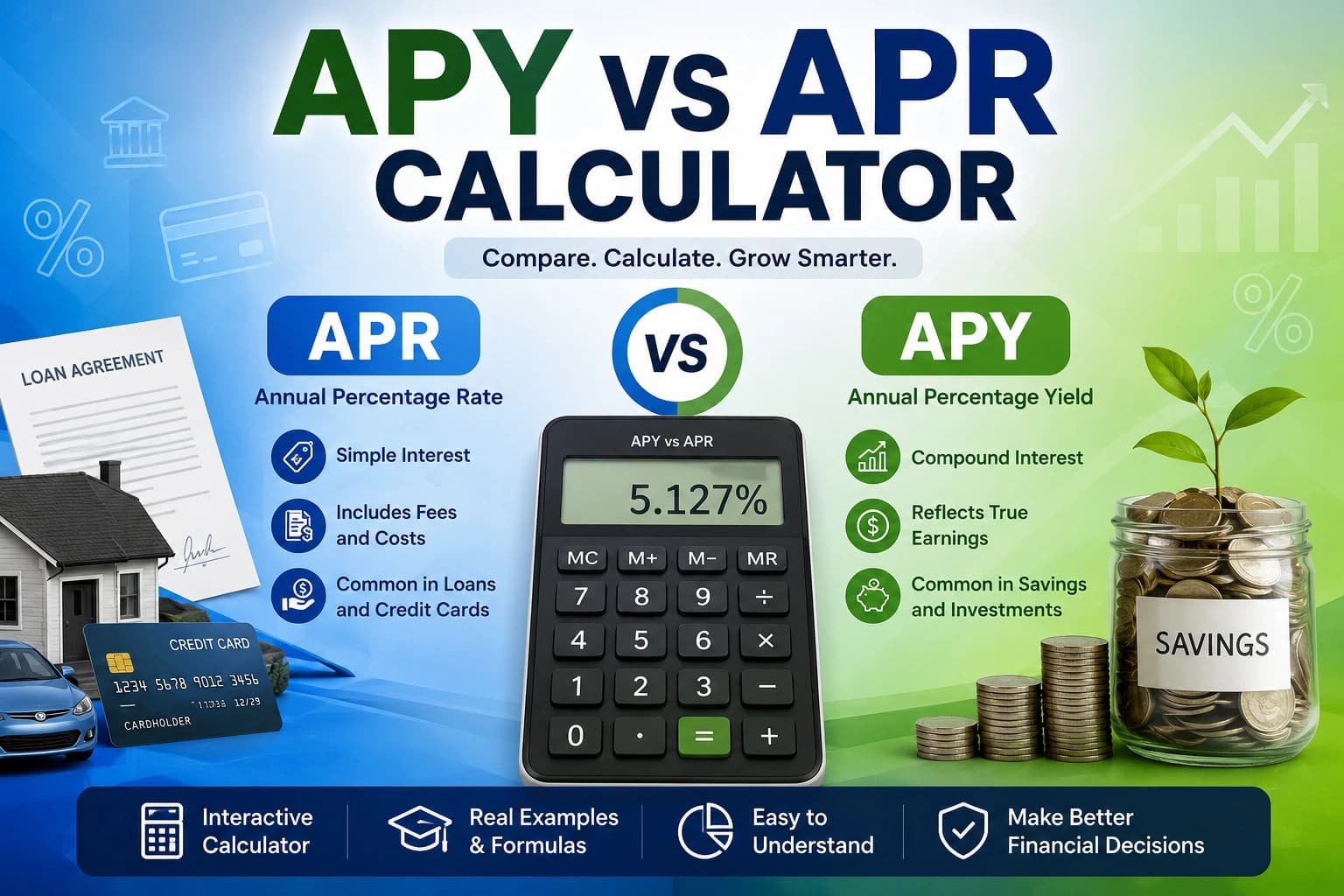
APR (Annual Percentage Rate) is the simple annual interest rate without compounding. APY (Annual Percentage Yield) includes the effect of compounding — it's always equal to or higher than APR. For savings accounts and CDs, APY is what you actually earn. For loans and credit cards, APR is the cost you pay. Knowing which one to use can be worth hundreds or thousands of dollars per year.
APR Defined: The Simple Rate
APR is the annual interest rate expressed as a straightforward percentage, without accounting for compounding within the year. It's the rate lenders are required by law (under the U.S. Truth in Lending Act) to disclose on loans, credit cards, and mortgages.
APR Formula:
APR = (Periodic Rate × Number of Periods in a Year)
Example: A credit card charges 1.5% per month. APR = 1.5% × 12 = 18% APR.
APR tells you the cost of borrowing before compounding is factored in. It's useful for comparing loan offers apples-to-apples.
APY Defined: The Compounding Effect
APY is the effective annual rate when compounding is applied within the year. The more frequently interest compounds (daily vs. monthly vs. annually), the higher the APY relative to the stated APR.
APY Formula:
APY = (1 + r/n)^n − 1
- r = annual interest rate (as a decimal)
- n = number of compounding periods per year
Example: A savings account advertises 5% APR compounded monthly:
APY = (1 + 0.05/12)^12 − 1 = (1.004167)^12 − 1 = 5.116% APY
That 0.116% difference on a $50,000 balance = $58 in extra interest earned per year — just from compounding frequency.
APR 5% vs APY: How Compounding Frequency Changes the Yield
| APR | Compounding Frequency | APY | Extra Yield on $10,000 |
|---|---|---|---|
| 5.00% | Annually (1×/year) | 5.000% | $0 (baseline) |
| 5.00% | Quarterly (4×/year) | 5.095% | $9.50 |
| 5.00% | Monthly (12×/year) | 5.116% | $11.60 |
| 5.00% | Daily (365×/year) | 5.127% | $12.70 |
| 5.00% | Continuous | 5.127% | $12.75 |
The difference between monthly and daily compounding is minimal at 5% APR. The real impact of compounding shows over multi-year timeframes.
Multi-Year Impact: $10,000 at 5% APR
| Years | Annual Compounding (APY 5%) | Monthly Compounding (APY 5.116%) | Difference |
|---|---|---|---|
| 1 | $10,500 | $10,512 | $12 |
| 5 | $12,763 | $12,834 | $71 |
| 10 | $16,289 | $16,470 | $181 |
| 20 | $26,533 | $27,127 | $594 |
| 30 | $43,219 | $44,677 | $1,458 |
When APR Matters vs When APY Matters
Use APR When Borrowing
For loans, mortgages, and credit cards, focus on APR. It represents the true annual cost before the lender's compounding schedule complicates comparison. Federal law (TILA) requires lenders to disclose APR for this reason.
- Mortgage: Use APR to compare lenders — it includes fees, points, and the interest rate in one number
- Auto loan: APR comparison works perfectly since auto loans typically compound monthly
- Credit cards: Credit card APR is usually stated as a daily periodic rate (APR ÷ 365). Carrying a balance compounds daily, making the true cost higher than the stated APR
Use APY When Saving
For savings accounts, CDs, and money market accounts, APY is the number that tells you what you'll actually earn. Banks are required by the Truth in Savings Act to disclose APY for deposit accounts.
- High-yield savings: Always compare APY — a bank advertising 5.00% APR compounding daily yields 5.127% APY, giving you more than an account with 5.10% APR compounding annually (5.100% APY)
- CDs: CD terms lock in APY, making comparison straightforward
Credit Card APR vs APY: A Special Case
Credit card issuers advertise APR, but because interest compounds daily on carried balances, your effective annual cost is actually higher. Example:
- Credit card APR: 24%
- Daily periodic rate: 24% ÷ 365 = 0.06575%
- Effective APY: (1 + 0.2400/365)^365 − 1 = 27.11% APY
That means a $5,000 balance carried for a full year costs $1,355 in interest — not $1,200 as the APR might suggest.
Free Calculators to Compare APY vs APR
- Compound Interest Calculator — See exactly how APY grows your savings over time with daily, monthly, or annual compounding
- Savings Calculator — Project your savings account balance at any APY over any timeframe
- Loan Calculator — Compare total loan costs using APR across different terms and rates
Frequently Asked Questions
Is higher APY always better?
For savings accounts and CDs, yes — higher APY means more money earned on your deposits. For loans and credit cards, a higher APY means you're paying more, so lower is better. The context (borrowing vs. saving) determines whether you want a higher or lower rate.
Can APY ever equal APR?
Yes — when interest compounds only once per year (annual compounding), APY equals APR exactly. The formula (1 + r/1)^1 − 1 = r. As compounding frequency increases, APY always stays above APR.
Why do banks advertise APY for savings but APR for loans?
U.S. law requires it. The Truth in Savings Act mandates APY disclosure for deposits (so consumers can compare true yields). The Truth in Lending Act mandates APR disclosure for loans (so consumers can compare true costs). Banks use whichever number makes their product look most competitive within those rules.
What is the difference between APR and interest rate on a mortgage?
The mortgage interest rate is just the base rate used to calculate your monthly payment. APR includes the interest rate plus origination fees, discount points, mortgage broker fees, and other costs — expressed as an annual percentage. APR is always equal to or higher than the stated interest rate and is the better number for comparing mortgage offers.
How do I calculate APY from APR?
Use this formula: APY = (1 + APR/n)^n − 1, where n is the number of compounding periods per year (12 for monthly, 365 for daily, 4 for quarterly). For example, 6% APR compounded monthly: APY = (1 + 0.06/12)^12 − 1 = 6.168%.
Conclusion
APR and APY answer different questions. APR tells you the cost or rate before compounding; APY tells you what you'll actually earn or pay after compounding is applied. For any savings decision, always compare APY. For any borrowing decision, compare APR — but be aware that frequent compounding (especially on credit cards) can push your true annual cost significantly above the stated APR. Use CalculatorApp.me's compound interest calculator to run the exact numbers for your situation.
Frequently Asked Questions
Our Methodology
All calculator content on CalculatorApp.me is reviewed by subject-matter experts, cross-referenced with official sources, and updated regularly for accuracy. Our formulas and data are verified against industry standards and government publications.
Jordan Hayes
Verified AuthorPersonal Finance Content Strategist
Jordan is a personal finance content strategist with 9+ years writing about mortgages, retirement, tax strategy, and budgeting. Every guide is cross-referenced with IRS publications, Federal Reserve data, and CFPB guidance to make complex calculations accessible. Editor at CalculatorApp.me.
Found this helpful? Share it!
Stay Updated
Get notified when we launch new calculators and features.
No spam. Unsubscribe anytime.