Compound Interest Explained: The Formula, Real Examples, and Why Starting Early Matters
Free Calculator
Compound Interest Calculator
Table of Contents
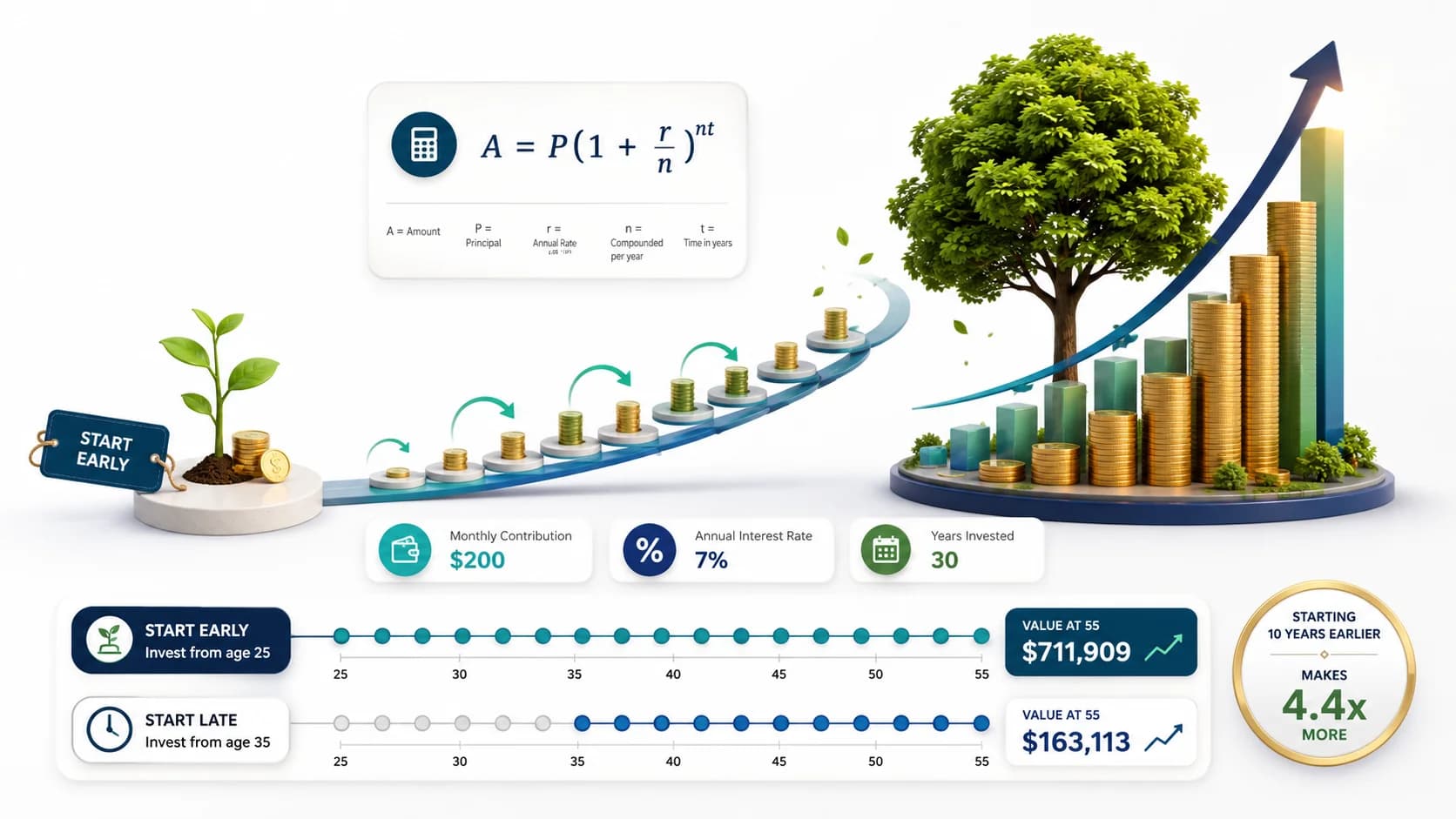
Compound interest earns returns on previous returns — A = P(1 + r/n)^(nt). At 8% average return, $500/month from age 25 becomes ~$1.5 million by 65. Every decade of delay roughly triples the monthly contribution needed to reach the same goal. Rule of 72: divide 72 by your return rate to estimate years until your money doubles.
What Is Compound Interest?
Compound interest is interest earned on both your original principal and previously accumulated interest. Unlike simple interest (which only accrues on the principal), compounding creates exponential growth — your money earns returns, and then those returns earn their own returns.
Albert Einstein reportedly called compound interest "the eighth wonder of the world." Whether he actually said it is debatable, but the math behind it is genuinely powerful. A one-time $10,000 investment at 8% annual return grows to $21,589 after 10 years, $46,610 after 20 years, and $100,627 after 30 years — all without adding another dollar.
What Is the Compound Interest Formula?
The formula for compound interest is:
A = P(1 + r/n)nt
Where:
A = Final amount (principal + interest)
P = Principal (initial investment)
r = Annual interest rate (as a decimal — 8% = 0.08)
n = Number of times interest compounds per year (12 for monthly, 365 for daily)
t = Number of years
Real Example: $5,000 at 7% for 25 Years
P = $5,000, r = 0.07, n = 12 (monthly compounding), t = 25:
A = 5,000 × (1 + 0.07/12)12×25 = 5,000 × (1.005833)300 = 5,000 × 5.727 = $28,635
Your $5,000 grew by $23,635 — nearly 5× your original investment — without any additional contributions.
How Does Compound Interest Compare to Simple Interest?
Simple interest uses the formula A = P(1 + rt) — interest is calculated only on the original principal. Here's how they compare on $10,000 at 8% over time:
Years | Simple Interest | Compound Interest | Compound Advantage |
|---|---|---|---|
5 | $14,000 | $14,693 | +$693 |
10 | $18,000 | $21,589 | +$3,589 |
20 | $26,000 | $46,610 | +$20,610 |
30 | $34,000 | $100,627 | +$66,627 |
The gap widens dramatically over time. After 30 years, compound interest earned 3× more than simple interest on the same principal. This is why long-term investing is so powerful.
How Compounding Frequency Affects Growth
The more frequently interest compounds, the more you earn — but the differences shrink as frequency increases. $10,000 at 8% for 10 years:
Frequency | n (per year) | Final Balance | Extra vs Annual |
|---|---|---|---|
Annually | 1 | $21,589 | — |
Quarterly | 4 | $21,911 | +$322 |
Monthly | 12 | $22,196 | +$607 |
Daily | 365 | $22,253 | +$664 |
Continuously | ∞ | $22,255 | +$666 |
Monthly vs. annual compounding adds $607 over 10 years. Daily vs. monthly adds only $57. The jump from annual to monthly matters most.
The Power of Starting Early: The $1 Million Example
Consider three investors each targeting $1 million by age 65 at 8% average annual returns:
Start Age | Monthly Needed | Years Investing | Total Contributed | Outcome |
|---|---|---|---|---|
Age 25 | $286/month | 40 years | $137,280 | ✓ $1M+ |
Age 35 | $671/month | 30 years | $241,560 | ✓ $1M+ |
Age 45 | $1,698/month | 20 years | $407,520 | ✓ $1M+ |
The 25-year-old invests $137,280 total. The 45-year-old invests $407,520 — three times more — to reach the same goal. Every decade of delay roughly triples the required monthly contribution.
The Rule of 72
A quick mental shortcut: divide 72 by your annual interest rate to estimate how long it takes to double your money.
6% return: 72 ÷ 6 = 12 years to double
8% return: 72 ÷ 8 = 9 years to double
10% return: 72 ÷ 10 = 7.2 years to double
12% return: 72 ÷ 12 = 6 years to double
At 8%, your money doubles roughly every 9 years. In 36 years (four doublings), $10,000 becomes $160,000.
Where Compound Interest Works
Savings Accounts & CDs
Banks compound interest daily or monthly. Current high-yield savings accounts offer 4.5–5.0% APY.
Stock Market Investments
The S&P 500 has returned an average of ~10% annually since 1926 — approximately 7% after inflation — according to SEC Investor.gov. Reinvesting dividends is a form of compounding.
Bonds
Corporate and government bonds pay periodic interest that can be reinvested at the prevailing rate.
Retirement Accounts (401k, IRA)
Tax-deferred compounding means you earn returns on money you would have otherwise paid in taxes — amplifying the effect.
When Compound Interest Works Against You
The same force that builds wealth can destroy it when you're borrowing:
Credit cards: 20–30% APR compounded daily. A $5,000 balance at 24% APR with minimum payments takes 25+ years and $12,000+ in interest to pay off.
Student loans: Unsubsidized federal loans accrue interest while you're in school (capitalized interest).
Payday loans: Effective APRs of 400%+ make these the most destructive form of compound debt.
The lesson: make compound interest work for you (invest early) and prevent it from working against you (pay off high-interest debt aggressively).
Compare investment strategies with our Investment Calculator, or plan your certificate of deposit returns with our CD Calculator.
Frequently Asked Questions
What is compound interest in simple terms?
Compound interest is "interest on interest." You earn interest on your original deposit, and then you earn interest on the accumulated interest too. This creates exponential growth over time.
How is compound interest different from simple interest?
Simple interest is calculated only on the original principal, using A = P(1 + rt). Compound interest includes previously earned interest in each calculation, using A = P(1 + r/n)^(nt). Over 30 years at 8%, compound interest earns roughly 3× more than simple interest.
How often does compound interest compound?
It depends on the account. Savings accounts and credit cards typically compound daily. CDs compound daily or monthly. Bonds compound semi-annually. The frequency is defined in your account terms as APY (Annual Percentage Yield).
Can compound interest make you rich?
Yes, but it requires time and consistency. Investing $500/month at 8% average return from age 25 to 65 produces about $1.5 million. The key ingredients are: start early, contribute regularly, reinvest returns, and be patient.
What is the Rule of 72?
A quick estimation shortcut: divide 72 by your annual return rate to find how many years it takes to double your money. At 8%, your money doubles in approximately 9 years.
Related Calculators
Try these free calculators related to this article:
In-Depth Guides
Dive deeper with our comprehensive guides on this topic:
Frequently Asked Questions
Our Methodology
All finance content on CalculatorApp.me is reviewed by subject-matter experts, cross-referenced with official sources, and updated regularly for accuracy. Our formulas and data are verified against industry standards and government publications.
Jordan Hayes
Verified AuthorPersonal Finance Content Strategist
Jordan is a personal finance content strategist with 9+ years writing about mortgages, retirement, tax strategy, and budgeting. Every guide is cross-referenced with IRS publications, Federal Reserve data, and CFPB guidance to make complex calculations accessible. Editor at CalculatorApp.me.
Found this helpful? Share it!
Stay Updated
Get notified when we launch new calculators and features.
No spam. Unsubscribe anytime.