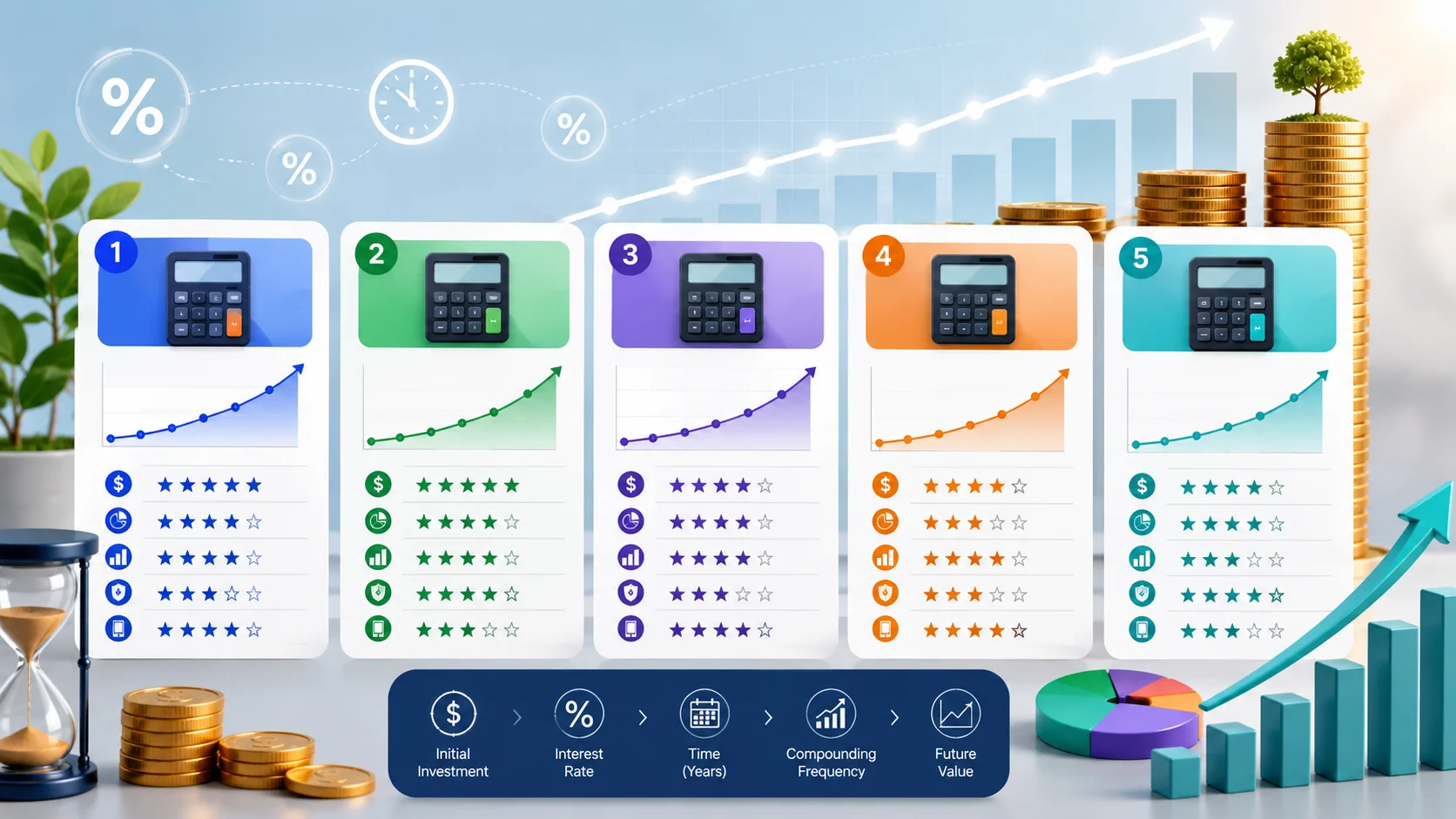
Best Free Compound Interest Calculator in 2026: 5 Tools Compared
Free Calculator
Compound Interest Calculator
Table of Contents
We compared 5 free compound interest calculators. Investor.gov (SEC) is the most trustworthy but bare-bones. Calculator.net offers the widest range of variable inputs. CalculatorApp.me adds side-by-side scenario comparison, goal-based reverse calculation ("how much do I need to save?"), and AI insights — all with no ads or upsells.
What to Look for in a Compound Interest Calculator
Compound interest is the most powerful force in personal finance — but the basic formula A = P(1 + r/n)^(nt) doesn't capture the full picture. A good calculator should handle:
- Compounding frequency: Daily, monthly, quarterly, semi-annual, annual
- Regular contributions: Monthly or annual additions (this is how most people actually invest)
- Visual growth chart: Seeing the exponential curve is more powerful than numbers alone
- Contribution vs interest split: How much of your final balance is money you put in vs money that grew?
- Tax consideration: Some tools adjust for tax drag on interest
Quick Comparison
| Calculator | Compounding Options | Contributions | Growth Chart | Year-by-Year Table | Ads | AI Insights |
|---|---|---|---|---|---|---|
| CalculatorApp.me | Daily → Annual | ✅ Monthly + Annual | ✅ Interactive | ✅ | None | ✅ |
| Investor.gov (SEC) | Daily → Annual | ✅ Monthly | ✅ Basic | ❌ | None | ❌ |
| Calculator.net | Daily → Annual | ✅ Multiple modes | ✅ | ✅ | Heavy | ❌ |
| NerdWallet | Monthly/Annual | ✅ Monthly | ✅ | ❌ | Affiliate | ❌ |
| Bankrate | Daily → Annual | ✅ Monthly | ✅ | ✅ | Heavy + affiliate | ❌ |
1. CalculatorApp.me — Best Overall
Best for: Investors and savers who want comprehensive projections with visual insights.
Our Compound Interest Calculator offers:
- All compounding frequencies: Daily, monthly, quarterly, semi-annual, annual
- Regular contributions: Add monthly or annual contributions to model real-world saving behaviour
- Interactive growth chart: Recharts-powered visualisation showing principal vs interest over time
- Year-by-year breakdown: Table showing balance, contributions, and interest earned each year
- AI-powered analysis: Get personalised insights on your investment scenario from 3 AI providers
- No advertisements: No display ads, no savings account affiliate links, no sponsored content
- Save and share: Save scenarios, print results, share calculations
- Works offline: PWA support for calculating on the go
2. Investor.gov (SEC) — Best Government Resource
Best for: Beginners who want a trustworthy, no-frills tool from a government source.
The SEC's Investor.gov calculator is clean, accurate, and completely free of commercial interests. It handles monthly contributions, multiple compounding frequencies, and shows a basic growth chart. As a government tool, there are zero ads or product recommendations.
Downsides: No year-by-year table. The chart is basic (no interactive hover). Limited customisation compared to dedicated finance calculators. No dark mode or mobile app experience.
3. Calculator.net — Most Calculation Modes
Best for: Power users who want every possible calculation option.
Calculator.net's compound interest calculator offers the most input options: initial investment, monthly/annual/quarterly contributions, compounding frequency, and a year-by-year results table. The math is solid and the output is comprehensive.
Downsides: The page is cluttered with display advertisements. On mobile, ads can make the calculator difficult to use. The design is dated. No dark mode, no offline capability, no AI analysis.
4. NerdWallet — Best Educational Context
Best for: Beginners who want to learn about compounding while calculating.
NerdWallet pairs its calculator with well-written explanations of how compound interest works, the Rule of 72, and why starting early matters. The calculator itself handles monthly contributions and shows a clean growth chart.
Downsides: Only monthly and annual compounding options (no daily or quarterly). No year-by-year breakdown table. The page includes affiliate links to savings accounts and investment platforms.
5. Bankrate — Best for Savings Account Comparison
Best for: Savers comparing high-yield savings accounts alongside their projections.
Bankrate's calculator is integrated with their savings account rate comparison tool. You can project compound growth and immediately see which savings accounts offer the best rates. The calculator itself is comprehensive with all compounding options.
Downsides: Heavy ad presence — display ads plus aggressive affiliate linking to banking products. The line between "tool" and "ad" is blurred. The page loads slower than simpler alternatives due to ad scripts.
The Power of Starting Early: A Visualisation
Here's why the right compound interest calculator matters — the numbers are staggering:
| Scenario | Monthly Contribution | Years | Total Contributed | Final Balance (7% annual) | Interest Earned |
|---|---|---|---|---|---|
| Start at 25 | $300 | 40 | $144,000 | $718,893 | $574,893 |
| Start at 35 | $300 | 30 | $108,000 | $340,599 | $232,599 |
| Start at 35, catch up | $600 | 30 | $216,000 | $681,199 | $465,199 |
Starting 10 years earlier with half the monthly contribution produces more money than starting later with double. That's compound interest at work. Model your own scenario with our Compound Interest Calculator.
Understanding Compounding Frequency
Does daily vs monthly compounding really matter? Less than you'd think:
| $10,000 at 5% for 10 Years | Final Balance | Difference from Annual |
|---|---|---|
| Annual compounding | $16,288.95 | — |
| Quarterly | $16,386.16 | +$97.21 |
| Monthly | $16,470.09 | +$181.14 |
| Daily | $16,486.65 | +$197.70 |
The difference between annual and daily compounding on $10,000 over 10 years at 5% is only $197.70. The rate and time matter far more than compounding frequency. Focus on maximising your contribution amount and investment horizon.
Frequently Asked Questions
What's the most accurate compound interest calculator?
All calculators listed here use the standard compound interest formula, so the basic math is identical. Accuracy differences arise from how they round, handle contributions (beginning vs end of period), and adjust for fees/taxes. For most users, any reputable calculator gives sufficiently accurate projections.
Is there a free compound interest calculator without ads?
Yes. CalculatorApp.me and Investor.gov (SEC) are both completely free with zero advertisements. CalculatorApp.me additionally offers AI insights, dark mode, and offline access.
How do I calculate compound interest with monthly contributions?
The formula combines compound interest with the future value of an annuity: FV = P(1 + r/n)^(nt) + PMT × [((1 + r/n)^(nt) – 1) / (r/n)]. Rather than doing this by hand, use a calculator that supports contributions — enter your initial amount, monthly addition, rate, and time period. Our Compound Interest Calculator handles this automatically.
What rate should I use for compound interest projections?
Historical averages: S&P 500 has returned ~10% annually (before inflation) since 1926. High-yield savings accounts currently offer 4-5%. After inflation, stock market returns are ~7% and savings accounts are ~1-2%. Use 7% for long-term stock market projections and your actual APY for savings accounts.
Related Calculators
Try these free calculators related to this article:
In-Depth Guides
Dive deeper with our comprehensive guides on this topic:
Frequently Asked Questions
Our Methodology
All finance content on CalculatorApp.me is reviewed by subject-matter experts, cross-referenced with official sources, and updated regularly for accuracy. Our formulas and data are verified against industry standards and government publications.
Jordan Hayes
Verified AuthorPersonal Finance Content Strategist
Jordan is a personal finance content strategist with 9+ years writing about mortgages, retirement, tax strategy, and budgeting. Every guide is cross-referenced with IRS publications, Federal Reserve data, and CFPB guidance to make complex calculations accessible. Editor at CalculatorApp.me.
Found this helpful? Share it!
Stay Updated
Get notified when we launch new calculators and features.
No spam. Unsubscribe anytime.