
Composite vs Wood Decking: 10-Year Cost Comparison (Trex, TimberTech, Cedar, PT)
Free Calculator
Concrete Calculator
Table of Contents
Composite decking costs roughly 30–40% more upfront than pressure-treated wood — $35–$70/sq ft installed versus $25–$40/sq ft — but wood needs restaining every 2–3 years at $550–$1,700 per application, while composite needs essentially none. Over a 10-year hold, a typical 320 sq ft deck lands around $21,700 total for wood versus $25,100–$25,400 for composite, once maintenance is included — a narrower gap than the sticker prices suggest. Model your own project cost with the free deck calculator.
Every deck-building decision eventually collapses into this one question: composite or wood? The upfront price difference is real and often steers homeowners straight to pressure-treated pine — but that number is only half the equation. Wood decking needs a maintenance budget that composite mostly doesn't, and composite lasts roughly twice as long before replacement. This guide runs the actual 10-year math, brand by brand, so the decision is based on total cost rather than the number on day one.
This comparison is a companion to our broader deck cost guide for 2026, which covers every material and size; here we go deep specifically on the composite-vs-wood tradeoff, since it's the single most common fork homeowners hit once they've decided to build. Both posts are part of the same construction calculator resource on this site.
Composite vs Wood Decking: Upfront Cost Comparison
The sticker-price gap between materials is the first thing most homeowners see, and it's substantial — composite decking can cost twice as much per square foot as basic pressure-treated pine before a single board is installed.
| Material | Materials only ($/sq ft) | Installed cost ($/sq ft) |
|---|---|---|
| Pressure-treated pine | $2 – $5 | $25 – $40 |
| Cedar | $5 – $10 | $30 – $50 |
| Composite (mid-grade, e.g. Trex Enhance / TimberTech Prime) | $10 – $18 | $35 – $55 |
| Composite (premium capped, e.g. Trex Transcend / TimberTech Azek) | $12 – $22 | $50 – $70 |
| Capped PVC / cellular vinyl | $5 – $15 | $55 – $80+ |
The premium composite row is highlighted because it's what most homeowners actually mean when they picture "composite decking" today — capped boards with a protective outer layer, sold under lines like Trex Transcend or TimberTech's AZEK-family products, rather than the older uncapped composite that gained a reputation for fading and mold in the 2000s. At the national scale, a 16x20 ft (320 sq ft) deck addition averaged $18,263 in wood versus $25,096 in composite according to the 2025 Cost vs Value Report from Zonda Media — a roughly $6,800 upfront premium for going composite at that size.
The Real 10-Year Cost: Upfront Price Isn't the Whole Story
Upfront cost is where the comparison usually stops — but wood decking carries an ongoing maintenance bill that composite mostly avoids, and that gap compounds every 2–3 years. Modeling a typical 320 sq ft (16x20 ft) deck over a 10-year hold:
| Cost component | Pressure-treated wood | Composite |
|---|---|---|
| Installed cost (national average, 16x20 ft) | $18,263 | $25,096 |
| Staining/sealing, per application | $550 – $1,700 (combined stain + seal) | Not required |
| Applications over 10 years (every 2–3 years) | ~4 applications | 0 |
| 10-year maintenance total | ~$2,200 – $6,800 | ~$150 – $400 (occasional soap-and-water cleaning) |
| Estimated 10-year total cost | ~$20,500 – $25,000 | ~$25,250 – $25,500 |
The highlighted row is the answer most people are actually looking for: at the low end of wood's maintenance range, pressure-treated decking is still cheaper than composite over 10 years — but at the high end of a diligent maintenance schedule (staining every 2 years with a quality product), the two materials land within a few hundred dollars of each other. The upfront $6,800 gap shrinks to well under $1,000 once a decade of upkeep is priced in, and that's before accounting for the labor and hassle of the staining work itself, which composite owners never do.
The math shifts further in composite's favor beyond year 10. Pressure-treated wood has a practical lifespan of roughly 10–20 years depending on climate and maintenance discipline, while capped composite is rated for 25–30 years by most manufacturers. A homeowner planning to stay in a home for 15–20+ years is comparing a wood deck that may need full replacement against a composite deck still years from the end of its service life — a scenario the 10-year table above doesn't fully capture.
Lifespan & Warranty: How Long Each Material Actually Lasts
Composite decking lasts roughly twice as long as pressure-treated wood before it needs full replacement, and manufacturer warranties reflect that gap directly.
| Material | Typical practical lifespan | Manufacturer warranty (composite brands) |
|---|---|---|
| Pressure-treated pine | 10 – 20 years | N/A (lumber warranty, not finish) |
| Cedar / redwood | 15 – 25 years with consistent maintenance | N/A |
| Capped composite (Trex, TimberTech) | 25 – 30 years | 25 – 50 years depending on product line |
| Capped PVC | Up to 50 years | Often matches or exceeds composite warranties |
The lifespan gap is the strongest argument for composite in a long-hold scenario: a deck that fails structurally sound but cosmetically worn out around year 15 forces a full-replacement decision, while a composite deck at year 15 is roughly halfway through its rated service life. If you're unsure how those numbers apply to a deck you're planning rather than replacing, run your dimensions through the deck calculator to compare material quantities before you buy.
Maintenance: Staining and Sealing vs. Power-Washing
Wood decking's ongoing cost isn't optional — untreated or unstained wood weathers, greys, and eventually cracks and splinters under UV and moisture exposure, which is why every wood-deck maintenance guide recommends restaining on a fixed schedule rather than "as needed."
- Wood staining/sealing frequency: every 2–3 years, more often in high-sun or high-moisture climates.
- Wood staining/sealing cost: $100–$1,465 per job depending on deck size and product, averaging around $850; combined staining-and-sealing jobs commonly run $800–$1,700.
- Composite maintenance: periodic soap-and-water cleaning or an occasional composite-safe cleaner; no staining, sealing, or sanding required at any point in the material's rated life.
The staining schedule is the number homeowners underestimate most when comparing materials — it's easy to price the first restain and forget it repeats every 2–3 years for as long as you own the deck. Over a 20-year hold, that's not one $850 job, it's seven or eight of them, plus the labor if you're not doing it yourself. When a client tells me they're leaning wood "because it's cheaper," I ask how many summers they plan to spend sanding and restaining before the number stops feeling cheap.
Trex vs. TimberTech: Which Composite Brand Costs More
Once a homeowner decides on composite, the next fork is brand and tier — and Trex and TimberTech, the two largest composite decking manufacturers, price differently enough to matter.
| Comparison point | Trex | TimberTech |
|---|---|---|
| Entry-tier material cost | $4 – $7/sq ft (Trex Enhance) | Roughly comparable to Trex Enhance (TimberTech Prime) |
| Mid-tier material cost | $6 – $10/sq ft | $6 – $10/sq ft |
| Full range across product lines | $5 – $12/sq ft | $14 – $24/sq ft (broader premium/PVC lineup) |
| Installed, entry to premium | $25 – $65/sq ft | $40 – $70/sq ft |
| General price position | 10–25% less than TimberTech on average | Runs 10–25% higher than Trex on average |
Neither brand is categorically "better" — Trex generally wins on value-tier pricing, while TimberTech's product range leans further into premium PVC-composite hybrids that push its average higher. Both brands publish 25–50 year warranties depending on the specific product line, so the deciding factor for most buyers ends up being color/texture preference and dealer availability in their region rather than a meaningful cost gap at the same tier.
Capped vs. Uncapped Composite: The Cost Difference Most Buyers Miss
"Composite decking" isn't one product — it splits into capped and uncapped composite, and the two perform differently enough that lumping them into a single price bracket hides the real decision most composite buyers are actually making. The difference comes down to a single manufacturing step: capped boards get an additional polymer (PE) shell wrapped around the wood-plastic core, while uncapped composite is the same core material with no protective outer layer.
| Attribute | Uncapped composite | Capped composite |
|---|---|---|
| Material cost | Up to ~$7/sq ft | Up to ~$12/sq ft |
| Price premium | Baseline | 20–50% higher than uncapped |
| Moisture/mold resistance | Vulnerable to water absorption, mold, discoloration | Polymer cap blocks moisture, mold, and stains |
| Typical warranty | ~10 years | 20–30 years |
| Availability | Faster to source | Longer lead times (more costly to produce) |
The warranty row is highlighted because it's the number that actually matters when you're comparing two products both marketed simply as "composite" — a capped board backed by a 25-year warranty and an uncapped board backed by a 10-year warranty are not the same purchase, even if a supplier quotes them in the same rough price conversation. Nearly every major brand sold today, including Trex and TimberTech's mainstream product lines discussed above, ships as capped composite; uncapped composite mostly persists at the extreme budget end of the market or in older housing stock installed before capping became standard. If a composite quote looks unusually low relative to the $35–$70/sq ft installed range used elsewhere in this guide, confirm whether the board is actually capped before assuming you've found a bargain.
The Trade-Off Nobody Mentions: Composite Decking Gets Hot
Every comparison above favors composite on maintenance and lifespan, but there's a real physical trade-off buyers routinely discover only after installation: composite decking gets noticeably hotter underfoot than wood in direct sun. In direct sunlight, composite decking surfaces can run 34–76°F hotter than the surrounding air — on an 80°F day, that's a deck surface exceeding 150°F, hot enough to be uncomfortable or even painful on bare feet.
- Color matters most. Darker composite colors absorb more heat than lighter ones; if heat is a concern, choose a lighter board color for any deck that gets full sun exposure.
- Board profile matters. Hollow-core composite boards run cooler than solid-core boards of the same color, and are lighter to handle during installation as a secondary benefit.
- Newer formulations have improved. Manufacturer heat-mitigation technologies (marketed under names like CoolDeck) claim up to 35% less heat absorption than standard composite, and some manufacturers now state that modern composite performs comparably to wood in direct sun rather than meaningfully hotter.
- Shade is the reliable fix. A pergola, retractable awning, market umbrellas, or strategically placed shade trees lower deck surface temperature more reliably than color or profile choice alone.
If a client is set on a dark-colored premium composite for a south- or west-facing deck with no shade structure planned, I tell them to budget for a pergola or awning in the same project — not as an aesthetic upsell, but because a dark composite deck in full afternoon sun can become genuinely unusable barefoot for several hours a day in summer. It's a far cheaper fix to plan shade into the original budget than to retrofit it after the first July.
Installation Cost Detail: Fasteners Nobody Budgets For
The per-square-foot brackets earlier in this guide bundle fastening hardware into the installed price, but it's worth understanding what that line item actually contains — because it's one of the few places composite decking has an internal budget-vs-premium choice wood doesn't.
- Face screws are the lowest-cost fastening method: roughly 350 stainless composite screws per 100 sq ft at standard spacing, with visible screw heads on the walking surface. This is the default for pressure-treated and cedar decking.
- Hidden fastener systems — clips that attach beneath grooved composite boards, leaving no visible screw heads — typically add roughly $1 or more per square foot in hardware alone versus face screws, plus somewhat more installation time to set each clip correctly.
- Fastening entire deck with premium stainless face screws instead can run two to three times the hardware cost of a hidden-fastener clip system, so the cost gap between the two methods isn't as one-sided as "hidden = expensive" — it depends which fastener tier you're comparing against.
Most grooved composite boards from major manufacturers are specifically engineered for hidden fastener systems, so if you've chosen a premium capped composite board, a hidden fastener system is often the intended (and sometimes only supported) installation method rather than an optional upgrade — confirm this with your specific product's installation guide before pricing a face-screw alternative.
Choosing by Climate: Hot, Cold, and High-Moisture Regions
Neither material is universally "better" in every climate — each has a specific weakness that matters more in some regions than others, and the right choice often depends more on your local weather pattern than on the cost comparisons above.
- Hot, sunny climates (Southwest, Deep South): Composite's heat-retention drawback (covered above) matters most here — a dark composite deck in full desert or Gulf Coast sun can run 30–75°F hotter than ambient. Choose a lighter color, a hollow-core profile, or plan shade structures into the budget from the start.
- Cold climates with freeze-thaw cycles (Northeast, Upper Midwest): This is composite's strongest case. Wood absorbs moisture that expands on freezing and contracts on thawing, gradually cracking, splintering, and warping the boards over repeated winters. Capped composite doesn't absorb water in meaningful quantities, which sidesteps freeze-thaw damage almost entirely — a genuine durability advantage in exactly the regions where wood decks age fastest.
- High-humidity, high-rainfall climates (Southeast, Pacific Northwest): Composite's moisture and mold resistance (see the capped-vs-uncapped section above) reduces the rot risk that humid climates accelerate in untreated or under-maintained wood.
- Moderate, dry climates: Climate plays a smaller role in the decision here, and the cost and maintenance factors covered elsewhere in this guide should weigh more heavily than climate-driven durability differences.
If your region falls into the cold or high-moisture categories, weigh composite's durability advantage alongside its cost premium — the freeze-thaw and rot resistance it offers isn't just a comfort feature, it directly extends the practical lifespan gap discussed earlier in this guide.
Which Is Better for Families? Kids, Pets & Bare Feet
Beyond cost and lifespan, one of the most common real-world reasons homeowners choose composite over wood has nothing to do with either number: splinters. Composite's protective cap binds the material into a smooth, consistent surface that doesn't splinter, crack, or split the way wood can as it weathers — a genuine safety consideration for households with young children who crawl and walk barefoot, or pets with sensitive paw pads.
- No splinter risk. A weathered wood deck can develop raised grain and splinters as the surface ages between staining cycles; composite's cap stays smooth for its full rated lifespan.
- Slip resistance. Many composite boards use a deeply embossed wood-grain texture engineered for traction, which can outperform smooth, wet wood in reducing slips during pool days or rainy weather.
- No chemical treatment. Pressure-treated wood is chemically treated to resist rot and insects — composite doesn't require this, which some pet owners weigh if a dog is prone to chewing on decking.
- Scratch and stain resistance. Capped composite resists scratching from dog claws and staining from spilled food or pet messes better than an unsealed or lightly weathered wood surface.
None of this changes the cost math elsewhere in this guide, but for a household actively weighing "worth the extra 30–40% upfront," the splinter-free and slip-resistant case is frequently the deciding factor that tips a close cost comparison toward composite — it's a genuine quality-of-life difference the dollar figures alone don't capture.
Which Should You Choose? Decision Framework by Priority
| Your priority | Recommendation |
|---|---|
| Lowest possible upfront cost | Pressure-treated pine — cheapest by a wide margin at $25–$40/sq ft installed |
| Lowest 10-year total cost | Pressure-treated wood still wins narrowly if you keep a consistent 2–3 year staining schedule |
| Minimal ongoing maintenance | Composite — no staining or sealing at any point in its service life |
| Longest lifespan / fewest future replacements | Capped composite or PVC, rated 25–50 years vs. wood's 10–20 |
| Best resale ROI percentage | Wood — recoups 94.9% of cost at resale vs. composite's 88.5% (2025 Cost vs Value Report) |
| Most resale dollars added in absolute terms | Composite — $22,210 added value vs. wood's $17,335, per the same report |
Notice there's no single "correct" answer in that table — it genuinely depends on whether you're optimizing for the cheapest number today, the lowest total cost over a decade, or the least amount of a weekend spent sanding and staining every other summer. If your primary driver is total project budget rather than material choice specifically, our companion post on how much a deck costs by size and material in 2026 walks through the full range including redwood, PVC, and aluminum options this comparison doesn't cover in depth.
What About Cedar and Redwood? Where Natural Wood Fits
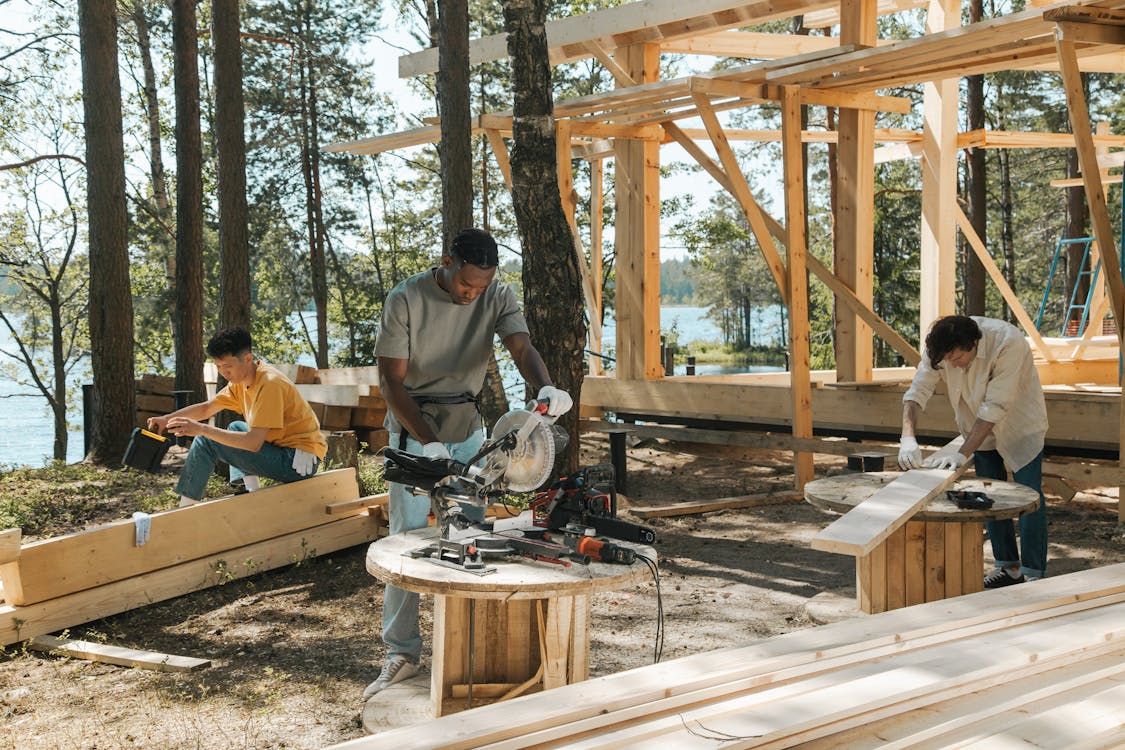
The composite-vs-wood framing above largely compares composite against pressure-treated pine, since PT is the material most cost comparisons default to — but cedar and redwood occupy a genuinely different position in the decision, not just a pricier version of the same wood category. Both are naturally rot- and insect-resistant softwoods that don't require chemical pressure-treatment, which is the main reason they command a premium over PT pine at $30–$50/sq ft installed versus PT's $25–$40/sq ft.
Cedar and redwood still need the same staining and sealing discipline as pressure-treated pine — the natural rot resistance protects the wood's structure, not its surface finish, so skipping maintenance still leads to graying and surface weathering on the same 2–3 year cycle. Where cedar and redwood pull ahead of PT pine is aesthetics and a modestly longer practical lifespan (15–25 years with consistent maintenance versus PT's 10–20), which is why they're most often chosen by homeowners who want a natural-wood look and are willing to keep up the maintenance schedule rather than switch to composite. If low maintenance is the priority, cedar and redwood don't solve that problem any better than PT pine does — that's specifically composite's advantage, not a natural-wood one.
Calculating Your Own 10-Year Total Cost of Ownership
The 10-year table earlier in this guide uses the national-average 16x20 ft deck, but the same formula scales to any project size. To estimate your own total cost of ownership for either material:
- Measure your footprint with the square footage calculator if your lot isn't a simple rectangle, then get your installed cost baseline from the deck calculator for your actual dimensions and chosen material.
- For wood: multiply your expected staining cost per application ($550–$1,700, scaled to your deck's square footage) by the number of applications over your planning horizon (one every 2–3 years).
- For composite: budget $15–$40/year for occasional cleaning — a rounding error next to wood's maintenance line.
- Add installed cost + total maintenance cost for each material, then compare the two totals over the same time horizon — not just the upfront price.
- Factor in your planning horizon explicitly: a 5-year hold favors wood's lower upfront cost; a 15+ year hold shifts the advantage toward composite once you're comparing a wood deck approaching replacement age against a composite deck still mid-lifespan.
The variable homeowners get wrong most often isn't the cost of any single staining job — it's how long they actually plan to stay in the home. If you're planning to sell within 3–5 years, wood's lower upfront cost and higher resale-percentage recoup usually wins outright. If you're building your "forever deck," composite's 10-year math and doubled lifespan usually wins, even before accounting for the hours you won't spend sanding and restaining.
Side-by-Side Worked Example: Pricing the Same 320 Sq Ft Deck in Both Materials
Abstract per-square-foot ranges are useful for budgeting, but seeing both materials priced for the identical project makes the trade-off concrete. Here's a 16x20 ft (320 sq ft) ground-level deck, priced in pressure-treated pine and mid-grade capped composite, in a Midwest-baseline labor market:
| Cost component | Pressure-treated pine | Mid-grade capped composite |
|---|---|---|
| Decking material | 320 × $3.50/sq ft = $1,120 | 320 × $14/sq ft = $4,480 |
| Footings (7 footings, installed — see the concrete calculator and concrete cost calculator for your own footing volume and price) | $2,100 | $2,100 |
| Professional labor | 320 × $22/sq ft = $7,040 | 320 × $25/sq ft = $8,000 |
| Building permit | ~$150 | ~$180 |
| Installed total (year 0) | ~$10,410 | ~$14,760 |
| 10-year maintenance | +$2,200 – $6,800 (4 staining cycles) | +$150 – $400 (cleaning only) |
| 10-year total cost of ownership | ~$12,600 – $17,200 | ~$14,900 – $15,150 |
The highlighted row is where the comparison actually resolves for a project this size: composite's higher year-0 cost is partly offset by wood's ongoing maintenance bill, enough that a diligently-maintained pressure-treated deck can still land within a few thousand dollars of composite over a decade — but a wood deck maintained at the low end of the staining budget (skipping a cycle here and there) closes that gap almost entirely, and by year 15–20, when wood may need full replacement while composite is still mid-lifespan, the total-cost advantage swings decisively toward composite. Run your own project's exact dimensions through the deck calculator to replace the estimates above with numbers specific to your build.
Sustainability: Recycled Content and Environmental Impact
Composite decking's environmental story is stronger than most buyers assume, largely because of what the boards are made from rather than how long they last. Trex, the category's largest manufacturer, builds its decking from 95% recycled and reclaimed materials — recycled plastic film (much of it otherwise destined for landfill) blended with reclaimed wood fiber sourced as a byproduct of other wood industries, not virgin timber. Trex reports recycling more than 6.4 billion pounds of waste plastic since its founding, with 377 million pounds of plastic film alone diverted from landfills in a recent year.
Wood decking has its own sustainability angle worth weighing: responsibly harvested cedar and pressure-treated pine are renewable resources, and untreated wood is biodegradable at end of life in a way composite (a plastic-wood blend) is not. Neither material is a clear environmental winner in every dimension — composite wins on diverting existing waste from landfills, wood wins on being a renewable, biodegradable raw material. Which one matters more is a values question, not a cost one, but it's worth factoring in alongside the dollar figures above.
If sustainability sourcing matters to your decision specifically, ask any wood supplier whether their cedar or redwood carries Forest Stewardship Council (FSC) certification, which verifies the lumber came from a responsibly managed forest rather than unregulated logging — not every supplier stocks certified lumber, and it's a fair question to ask before assuming "wood" automatically means "sustainable." On the composite side, ask what percentage of a specific product's core is recycled versus virgin material, since that figure varies meaningfully between manufacturers and even between product lines from the same brand.
- Composite costs 30–40% more upfront ($35–$70/sq ft installed) than pressure-treated wood ($25–$40/sq ft)
- Wood needs restaining every 2–3 years at $550–$1,700 per application; composite needs essentially none
- Over 10 years, wood totals roughly $20,500–$25,000 versus composite's $25,250–$25,500 for a 320 sq ft deck — a much narrower gap than the upfront prices suggest
- Composite lasts 25–30 years versus wood's practical 10–20-year lifespan, with warranties up to 50 years
- Wood recoups a higher resale percentage (94.9% vs. 88.5%), but composite adds more resale dollars in absolute terms
Frequently Asked Questions
Is composite decking cheaper than wood in the long run?
It's close. Composite costs more upfront, but wood's recurring staining and sealing cost (roughly $550–$1,700 every 2–3 years) narrows the 10-year gap to a few hundred dollars in many cases, and composite can pull ahead once you factor in wood's shorter 10–20 year lifespan versus composite's 25–30 years.
How much more expensive is composite decking than wood?
Composite typically runs 30–40% more per square foot installed than pressure-treated pine — roughly $35–$70/sq ft for composite versus $25–$40/sq ft for pressure-treated wood, per 2026 contractor cost data.
Does composite decking really require no maintenance?
Composite decking doesn't need staining, sealing, or sanding, but it isn't fully maintenance-free — periodic cleaning with soap and water (or a composite-safe cleaner) keeps mold and pollen buildup from staining the surface, at a fraction of the cost and frequency of wood's staining schedule.
Which lasts longer, Trex or TimberTech?
Both brands publish warranties ranging from 25 to 50 years depending on the specific product line, and neither has a meaningfully longer rated lifespan than the other at a comparable price tier — the bigger practical difference between them is price positioning, with TimberTech generally running 10–25% higher than Trex.
Is wood or composite decking better for resale value?
Wood recoups a higher percentage of its cost (94.9% vs. 88.5% for composite, per the 2025 Cost vs Value Report), but because composite decks cost more to build, they add more resale dollars in absolute terms — roughly $22,210 in added value versus wood's $17,335.
How often do I need to stain a wood deck?
Every 2 to 3 years, more frequently in climates with intense sun or high moisture exposure. Skipping a cycle accelerates UV and moisture damage, which can shorten the deck's overall lifespan below the typical 10–20 year range.
What's the difference between capped and uncapped composite decking?
Capped composite has an extra polymer layer wrapped around the wood-plastic core for moisture, mold, and stain resistance, and typically carries a 20–30 year warranty versus roughly 10 years for uncapped composite. Capped boards cost 20–50% more than uncapped, and nearly every major brand sold today — including Trex and TimberTech's mainstream lines — ships as capped composite.
Does composite decking get too hot to walk on barefoot?
It can. In direct sun, composite decking can reach 34–76°F hotter than the surrounding air — over 150°F on an 80°F day for darker, solid-core boards. Lighter colors, hollow-core profiles, heat-mitigation technologies like CoolDeck, and simple shade structures all reduce the effect meaningfully.
Is composite or wood decking better in cold climates?
Composite generally performs better in climates with repeated freeze-thaw cycles. Wood absorbs moisture that expands when frozen and contracts when it thaws, gradually cracking and warping the boards over successive winters. Capped composite doesn't absorb meaningful moisture, largely sidestepping that damage.
Is composite decking better than wood for families with kids or pets?
Many families find it is. Composite's capped surface doesn't splinter, crack, or split the way aging wood can, and its embossed texture often grips better than smooth or wet wood — genuine safety advantages for bare feet and paw pads, separate from the cost comparison.
- Ergeon — "Deck Cost 2026: Real Installed Prices by Material" (retrieved July 2026)
- Angi — "How Much Does Composite Decking Cost?" (2026 Data)
- Angi — "How Much Does It Cost to Stain a Deck?" (2026 Data)
- Angi — "How Often to Stain a Deck"
- Zonda Media / JLC — 2025 Cost vs Value Report (national deck addition ROI data)
- TimberTech — "How Long Does Decking Last? Material Lifespans"
- Trex — "Cost to Build a Composite Deck"
- Trex — "Recycled Decking Material" (95% recycled/reclaimed content data)
- Coowin Group — "Capped vs. Uncapped Composite Decking" (cost & warranty comparison)
- EnviroBuild — "Does Composite Decking Get Hot in the Sun?" (surface temperature data)
- TimberTech — "Heat Resistant Composite Decking" (CoolDeck technology)
- Intercrus Decks — "Hidden Fasteners vs. Face Screws: Squeaks, Movement, and Cost"
- Revamp Fence — "Are Composite Decks Safe for Pets and Kids?"
- TruNorth Decking — "How Composite Decking Beats the Freeze-Thaw Cycle Every Winter"
Related Calculators
Try these free calculators related to this article:
In-Depth Guides
Dive deeper with our comprehensive guides on this topic:
Frequently Asked Questions
Our Methodology
All construction content on CalculatorApp.me is reviewed by subject-matter experts, cross-referenced with official sources, and updated regularly for accuracy. Our formulas and data are verified against industry standards and government publications.
Marcus Webb
Verified AuthorEngineering & Applied Mathematics Specialist
Marcus specializes in structural analysis, fluid mechanics, and construction calculations, verifying every formula against ASCE standards, ACI codes, and published engineering handbooks. Content lead at CalculatorApp.me.
Found this helpful? Share it!
Stay Updated
Get notified when we launch new calculators and features.
No spam. Unsubscribe anytime.