Unlocking the Secrets of Geometry Formulas: A Guide for Students
Table of Contents
Geometry formulas are the backbone of understanding shapes and their properties. They help us calculate dimensions like area, volume, and surface area.
In this guide, you’ll learn the essential formulas for 2D and 3D shapes, how to use them correctly, and where to verify your answers using calculators and trusted references.
2D geometry: area and perimeter basics
Right triangles: Pythagorean theorem and quick checks
3D geometry: volume and surface area
Units: how to avoid common conversion mistakes

Students who need a more detailed reference can explore our Complete Geometry Formulas Guide, covering 2D shapes, 3D solids, triangles, circles and coordinate geometry.
For extra practice and clear walkthroughs, check out High school geometry lessons.
Table of Contents
What are Geometry Formulas?
The Role of Geometry in Real Life
Importance of Geometry Formulas
Overview of Geometry Shapes
Geometry Formulas Comparison Table
Geometry Formulas for 2D Shapes
Pythagorean Theorem and Right Triangles
Geometry Formulas for 3D Shapes
Trigonometry in Geometry
Units and Conversions
Formula Chart for Geometry
Revision Resources
FAQ
Conclusion
What are Geometry Formulas?
Geometry formulas are mathematical equations used to calculate various properties of shapes. These properties include area, volume, and surface area. They are essential in both 2D and 3D geometry.
These formulas provide tools to solve geometric problems with precision. They are fundamental in disciplines that require spatial accuracy. From simple diagrams to complex models, they are crucial for accurate calculations.
If you want a broader collection of equations beyond geometry, explore our Math Formula Library.
Common uses of geometry formulas include:
Determining the space inside 2D shapes
Calculating the space enclosed by 3D objects
Measuring the total exterior area of 3D shapes
The Role of Geometry in Real Life
Geometry plays a crucial role in our daily lives. It is the framework for various fields, from architecture to engineering. The precision of geometry ensures stability and functionality in designs.
Many real-world scenarios rely on geometric principles. These include:
Constructing buildings and bridges
Designing machinery and vehicles
Creating graphics and animations
By understanding geometry, students can solve practical problems. For instance, calculating the right angle of a ramp or designing ergonomic furniture. Knowing how to apply geometry formulas fosters innovation in technology and art. Furthermore, it enhances logical thinking and spatial awareness, skills valuable beyond mathematics.
Importance of Geometry Formulas
Geometry formulas are foundational in mathematics education. They allow students to calculate dimensions and understand shapes in-depth. This knowledge is crucial for advanced studies and everyday problem-solving.
The application of geometry formulas spans various disciplines. Important benefits include:
Facilitating comprehension of spatial relationships
Enhancing logical reasoning abilities
Building a foundation for more complex math like calculus
Overview of Geometry Shapes
Geometry involves the study of various shapes and forms. These shapes are categorized into two primary types: 2D shapes and 3D shapes.
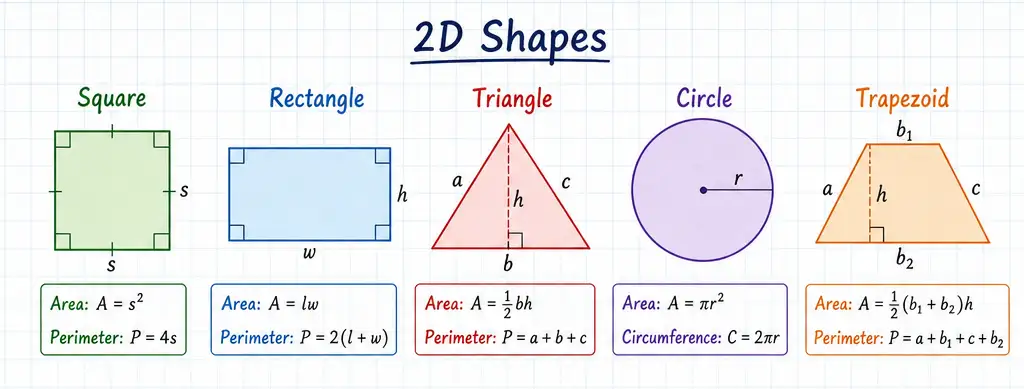
Common 2D shapes include squares, rectangles, triangles, and circles.
Common 3D shapes include cubes, spheres, cylinders, and pyramids.

Geometry Formulas Comparison Table
This comparison table helps you pick the correct formula type (area, perimeter, volume, surface area), identify the needed inputs, and choose a tool to verify your answer.
Shape What you’re finding Formula Inputs Helpful tool
Rectangle | Area | A = l × w | Length, width | |
Triangle | Area | A = ½ × b × h | Base, height | |
Circle | Area | A = πr² | Radius | |
Rectangle | Perimeter | P = 2(l + w) | Length, width | |
Right triangle | Missing side | c² = a² + b² | Two sides | |
Cube | Volume | V = s³ | Side length | |
Cylinder | Volume | V = πr²h | Radius, height | |
Sphere | Volume | V = 4/3 × πr³ | Radius |
Geometry Formulas for 2D Shapes
2D shapes are the foundation of geometry, and each has a specific area formula. These formulas help calculate the space inside the shape's boundaries.
After learning each formula, use our free Area Calculator to check the area of rectangles, squares, triangles, circles, trapezoids and other geometric shapes.
The area calculator currently includes multiple shape options, including rectangles, squares, triangles, circles, ellipses, trapezoids, parallelograms and regular polygons.
To reinforce fundamentals, you can also review Area and perimeter concepts.

Area Formulas for Common Shapes
Different 2D shapes use unique formulas to determine their area. Here are the essentials:
Triangle: ( \text{Area} = \frac{1}{2} \times \text{base} \times \text{height} )
Rectangle: ( \text{Area} = \text{length} \times \text{width} )
Circle: ( \text{Area} = \pi \times \text{radius}^2 )
Perimeter (2D “Surface” Outline)
2D shapes don’t have surface area in the 3D sense, but perimeter is the key boundary measurement.
Triangle: ( \text{Perimeter} = \text{sum of all sides} )
Rectangle: ( \text{Perimeter} = 2 \times (\text{length} + \text{width}) )
Pythagorean Theorem and Right Triangles
Right triangles are a core part of geometry, especially when you need to find missing side lengths or distances.
When two sides of a right triangle are known, the Right Triangle Calculator can find the missing side, angles, area and perimeter.
The right-triangle tool uses the Pythagorean theorem and trigonometric relationships to calculate missing sides and angles.

Geometry Formulas for 3D Shapes
3D shapes have depth, which makes calculating their properties more complex. Volume and surface area are key measurements for these shapes.
For a textbook-style Volume and surface-area formulas reference, OpenStax provides clear explanations and examples.

Volume Formulas
Key volume formulas include:
Cube: ( \text{Volume} = \text{side}^3 )
Sphere: ( \text{Volume} = \frac{4}{3} \pi \times \text{radius}^3 )
Cylinder: ( \text{Volume} = \pi \times \text{radius}^2 \times \text{height} )
For cubes, spheres, cylinders, cones and prisms, students can verify their work with the Volume and Surface Area Calculator.
Surface Area Formulas
Surface area measures the total area covering a 3D shape. Here are two common examples:
Prism: ( \text{Surface Area} = 2 \times \text{Base Area} + \text{Perimeter} \times \text{Height} )
Pyramid: ( \text{Surface Area} = \text{Base Area} + \frac{1}{2} \times \text{Perimeter} \times \text{Slant Height} )
Trigonometry in Geometry
Trigonometry helps you solve geometry problems involving angles, slopes, heights, and distances.
Use the Scientific Calculator for sine, cosine, tangent, square roots, exponents and other advanced geometry calculations.
Units and Conversions
Before applying a geometry formula, convert all measurements into matching units with the Unit Conversion Calculator.
For an official overview of standards and symbols, see the International System of Units.

Formula Chart for Geometry
A formula chart for geometry acts as a valuable quick-reference tool. It gathers essential formulas for area, volume, and surface area in one place.
Reference Sheet for Geometry Formulas
Such a sheet might include:
Basic area formulas for 2D shapes
Common volume formulas for 3D shapes
Surface area formulas for different solid figures
For an additional Geometric formulas reference, OpenStax is a helpful companion for students.
Revision Resources
Keep our Area and Volume Formulas Cheat Sheet available for quick revision before homework, tests or exams.
The cheat sheet contains formulas and examples for 2D area, 3D volume, triangle methods and real-world geometry applications.
For broader studying across topics, see our Essential Math Formulas for Students.
If you're measuring rooms and flooring, our Square Footage Calculator can help you apply rectangle and square area formulas quickly.
FAQ
What are the most important geometry formulas to memorize?
Start with rectangle and triangle area, circle area, right-triangle relationships (Pythagorean theorem), and the volume formulas for cube and cylinder. These cover many common homework and exam problems.
What’s the difference between area and perimeter?
Area measures how much space is inside a 2D shape, while perimeter measures the distance around it. For practice, review Area and perimeter concepts.
What’s the difference between volume and surface area?
Volume measures how much space is inside a 3D solid, while surface area measures the total area of its outer faces. See Volume and surface-area formulas for examples.
When should I convert units in geometry problems?
Convert units before you calculate so your inputs match (for example, convert cm to m before using a formula). You can use the Unit Conversion Calculator to keep units consistent.
How can I quickly check if my answer is correct?
Use a calculator tool to verify results: the Area Calculator for 2D shapes, the Right Triangle Calculator for right-triangle problems, and the Volume and Surface Area Calculator for 3D solids.
Conclusion
Geometry formulas unlock solutions to practical and theoretical problems. A solid grasp of these formulas equips students for success in school and beyond.
Explore all our Math Calculators to practise formulas, check answers and understand each calculation step by step.
Recap of Key Geometry Formulas
Area formulas for rectangles and triangles
Volume formulas for cubes and cylinders
Surface area calculations for common solids
Tips for Memorizing Geometry Formulas
Use flashcards for quick recall
Practice problems regularly
Visualize shapes and diagrams
In-Depth Guides
Dive deeper with our comprehensive guides on this topic:
Frequently Asked Questions
Our Methodology
All Geometry Formulas content on CalculatorApp.me is reviewed by subject-matter experts, cross-referenced with official sources, and updated regularly for accuracy. Our formulas and data are verified against industry standards and government publications.
Jordan Hayes
Verified AuthorPersonal Finance Content Strategist
Jordan is a personal finance content strategist with 9+ years writing about mortgages, retirement, tax strategy, and budgeting. Every guide is cross-referenced with IRS publications, Federal Reserve data, and CFPB guidance to make complex calculations accessible. Editor at CalculatorApp.me.
Found this helpful? Share it!
Stay Updated
Get notified when we launch new calculators and features.
No spam. Unsubscribe anytime.