Understanding Cubic Meters: A Comprehensive Guide
Table of Contents
Understanding Cubic Meters: A Comprehensive Guide
Understanding cubic meters is essential for many fields. From construction to shipping, this unit of volume plays a crucial role.
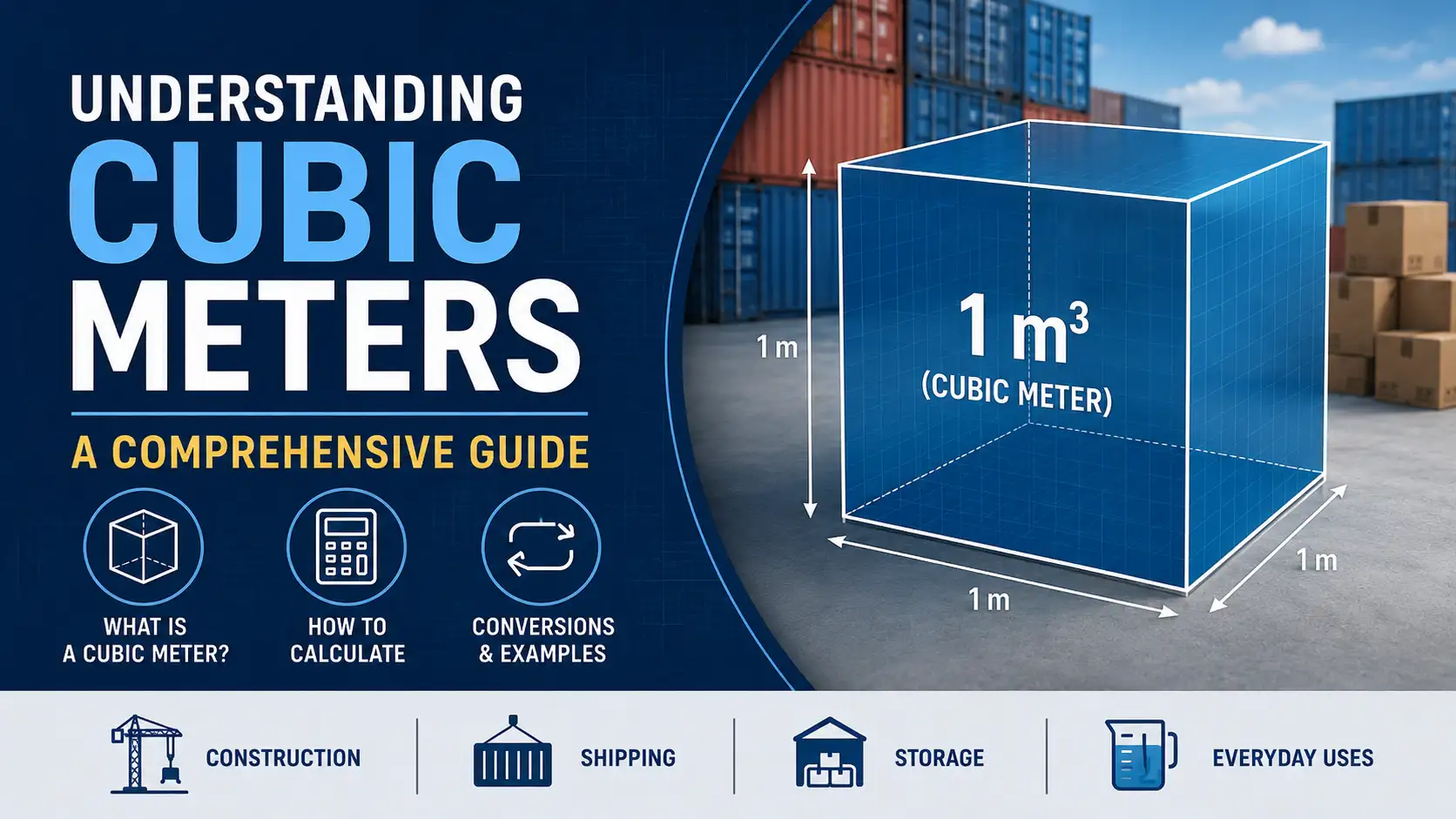
A cubic meter represents the volume of a cube with sides of one meter. It's a standard measurement in the metric system.
Knowing how to calculate cubic meters can simplify many tasks. It helps in determining the capacity of spaces and containers.
A cubic meter calculator can make these calculations quick and easy. A CBM calculator converts dimensions into cubic meters, saving time and reducing errors.
This guide will explore the importance of cubic meters. We'll cover how to find cubic meters and use a calculator effectively.
You'll also learn about converting cubic meters to other units. This knowledge is valuable for students, professionals, and DIY enthusiasts alike.
By mastering these concepts, you can enhance your problem-solving skills and improve efficiency in various projects.
Table of contents
What Is a Cubic Meter?
Why Understanding Cubic Meters Matters
The Formula: How to Find Cubic Metres
Step-by-Step: Using a Calculator for Cubic Meters
Practical Examples of Calculating Volume in Cubic Meters
Converting Cubic Meters to Other Units
Calculating Volume in Cubic Feet vs. Meters Cubed
Common Applications: Where Cubic Meters Are Used
Tips for Accurate Volume Calculations
Frequently Asked Questions About Cubic Meter Calculators
Conclusion: Mastering Volume in Cubic Meters
What Is a Cubic Meter?
A cubic meter is a metric system unit of volume definition. It represents the space within a cube measuring one meter on each side.
This measurement is vital in many fields, providing a universal standard for volume. It's used worldwide due to its convenience and simplicity as part of the International System of Units; for a formal reference, see the SI unit of volume.
Mathematically, calculating cubic meters is straightforward. It's the result of multiplying the length, width, and height of an object, all in meters.
Here's the simple formula:
Volume in Cubic Meters = Length × Width × Height
Imagine a swimming pool or a large container; calculating the volume helps in understanding capacity. Knowing the volume in cubic meters can guide decisions about resource allocation.
The concept can also be visualized easily. Think of a large box that measures 1x1x1 meter. The total space within is one cubic meter.
Using a cubic meter calculator can simplify finding the volume. Many online tools and apps can assist, offering flexibility and accuracy.
Understanding cubic meters aids in various activities, from project planning to environmental assessments. It's a fundamental metric in science and industry.

Why Understanding Cubic Meters Matters
Understanding cubic meters is crucial in many industries. It plays a significant role in construction, helping estimate materials and costs.
Logistics also relies on this measurement. It determines shipping and storage capacities, ensuring efficient operations.
Cubic meters are standard in international trade, offering a consistent unit for transactions. This shared understanding facilitates global commerce.
Moreover, the metric aids in scientific research. Applications span fields like environmental science and engineering.
Key benefits include:
Accurate Estimations: Essential for project planning and budgeting.
Consistency: Standard unit used worldwide for measurements.
Application: Vital in numerous fields from science to logistics.
Recognizing its importance ensures sound decisions. It aids in space utilization and resource management across various sectors. With its simplicity, the cubic meter becomes a fundamental unit for precise and meaningful volume calculations.
Grasping the concept of cubic meters aligns practices with global standards. It enhances communication and collaboration within international teams.

The Formula: How to Find Cubic Metres
Finding cubic meters is straightforward when you know the formula. It's essential for accurate volume measurements in a range of applications.
The formula involves multiplying dimensions: length, width, and height. These should all be in meters for consistency.
Formula Breakdown
Volume = Length x Width x Height
Using this formula allows you to calculate the volume of various objects, from small boxes to large spaces. Always ensure measurements are correct to avoid errors.
For worked examples, see the cubic metre formula. You can also review Volume and surface-area formulas.
For example, consider a rectangular container. If it's 2 meters long, 1 meter wide, and 0.5 meters high, the volume calculation would be:
[ \text{Volume} = 2 , \text{m} \times 1 , \text{m} \times 0.5 , \text{m} = 1 , \text{cubic meter} ]
This formula becomes a helpful tool in everyday scenarios. It's the backbone of many industry standards and practices.
Understanding this simple yet powerful equation enhances your problem-solving skills. It ensures accuracy in tasks such as building, packing, and designing spaces.
If you need help with other shapes, try a volume calculator.

by Bozhin Karaivanov (https://unsplash.com/@bkaraivanov)
Step-by-Step: Using a Calculator for Cubic Meters
Using a calculator for cubic meters simplifies and speeds up volume calculations. These tools are available both online and as mobile apps.
If you want a quick tool, try a CBM calculator.
Steps to Use a Cubic Meter Calculator
Input Measurements: Enter the length, width, and height.
Select Units: Confirm they are in meters for accurate results.
Calculate: The tool will compute the volume in cubic meters.
An online calculator displays results quickly. Input the required data in a user-friendly interface.

by CHUTTERSNAP (https://unsplash.com/@chuttersnap)
Benefits of Using a Calculator
Efficiency: Reduces time taken for manual calculations.
Accuracy: Minimizes errors, especially in complex problems.
Convenience: Access from anywhere via a device.
To ensure the calculator's accuracy, always double-check inputs. Mistakes usually occur from incorrect entries.
These tools are perfect for construction projects or storage planning. Calculators help in determining the capacity needed for various tasks.
Using a calculator is practical for anyone dealing with volume measurement challenges. It also aids students in understanding theoretical concepts.

by Bozhin Karaivanov (https://unsplash.com/@bkaraivanov)
Always ensure your calculator uses standard metric conversions. This guarantees the correctness of results, especially when converting units.
Incorporating such calculators into daily practice enhances learning and practical application skills.
Practical Examples of Calculating Volume in Cubic Meters
Understanding how to calculate volume in cubic meters is practical. It applies to everyday situations and professional fields.
Imagine you need to find the volume of a swimming pool. Measure its length, width, and depth in meters. Using the formula, multiply these to find the volume.

by Markus Spiske (https://unsplash.com/@markusspiske)
In construction, accurately measuring the volume of concrete needed is crucial. It prevents waste and keeps costs manageable. A concrete volume calculator or concrete quantity calculator can help.
Common Examples:
Shipping Containers: Calculate volume to determine cargo capacity. For planning, see the shipping-container capacity guide.
Room Volume: Helpful in HVAC for heating and cooling needs.
Gardening: Ensures you have enough soil for a raised bed.
When moving, calculating the volume of furniture helps in selecting the right size vehicle. This saves time and money during transport.
In the food industry, cubic meters measure storage spaces in warehouses. Accuracy ensures optimal stock levels.
Cubic meter calculations also aid environmental studies. They quantify water bodies or air pollution levels, aiding in necessary interventions.
Understanding these examples empowers anyone needing precise volume calculations. Whether for personal projects or professional duties, mastering cubic meters is invaluable.
For soil, gravel and earthwork volumes, try a compaction volume estimator.
For more tools, explore construction calculators and the construction calculator guide.
Converting Cubic Meters to Other Units
Converting cubic meters to other units can be essential for specific tasks. Whether you are working in construction or shipping, conversions help. Understanding conversions ensures you're working with the right measurements.
For quick conversions, use a unit converter or follow the complete unit-conversion guide. For a step-by-step method, see Converting cubic units correctly.
Cubic meters can be converted into liters, cubic feet, or gallons. These are popular units in different contexts.
Conversion methods rely on set factors. Each cubic meter equals 1,000 liters. Knowing this, you can easily switch between the two.
Converting to cubic feet involves another step. One cubic meter is about 35.3 cubic feet. This conversion is important in countries using the imperial system.
You may also need to convert to gallons. Cubic meters are equivalent to 264.2 gallons.
Quick Reference for Conversions:
1 cubic meter = 1,000 liters
1 cubic meter ≈ 35.3 cubic feet
1 cubic meter ≈ 264.2 gallons
These conversions provide the flexibility to solve different problems. Whether dealing with liquids or solids, knowing these figures is beneficial.

by Bozhin Karaivanov (https://unsplash.com/@bkaraivanov)
Knowing these conversions enhances accuracy and communication, especially in international projects. Different countries use different systems, and being knowledgeable avoids confusion.
Cubic Meters to Liters, Cubic Feet, and Gallons
Different projects require measuring space in various units. Converting cubic meters helps in adapting to various needs.
For example, knowing that one cubic meter equals 1,000 liters is essential in the beverage industry. It ensures correct quantities and prevents shortages or overstocking.
In construction, converting cubic meters to cubic feet provides clarity in blueprint specifications. Knowing this conversion helps in understanding space in building interiors.
Conversion Quick Guide:
1 cubic meter = 1,000 liters
1 cubic meter ≈ 35.3 cubic feet
1 cubic meter ≈ 264.2 gallons
Understanding these conversions makes planning easier and ensures compliance with local standards. Effective communication and precision are crucial for project success.
Calculating Volume in Cubic Feet vs. Meters Cubed
Calculating volume in different units can seem complex, but it's manageable. Understanding how to switch between cubic feet and meters cubed is crucial. Both units measure volume but serve different contexts.
Cubic meters are the standard in the metric system, used globally. It's common in scientific and engineering applications. Meanwhile, cubic feet are prominent in the United States due to the imperial system.
To calculate in cubic meters, you multiply the length, width, and height in meters. For cubic feet, measurements are in feet instead. The metric formula is straightforward: Volume = Length x Width x Height.
Converting between the two requires a conversion factor. Remember, 1 cubic meter is approximately 35.3 cubic feet. This conversion enables you to navigate projects across different system preferences.
Comparison table: common volume units
Unit Symbol Equals 1 m3 Where you'll see it
Cubic meter | m3 | 1 | Metric measurements (global) |
Liter | L | 1,000 | Liquids, small container volumes |
Cubic foot | ft3 | 35.3 | U.S. construction, storage, HVAC |
U.S. gallon | gal (US) | 264.2 | U.S. liquid capacity |
Key Differences:
Metric System: Cubic meters (m3)
Imperial System: Cubic feet (ft3)
Conversion: 1 m3 ≈ 35.3 ft3
Grasping these differences helps ensure successful project completion, especially in multinational collaborations. Understanding volume calculations can optimize space usage and resource planning efficiently.
Common Applications: Where Cubic Meters Are Used
Cubic meters measure volume in many sectors, offering a universal standard. This unit plays a pivotal role in construction and architecture. Architects use it to determine space and material requirements.
In shipping and logistics, volume in cubic meters affects container size and cargo capacity. Knowing how to calculate these can optimize supply chain efficiency. It's integral for reducing shipping costs. For more, see the logistics and freight calculator guide.
To estimate shipping prices by volume, review freight cost per CBM and use a freight cost estimator.
CBM is also closely related to chargeable weight; see volumetric weight explained and compare with actual weight using a shipping weight calculator.
When choosing a shipping method based on volume, see LCL versus FCL shipping.
Environmental studies often rely on meters cubed. Researchers assess the volume of water bodies and pollutant dispersion. It helps in understanding ecological impact accurately.
In agriculture, determining the storage space for produce like grains is crucial. Volume calculations ensure optimal storage conditions. It aids in planning and resource allocation.
Here are some common applications:
Construction
Shipping
Environmental Studies
Agriculture
Storage Solutions

by The New York Public Library (https://unsplash.com/@nypl)
Lastly, manufacturing often involves cubic meters for inventory management. Ensuring product consistency and quality depends on precise measurements. This application underscores the versatility and importance of this unit across various fields.
Tips for Accurate Volume Calculations
Accurate volume calculations require attention to detail. First, ensure all measurements are in the same unit before starting any calculations. Consistency is vital for preventing errors.
Use reliable tools. A good calculator for cubic meters will help achieve precision in results. This is especially true for complex calculations requiring more than basic arithmetic.
When taking measurements, record them carefully and double-check. Confirm dimensions, especially in large projects, to avoid costly mistakes. Accuracy at this stage is crucial.
Consider the following tips for accurate calculations:
Ensure unit consistency
Use a reliable calculator
Double-check measurements
Note down dimensions properly

by Amr Taha (https://unsplash.com/@amr_taha)
Lastly, practice makes perfect. Regularly engaging in volume calculation exercises will improve your skills. Familiarity with the process increases speed and reduces the chance of errors over time.
Frequently Asked Questions About Cubic Meter Calculators
What does CBM mean?
CBM stands for cubic meter and is commonly used in logistics to describe volume (for example, how much space cargo takes up). A CBM calculator can help you calculate it quickly.
How do I calculate cubic meters?
Multiply length × width × height (all in meters). If you're working with different shapes, a volume calculator can help.
How do I convert cubic meters to liters or cubic feet?
Use the conversion factors in the conversion section, or use a unit converter. For a deeper walkthrough, see the complete unit-conversion guide.
What's the difference between CBM and volumetric weight?
CBM is pure volume. Volumetric (dimensional) weight is a billing method that converts volume into an equivalent weight to determine chargeable weight. See volumetric weight explained.
Why is CBM important for shipping prices?
Many quotes and fees depend on how much space your shipment occupies. See freight cost per CBM for examples and use a freight cost estimator to model costs.
What's the best way to check my inputs?
Measure twice, convert units before calculating, and keep a consistent rounding approach. When shipping, it can also help to compare actual weight vs chargeable weight with a shipping weight calculator.
Conclusion: Mastering Volume in Cubic Meters
Understanding and calculating cubic meters is crucial in various fields. Whether it's for construction or logistics, precision is key. Mastery of this concept streamlines many tasks.
Leverage calculators for cubic meters to simplify your calculations. These tools enhance accuracy and efficiency. As you grow familiar with the metric, you'll find it easier to navigate related projects and discussions. With this knowledge, you are better equipped to tackle real-world challenges involving volume measurement.
Frequently Asked Questions
Our Methodology
All calculator content on CalculatorApp.me is reviewed by subject-matter experts, cross-referenced with official sources, and updated regularly for accuracy. Our formulas and data are verified against industry standards and government publications.
Jordan Hayes
Verified AuthorPersonal Finance Content Strategist
Jordan is a personal finance content strategist with 9+ years writing about mortgages, retirement, tax strategy, and budgeting. Every guide is cross-referenced with IRS publications, Federal Reserve data, and CFPB guidance to make complex calculations accessible. Editor at CalculatorApp.me.
Found this helpful? Share it!
Stay Updated
Get notified when we launch new calculators and features.
No spam. Unsubscribe anytime.