Debt-to-Income Ratio | DTI Guide
Free Calculator
Proportion Calculator
Table of Contents
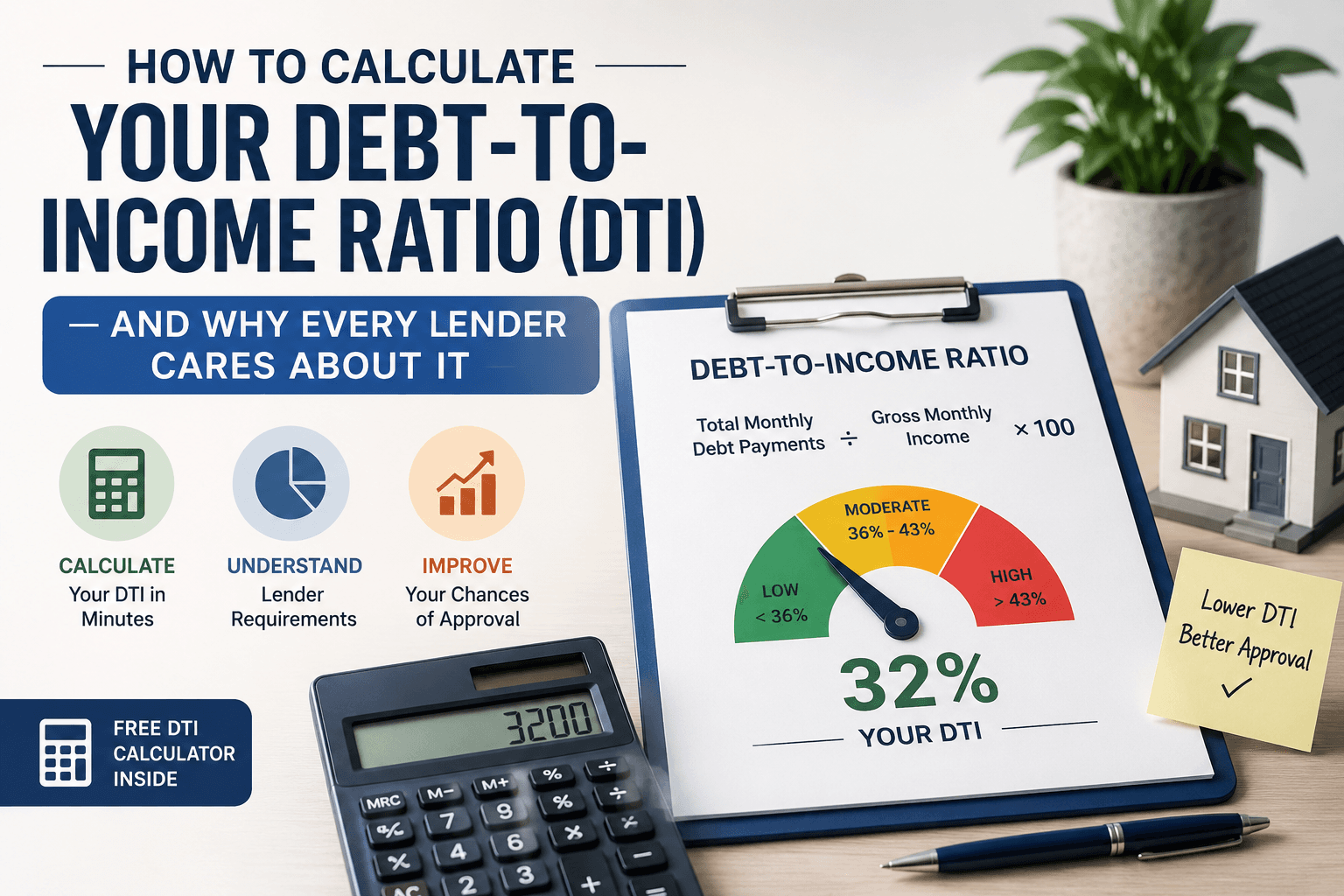
How to Calculate Your Debt-to-Income Ratio (DTI) — and Why Every Lender Cares About It
Your DTI ratio can make or break a mortgage application. This complete guide explains what it means, how to calculate it in minutes, what lenders actually look for, and exactly how to lower yours — fast.
Quick Answer: What Is a Good DTI Ratio?
Below 36% — Excellent. You qualify for the best loan terms and lowest rates.
36% – 43% — Good. Most lenders will approve you; rates remain competitive.
44% – 50% — Fair. Some lenders may approve with compensating factors like strong credit.
Above 50% — High risk. Mortgage approval is difficult. Focus on reducing debt first.
Formula: DTI = Total Monthly Debt Payments ÷ Gross Monthly Income × 100
📋 Table of Contents
What Is a Debt-to-Income Ratio (DTI)?
Your debt-to-income ratio — commonly written as DTI — is one of the most important numbers in your financial life, especially when you want to borrow money. It tells lenders a simple but powerful truth: how much of every dollar you earn is already spoken for by debt payments.
Put plainly, the DTI ratio compares your total recurring monthly debt payments to your gross monthly income (income before taxes). Lenders express the result as a percentage. The higher that percentage climbs, the more of your paycheck is committed to existing debts — and the riskier you appear to a bank or mortgage company.
Think of it this way. If you earn $5,000 per month and you pay $1,500 toward loans and credit cards, your DTI is 30%. That means 30 cents of every dollar you earn goes straight to debt. The remaining 70 cents covers housing, groceries, utilities, savings, and everything else — which reassures a lender that you have breathing room for a new payment.
Now flip the scenario. If your debt payments rise to $3,000 on the same $5,000 income, your DTI hits 60%. A lender sees that 60 cents of every dollar is gone before you buy groceries, pay utilities, or handle an emergency. That's a very different picture — and a much harder path to loan approval.
Key Insight: According to the National Association of Realtors' 2025 Profile of Homebuyers and Sellers, a high DTI is the single most common reason lenders deny a mortgage application, outpacing low credit scores, insufficient down payments, and employment issues combined.
TOTAL MONTHLY DEBT PAYMENTS $2,000 car + student + credit cards ÷ GROSS MONTHLY INCOME $6,000 before taxes = YOUR DTI 33% ✓ Good Range How the DTI Ratio Formula Works calculatorapp.me — Debt-to-Income Ratio Explained
The DTI formula: Total Monthly Debt Payments ÷ Gross Monthly Income × 100. In this example, $2,000 ÷ $6,000 = 33% DTI — a healthy range lenders view favorably.
The History Behind DTI
The debt-to-income ratio did not appear overnight. It evolved over decades as lenders searched for a reliable, easy-to-compare measure of borrower risk. Before modern credit scoring, banks relied heavily on personal relationships and subjective judgment. The DTI formula gave underwriters a consistent, mathematical way to evaluate ability to repay across millions of applications.
Today, the DTI ratio is embedded in virtually every major lending framework in the United States — from Fannie Mae and Freddie Mac guidelines for conventional loans to the Federal Housing Administration's criteria for FHA loans. Even the Consumer Financial Protection Bureau (CFPB) weaves DTI into its definition of a Qualified Mortgage.
Why Lenders Care So Much About Your DTI
Walk into any bank, credit union, or online mortgage lender, and your DTI will be one of the first numbers they calculate. It is not a formality. Lenders care about your DTI because it answers the most fundamental question in lending: Can this borrower afford to repay a new loan without financial collapse?
Credit scores measure your history of repaying debt. The DTI ratio, by contrast, measures your current capacity to take on new payments. Both numbers are essential, but they reveal different things. A borrower can have a strong credit score built from years of perfect payment history — yet carry so much debt that adding a mortgage payment would genuinely stretch them beyond their means. The DTI catches that.
Regulatory Importance: The Qualified Mortgage Rule
The CFPB's Qualified Mortgage (QM) rule specifically ties DTI to lending standards. A Qualified Mortgage — a loan that meets federal standards designed to protect borrowers — traditionally required a back-end DTI at or below 43%. While updated rules introduced an alternative price-based test in 2021, the DTI benchmark remains central to how lenders evaluate risk and regulatory compliance.
Lenders who issue non-QM loans (loans that don't meet QM standards) take on more regulatory risk. They typically offset that by charging higher interest rates or requiring larger down payments. The bottom line: a higher DTI nearly always costs you more money, even when it doesn't get you flat-out denied.
"A high DTI is the most common reason that lenders deny a mortgage application. It's not just a number — it tells us whether a borrower has genuine capacity to sustain payments through life's inevitable financial surprises." — Based on 2025 National Association of Realtors Homebuyer & Seller Report
How DTI Affects Your Interest Rate
Even when a high DTI doesn't result in rejection, it often results in a higher interest rate. Lenders use risk-based pricing: borrowers who present greater default risk pay more for the privilege of borrowing. A DTI of 48% might get you approved, but you may receive a rate 0.25%–0.75% higher than a borrower with a 33% DTI. On a $350,000 mortgage, that difference can add up to tens of thousands of dollars over the life of the loan.
Top Reasons Lenders Deny Mortgage Applications (2025) % of Denials 40% High DTI Ratio 23% Low Credit Score 15% Insufficient Down Payment 12% Incomplete Documents 10% Employment Issues High DTI is the #1 reason — more than credit score and down payment combined
Source: National Association of Realtors, 2025 Profile of Home Buyers and Sellers. High DTI accounts for 40% of mortgage denials — nearly double the next most common reason.
Front-End vs. Back-End DTI: What's the Difference?
When mortgage lenders discuss DTI, they actually look at two separate ratios, not one. Understanding the difference is critical because lenders set maximum thresholds for both — and you need to satisfy both to qualify.
Front-End DTI (Housing Ratio)
The front-end DTI — sometimes called the housing ratio or mortgage-to-income ratio — measures only your housing costs as a percentage of gross monthly income. It includes your potential new mortgage payment (principal + interest), property taxes, homeowners insurance, and HOA dues if applicable. It does not include any of your other debts.
Front-End DTI Formula
Monthly Housing Costs ÷ Gross Monthly Income × 100
Most conventional loan guidelines prefer a front-end DTI of 28% or less. FHA loans typically use a front-end threshold of 31%. Going above these numbers doesn't automatically disqualify you, but it raises flags and may require compensating factors.
Back-End DTI (Total Debt Ratio)
The back-end DTI — the one most people mean when they just say "DTI" — includes all your recurring monthly debt obligations: housing costs plus car loans, student loans, minimum credit card payments, personal loans, child support, alimony, and any other installment or revolving debt. This is the number lenders weight most heavily.
Back-End DTI Formula
All Monthly Debt Payments ÷ Gross Monthly Income × 100
Front-End vs. Back-End DTI Ratio FRONT-END DTI (Housing Ratio) 🏠 Mortgage Principal & Interest 🏦 Property Taxes 🛡 Homeowners Insurance 🏘 HOA Fees (if applicable) Ideal: ≤ 28% BACK-END DTI (Total Debt Ratio — All Debts) ✦ Everything in Front-End DTI, PLUS: 🚗 Car Loans 🎓 Student Loans 💳 Min. Credit Card Payments 📋 Personal Loans, Child Support Ideal: ≤ 36%–43%
Front-end DTI focuses only on housing costs. Back-end DTI adds all other recurring monthly debt obligations — and is the primary ratio lenders use to make lending decisions.
Pro Tip: When a lender quotes you a DTI requirement like "36/43," they mean a front-end ratio of 36% and a back-end ratio of 43%. Both numbers must stay within their limits. The back-end number is almost always the one that trips borrowers up.
How to Calculate Your DTI Ratio Step-by-Step
Calculating your DTI ratio takes less than five minutes. You need two sets of numbers: your monthly debt payments and your gross monthly income. Here is the exact process lenders use — and how you can replicate it at home right now.
Step 1: List Every Monthly Debt Payment
Pull out your statements and write down the minimum required monthly payment for each of the following:
Your new mortgage payment (principal + interest + taxes + insurance) — or current rent if you're not yet a homeowner
Car loans or lease payments
Student loan payments (use the minimum required amount)
Minimum credit card payments (not the full balance — just the minimum)
Personal loans or lines of credit
Child support or alimony payments ordered by a court
Any other installment debts with more than 10 months remaining
Step 2: Calculate Your Gross Monthly Income
Gross income means before taxes and deductions. Include all sources:
Salary or hourly wages (annual salary ÷ 12)
Overtime, bonuses, and commissions (if documented for two years or more)
Self-employment income (net income from tax returns, typically averaged over two years)
Social Security or disability income
Child support or alimony received
Rental income (typically 75% of gross rents to account for vacancies and expenses)
Investment or pension income
Step 3: Apply the Formula
DTI Formula
DTI = (Total Monthly Debt Payments ÷ Gross Monthly Income) × 100
Add all monthly debt payments. Total every recurring debt obligation from Step 1. Do not include groceries, utilities, Netflix, or other variable expenses — only fixed debt payments.
Determine gross monthly income. If you're salaried, divide your annual salary by 12. If you're hourly, multiply your hourly rate by your average weekly hours, then multiply by 52 and divide by 12.
Divide debt by income. Take your total monthly debts and divide by your gross monthly income.
Convert to a percentage. Multiply the result by 100. That number is your DTI ratio.
4 Steps to Calculate Your DTI Ratio 1 LIST MONTHLY DEBTS Mortgage, car, loans, credit card minimums 2 FIND GROSS MONTHLY INCOME Salary ÷ 12 All sources, before tax 3 DIVIDE DEBT BY INCOME $2,000 ÷ $6,000 = 0.333 4 MULTIPLY × 100 = 33.3% YOUR DTI RATIO ✓ Very Good Range calculatorapp.me — Use our free DTI calculator to skip the math
The four-step process to calculate your debt-to-income ratio. Use gross (pre-tax) income and minimum required payment amounts for each debt — not total balances.
Worked Example
Sarah's DTI Calculation
Sarah earns $75,000 per year ($6,250 per month gross). Her monthly debts include:
Proposed mortgage payment (PITI): $1,400
Car loan: $380
Student loan: $220
Minimum credit card payment: $95
Total monthly debts: $2,095
DTI = $2,095 ÷ $6,250 = 0.335 × 100 = 33.5%
Sarah's back-end DTI of 33.5% is well within the ideal range. Most lenders would view her as a low-risk borrower and offer competitive rates.
Use Our Free DTI Calculator
Enter your monthly debt payments and income below to calculate your debt-to-income ratio instantly. For a full breakdown with front-end and back-end analysis, try our advanced DTI calculator.
DTI Ratio Calculator
Enter your numbers to calculate your debt-to-income ratio in seconds.
Total Monthly Debt Payments ($)
Gross Monthly Income ($)
Calculate My DTI Ratio →
—
Your Debt-to-Income Ratio
→ Full DTI Calculator with Front-End & Back-End Breakdown
What Counts as Debt — and What Doesn't?
One of the most common sources of confusion is not knowing which payments count toward your DTI. Lenders have clear rules — and some items you'd expect to be included actually aren't.
✓ Counted in DTI
Mortgage or rent payments
Car loans
Student loan payments
Minimum credit card payments
Personal or installment loans
Child support / alimony paid
Co-signed loans (if you're responsible)
Home equity loans or HELOCs
Boat, RV, or motorcycle loans
✗ NOT Counted in DTI
Grocery bills
Utility payments (gas, electric, water)
Phone or internet bills
Streaming or subscription services
Insurance premiums (health, auto, life)
Gym memberships
Daycare or tuition
Medical bills (unless in collections)
Taxes (income, property — when not escrowed)
Important: If a debt has 10 or fewer months of payments remaining, some lenders (especially conventional loan underwriters) will exclude it from the DTI calculation. Always disclose all debts accurately — lenders will pull your full credit report and will see them regardless.
Where Does Your $6,000 Monthly Gross Income Go? DTI Debts 33% · $1,980 Taxes 17% Living 15% Save 10% Discretionary 25% · $1,500 Monthly debt payments (counted in DTI) Federal & state income taxes Fixed living costs (utilities, groceries, insurance) Savings & emergency fund Discretionary spending (dining, travel, hobbies) Key: Lenders only count the red segment (debt payments) against your gross income. Groceries, utilities, taxes, and subscriptions do NOT count toward DTI.
How a $6,000 monthly gross income is typically allocated. Lenders measure only your fixed debt obligations (red segment) — not taxes, food, utilities, or other living costs.
What Is the Ideal DTI Ratio?
There is no single universal "perfect" DTI — it varies by lender, loan program, and the strength of your overall application. That said, the industry has developed widely accepted benchmarks that you can use as your targets.
DTI Ratio Ranges and What They Mean for Borrowers | |||
DTI Range | Rating | What It Means | Loan Approval Outlook |
|---|---|---|---|
Under 20% | Excellent | Minimal debt burden relative to income | Qualify for best rates and terms |
20% – 35% | Very Good | Comfortable financial position | Strong approval odds, competitive rates |
36% – 43% | Acceptable | Manageable debt load | Approved by most lenders; rates still fair |
44% – 50% | Elevated | Debt burden is significant | Approval possible with compensating factors |
Above 50% | High Risk | Income largely consumed by debt | Approval difficult; non-QM lenders only |
The widely cited "28/36 rule" serves as a practical benchmark for homebuyers: keep your front-end housing costs below 28% of gross income, and keep your total back-end DTI below 36%. Following this rule helps you maintain financial flexibility even if income drops or unexpected expenses arise.
DTI Ratio Scale: Where Do You Fall? Excellent <20% Very Good 20–35% Acceptable 36–43% Elevated 44–50% High Risk >50% 0% 20% 36% 44% 50% 70%+ calculatorapp.me — DTI Rating Scale
The DTI ratio scale from excellent (under 20%) to high risk (above 50%). The 36%–43% range is the sweet spot most lenders target for standard loan programs.
Calculate Your Mortgage Affordability
See how your DTI connects to the home price you can realistically afford — with our free mortgage calculator.
DTI Requirements by Loan Type (2025)
Different loan programs enforce different DTI ceilings. Knowing these thresholds before you apply helps you target the right loan program and avoid surprises during underwriting.
2025 Maximum DTI Ratios by Loan Type | |||
Loan Type | Front-End Max | Back-End Max | Notes |
|---|---|---|---|
Conventional (Fannie/Freddie) | 28% | 45%–50% | Up to 50% via automated underwriting with strong credit (620+) |
FHA Loan | 31% | 43%–50% | Up to 57% possible via AUS; up to 50% with compensating factors (credit 580+) |
VA Loan | No hard cap | 41% (guideline) | No formal cap via AUS; residual income is the key metric |
USDA Loan | 29% | 41% | Up to 55% via AUS in some cases |
Jumbo Loan | 28% | 38%–43% | Stricter requirements; lender-specific rules apply |
Non-QM Loan | Varies | Up to 55%+ | Flexible but higher rates; bank statement or DSCR programs |
Understanding Automated Underwriting Systems (AUS)
Many of the "up to 50%" or higher DTI approvals you'll see happen through Automated Underwriting Systems (AUS) — software tools like Fannie Mae's Desktop Underwriter (DU) or Freddie Mac's Loan Product Advisor (LPA). These systems evaluate your entire application holistically: credit score, assets, down payment, loan-to-value ratio, and DTI together. A borrower with a 700 credit score, 20% down, and strong reserves might receive AUS approval at 50% DTI when a manual underwriter would decline the same application.
Maximum Back-End DTI by Loan Type (2025) 0% 36% 43% QM 50% Conventional 50% With strong credit & AUS FHA Up to 57% Via AUS with compensating factors VA 41% guideline No hard cap — residual income key USDA Up to 55% Via AUS; manual cap 41% Jumbo 38–43% Strictest requirements Non-QM 55%+ Flexible; higher rates apply QM LINE
Maximum back-end DTI thresholds by loan program in 2025. FHA and VA loans offer the most flexibility. Conventional AUS approvals can reach 50%. Jumbo loans are the most restrictive.
Compensating Factors That Help High-DTI Borrowers
When your DTI sits above the standard threshold, lenders look for compensating factors that offset the risk. The stronger these factors, the better your approval odds:
High credit score (720 or above signals responsible debt management)
Large down payment (20% or more reduces lender risk significantly)
Substantial cash reserves (6–12 months of mortgage payments in savings)
Long-term employment stability (same employer for 5+ years)
Minimal payment shock (new mortgage payment is close to current rent)
Low loan-to-value ratio (strong equity position)
Residual income (especially important for VA loans)
How DTI and Credit Score Work Together
DTI and credit score are the two most powerful levers in mortgage underwriting — and they work in opposite directions when one is weak. A strong credit score can partially compensate for a higher DTI. A low DTI can partially compensate for a fair credit score. Understanding this interplay gives you strategic options.
DTI and Credit Score Interaction Matrix | ||||
Credit Score | DTI < 36% | DTI 36%–43% | DTI 44%–50% | DTI > 50% |
|---|---|---|---|---|
760+ | Best Rates | Approve | Likely OK | Possible |
720–759 | Great | Approve | Possible | Difficult |
680–719 | Good | Conditional | Difficult | Unlikely |
620–679 | Possible | Difficult | Unlikely | Denied |
Below 620 | Limited | Denied | Denied | Denied |
Important distinction: Your DTI ratio does not directly appear in or affect your credit score. However, the behaviors that create a high DTI — carrying large loan balances, high credit card utilization, multiple installment accounts — do influence the credit score calculation. If you are working to improve your financial profile, both numbers benefit from the same core strategies: pay down debt and avoid taking on new obligations.
Real-Life DTI Examples
Abstract percentages can be hard to internalize. Here are three realistic borrower profiles that show how DTI plays out in practice.
Example 1 — First-Time Homebuyer
Marcus — Single, $58,000/Year Salary
Monthly gross income: $4,833
Proposed mortgage (PITI): $1,100
Car payment: $290
Student loan: $185
Credit card minimums: $65
Total debt: $1,640 | Back-end DTI: 33.9%
Marcus falls comfortably in the "very good" range. He qualifies for conventional, FHA, VA, and USDA loans. His front-end DTI (housing ratio) is 22.8% — well below the 28% guideline.
Example 2 — Move-Up Buyer
The Kellermans — Dual Income, $120,000 Combined
Monthly gross income: $10,000
Proposed mortgage (PITI): $2,600
Two car payments: $780
Student loans: $450
Credit card minimums: $200
Total debt: $4,030 | Back-end DTI: 40.3%
The Kellermans are in the "acceptable" range. They will likely qualify for conventional and FHA loans, though a lender may request compensating factors. Paying off one car or reducing credit card balances would push them into the "very good" tier and potentially unlock better rates.
Example 3 — High DTI Borrower
Priya — Self-Employed Consultant, $95,000 Net Income
Monthly gross income (net from Schedule C): $7,917
Proposed mortgage (PITI): $2,200
Business vehicle loan: $620
Student loan: $310
Credit card minimums: $390
Personal loan: $285
Total debt: $3,805 | Back-end DTI: 48.1%
Priya's DTI is elevated. A conventional lender may decline unless AUS approves or she has strong compensating factors (e.g., $40,000 in savings, 760 credit score). An FHA loan with sufficient reserves is more likely. Working with a mortgage broker familiar with self-employed borrowers is her best first move. Use our loan calculator to model different payment scenarios.
9 Proven Strategies to Lower Your DTI Ratio
Every point you shave off your DTI ratio expands your borrowing options and can save you thousands in interest over the life of a loan. Here are the most effective, actionable strategies — ranked by speed and impact.
1. Pay Off Small Debts First (Snowball Method)
The fastest way to lower your DTI is to eliminate monthly obligations entirely, not just reduce balances. A debt with a $150 minimum payment that you pay off completely removes $150 from your monthly debt total — immediately dropping your DTI ratio. Targeting the smallest balances first (the debt snowball approach) delivers fast wins that compound over time.
However, if a small debt carries a high interest rate, the debt avalanche method (targeting highest rates first) saves more money — even though DTI improvements may come more slowly.
2. Avoid Taking on New Debt Before Applying
This one sounds obvious but costs many homebuyers dearly. Financing a new car, opening a furniture credit account, or taking a personal loan in the months before a mortgage application can push your DTI above lenders' thresholds. Avoid any new credit applications or major purchases from at least six months before you plan to apply for a mortgage.
3. Increase Your Gross Income
Since DTI is a ratio, raising the denominator (income) lowers the percentage just as effectively as reducing the numerator (debt). Consider:
Asking for a raise or promotion (document it with a new offer letter or pay stub)
Taking a part-time or freelance position (note: lenders typically require 24 months of documented self-employment income)
Renting out a room or property — 75% of rental income is often counted
Monetizing a side skill or consulting business
4. Pay Down Credit Card Balances
Credit cards are revolving debt, and lenders use your current minimum payment in the DTI calculation. Reducing your credit card balance lowers the required minimum payment, directly reducing your DTI. Aim to keep each card below 30% utilization — this also improves your credit score simultaneously.
5. Pay Off a Car Loan Early
If your vehicle loan has a remaining balance that is manageable to pay off, doing so before applying for a mortgage can significantly lower your DTI. Even paying it down to 10 months remaining may allow a lender to exclude it from the DTI calculation under some guidelines.
6. Refinance Existing Loans for Lower Payments
Refinancing a student loan or personal loan to a longer term reduces the minimum monthly payment — and therefore reduces your DTI — even if the total interest paid over time increases. This trade-off makes sense specifically when mortgage qualification is the immediate goal. Once you're in the home and settled, you can accelerate those loan payments to minimize long-term interest costs.
7. Choose a Less Expensive Home (Lower Front-End DTI)
Reducing your target purchase price reduces the mortgage payment and therefore both your front-end and back-end DTI. This is a particularly effective strategy for first-time buyers who find their dream home pushes DTI too high. Starting with a more affordable property and building equity gives you a path to trade up in five to seven years.
8. Make a Larger Down Payment
A larger down payment reduces your loan amount, which directly lowers your principal and interest payment — and therefore your front-end DTI. On a $400,000 purchase, increasing your down payment from 5% to 20% reduces the loan balance by $60,000, which could lower your monthly payment by $300–$400 depending on your interest rate.
9. Add a Co-Borrower with Income
Adding a creditworthy co-borrower — such as a spouse, partner, or parent — adds their income to the DTI calculation. If a co-borrower earns $4,000 per month and has minimal debts, their income can dramatically lower the combined DTI. Be aware: their debts are also added to the calculation, so this only helps if their income is substantially greater than their debt obligations.
Action Plan: Before applying for a mortgage, give yourself a 6–12 month DTI improvement runway. Target a DTI below 36% for the best outcomes. Use our DTI calculator monthly to track your progress as you pay down debt.
Common DTI Mistakes Homebuyers Make
Most DTI-related setbacks are entirely preventable. These are the mistakes mortgage professionals see most often from homebuyers who underestimate how closely lenders scrutinize this number.
Forgetting PITI in the Calculation
Many buyers estimate their mortgage payment using only principal and interest — completely forgetting property taxes, homeowners insurance, and private mortgage insurance (PMI) if applicable. In high-tax states, the PITI total can be $400–$800 per month higher than a principal-and-interest estimate. Always use the full PITI figure when calculating DTI.
Counting Net Income Instead of Gross
DTI uses gross income (before taxes), not net take-home pay. Using your net paycheck makes your DTI look worse than it actually is. Lenders will use your pre-tax income from W-2s, tax returns, or pay stubs — make sure you use the same figure.
Opening New Credit Lines Before Closing
New credit accounts open in the months before a mortgage application can raise red flags and increase your monthly obligation calculations. Never open new credit between mortgage application and closing. The final credit pull before closing can sink an approved loan if new debt appears.
Ignoring Student Loan Repayment Status
Borrowers on income-driven repayment plans for federal student loans may have a current payment of $0 or very low amounts. However, many lenders use 0.5%–1% of the total student loan balance as the monthly payment figure for DTI purposes, regardless of what you actually pay. On $80,000 in student loans, that could add $400–$800 per month to your calculated DTI — even if your actual payment is much lower.
Not Verifying All Income Sources
Lenders require documented, verifiable income — not promises or estimates. Bonus income, rental income, freelance income, and investment income all require specific documentation. Income that can't be documented doesn't count, which can raise your effective DTI above what you expect.
DTI for Self-Employed and Gig Workers
Self-employed borrowers, freelancers, and gig economy workers face a unique DTI challenge: income documentation. While a W-2 employee can show a recent pay stub and be done with it, self-employed borrowers typically need to show two years of tax returns, bank statements, or both.
How Lenders Calculate Self-Employment Income
For most self-employed borrowers, lenders use the net income after deductions reported on Schedule C of your federal tax return — averaged over the most recent two years. This creates a painful paradox: the more business expenses you deduct to minimize taxes, the lower your qualifying income — and therefore the higher your calculated DTI ratio.
If your tax strategy has aggressively minimized reported income, you may need to consider options like:
Bank statement loans: Lenders use 12–24 months of business bank deposits (typically at 50%–75% of gross deposits) rather than tax returns
P&L loans: A CPA-prepared profit and loss statement supports income documentation
Asset depletion: Some lenders calculate income by dividing liquid assets over a set period
Co-borrower strategy: A W-2-employed co-borrower can help satisfy income requirements
Self-Employed Tip: If you plan to buy a home in the next two to three years, work with a tax professional and a mortgage broker simultaneously. Sometimes modest changes to your deduction strategy can meaningfully increase your documented income — and dramatically improve your DTI qualification position.
DTI Tips Specifically for First-Time Homebuyers
First-time buyers often enter the mortgage process without a clear understanding of how their student loans, car payments, and credit card habits combine to create a DTI that surprises them. Here is what you need to know if this is your first home purchase.
Start Tracking Your DTI 12 Months Early
Use our free DTI calculator to calculate your ratio right now — and then recalculate every month. Watching the number move as you pay down debt is motivating and helps you time your application strategically.
Use First-Time Buyer Programs with Flexible DTI
Many state housing finance agencies offer first-time buyer programs with more flexible DTI requirements, down payment assistance, and below-market interest rates. These programs can dramatically expand your purchasing power even if your DTI is in the 40%–45% range. Check your state housing authority's website for available programs.
Get Pre-Approved, Not Just Pre-Qualified
A pre-qualification is a quick estimate based on self-reported information. A pre-approval involves actual income and credit verification — and it tests your true DTI. Getting pre-approved before you begin home shopping prevents the heartbreak of falling in love with a home that your DTI cannot support.
Consider FHA for Higher DTI Flexibility
FHA loans accept back-end DTI ratios up to 50% with compensating factors — more flexibility than conventional loans. The trade-off is mortgage insurance premiums (MIP) for the life of the loan in most cases. If your credit score is 620–679 and your DTI is above 43%, an FHA loan is likely your best initial path. Once you've built equity and improved your DTI, you can refinance into a conventional loan without MIP.
Not Sure How Much You Can Borrow?
Use our loan calculator to see monthly payments and total costs at different loan amounts and interest rates.
Frequently Asked Questions About DTI Ratio
What is a good debt-to-income ratio to buy a house? +
A DTI below 36% is considered excellent for homebuying. Most lenders comfortably approve borrowers at or below 43%. With compensating factors (strong credit, large down payment, or cash reserves), some borrowers qualify up to 50% on conventional loans and higher on FHA loans. The "28/36 rule" is a great benchmark: keep housing costs under 28% of gross income and total debt under 36%.
Does my debt-to-income ratio affect my credit score? +
No — your DTI ratio does not directly appear in or influence your credit score. Credit scores are calculated using payment history, credit utilization, length of credit history, types of credit, and recent inquiries. However, the underlying behaviors that raise DTI — large balances, multiple loans — can indirectly affect your score through factors like credit utilization ratio.
Can I get a mortgage with a 50% DTI? +
Yes, it is possible — particularly with FHA loans or through automated underwriting on conventional loans with strong compensating factors. FHA guidelines allow DTI up to 50% with compensating factors like a credit score above 580 and verified cash reserves. Some non-QM (non-Qualified Mortgage) lenders go even higher. Expect higher interest rates and more scrutiny at elevated DTI levels.
How quickly can I lower my DTI ratio? +
You can begin lowering your DTI immediately by making extra debt payments. Eliminating a small debt entirely removes its minimum payment from your monthly debt total right away. Meaningful DTI improvement typically takes 3–12 months of focused effort. The most effective strategies are paying off small balances completely (instant impact on monthly obligations) and avoiding any new credit accounts.
Is DTI calculated before or after taxes? +
DTI always uses gross income — your income before taxes and deductions. Lenders verify gross income through W-2 forms, tax returns, pay stubs, and bank statements. Never use your net take-home pay for DTI calculations; it will make your ratio look artificially high and give you an inaccurate picture of your qualification position.
What is the difference between DTI and credit utilization? +
DTI measures your total monthly debt payments as a percentage of gross monthly income — it is a cash flow measure. Credit utilization measures your revolving credit card balances as a percentage of your total available credit limit — it is a balance-to-limit measure that directly affects your credit score. Both metrics are important for mortgage qualification. DTI determines if you can afford a new payment; credit utilization signals how you manage existing credit lines.
Do student loans count in DTI calculations? +
Yes, student loans count in DTI — but the exact figure used depends on the loan program and your repayment status. If you are in an income-driven repayment plan with a low or $0 payment, many conventional lenders still use 0.5%–1% of your total outstanding balance as the monthly payment for DTI purposes. FHA uses the greater of 1% of the balance or the documented payment. VA loans use the documented payment amount. Understanding how your student loans are treated is critical if you carry significant education debt.
Can rental income reduce my DTI? +
Yes — documented rental income can be added to your gross income for DTI purposes, which lowers your ratio. Lenders typically count 75% of gross rental income (to account for vacancies and expenses). You'll need to document the rental income with lease agreements, and often with a history of rental income shown on tax returns. If you're buying a multi-unit property and will occupy one unit, the expected rental income from other units can sometimes be used to offset the mortgage payment.
Conclusion: Your DTI Is Manageable — Here's Your Next Step
Your debt-to-income ratio is one of the most consequential numbers in your financial life — but it is not a fixed fate. Every debt you pay down, every dollar of income you add, every unnecessary loan you avoid moves the needle in your favor.
Here is what you should do right now:
Calculate your current DTI using the DTI calculator above or our full tool with front-end and back-end breakdown.
Identify your biggest DTI drivers. Which monthly debt is consuming the largest share of your income? Target that obligation first.
Give yourself a 6–12 month runway. Focused debt reduction over one year can transform a 47% DTI into a lender-friendly 38%.
Get pre-approved. Work with a licensed mortgage professional who can test your actual DTI against specific loan programs and suggest the best path forward for your situation.
Use our calculators. Our mortgage calculator and loan calculator help you model different scenarios — home prices, down payments, loan terms — before you commit to anything.
Homeownership is achievable at many DTI levels. The key is knowing where you stand, knowing what lenders expect, and having a clear, actionable plan to bridge the gap. You now have all three.
Share This Guide: If this article helped you understand your DTI, share it with a friend or family member who is planning to buy a home. Understanding your numbers before you apply is the single most powerful thing you can do to improve your mortgage outcome.
Related Calculators & Guides
🏠 Mortgage Calculator
Calculate monthly payments, total interest, and amortization schedule for any home loan.
💰 Loan Calculator
Estimate payments for personal, auto, and student loans with adjustable terms and rates.
Sources & References
This article draws on data and guidelines from the following authoritative sources:
Consumer Financial Protection Bureau. "What is a debt-to-income ratio?" consumerfinance.gov
Fannie Mae. Desktop Underwriter (DU) Underwriting Guidelines. fanniemae.com
U.S. Department of Housing and Urban Development. FHA Single Family Housing Policy Handbook. hud.gov
U.S. Department of Veterans Affairs. VA Pamphlet 26-7, Chapter 4: Credit Underwriting. benefits.va.gov
U.S. Department of Agriculture. Single-Family Housing Guaranteed Loan Program: Ratio Analysis. rd.usda.gov
Bankrate. "How to calculate your debt-to-income ratio." bankrate.com
Zillow. "Debt-to-Income Ratio Calculator." zillow.com
Rocket Mortgage. "FHA DTI Ratio Requirements." rocketmortgage.com
National Association of Realtors. 2025 Profile of Home Buyers and Sellers. nar.realtor
The Mortgage Reports. "How to Get a Loan With a High Debt-to-Income Ratio." themortgagereports.com
Disclaimer: The content on this page is for informational and educational purposes only. It does not constitute financial, legal, or mortgage advice. DTI thresholds vary by lender, loan program, and borrower circumstances. Always consult a licensed mortgage professional before making borrowing decisions. CalculatorApp.me makes no representations regarding specific lender requirements, which may change at any time.
Related Calculators
Try these free calculators related to this article:
Frequently Asked Questions
Our Methodology
All calculator content on CalculatorApp.me is reviewed by subject-matter experts, cross-referenced with official sources, and updated regularly for accuracy. Our formulas and data are verified against industry standards and government publications.
Jordan Hayes
Verified AuthorPersonal Finance Content Strategist
Jordan is a personal finance content strategist with 9+ years writing about mortgages, retirement, tax strategy, and budgeting. Every guide is cross-referenced with IRS publications, Federal Reserve data, and CFPB guidance to make complex calculations accessible. Editor at CalculatorApp.me.
Found this helpful? Share it!
Stay Updated
Get notified when we launch new calculators and features.
No spam. Unsubscribe anytime.