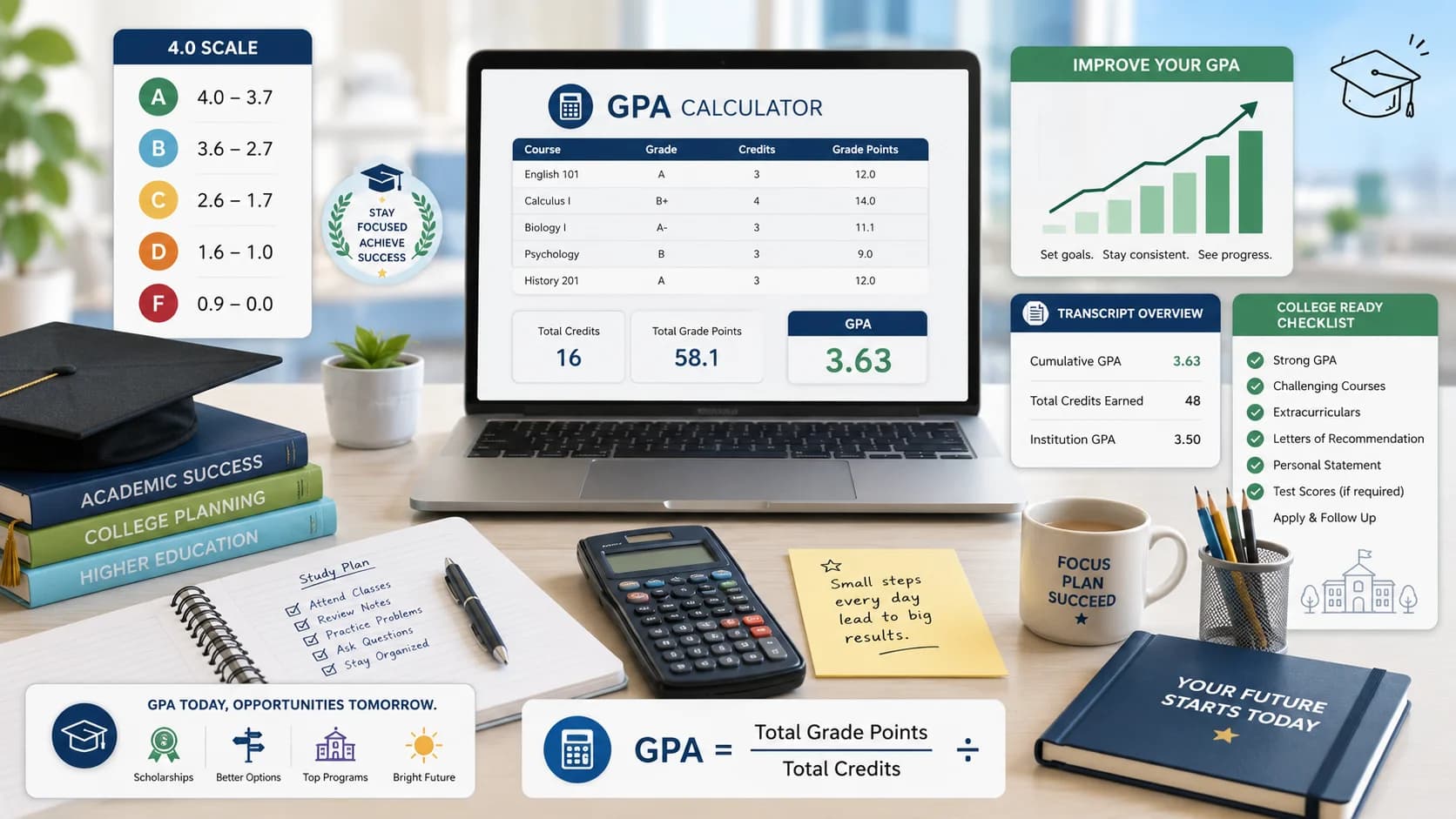
GPA Calculator Guide: How to Calculate GPA, Raise It, and What It Means for College
Table of Contents
GPA Calculator Guide: How to Calculate GPA, Raise It, and What It Means for College

Photo: Pexels
This guide is part of our complete GPA Calculator Guide, covering weighted GPA, grade conversion charts, and grad-school requirements.
Your GPA is a single number that follows you from freshman year through graduate school applications, job interviews, and scholarship eligibility. Understanding how it's calculated — and what actually moves it — is the most valuable academic strategy you can learn.
This guide covers the GPA formula from scratch, explains the difference between weighted and unweighted scales, shows you how cumulative GPA is calculated, and gives you proven strategies to raise your GPA efficiently. Use our free GPA Calculator to run the math instantly.
Key Takeaways
- GPA = total quality points ÷ total credit hours. Quality points = grade points × credit hours per course.
- Standard grade point values: A = 4.0, B = 3.0, C = 2.0, D = 1.0, F = 0.0.
- Weighted GPA adds bonus points for AP/IB (typically +1.0) and Honors courses (+0.5).
- Early semesters have an outsized impact on cumulative GPA because they represent a larger share of total credits.
- Most colleges and employers consider a 3.0 (B) as a baseline; 3.5+ is generally considered strong.
The GPA Formula
GPA (Grade Point Average) is a credit-weighted average of your grade points. The formula is:
GPA = Σ(Grade Points × Credit Hours) ÷ Σ(Total Credit Hours)
The numerator is called "quality points." The denominator is the total attempted credit hours.
Grade points are assigned based on the letter grade received:
| Letter Grade | Percentage Range | Grade Points (4.0 Scale) |
|---|---|---|
| A+ | 97–100% | 4.0 |
| A | 93–96% | 4.0 |
| A− | 90–92% | 3.7 |
| B+ | 87–89% | 3.3 |
| B | 83–86% | 3.0 |
| B− | 80–82% | 2.7 |
| C+ | 77–79% | 2.3 |
| C | 73–76% | 2.0 |
| D | 60–69% | 1.0 |
| F | Below 60% | 0.0 |
Step-by-Step GPA Calculation
Let's calculate semester GPA for a typical college student taking five courses:
| Course | Credits | Grade | Grade Points | Quality Points |
|---|---|---|---|---|
| Biology 201 | 4 | A | 4.0 | 4 × 4.0 = 16.0 |
| English 101 | 3 | B+ | 3.3 | 3 × 3.3 = 9.9 |
| Calculus I | 4 | B− | 2.7 | 4 × 2.7 = 10.8 |
| History 110 | 3 | A− | 3.7 | 3 × 3.7 = 11.1 |
| PE (elective) | 1 | A | 4.0 | 1 × 4.0 = 4.0 |
| Total | 15 credits | — | — | 51.8 quality points |
Semester GPA = 51.8 ÷ 15 = 3.45
Notice that the B− in the 4-credit Calculus course (2.7 grade points × 4 credits = 10.8 quality points) has a much larger effect than the A in the 1-credit PE class (4.0 × 1 = 4.0 quality points). In GPA math, credit hours determine importance, not the grade alone.
Cumulative GPA: Combining Multiple Semesters
Cumulative GPA is calculated exactly the same way — it just pools all quality points and credit hours from every completed semester:
Cumulative GPA = Total Quality Points Across All Semesters ÷ Total Credit Hours Attempted
Example: After Semester 1 (15 credits, GPA 3.45, quality points = 51.8) and Semester 2 (16 credits, GPA 3.10, quality points = 49.6):
Cumulative GPA = (51.8 + 49.6) ÷ (15 + 16) = 101.4 ÷ 31 = 3.27
This is why a single bad semester is hard to overcome — and why every early semester counts so heavily. With only 15 credits completed, each course represents about 6.7% of your total GPA weight. By senior year (120 credits completed), one 3-credit course represents only 2.4%.
Weighted vs. Unweighted GPA
The calculation above is an unweighted GPA — all courses count on the same 0.0–4.0 scale regardless of difficulty. An A in AP Physics and an A in study hall both contribute 4.0 grade points.
A weighted GPA adds bonus grade points to recognized advanced courses:
| Course Level | Bonus Points | A = (Max) | B = | C = |
|---|---|---|---|---|
| Regular | +0.0 | 4.0 | 3.0 | 2.0 |
| Honors | +0.5 | 4.5 | 3.5 | 2.5 |
| AP / IB | +1.0 | 5.0 | 4.0 | 3.0 |
A student who takes five AP courses and earns all A's can achieve a weighted GPA above 5.0. This is intentional — weighted GPA rewards both high grades and academic rigor simultaneously. It's why a student with a 3.8 weighted GPA may be more competitive for selective colleges than one with a 4.0 unweighted.
Which GPA do colleges look at?
Most selective colleges recalculate your GPA on their own scale when evaluating applications, often stripping out the weighting or re-weighting based on their own rubric. They want to compare applicants on the same baseline. However, they also review your transcript directly and can see the difficulty of your course load. Taking rigorous courses and earning a 3.7 weighted GPA is generally more impressive than a 4.0 achieved in all standard-level classes.
What Is a Good GPA?
Context matters — a "good" GPA depends on institution type, major, and purpose:
| Context | Minimum / Baseline | Strong | Excellent |
|---|---|---|---|
| College graduation requirement | 2.0 | 3.0 | 3.7+ |
| Entry-level job (most industries) | 2.5 | 3.0 | 3.5+ |
| Graduate school (MBA, etc.) | 3.0 | 3.3 | 3.7+ |
| Medical / Law school | 3.5 | 3.7 | 3.9+ |
| Academic scholarship | 3.0 | 3.5 | 3.75+ |
How to Raise Your GPA: 6 Proven Strategies
1. Prioritize high-credit courses
An A in a 4-credit course contributes 4 quality points; an A in a 1-credit course contributes only 1. Identify the high-credit courses on your schedule each semester and direct your best effort toward those. Raising a B to an A in a 4-credit course does four times as much for your GPA as doing the same in a 1-credit course.
2. Retake courses where your school replaces the grade
Many institutions allow grade replacement — the original grade is removed from GPA calculation and the new grade substitutes. Turning a D (1.0) into a B (3.0) in a 3-credit course removes 3 quality points and adds 9, a net swing of +6 quality points. Verify your school's policy before retaking.
3. Use pass/fail strategically for elective courses outside your strengths
If your school allows it, taking elective courses pass/fail protects your GPA from subjects where you're unlikely to score above a C. The pass designation doesn't affect your GPA, while a C does. Use this strategically for required physical education, fine arts electives, or other courses outside your expertise.
4. Front-load your easiest electives early
When your cumulative credit count is low, each course represents a larger fraction of your total GPA. Earning A's in easier electives early in your academic career inflates your GPA before the harder upper-division courses arrive. By the time those arrive, you have more quality points cushioning you.
5. Seek grade forgiveness for academic difficulties
Many schools have academic forgiveness policies for students who experienced extenuating circumstances (medical, personal, financial). These policies can allow grade exclusions or replacements that aren't available under standard retake policies. Contact your academic advisor if a single semester is significantly dragging your cumulative average.
6. Understand grade boundaries and fight for the curve
An 89.4% and a 90.0% both reflect strong work, but one earns a B+ (3.3 points) and the other an A− (3.7 points) — a meaningful difference multiplied by the course's credit hours. Know your grade cutoffs, ask professors about rounding policies, and don't be afraid to politely inquire about borderline situations before final grades are submitted.
Calculate Your GPA Now
Use our free GPA Calculator to compute your current semester or cumulative GPA instantly. Enter courses, credit hours, and grades — it handles the quality point math and shows you where you stand. You can also model "what-if" scenarios: what happens to your cumulative GPA if you earn a 3.5 next semester?
Need to find out what grade you need on remaining assignments or your final exam this semester? Use our Grade Calculator — it tells you exactly what score you need to hit any target grade in each course. Then convert those course grades into your GPA projection instantly.
Frequently Asked Questions
How do I calculate my GPA by hand?
Multiply each course's grade points by its credit hours to get quality points. Sum all quality points. Divide by total credit hours attempted. Example: 3 courses with (3 credits × 4.0), (4 credits × 3.0), (3 credits × 3.7) = 12 + 12 + 11.1 = 35.1 quality points ÷ 10 credit hours = 3.51 GPA.
What is the difference between semester GPA and cumulative GPA?
Semester GPA reflects only the current term's courses. Cumulative GPA combines all semesters — every course you've ever completed contributes to it. Graduate school and job applications almost always ask for your cumulative GPA, not a single semester's.
Does a W (withdrawal) affect my GPA?
A W grade typically does not affect GPA — the course is simply excluded from the calculation. However, excessive W's can affect financial aid eligibility, academic standing thresholds (completion rate requirements), and may raise red flags in graduate school applications if explanations aren't provided.
Can I have a GPA above 4.0?
On an unweighted scale, 4.0 is the maximum. On a weighted scale that assigns 5.0 for A's in AP/IB courses, a student taking primarily advanced courses with high grades can exceed 4.0. Many high schools report both weighted and unweighted GPA on transcripts for this reason.
How much can I raise my GPA in one semester?
It depends on how many credits you've completed. With 30 credits completed at a 2.8 GPA, earning a 4.0 in 15 credits brings your cumulative GPA to: (30 × 2.8 + 15 × 4.0) ÷ 45 = (84 + 60) ÷ 45 = 3.20. The more credits completed, the slower GPA changes — this is why raising a GPA senior year is difficult.
Do F grades stay on my GPA forever?
Unless your school has a grade replacement or forgiveness policy, F grades (0.0) remain in your cumulative GPA calculation permanently. An F in a 3-credit course at a 3.5 GPA (after 30 credits) drops your average to approximately 3.22. Recovery requires multiple high-grade semesters.
In-Depth Guides
Dive deeper with our comprehensive guides on this topic:
Frequently Asked Questions
Our Methodology
All GPA calculator content on CalculatorApp.me is reviewed by subject-matter experts, cross-referenced with official sources, and updated regularly for accuracy. Our formulas and data are verified against industry standards and government publications.
Jordan Hayes
Verified AuthorPersonal Finance Content Strategist
Jordan is a personal finance content strategist with 9+ years writing about mortgages, retirement, tax strategy, and budgeting. Every guide is cross-referenced with IRS publications, Federal Reserve data, and CFPB guidance to make complex calculations accessible. Editor at CalculatorApp.me.
Found this helpful? Share it!
Stay Updated
Get notified when we launch new calculators and features.
No spam. Unsubscribe anytime.