GST Slabs in India 2026: Complete Rate Guide for Every Category
Free Calculator
GST Calculator
Table of Contents
GST Slabs India: What Is GST and How Does It Work?
Goods and Services Tax (GST) is India's unified indirect tax that replaced 17 separate taxes (service tax, VAT, excise duty, octroi, etc.) on 1 July 2017. It applies to the supply of goods and services at every stage of the value chain, with Input Tax Credit (ITC) preventing tax cascading.
This guide is part of our complete India Finance Guide, which also covers income tax slabs, EMI, SIP, and Section 80C planning.
India uses a dual GST model: the central government collects CGST and state governments collect SGST (or IGST for inter-state transactions). For example, 18% GST on a ₹1,000 item = ₹90 CGST + ₹90 SGST = ₹180 total tax.
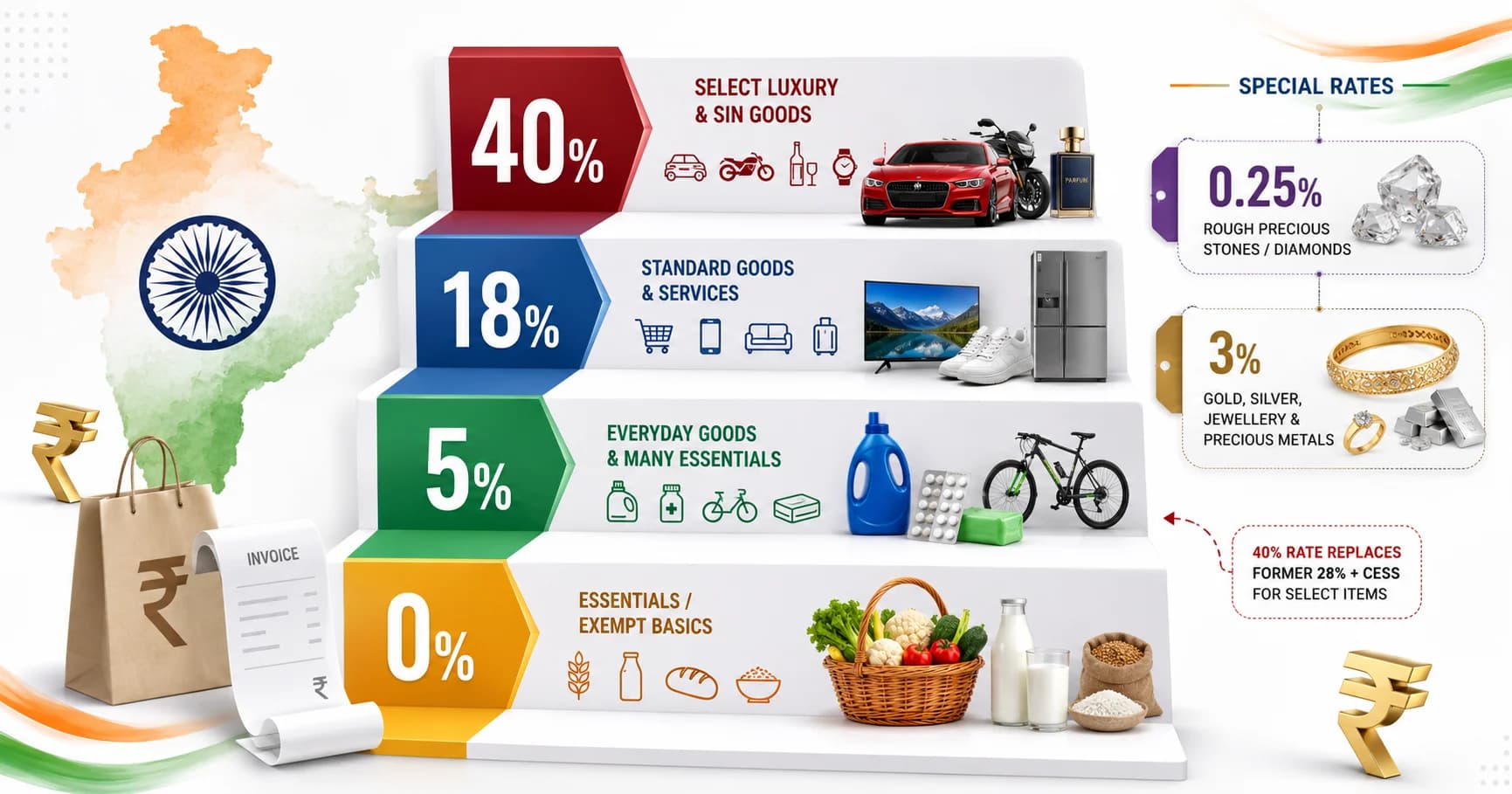
The 5 GST Slabs in India
0% GST (Exempt)
Essential items and services are GST-free:
- Food: Fresh fruits, vegetables, milk, eggs, bread, salt, cereals, fresh meat and fish
- Healthcare: Hospital services, health insurance (for senior citizens under select schemes)
- Education: School and college tuition, educational services by institutions
- Other: Books, newspapers, sindoor, bangles, handloom, khadi
5% GST
Necessities and mass consumption items:
- Food: Sugar, tea, coffee (not instant), edible oils, spices, packaged food items (under ₹1,000/kg), skimmed milk powder
- Transport: Economy class air tickets, cab/auto rides, railways (non-AC)
- Other: Fertilizers, small restaurant meals (turnover under ₹1.5 crore with no ITC), footwear under ₹1,000
12% GST
Standard rate for processed goods:
- Food: Butter, ghee, fruit juices, namkeen, dry fruits in retail packs
- Services: Business class air tickets, work contracts, movie tickets under ₹100
- Other: Cell phones, sewing machines, umbrellas, processed foods, furniture
18% GST (Standard Rate)
The most common slab covering the majority of goods and services:
- Food: Instant noodles, pasta, chocolates, ice cream, mineral water, restaurant dining (with AC, turnover above ₹1.5 crore)
- Services: IT services, telecom, banking, insurance, hotel rooms ₹1,000-7,500/night
- Other: Electronics, computers, industrial goods, hair oil, toothpaste, detergent, cameras, speakers
28% GST (Luxury + Demerit)
Luxury, sin, and demerit goods:
- Vehicles: Cars, SUVs (+ cess of 1-22% depending on size and fuel type)
- Sin goods: Tobacco, cigarettes, aerated drinks (+ compensation cess)
- Luxury: Movie tickets above ₹100, 5-star hotel rooms above ₹7,500/night, gambling, race club betting
- Other: Washing machines, ACs, paint, cement, automobile parts
CGST, SGST, and IGST Explained
| Transaction Type | Tax Components | Example (18% GST on ₹10,000) |
|---|---|---|
| Within same state (intra-state) | CGST + SGST | ₹900 CGST + ₹900 SGST = ₹1,800 |
| Between different states (inter-state) | IGST | ₹1,800 IGST |
| Imports | IGST + Customs Duty | IGST on (assessable value + customs duty) |
The total tax amount is the same — only the collection split differs. IGST is later settled between the central and destination state governments.
Use our GST Calculator to instantly compute CGST, SGST, or IGST for any amount and slab rate.
GST Registration: Who Needs It?
| Category | Threshold (Regular States) | Threshold (Special Category States) |
|---|---|---|
| Goods suppliers | ₹40 lakh | ₹20 lakh |
| Service providers | ₹20 lakh | ₹10 lakh |
| E-commerce sellers | No threshold (mandatory) | No threshold (mandatory) |
| Inter-state suppliers | No threshold (mandatory) | No threshold (mandatory) |
Special category states: Arunachal Pradesh, Manipur, Meghalaya, Mizoram, Nagaland, Sikkim, Tripura, Uttarakhand, and Himachal Pradesh.
Composition Scheme: Simplified GST for Small Businesses
Businesses with turnover up to ₹1.5 crore (₹75 lakh for special category states) can opt for the composition scheme:
- Manufacturers: Pay 1% of turnover as GST
- Restaurants: Pay 5% of turnover (no ITC available)
- Service providers: Pay 6% of turnover (added in 2019, turnover cap ₹50 lakh)
Trade-off: Composition dealers can't collect GST from customers, can't claim ITC, and can't sell inter-state.
Input Tax Credit (ITC): How Businesses Save
ITC allows businesses to set off GST paid on inputs (purchases) against GST collected on outputs (sales). This is the core mechanism that prevents tax cascading.
Example
- Manufacturer buys raw materials for ₹1,00,000 + 18% GST (₹18,000) = ₹1,18,000
- Sells finished goods for ₹1,50,000 + 18% GST (₹27,000) = ₹1,77,000
- GST payable = ₹27,000 – ₹18,000 (ITC) = ₹9,000
Without ITC, the manufacturer would pay ₹27,000 in GST regardless of what they paid on inputs — the old "tax on tax" problem that GST was designed to solve.
Reverse Charge Mechanism (RCM)
In some cases, the recipient (not the supplier) pays GST directly to the government:
- Services from unregistered persons (above ₹5,000/day)
- Legal services by advocates
- Transport by GTA (Goods Transport Agency)
- Service by directors to the company
- Import of services
Businesses on RCM can claim ITC on the reverse charge GST they pay, making it cost-neutral for registered entities.
GST Calculation: Inclusive vs Exclusive
GST Exclusive (Adding GST to a Price)
GST Amount = Base Price × GST Rate
Example: ₹10,000 item at 18% → ₹10,000 + ₹1,800 = ₹11,800 final price
GST Inclusive (Extracting GST from a Price)
Base Price = Inclusive Price / (1 + GST Rate)
Example: ₹11,800 inclusive of 18% GST → ₹11,800 / 1.18 = ₹10,000 base price (GST = ₹1,800)
Our GST Calculator handles both exclusive and inclusive calculations with instant CGST/SGST split.
Frequently Asked Questions
What is the GST rate on mobile phones?
Mobile phones are taxed at 18% GST (earlier it was 12%, revised in April 2020). This applies to all mobile phones regardless of price.
Is GST applicable on rent?
Residential rent is exempt from GST when rented to an individual for personal use. Commercial property rent attracts 18% GST. However, if a registered business rents residential property, it pays GST under reverse charge (effective July 2022).
What is the GST on gold?
Gold and gold jewellery attract 3% GST (the only item at this unique slab). Making charges on jewellery attract 5% GST.
How do I file GST returns?
Regular taxpayers file GSTR-3B (monthly/quarterly summary) and GSTR-1 (invoice-level details). Composition dealers file GSTR-4 (annually). All returns are filed online at the GST portal (gst.gov.in).
What happens if I don't register for GST?
Operating without GST registration when required attracts a penalty of 10% of the tax due or ₹10,000 (whichever is higher). For deliberate evasion, the penalty is 100% of the tax due.
Related Articles on CalculatorApp.me
- SIP vs Lump Sum Investment in India
- Fixed Deposit vs Mutual Fund in India
- EMI Flat Rate vs Reducing Balance
GST & Tax Resources – India
Related Calculators
Try these free calculators related to this article:
In-Depth Guides
Dive deeper with our comprehensive guides on this topic:
Frequently Asked Questions
Our Methodology
All finance content on CalculatorApp.me is reviewed by subject-matter experts, cross-referenced with official sources, and updated regularly for accuracy. Our formulas and data are verified against industry standards and government publications.
Jordan Hayes
Verified AuthorPersonal Finance Content Strategist
Jordan is a personal finance content strategist with 9+ years writing about mortgages, retirement, tax strategy, and budgeting. Every guide is cross-referenced with IRS publications, Federal Reserve data, and CFPB guidance to make complex calculations accessible. Editor at CalculatorApp.me.
Found this helpful? Share it!
Stay Updated
Get notified when we launch new calculators and features.
No spam. Unsubscribe anytime.