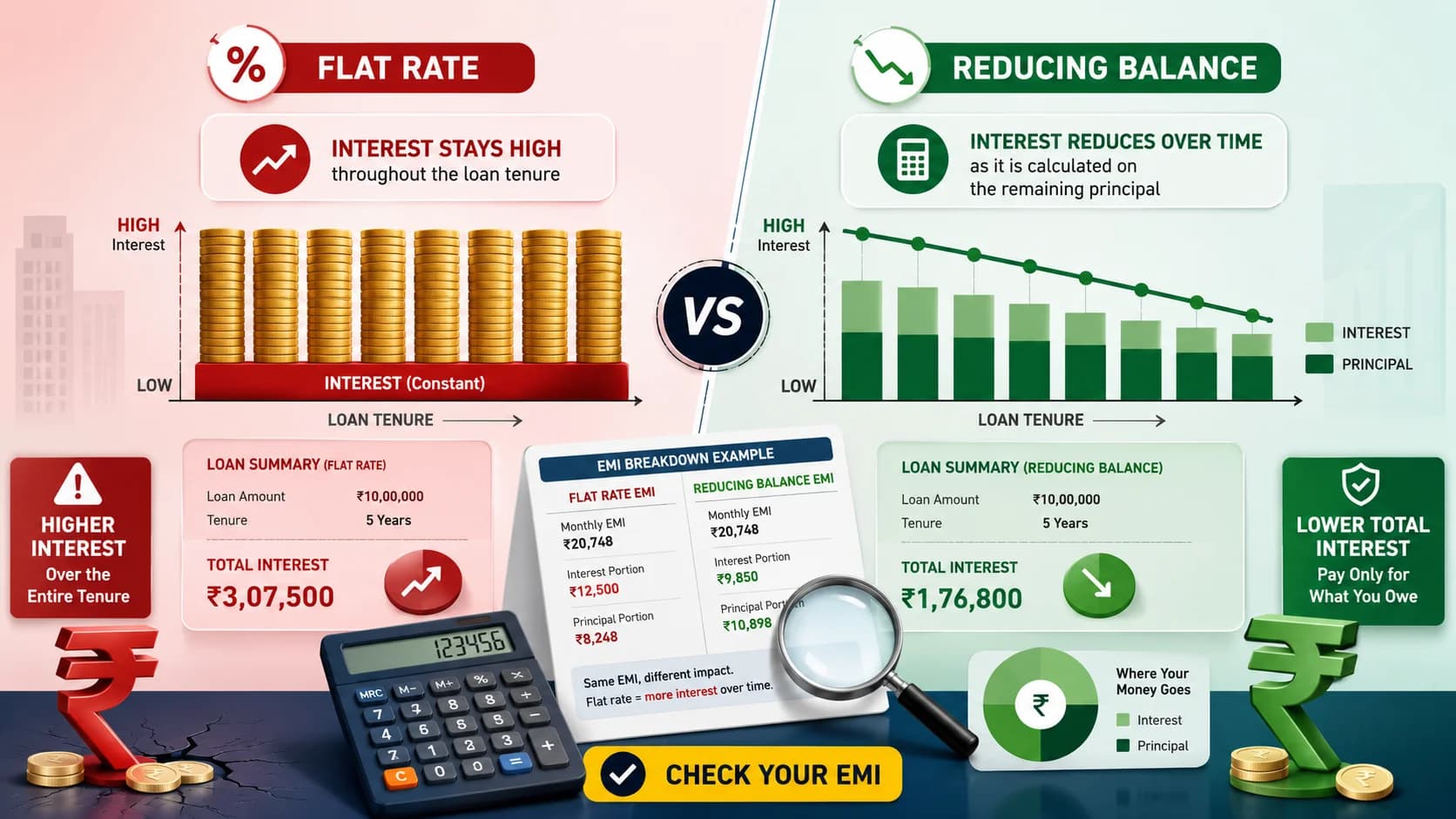
EMI Flat Rate vs Reducing Balance: How Banks Charge You More (and How to Check)
Free Calculator
EMI Calculator
Table of Contents
EMI Flat Rate vs Reducing Balance: What Is an EMI?
An Equated Monthly Installment (EMI) is a fixed monthly payment that covers both principal and interest on a loan. Every month you pay the same amount, but the split between principal and interest changes over the loan tenure.
This article is part of our complete India Finance Guide — covering EMI, SIP, PPF, NPS, GST, income tax (new vs old regime), and HRA in one place.
New to EMI math? Start with our EMI calculator India guide for the formula, worked examples, and current bank rates.
In India, banks and NBFCs (Non-Banking Financial Companies) use two fundamentally different methods to calculate EMI: flat rate and reducing balance. Understanding the difference can save you lakhs of rupees.
Flat Rate Method: How It Works
In the flat rate method, interest is calculated on the original loan amount for the entire tenure, regardless of how much principal you've already repaid.
Formula
EMI = (Principal + Total Interest) / Number of Months
Where Total Interest = Principal × Rate × Tenure (in years)
Example: ₹5,00,000 Personal Loan at 9% Flat Rate for 5 Years
- Total Interest = ₹5,00,000 × 9% × 5 = ₹2,25,000
- Total Payable = ₹5,00,000 + ₹2,25,000 = ₹7,25,000
- EMI = ₹7,25,000 / 60 months = ₹12,083/month
Looks straightforward — but there's a problem. By month 30, you've repaid ₹2,50,000 of principal. Yet the bank is still charging interest on the full ₹5,00,000. You're paying interest on money you've already returned.
Reducing Balance Method: How It Works
In the reducing balance method (also called diminishing balance), interest is calculated only on the outstanding principal — the amount you actually owe at that point in time.
Formula
EMI = [P × r × (1+r)^n] / [(1+r)^n – 1]
Where P = principal, r = monthly interest rate (annual rate / 12), n = total number of months.
Same Example: ₹5,00,000 at 9% Reducing Balance for 5 Years
- Monthly rate = 9% / 12 = 0.75%
- EMI = ₹10,379/month
- Total Payable = ₹10,379 × 60 = ₹6,22,740
- Total Interest = ₹6,22,740 – ₹5,00,000 = ₹1,22,740
The Real Cost Comparison
| Parameter | Flat Rate (9%) | Reducing Balance (9%) |
|---|---|---|
| Loan Amount | ₹5,00,000 | ₹5,00,000 |
| Stated Rate | 9% | 9% |
| Monthly EMI | ₹12,083 | ₹10,379 |
| Total Interest | ₹2,25,000 | ₹1,22,740 |
| Total Payable | ₹7,25,000 | ₹6,22,740 |
| Effective Rate | ~16-17% | 9% |
The flat rate loan costs ₹1,02,260 more in interest — 83% more than reducing balance at the same stated rate. The flat rate's effective interest rate is approximately 16-17%, nearly double the headline figure.
Conversion Formula: Flat Rate to Reducing Balance
To compare loan offers fairly, convert the flat rate to an approximate reducing balance equivalent:
Approximate Reducing Balance Rate ≈ Flat Rate × 1.8 to 1.95
This multiplier varies slightly with tenure, but 1.8-1.95× is accurate for 3-7 year loans. So a "9% flat rate" is roughly equivalent to a 16.2-17.6% reducing balance rate.
For exact comparison, use our EMI Calculator to compute the actual EMI and total interest for any loan amount and rate.
Which Method Do Indian Lenders Use?
| Loan Type | Typical Method | Why |
|---|---|---|
| Home Loans | Reducing Balance | RBI directive; long tenure makes flat rate too expensive |
| Car Loans | Reducing Balance (mostly) | Banks use reducing; some dealers quote flat rates |
| Personal Loans | Reducing Balance | Banks and reputable NBFCs shifted to reducing balance |
| Gold Loans | Both | Some traditional NBFCs still use flat rate |
| Consumer Durable Loans | Flat Rate (often) | "0% EMI" schemes hide the cost in product price markup |
| Two-Wheeler Loans | Both | Dealers may quote flat rate; banks use reducing |
RBI directive: Since 2010, the Reserve Bank of India has required banks and regulated NBFCs to disclose the Annual Percentage Rate (APR) — the true cost in reducing balance terms — for all retail loans.
How "0% EMI" Schemes Actually Work
When you see "No-Cost EMI" on Amazon, Flipkart, or at electronics stores, the interest isn't truly zero. Instead:
- The seller absorbs the interest (paid to the NBFC as a discount on the product price)
- Or the product is priced higher and you lose the "cash discount" (typically 5-10%)
- Processing fees (₹199-499) are often added on top
A ₹50,000 product on "0% EMI for 12 months" often costs ₹51,500-52,000 when you add the processing fee and forgo the bank cashback/discount available on full payment.
How to Check Which Method Your Lender Uses
- Ask for the amortization schedule — if the interest component decreases each month, it's reducing balance
- Check the loan agreement — look for "diminishing balance" or "reducing balance"
- Calculate it yourself — use our EMI Calculator with the stated rate on reducing balance. If the calculated EMI matches your actual EMI, it's reducing balance. If your actual EMI is higher, the lender is using flat rate
- Ask for the APR — RBI requires disclosure. If the APR is significantly higher than the stated rate, it's flat rate
Prepayment and Part-Payment: Where Method Really Matters
With reducing balance, making part-payments (e.g., using a bonus to repay ₹50,000 extra) immediately reduces your outstanding principal. All future EMIs have less interest because interest is calculated on the lower balance. This can save years of payments.
With flat rate, part-payments don't reduce your interest burden proportionally because interest was calculated upfront on the original amount. Some flat-rate lenders recalculate the schedule; others simply reduce the tenure without adjusting interest.
For home loan borrowers, our Amortization Calculator shows exactly how extra payments impact your total interest outgo over the full tenure.
5 Tips for Indian Borrowers
- Always ask for the reducing balance rate — if a lender only quotes flat rate, ask them to convert
- Compare APR, not headline rates — APR includes processing fees and is always on a reducing balance basis
- Favour banks over unregulated NBFCs — banks must follow RBI's fair practice code and disclose APR
- Read the fine print on "0% EMI" — calculate the effective cost including processing fees and forgone discounts
- Prefer loans with no prepayment penalty — floating rate home loans have zero prepayment penalty by RBI rules since 2014
Frequently Asked Questions
What is the difference between flat rate and reducing balance EMI?
Flat rate calculates interest on the original loan amount for the entire tenure. Reducing balance calculates interest only on the outstanding principal. A 9% flat rate is equivalent to approximately 16-17% reducing balance — costing nearly double in actual interest.
Which is better: flat rate or reducing balance?
Reducing balance is always better for the borrower because you pay interest only on what you actually owe. All major banks in India use reducing balance for home, car, and personal loans.
How do I convert flat rate to reducing balance?
Multiply the flat rate by approximately 1.8 to 1.95. For example, 10% flat ≈ 18-19.5% reducing balance. For exact conversion, compare the EMI calculated by our EMI Calculator with the EMI quoted by the lender.
Are home loans in India flat rate or reducing balance?
Home loans in India are always on reducing balance, as mandated by the RBI. Most are on floating rate (linked to RLLR or MCLR), meaning the interest rate can change during the tenure.
What does "0% EMI" actually mean?
The interest cost is absorbed by the seller or hidden in the product price. You may also pay processing fees (₹199-499). Always compare the "0% EMI" total outgo with the price for outright purchase including any bank discounts or cashback.
Related Articles on CalculatorApp.me
- Amortization Schedule Explained
- SIP vs Lump Sum Investment in India
- Fixed Deposit vs Mutual Fund in India
- Car Loan Calculator Guide
Loan & EMI Resources
Related Calculators
Try these free calculators related to this article:
In-Depth Guides
Dive deeper with our comprehensive guides on this topic:
Frequently Asked Questions
Our Methodology
All finance content on CalculatorApp.me is reviewed by subject-matter experts, cross-referenced with official sources, and updated regularly for accuracy. Our formulas and data are verified against industry standards and government publications.
Jordan Hayes
Verified AuthorPersonal Finance Content Strategist
Jordan is a personal finance content strategist with 9+ years writing about mortgages, retirement, tax strategy, and budgeting. Every guide is cross-referenced with IRS publications, Federal Reserve data, and CFPB guidance to make complex calculations accessible. Editor at CalculatorApp.me.
Found this helpful? Share it!
Stay Updated
Get notified when we launch new calculators and features.
No spam. Unsubscribe anytime.