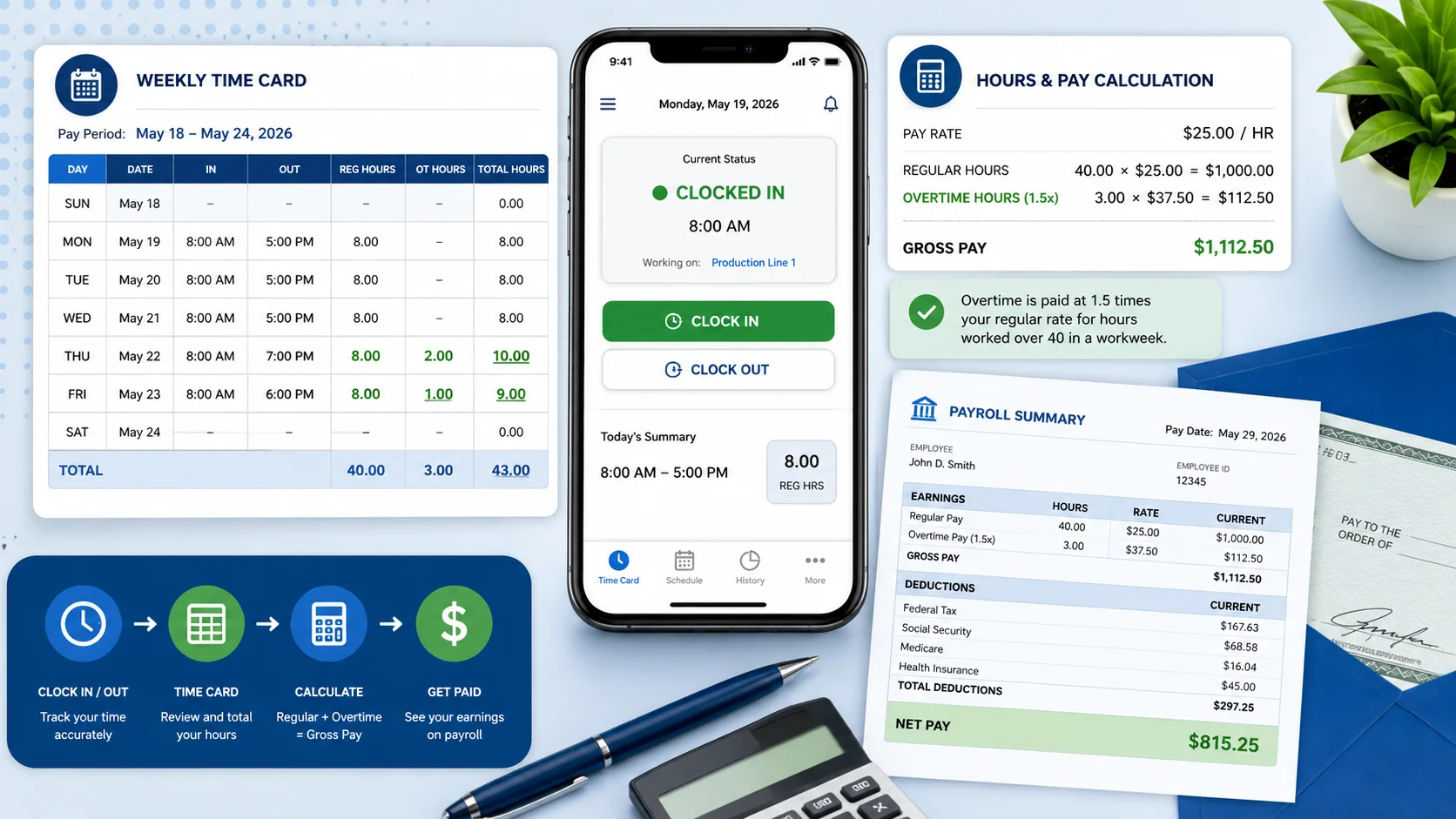
How to Calculate Hours Worked: Time Card, Overtime & Pay Guide 2026
Table of Contents
Bottom line: To calculate hours worked, subtract your start time from your end time, subtract any unpaid breaks, and convert to decimal hours if needed for payroll. For example: 8:00 AM to 5:30 PM minus a 30-minute lunch = 9.0 hours. Multiply by your hourly rate to get gross pay. Use our free hours calculator to handle any shift — including overnight shifts, overtime, and weekly timesheet totals — in seconds.
Key Takeaways
- Hours worked = (end time − start time) − unpaid break time, converted to decimal hours.
- Convert minutes to decimal by dividing by 60: 30 min = 0.5 hours; 15 min = 0.25 hours.
- Overtime under FLSA: over 40 hours/week = 1.5× regular rate for non-exempt employees.
- Overnight shifts: add 24 hours to end time when it's earlier than start time (e.g., 11 PM to 7 AM = 8 hrs).
- A weekly timesheet adds up each day's hours, then separates regular (≤40) from overtime (>40) hours.
- Use our free time card calculator to compute full-week timesheets with overtime and gross pay automatically.
The Basic Formula: How to Calculate Hours Worked
The formula for calculating hours worked in any shift:
Step-by-Step Example
- Start time: 8:30 AM
- End time: 5:00 PM
- Unpaid lunch: 45 minutes
- Raw hours: 8:30 AM to 5:00 PM = 8 hours 30 minutes = 8.5 hours
- Minus lunch: 8.5 − 0.75 = 7.75 hours (7 hours 45 minutes)
- Gross pay at $18/hr: 7.75 × $18 = $139.50
Converting Minutes to Decimal Hours
Payroll systems use decimal hours (7.75, not "7 hours 45 minutes"). Here's the conversion for every 5-minute increment:
| Minutes | Decimal Hours | Minutes | Decimal Hours |
|---|---|---|---|
| 5 min | 0.08 | 35 min | 0.58 |
| 10 min | 0.17 | 40 min | 0.67 |
| 15 min | 0.25 | 45 min | 0.75 |
| 20 min | 0.33 | 50 min | 0.83 |
| 25 min | 0.42 | 55 min | 0.92 |
| 30 min | 0.50 | 60 min | 1.00 |
Formula: Decimal hours = whole hours + (minutes ÷ 60)
How to Calculate Overtime Pay
Under the Fair Labor Standards Act (FLSA), non-exempt employees in the US must receive at least 1.5× their regular hourly rate for all hours worked beyond 40 in a workweek. Some states (California, Alaska) have daily overtime rules — checking your state's Department of Labor is important if you work more than 8 hours in a single day.
Overtime Calculation Example
Employee earns $20/hour. They work 46 hours in a week:
- Regular hours: 40 × $20.00 = $800.00
- Overtime hours: 6 × ($20.00 × 1.5) = 6 × $30.00 = $180.00
- Total gross pay: $980.00
Our hours calculator handles this automatically — enter your regular rate and total weekly hours and it splits regular vs. overtime and shows gross pay.
Weekly Timesheet Calculator: Adding Up Multiple Days
For a full work week, add each day's hours separately, then sum for the weekly total. Here's an example 5-day timesheet:
| Day | Start | End | Break | Hours Worked |
|---|---|---|---|---|
| Monday | 8:00 AM | 5:00 PM | 30 min | 8.50 hrs |
| Tuesday | 8:30 AM | 6:00 PM | 30 min | 9.00 hrs |
| Wednesday | 9:00 AM | 5:30 PM | 30 min | 8.00 hrs |
| Thursday | 8:00 AM | 7:00 PM | 45 min | 10.25 hrs |
| Friday | 8:00 AM | 4:00 PM | 30 min | 7.50 hrs |
| Total | 43.25 hrs | |||
| Regular hours (≤40) | 40.00 hrs | |||
| Overtime hours (>40) | 3.25 hrs | |||
Calculating Hours for Overnight Shifts
When a shift crosses midnight, the math requires a small adjustment. Add 24 hours to the end time if it is earlier than the start time:
- Shift: 10:00 PM to 6:00 AM
- End time adjusted: 6:00 AM + 24 hours = 30:00 (or 6:00 AM next day)
- Hours worked: 30:00 − 22:00 = 8 hours
Our time card calculator handles overnight shifts automatically — just enter your times as normal and it detects the midnight crossing.
Common Time Card Mistakes (and How to Avoid Them)
- Forgetting to deduct unpaid breaks: Most employers deduct 30–60 minutes for meal breaks. Check your employment agreement or company policy.
- Rounding errors: Many employers round time to the nearest quarter hour (15 minutes). Know your company's policy.
- Missing overnight split: Forgetting to add 24 hours to end times creates negative hours in manual calculations.
- Confusing paid vs. unpaid breaks: Short rest breaks (5–20 min) are generally paid under FLSA; meal breaks (30+ min where employee is completely relieved) are unpaid.
- Not tracking travel time: Time commuting to work is not paid. Travel between job sites during the workday generally is paid.
Free Time Card and Hours Calculator
Rather than doing this manually every week, our hours calculator lets you:
- Enter start and end times for each day (AM/PM or 24-hour clock)
- Subtract break time automatically
- Add up the full week's hours
- Apply your hourly rate and see regular pay + overtime pay calculated separately
- Export the results for your records
It handles overnight shifts, multiple breaks per day, and both hourly and salaried pay scenarios. Try it free — no signup required.
Frequently Asked Questions About Calculating Work Hours
How do I calculate hours and minutes between two times?
Subtract the start time from the end time. For 9:15 AM to 4:45 PM: the difference is 7 hours 30 minutes (7.50 decimal hours). If the end time is earlier than the start time (overnight shift), add 24 hours to the end time before subtracting.
How do I convert time to decimal for payroll?
Divide the minutes by 60 and add to the whole hours. Examples: 7 hours 15 min = 7 + (15÷60) = 7.25 hours. 8 hours 45 min = 8 + (45÷60) = 8.75 hours. Most payroll software uses decimal hours, not hours:minutes format.
How many hours is a full-time job per week?
The FLSA defines a standard workweek as 40 hours for overtime threshold purposes. The ACA defines "full-time" as 30+ hours per week for benefits eligibility. Most employers consider 35–40 hours per week to be full-time for employment purposes.
Does my employer have to pay overtime for more than 8 hours in a day?
Under federal FLSA, overtime is calculated weekly (over 40 hours), not daily. However, California, Alaska, and a few other states require daily overtime for hours worked over 8 in a single day. Check your state's labor laws for daily overtime requirements.
Frequently Asked Questions
Our Methodology
All time card content on CalculatorApp.me is reviewed by subject-matter experts, cross-referenced with official sources, and updated regularly for accuracy. Our formulas and data are verified against industry standards and government publications.
Jordan Hayes
Verified AuthorPersonal Finance Content Strategist
Jordan is a personal finance content strategist with 9+ years writing about mortgages, retirement, tax strategy, and budgeting. Every guide is cross-referenced with IRS publications, Federal Reserve data, and CFPB guidance to make complex calculations accessible. Editor at CalculatorApp.me.
Found this helpful? Share it!
Stay Updated
Get notified when we launch new calculators and features.
No spam. Unsubscribe anytime.