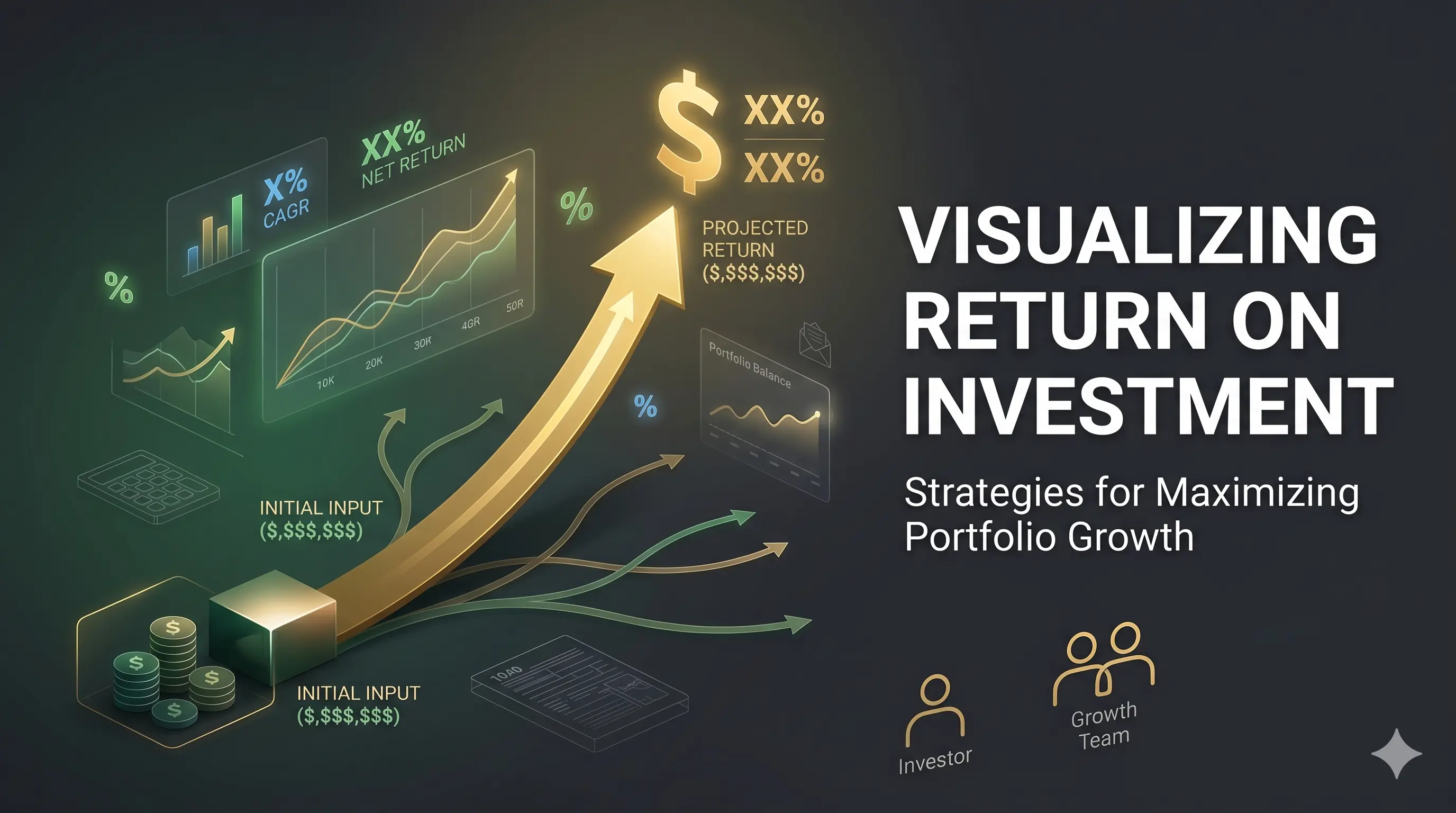
How to Calculate ROI: The Formula, Real-World Examples, and Common Mistakes to Avoid
Free Calculator
ROI Calculator
Table of Contents
How to Calculate ROI: The Basic Formula
ROI = (Net Profit / Cost of Investment) × 100
Or equivalently: ROI = [(Final Value − Initial Cost) / Initial Cost] × 100
ROI (Return on Investment) measures how much profit or loss an investment generates relative to its cost, expressed as a percentage. A positive ROI means profit; a negative ROI means loss.
Simple Example
You invest $10,000 in stocks and sell them later for $13,500:
Net profit: $13,500 − $10,000 = $3,500
ROI: ($3,500 / $10,000) × 100 = 35%
For every dollar invested, you earned 35 cents in profit.
Why Basic ROI Can Be Misleading
The simple formula has a critical flaw: it ignores time. A 35% ROI over 1 year is excellent. A 35% ROI over 10 years is mediocre (roughly 3% annually). Without context, the same percentage can represent vastly different investment quality.
Annualized ROI (CAGR)
To compare investments of different durations, use annualized ROI (also called CAGR — Compound Annual Growth Rate):
Annualized ROI = [(Final Value / Initial Cost)1/years − 1] × 100
Examples:
Investment A: 50% total return over 5 years → Annualized: (1.50)0.2 − 1 = 8.45%/year
Investment B: 35% total return over 2 years → Annualized: (1.35)0.5 − 1 = 16.19%/year
Investment B's total return is lower, but its annualized return is nearly twice as high — making it the better investment.
ROI in Different Contexts
Real Estate ROI
Real estate ROI must include all costs and income:
Total cost: Purchase price + closing costs + renovations + ongoing maintenance
Total return: Sale price − selling costs (agent fees, closing costs) + rental income during holding period
Example: Buy a rental property for $250,000 (total cost including repairs: $280,000). Earn $30,000 in net rental income over 4 years, then sell for $310,000 (net after fees: $290,000).
Total return: $290,000 + $30,000 − $280,000 = $40,000
ROI: ($40,000 / $280,000) × 100 = 14.3%
Annualized: (1.143)0.25 − 1 = 3.4%/year
Business/Marketing ROI
For marketing campaigns: ROI = [(Revenue from Campaign − Campaign Cost) / Campaign Cost] × 100
A $5,000 Google Ads campaign that generates $18,000 in revenue:
ROI: ($18,000 − $5,000) / $5,000 × 100 = 260%
Industry benchmark: digital marketing ROI above 200% is considered good. Above 500% is exceptional.
Stock Market ROI
For stocks, include dividends: Total Return = (Capital Gains + Dividends) / Initial Investment × 100
Buy 100 shares at $50 ($5,000). Receive $200 in dividends. Sell at $62 ($6,200).
Total return: ($6,200 + $200 − $5,000) / $5,000 × 100 = 28%
5 Common ROI Calculation Mistakes
1. Ignoring all costs. Include transaction fees, taxes, maintenance, insurance, and opportunity costs. Untderstating costs inflates ROI.
2. Forgetting inflation. A 7% nominal return with 3% inflation is only 4% real return. For long-term comparisons, always calculate real ROI (after inflation).
3. Comparing different time periods. A 100% return over 10 years (~7.2% annualized) is worse than 50% over 3 years (~14.5% annualized). Always annualize.
4. Survivorship bias. Looking only at successful investments while ignoring losses distorts your overall ROI. Track total portfolio performance.
5. Ignoring risk. A 15% return from government bonds is exceptional. A 15% return from crypto is average — but with 10× the risk. Risk-adjusted returns (Sharpe Ratio) provide a fairer comparison.
ROI vs. Other Financial Metrics
ROI vs. IRR: Internal Rate of Return accounts for the time value of money and cash flow timing. Better for projects with irregular cash flows.
ROI vs. NPV: Net Present Value shows absolute dollar profit in today's terms. Better for comparing projects of different sizes.
ROI vs. Payback Period: Payback period tells you when you break even. ROI tells you total profitability. Use both together.
Calculate Your ROI
Use our free ROI Calculator to evaluate any investment with customizable inputs for cost, returns, and time period. Compare potential investments with our Investment Calculator, or model compound growth scenarios with our Compound Interest Calculator.
Frequently Asked Questions
What is a good ROI?
It depends on the context. Stock market: 7-10% annually is typical. Real estate: 8-12% annually is good. Business investment: 15-25%+ is expected due to higher risk. Savings accounts: 4-5% APY is considered excellent in 2026.
Can ROI be negative?
Yes. Negative ROI means you lost money. If you invest $10,000 and the value drops to $8,000, your ROI is -20%. All investments carry risk of negative returns.
How do I calculate ROI with monthly contributions?
For recurring investments, use the internal rate of return (IRR) or money-weighted return instead of basic ROI. These methods account for the timing and size of each contribution.
Is ROI the same as profit margin?
No. ROI measures return relative to investment cost. Profit margin measures profit relative to revenue. A business can have a high profit margin but low ROI if the initial investment was large.
How does inflation affect ROI?
Real ROI = Nominal ROI − Inflation Rate (approximately). A 10% nominal return with 3% inflation yields approximately 7% real return. For long-term planning, always use real returns.
Related Articles on CalculatorApp.me
ROI & Investment Resources
Related Calculators
Try these free calculators related to this article:
In-Depth Guides
Dive deeper with our comprehensive guides on this topic:
Frequently Asked Questions
Our Methodology
All finance content on CalculatorApp.me is reviewed by subject-matter experts, cross-referenced with official sources, and updated regularly for accuracy. Our formulas and data are verified against industry standards and government publications.
Jordan Hayes
Verified AuthorPersonal Finance Content Strategist
Jordan is a personal finance content strategist with 9+ years writing about mortgages, retirement, tax strategy, and budgeting. Every guide is cross-referenced with IRS publications, Federal Reserve data, and CFPB guidance to make complex calculations accessible. Editor at CalculatorApp.me.
Found this helpful? Share it!
Stay Updated
Get notified when we launch new calculators and features.
No spam. Unsubscribe anytime.