How to Calculate Your Grade: Final Exam & Course Grade Formula Explained
Free Calculator
Percentage Calculator
Table of Contents
How to Calculate Your Grade: Final Exam & Course Grade Formula Explained

Photo: Pexels
For the complete grading reference — GPA formulas, conversion charts, and final-exam math — see our GPA Calculator Guide.
You have three assignments left, a midterm grade of 78%, and finals in two weeks. Will you hit a B? What score do you actually need on the final exam? Knowing how to calculate your grade — and what it takes to move the needle — turns end-of-semester anxiety into a precise action plan.
This guide explains the weighted grade formula, shows you how professors calculate your course average, and gives you the exact equation to find out what you need on any remaining assignment to hit your target grade.
Key Takeaways
- Most courses use a weighted average: each category (homework, tests, final) counts for a set percentage of your grade.
- The formula: Course Grade = Σ(category score × category weight).
- To find what you need on your final: Required Score = (Target Grade − Current Weighted Score) ÷ Final Exam Weight.
- One assignment rarely makes or breaks a grade — the weight is what matters.
- Our free Grade Calculator does all this math instantly.
How Course Grades Are Calculated
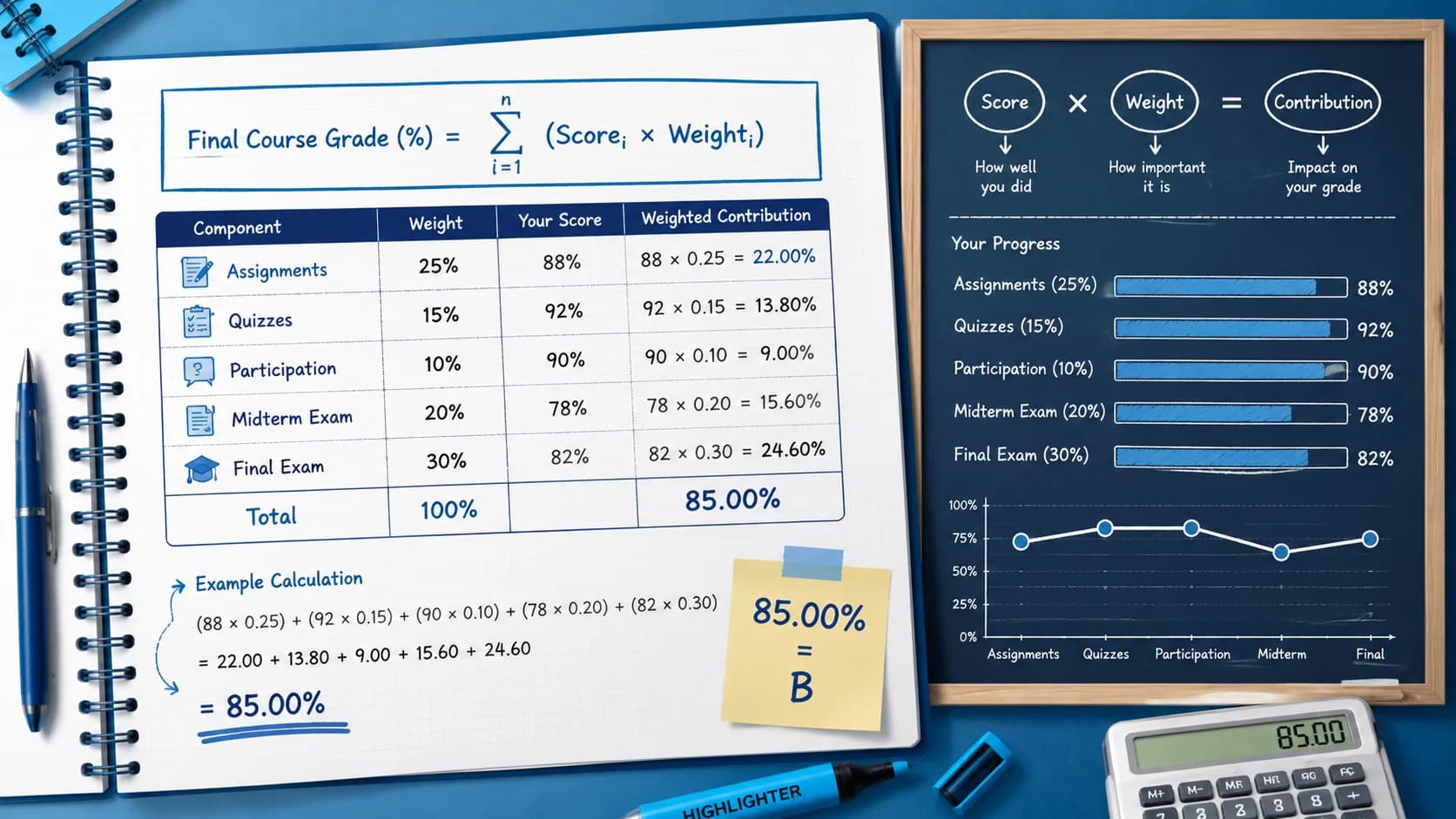
Almost every college and high school course uses a weighted average. The professor assigns a percentage weight to each grade category — homework, quizzes, midterms, final exam, participation — and your overall grade is a weighted sum of your performance in each.
The formula looks like this:
Course Grade = (Score₁ × Weight₁) + (Score₂ × Weight₂) + … + (Scoreₙ × Weightₙ)
Where each weight is expressed as a decimal (e.g., 30% = 0.30) and all weights sum to 1.0.
This means a 95% on homework worth 10% of your grade contributes exactly 9.5 points toward your final average. A 65% on a final exam worth 40% contributes 26 points. The categories with higher weights have a much larger impact on your final grade — which is exactly why a single low quiz score rarely ruins your semester, but a poor final exam can.
Step-by-Step Grade Calculation Example
Let's walk through a real example. Suppose your syllabus has this breakdown:
| Category | Weight | Your Score | Contribution |
|---|---|---|---|
| Homework | 20% | 88% | 88 × 0.20 = 17.6 |
| Quizzes | 15% | 75% | 75 × 0.15 = 11.25 |
| Midterm Exam | 25% | 82% | 82 × 0.25 = 20.5 |
| Final Exam | 40% | ? | ? × 0.40 |
| Current total (before final) | 17.6 + 11.25 + 20.5 = 49.35 out of 60% | ||
Your current weighted score from completed work is 49.35 points, earned from 60% of the course weight. To find your current average on completed work: 49.35 ÷ 0.60 = 82.25%.
How to Calculate What You Need on Your Final Exam
This is the question students ask most often. With the example above, what score do you need on the final exam to finish the course with a B (80%)?
Required Final Score = (Target Grade − Current Weighted Points) ÷ Final Exam Weight
Required Final Score = (80 − 49.35) ÷ 0.40 = 30.65 ÷ 0.40 = 76.6%
You need a 77% or higher on the final to earn a B in the course. That's a concrete, actionable target — not just a vague worry about "doing well."
What if you're shooting for an A (90%)?
(90 − 49.35) ÷ 0.40 = 40.65 ÷ 0.40 = 101.6%
An A is mathematically out of reach unless there is extra credit available. Knowing this a week before the final lets you redirect energy toward other courses or negotiate with your professor, rather than burning out chasing an impossible target.
Simple (Unweighted) Grade Average
Some courses — particularly at the secondary school level — don't use category weights. Every graded item counts equally, and your grade is a straight percentage average:
Course Grade = Sum of All Scores ÷ Number of Assignments
For example, if you scored 72, 85, 91, 78, and 88 on five tests of equal weight:
(72 + 85 + 91 + 78 + 88) ÷ 5 = 414 ÷ 5 = 82.8%
Even in unweighted courses, not all assignments are created equal if the point values differ. A 50-point test and a 10-point quiz both go into the average, but the test is five times more powerful. Always check whether your professor averages by percentage (unweighted) or by total points earned vs. total points possible.
Points-Based Grade Systems
Some professors don't publish weights at all — they publish total points possible. Your grade is simply:
Grade % = (Total Points Earned ÷ Total Points Possible) × 100
Example: You've earned 412 out of 500 total points so far. The final exam is worth 100 points, making the total possible 600.
- Current grade: 412 ÷ 500 = 82.4%
- To find what you need on the final to achieve 85%: (85% × 600) − 412 = 510 − 412 = 98 points out of 100
In points-based systems, every assignment's weight is implicitly encoded in its point value. A 200-point project is worth four times a 50-point quiz — even if neither is labeled with a percentage weight.
How Letter Grades Convert to Percentages
Grade cutoffs vary by institution and professor, but the most common scale in the US is:
| Letter Grade | Standard Range | GPA Points (4.0 scale) |
|---|---|---|
| A | 90–100% | 4.0 |
| B | 80–89% | 3.0 |
| C | 70–79% | 2.0 |
| D | 60–69% | 1.0 |
| F | Below 60% | 0.0 |
Many schools also use plus/minus grades (A−, B+, etc.) with corresponding GPA values like 3.7 for A−, 3.3 for B+, and 2.7 for B−. Always check your institution's official grading policy — some professors set an A cutoff at 93%, while others use 90%.
5 Mistakes That Distort Your Grade Calculation
1. Assuming equal weight when categories differ
If you average your homework average (88%) with your midterm (72%), you get 80% — but if homework is 10% of the grade and the midterm is 40%, the actual weighted result is much closer to your midterm score. Always apply weights before averaging.
2. Using the percentage on your gradebook, not the weighted contribution
Many online gradebooks show "Category Average" — your average within that category — not how much it contributes to your final grade. Multiply the category average by its weight to get the actual contribution.
3. Forgetting dropped grades
Many professors drop the lowest quiz or homework grade. Until the drop happens, your gradebook may show a lower score than your final grade will be. Factor in the drop when projecting your course average.
4. Rounding too early
Rounding 82.4% to 82% and then multiplying by 0.25 introduces small errors that compound across categories. Keep at least one decimal place through all intermediate steps.
5. Ignoring extra credit
Extra credit points go directly into your numerator (points earned) without increasing the denominator (points possible). Even a small amount of extra credit can push you across a grade boundary — always take it if offered.
Calculate Your Grade Now
Use our free Grade Calculator to compute your current course average and find out exactly what score you need on upcoming assignments or your final exam to hit any target grade. Enter your scores, weights, and target — it does the rest in seconds.
Once you know your course grades, convert them into your overall GPA with our GPA Calculator. And if you're tracking multiple courses or planning next semester's course load, the Percentage Calculator can help you run quick grade-check math on the fly.
Frequently Asked Questions
How do I calculate my grade if I don't know the weights?
Check your syllabus — professors are required to publish grading weights at the start of the course. If the syllabus only shows total points possible per assignment (not percentage weights), use the points-based formula: Grade % = (Points Earned ÷ Total Points Possible) × 100.
What does "weighted average" mean for grades?
A weighted average assigns different levels of importance to different components. An A on a 10-point quiz matters far less than an A on a 100-point exam if the exam carries more weight. Weighted average = Σ(score × weight) ÷ Σ(weights).
Can a single bad test grade ruin my course average?
It depends on the weight. A single quiz worth 5% of your grade has almost no impact. A single final exam worth 40% can shift your grade by 15–20 percentage points depending on the score. Always know the weight before assigning emotional importance to any one test.
How do I calculate my grade if my professor hasn't posted all scores yet?
Calculate your current weighted score using only the graded components, then use the "required score" formula to find what you need on the remaining work. Assume remaining ungraded assignments don't exist yet in your calculation.
What score do I need on my final to pass the course?
Use this formula: Required Final Score = (Passing Grade − Current Weighted Points) ÷ Final Exam Weight. If the result exceeds 100%, passing with only the final exam is mathematically impossible — you'll need extra credit or to discuss options with your professor.
How does extra credit affect my grade?
Extra credit adds points to your numerator without adding to the denominator (total points possible). This effectively raises your percentage grade. Even 5 extra credit points on a 500-point course scale add 1% to your final grade — which can be the difference between grade letter cutoffs.
Related Calculators
Try these free calculators related to this article:
In-Depth Guides
Dive deeper with our comprehensive guides on this topic:
Frequently Asked Questions
Our Methodology
All grade calculator content on CalculatorApp.me is reviewed by subject-matter experts, cross-referenced with official sources, and updated regularly for accuracy. Our formulas and data are verified against industry standards and government publications.
Jordan Hayes
Verified AuthorPersonal Finance Content Strategist
Jordan is a personal finance content strategist with 9+ years writing about mortgages, retirement, tax strategy, and budgeting. Every guide is cross-referenced with IRS publications, Federal Reserve data, and CFPB guidance to make complex calculations accessible. Editor at CalculatorApp.me.
Found this helpful? Share it!
Stay Updated
Get notified when we launch new calculators and features.
No spam. Unsubscribe anytime.