LTV Ratio Explained: Why It Affects Your Rate, PMI, and Approval
Free Calculator
Proportion Calculator
Table of Contents
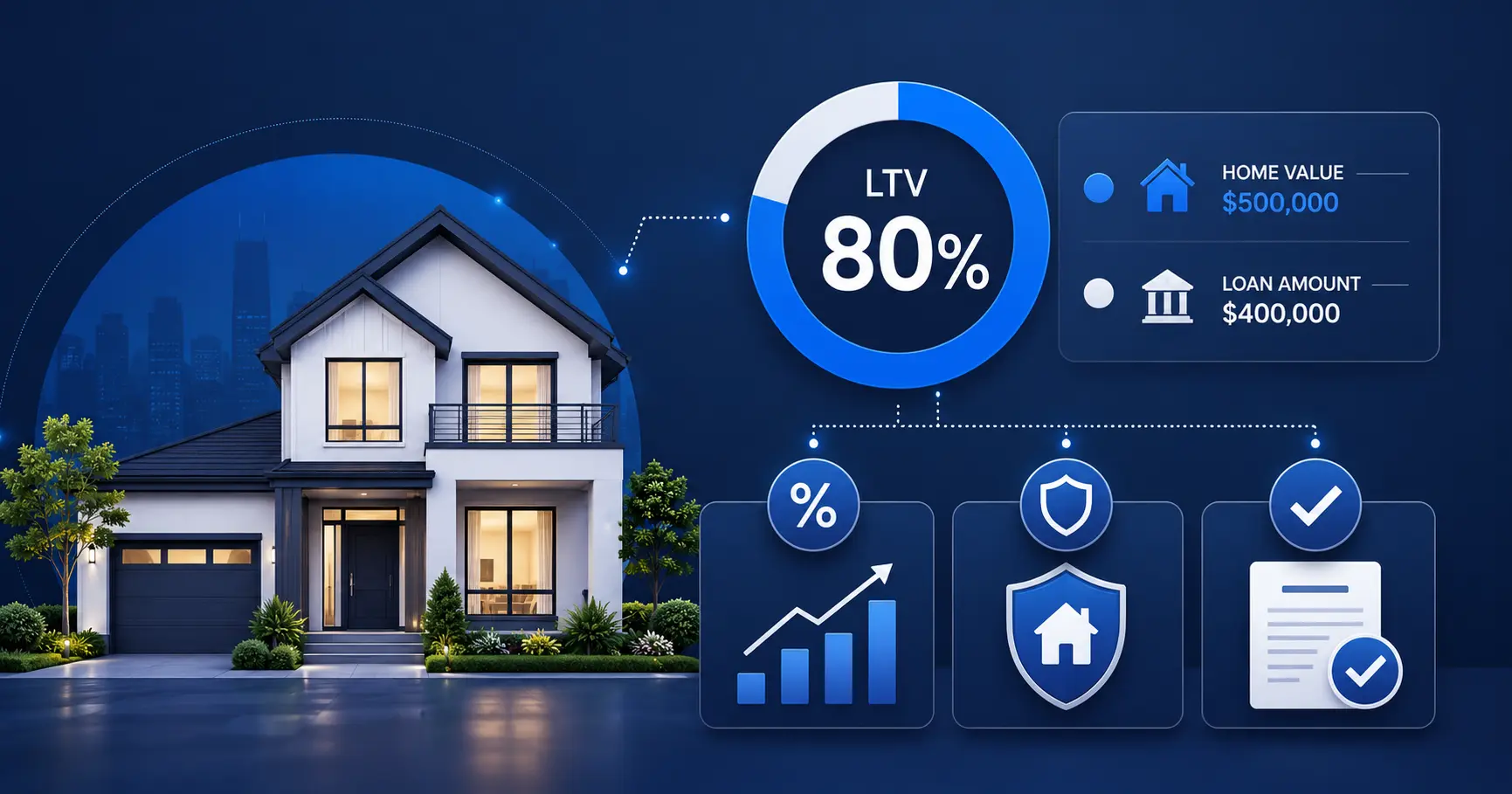
Bottom line: Your loan-to-value (LTV) ratio is one of three factors — alongside credit score and DTI — that determine your mortgage rate and whether you qualify. LTV = loan amount ÷ appraised property value × 100. An 80% LTV (20% down payment) is the gold standard: no PMI required, best available rates, and widest lender choice. Higher LTVs are allowed but come with added costs and restrictions. Understanding LTV helps you decide how much to put down, when to refinance, and when PMI can be cancelled.
Key Takeaways
LTV = loan amount ÷ appraised value × 100. A $240,000 loan on a $300,000 home = 80% LTV.
LTV below 80% eliminates PMI on conventional loans — worth $100–$300/month in savings.
Every 5% improvement in LTV (e.g., 95% → 90%) typically improves your mortgage rate by 0.125%–0.25%.
Lenders use CLTV (combined LTV) if you have a second mortgage or HELOC.
FHA, VA, and USDA loans allow LTVs up to 96.5%, 100%, and 100% respectively.
PMI cancels automatically once your LTV reaches 78% based on the original amortization schedule.
What Is Loan-to-Value (LTV) Ratio?
LTV ratio measures how much of a property's value is financed by a mortgage loan. It is calculated as:
LTV = (Loan Amount ÷ Appraised Property Value) × 100
For a home purchase: the loan amount is your purchase price minus your down payment. For a refinance: the loan amount is your current outstanding balance.
Example: You buy a $350,000 home with $70,000 down (20%). Your loan amount is $280,000. LTV = $280,000 ÷ $350,000 × 100 = 80%.
LTV represents the lender's risk exposure. If you default and the lender must foreclose and sell the property, a lower LTV gives the lender a larger safety margin to recover the loan balance even if the property value has declined. This is why lenders offer better terms at lower LTVs.
LTV Thresholds and What They Mean
LTV Ratio | Down Payment | PMI Required? | Rate Impact | Lender Risk Level |
|---|---|---|---|---|
≤60% | 40%+ | No | Best possible rate | Very Low |
61–75% | 25–39% | No | Excellent rates | Low |
76–80% | 20–24% | No | Standard best-tier rates | Low-Moderate |
81–85% | 15–19% | Yes | +0.125%–0.25% vs. 80% | Moderate |
86–90% | 10–14% | Yes | +0.25%–0.50% | Moderate-High |
91–95% | 5–9% | Yes | +0.50%–0.75% | High |
96.5% | 3.5% | FHA MIP | FHA rate (typically competitive) | High (FHA only) |
97% | 3% | Yes (conventional) | +0.75%–1.0% vs. 80% | High |
100% | 0% | VA/USDA funding fee | Program-specific | Very High (VA/USDA only) |
How LTV Affects Your Mortgage Rate
Fannie Mae and Freddie Mac publish Loan-Level Price Adjustments (LLPAs) — fee grids that adjust the cost of a loan based on credit score and LTV. These fees are usually expressed in points (1 point = 1% of the loan amount) and are built into the interest rate you receive.
For a borrower with a 720 credit score:
LTV ≤ 60%: 0.000 points added
LTV 60.01–70%: 0.250 points added
LTV 70.01–75%: 0.250 points added
LTV 75.01–80%: 0.500 points added
LTV 80.01–85%: 0.750 points added
LTV 85.01–90%: 1.000 points added
LTV 90.01–95%: 1.250 points added
LTV 95.01–97%: 1.500 points added
On a $300,000 loan, 1.5 points = $4,500 in fees (or an equivalent rate increase). This cost is in addition to PMI. Lenders typically roll LLPAs into the interest rate rather than charging them at closing, so the actual rate difference between 80% LTV and 97% LTV can be 0.375%–0.875% on the quoted rate.
Use our loan amortization calculator to compare the total cost of two scenarios at different LTVs and rates over the life of the loan.
LTV and PMI: When You Pay It and When It Goes Away
Private mortgage insurance protects the lender (not you) if you default. It is required on conventional loans when your LTV exceeds 80% at origination. Typical PMI costs:
0.5%–1.5% of the loan amount per year, paid monthly
On a $280,000 loan: $116–$350 per month
Most common rate: 0.7%–0.9% for borrowers with good credit and LTV of 85%–95%
PMI is not permanent. Under the Homeowners Protection Act (HPA) of 1998:
You can request PMI cancellation when your LTV reaches 80% based on the original amortization schedule (your original purchase price).
PMI automatically cancels when your LTV reaches 78% on the original schedule, even without a request.
You may be able to cancel PMI earlier if significant appreciation has pushed your current LTV below 80% — but you typically need to pay for a new appraisal ($300–$600) and have the loan for at least two years.
If your home has appreciated substantially since purchase, cancelling PMI early can save significant money. For example: You bought at $300,000 with 10% down ($270,000 loan). Home is now worth $380,000. Current LTV: $265,000 remaining ÷ $380,000 = 69.7%. You can request immediate PMI cancellation with a new appraisal. Monthly savings on PMI: ~$165/month.
Combined LTV (CLTV): When You Have Multiple Loans
If you take out a second mortgage, HELOC, or piggyback loan alongside your primary mortgage, lenders use Combined LTV (CLTV):
CLTV = (First mortgage balance + Second mortgage balance) ÷ Property value × 100
Example: $240,000 primary mortgage + $30,000 HELOC on a $300,000 home: CLTV = ($240,000 + $30,000) ÷ $300,000 = 90% CLTV.
A common piggyback loan strategy to avoid PMI is the 80/10/10: 80% first mortgage, 10% second mortgage (piggyback), 10% down payment. The first mortgage stays at 80% LTV (no PMI), while the second mortgage — which carries a higher rate — covers the additional 10%. In some rate environments, the combined payment on an 80/10/10 is lower than an 90% LTV loan with PMI. In others it is higher — do the math for your specific scenario using our affordability calculator.
LTV in Refinancing: When Does It Make Sense?
When you refinance, the lender runs a new appraisal and calculates LTV on your current outstanding balance against today's appraised value. Rising home values improve your LTV over time even without making extra payments, which can open refinancing opportunities:
Rate-and-term refinance: If your LTV has improved since origination (from appreciation or amortization), you may now qualify for a better rate or can drop PMI.
Cash-out refinance: You borrow more than the current balance, pulling out equity as cash. Most lenders cap cash-out refinances at 80% LTV on conventional loans. VA allows up to 90% cash-out.
Streamline refinances: FHA and VA streamline refinances may have less strict LTV requirements since they do not require a new appraisal in most cases.
If home values in your area have risen 15%–20% since you purchased, run a quick calculation: current balance ÷ (original price × 1.15) could reveal that your LTV is now below 80%, making PMI cancellation or a rate refinance worth exploring.
LTV by Loan Type: Allowed Maximums
Loan Program | Max LTV (Purchase) | Min Down Payment | PMI/MIP? | Who Qualifies |
|---|---|---|---|---|
Conventional (Fannie/Freddie) | 97% | 3% | PMI required above 80% | Credit 620+; income limits vary |
FHA | 96.5% | 3.5% | MIP for life of loan (if <10% down) | Credit 580+ (500 with 10% down) |
VA | 100% | 0% | Funding fee (one-time, 1.25–3.3%) | Eligible veterans and service members |
USDA | 100% | 0% | Guarantee fee + annual fee | Rural areas; income limits apply |
Jumbo | 80–90% | 10–20% | May require PMI or larger reserves | High-balance loans; stricter credit requirements |
Frequently Asked Questions About LTV Ratio
Does a lower LTV always mean a lower interest rate?
In general, yes — lenders price risk, and a lower LTV means less risk. However, credit score has an equal or greater impact on rate than LTV in many scenarios. A borrower with a 760 score at 85% LTV will often get a better rate than a borrower with a 650 score at 75% LTV. Both factors matter, and both work together in the lender's pricing grid.
What if the appraisal comes in lower than the purchase price?
If the home appraises below the purchase price, your LTV is calculated using the lower appraised value — not the purchase price. This can require a larger down payment than you planned to maintain the same LTV. For example: you agreed to pay $320,000 but it appraised at $305,000. To achieve 80% LTV, you now need $61,000 down instead of $64,000 (because 20% of $305,000 = $61,000, and you must make up the $15,000 gap between appraised value and purchase price separately).
Can I avoid PMI without a 20% down payment?
Yes, through three methods: (1) Lender-paid PMI (LPMI) — lender pays PMI in exchange for a higher rate; (2) Piggyback loans (80/10/10) — a second mortgage covers the gap; (3) VA or USDA loans if you qualify. Each option has trade-offs. LPMI typically costs more over a long holding period because the higher rate is permanent, while traditional PMI can be cancelled once you reach 20% equity.
How quickly does LTV improve through normal amortization?
On a 30-year fixed loan, LTV improvement through amortization is slow in the early years because most of each payment goes to interest. On a $300,000 loan at 7%: after 5 years, your balance is approximately $279,000 (LTV on original value: 93%). After 10 years, approximately $252,000 (84%). Home appreciation matters far more for LTV improvement in the early years than amortization. Use our amortization calculator to see the exact balance at any point.
Related Calculators
Try these free calculators related to this article:
In-Depth Guides
Dive deeper with our comprehensive guides on this topic:
Frequently Asked Questions
Our Methodology
All LTV ratio content on CalculatorApp.me is reviewed by subject-matter experts, cross-referenced with official sources, and updated regularly for accuracy. Our formulas and data are verified against industry standards and government publications.
Jordan Hayes
Verified AuthorPersonal Finance Content Strategist
Jordan is a personal finance content strategist with 9+ years writing about mortgages, retirement, tax strategy, and budgeting. Every guide is cross-referenced with IRS publications, Federal Reserve data, and CFPB guidance to make complex calculations accessible. Editor at CalculatorApp.me.
Found this helpful? Share it!
Stay Updated
Get notified when we launch new calculators and features.
No spam. Unsubscribe anytime.