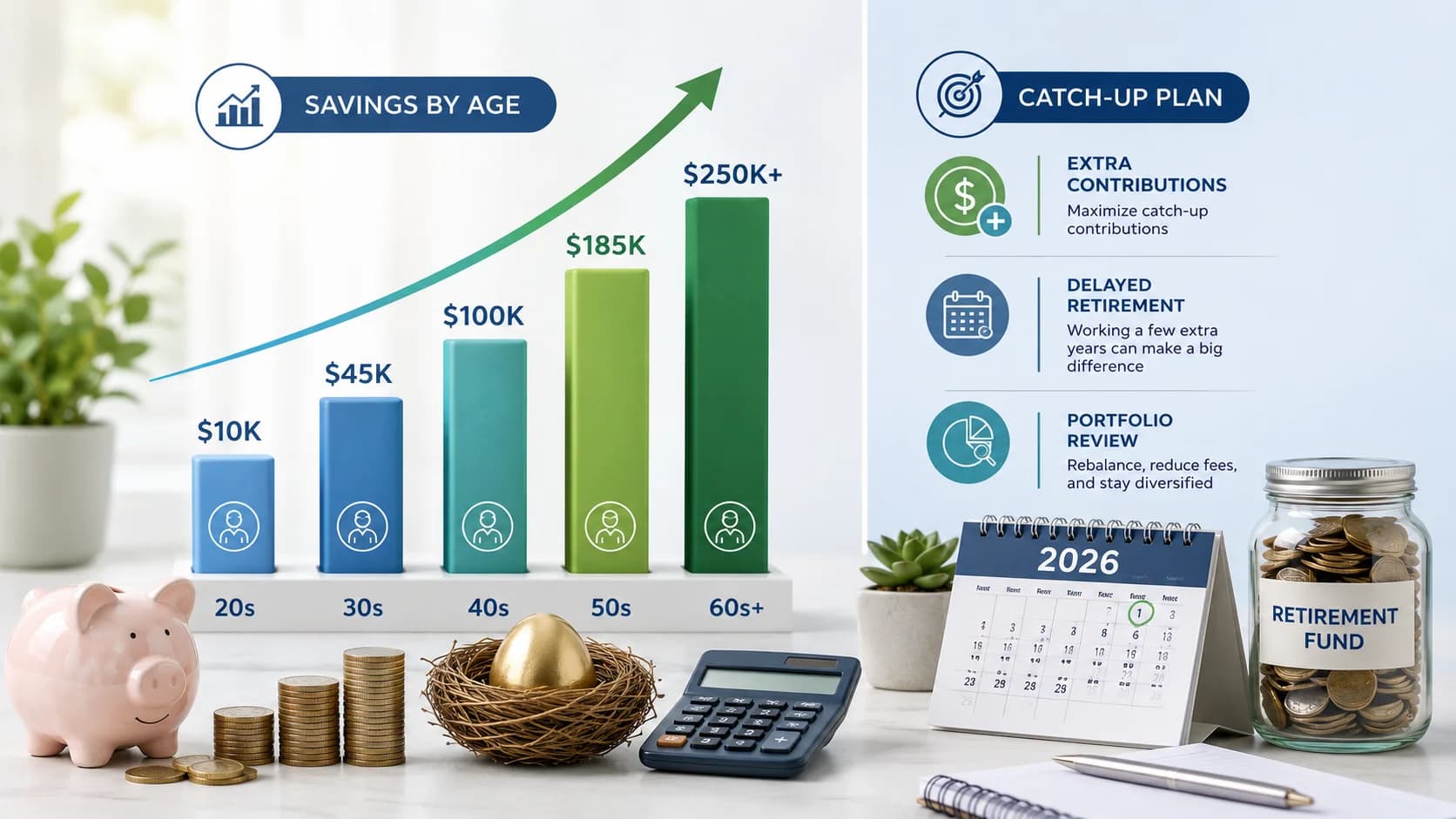
Retirement Savings by Age: Benchmarks and How to Catch Up in 2026
Free Calculator
Retirement Calculator
Table of Contents
Retirement Savings by Age: Benchmarks and How to Catch Up in 2026

TL;DR: Fidelity Investments recommends saving 1× your salary by age 30, 3× by 40, 6× by 50, and 10× by 67. In 2026, the median 401(k) balance for Americans aged 55–64 is $87,571 (Vanguard, 2024) — far short of most benchmarks. Whether you are ahead or behind, this guide shows where you should be at every decade and the fastest ways to close the gap.
The Standard Retirement Savings Benchmarks by Age
The most widely cited benchmark for retirement savings comes from Fidelity Investments, which recommends saving a specific multiple of your annual salary by key age milestones. Meeting these targets, according to Fidelity's 2025 Retirement Savings Assessment, gives most people a roughly 45% income replacement rate from personal savings — enough to supplement Social Security and maintain a comfortable retirement.
- Age 30: 1× your annual salary saved
- Age 35: 2× your annual salary saved
- Age 40: 3× your annual salary saved
- Age 45: 4× your annual salary saved
- Age 50: 6× your annual salary saved
- Age 55: 7× your annual salary saved
- Age 60: 8× your annual salary saved
- Age 67: 10× your annual salary saved
For someone earning $70,000 per year — close to the 2024 U.S. median individual earnings according to the Bureau of Labor Statistics — these benchmarks translate to $70,000 saved by 30, $210,000 by 40, and $700,000 by retirement. Use our retirement calculator to personalize these targets based on your actual salary, expected Social Security income, and planned retirement age.
Where Americans Actually Stand: The Reality Gap
According to Vanguard's 2024 "How America Saves" report — covering 5 million 401(k) participants — median balances by age group are:
- Under 25: Median $7,351 | Average $18,880
- 25–34: Median $14,933 | Average $37,557
- 35–44: Median $35,537 | Average $91,281
- 45–54: Median $60,763 | Average $168,646
- 55–64: Median $87,571 | Average $244,750
- 65+: Median $88,488 | Average $272,588
The median 55–64-year-old has $87,571 saved — roughly $420,000 short of the 6–7× benchmark for a $60,000 earner. Our compound interest calculator can show how even modest additional contributions compound dramatically over 20–30 years.
Your 20s: Build the Foundation (Target: 1× Salary by 30)
The 20s are the single most powerful decade for retirement savings because time does the heavy lifting. A $5,000 contribution at age 25 grows to approximately $54,274 by age 65 at a 6% average annual return (Securities and Exchange Commission). That same $5,000 invested at 45 reaches only $16,036 — a 70% reduction from waiting 20 years. The highest-impact action: capture your full employer 401(k) match. In 2026, the 401(k) limit is $23,500 (IRS Notice 2025-3) and the average employer match is 4.7% of salary (Vanguard 2024).
- Open and fund a Roth IRA — 2026 limit is $7,000 (IRS)
- Contribute enough to your 401(k) to capture the full employer match
- Automate contributions so saving happens before you can spend
- Never cash out a 401(k) when switching jobs — always roll it over
Your 30s: Accelerate Through Competing Priorities (Target: 3× Salary by 40)
The 30s bring competing demands: mortgages, childcare, student loan repayment. Vanguard's 2024 data shows the average 35–44-year-old has $91,281 in their 401(k) — well below the 3× benchmark for a $70,000 earner ($210,000). Going from a 10% to 15% savings rate adds $3,500 per year; at 7% returns over 20 years, that grows to an additional $148,000 in retirement savings.
Use our savings calculator to model the impact of increasing your savings rate by 1–2% annually. Pair it with our investment calculator for realistic portfolio projections.
- Maximize the employer 401(k) match — treat it as non-negotiable
- Open a Roth IRA alongside your 401(k) for tax diversification
- Maintain your savings rate as income grows; resist lifestyle inflation
- Build a 3–6 month emergency fund so you never raid retirement accounts
Your 40s: Peak Earning, Mid-Course Correction (Target: 6× Salary by 50)
The 40s are typically peak earning years and the most important decade for acceleration. The Employee Benefit Research Institute's 2025 Retirement Confidence Survey found that 64% of workers in their 40s feel behind on retirement savings. Contributing $23,500 per year at 7% returns from age 45 brings you to approximately $232,000 by 50 — meaningful progress even against a large gap.
- Maximize all tax-advantaged accounts: 401(k), IRA, and HSA if eligible
- Review your asset allocation — many 40-somethings invest too conservatively
- Pay down high-interest debt to free up cash flow for savings
- Consider a fee-only certified financial planner for a formal gap analysis
Your 50s and 60s: Catch-Up Contributions and Final Sprint (Target: 10× by 67)
At age 50, the IRS allows catch-up contributions: an extra $7,500 in 401(k)s in 2026 on top of the $23,500 base limit, per IRS Notice 2025-3. For ages 60–63, the SECURE 2.0 Act allows $11,250 extra instead of $7,500 — bringing the total 2026 limit to $34,750. Delaying Social Security from 62 to 70 increases your monthly benefit by 76% (Social Security Administration). Run the numbers with our 401(k) calculator and read our retirement planning guide.
The Savings Rate Is the Number That Matters Most
Research by financial planner Michael Kitces (2024) shows households saving 15–20% of gross income achieve retirement readiness across almost all income levels. Vanguard's 2024 participant data confirms: those saving 10%+ have median balances 4× higher than those saving under 4%. Our compound interest calculator can project exactly where your current savings rate leads by your target retirement date.
Frequently Asked Questions
How much should a 30-year-old have saved for retirement?
Fidelity recommends having 1× your annual salary saved by age 30. For someone earning $60,000, that means $60,000 in retirement accounts, achievable by saving 10–15% of income and capturing your full employer 401(k) match every year without exception.
What if I am 40 and have not started saving for retirement?
Starting at 40 still leaves 25+ years of compound growth. The 2026 401(k) limit is $23,500 and the IRA limit is $7,000. Reducing discretionary expenses to free up savings capacity is the highest-leverage action. A fee-only certified financial planner can build a customized catch-up plan for your situation.
How much money do I need to retire comfortably?
The 25× rule: multiply your expected annual spending by 25. If you plan to spend $50,000/year, you need $1.25 million. This is based on a 4% safe withdrawal rate that sustains a 30-year retirement in 95% of historical market scenarios (William Bengen, 1994). Social Security income reduces how much you need to self-fund.
Is a 401(k) or Roth IRA better for retirement?
A traditional 401(k) reduces taxable income now but withdrawals are taxed in retirement. A Roth IRA offers no immediate deduction but all qualified withdrawals are tax-free. If your tax rate will be higher in retirement, the Roth is generally superior. Most advisors recommend both for tax diversification. The 2026 Roth IRA income limit phases out at $150,000 for single filers (IRS).
What is the average 401(k) balance by age 55?
Vanguard's 2024 data shows the average 401(k) balance for ages 55–64 is $244,750 and the median is $87,571. Fidelity suggests 7× salary saved by 55 — meaning $420,000 for a $60,000 earner. Catch-up contributions and focused saving over remaining working years can meaningfully close the gap.
Related Calculators
Try these free calculators related to this article:
In-Depth Guides
Dive deeper with our comprehensive guides on this topic:
Frequently Asked Questions
Our Methodology
All calculator content on CalculatorApp.me is reviewed by subject-matter experts, cross-referenced with official sources, and updated regularly for accuracy. Our formulas and data are verified against industry standards and government publications.
Jordan Hayes
Verified AuthorPersonal Finance Content Strategist
Jordan is a personal finance content strategist with 9+ years writing about mortgages, retirement, tax strategy, and budgeting. Every guide is cross-referenced with IRS publications, Federal Reserve data, and CFPB guidance to make complex calculations accessible. Editor at CalculatorApp.me.
Found this helpful? Share it!
Stay Updated
Get notified when we launch new calculators and features.
No spam. Unsubscribe anytime.