The 50/30/20 Budget Rule: Complete Guide to Managing Your Money in 2026
Free Calculator
Paycheck Calculator
Table of Contents
The 50/30/20 Budget Rule: Complete Guide to Managing Your Money in 2026
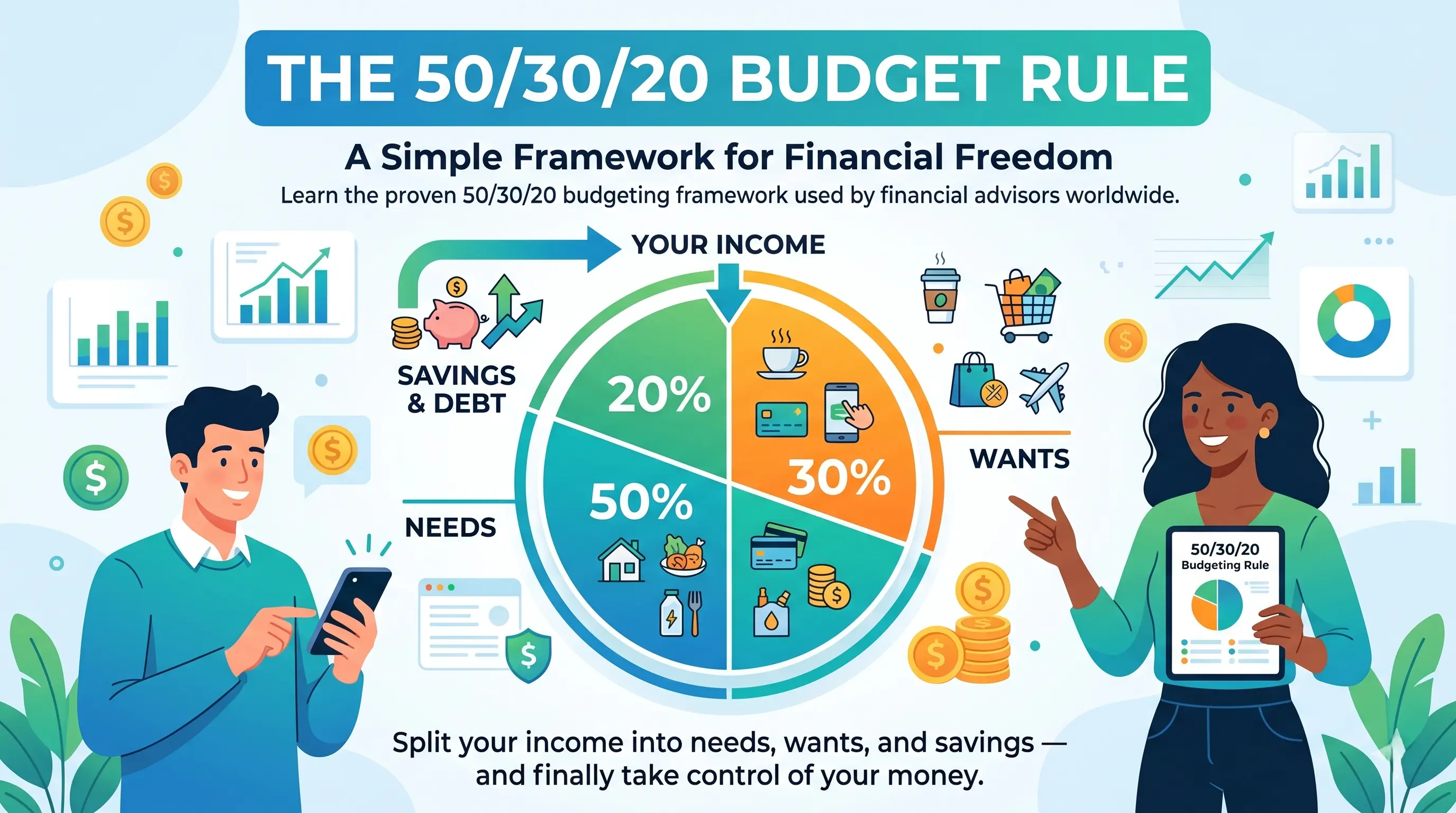
The 50/30/20 budget rule is a simple, proven personal finance framework that divides your monthly after-tax income into three buckets: 50% for needs, 30% for wants, and 20% for savings and debt repayment. Created by Harvard bankruptcy professor and U.S. Senator Elizabeth Warren in her 2005 book All Your Worth, it is the most widely recommended budgeting method for beginners because it requires no spreadsheet and takes under 20 minutes to set up. If you want one rule to follow for the rest of your financial life, this is it.
How the 50/30/20 Rule Works
The math is straightforward. Take your monthly take-home pay (after taxes, not your gross salary) and divide it into three proportions:
- 50% — Needs: Non-negotiable expenses required for survival and daily function
- 30% — Wants: Discretionary spending that improves quality of life but is not essential
- 20% — Savings & Debt: Wealth-building contributions and extra debt payments above minimums
On a $5,000 per month take-home salary that works out to $2,500 for needs, $1,500 for wants, and $1,000 toward savings and debt. The simplicity is the point — you do not need to track 40 categories. You only need to know which of three buckets a purchase belongs to.
What Counts as Needs (50%)
Needs are expenses you cannot eliminate without serious consequences. They are the non-negotiable costs of existing. Common needs include:
- Housing: Rent or mortgage payment, property taxes, renters or homeowners insurance
- Groceries: Basic food and household supplies (not restaurant meals)
- Utilities: Electricity, gas, water, basic internet (needed for work or school), phone
- Transportation: Car payment, gas, public transit, required car insurance
- Health insurance: Premiums, required co-pays, prescriptions
- Minimum debt payments: Minimum monthly amounts on student loans, credit cards, and auto loans
- Childcare: Required care that enables you to work
A common mistake is classifying wants as needs. A $700/month car payment is not a need — an affordable used car is. A $200/month cable package is not a need — basic internet is. If your needs regularly exceed 50%, look for ways to reduce housing, transportation, or subscription costs first, as these have the highest impact.
What Counts as Wants (30%)
Wants are purchases that enrich your life but are not required for basic function. This is where most people overspend without realizing it. Common wants include:
- Dining out, coffee shops, takeout, and food delivery
- Streaming services (Netflix, Spotify, Disney+, etc.)
- Gym memberships and fitness apps
- Shopping for clothing, electronics, and home decor beyond necessities
- Vacations, weekend trips, and entertainment
- Hobbies, subscriptions, and membership clubs
- Upgraded phone plans beyond basic calling and data
- Premium groceries and specialty food items
The 30% wants bucket is intentional — a budget that allows zero enjoyment will fail. The goal is not to eliminate wants but to spend on them consciously. Research by the American Psychological Association shows that experiential spending (travel, concerts, experiences) produces more lasting satisfaction than material purchases, so direct your 30% accordingly.
What Counts as Savings & Debt (20%)
The 20% category is your financial future. It covers three priorities:
- Emergency fund first: Build 3–6 months of living expenses in a high-yield savings account before anything else. This single step prevents debt from derailing every other financial goal.
- Retirement contributions: 401(k), IRA, or Roth IRA contributions. If your employer matches 401(k) contributions, contribute enough to get the full match — it is an instant 50–100% return on investment.
- Extra debt payments: Payments above the required minimum on high-interest debt (credit cards, personal loans). Avalanche method: pay off highest-interest debt first. Snowball method: pay smallest balances first for psychological momentum.
- Investing: Brokerage account contributions to index funds, ETFs, or other long-term investments once emergency fund and high-interest debt are handled.
Use our Savings Calculator to model how consistent 20% savings compounds over 10, 20, and 30 years. The numbers are motivating.
50/30/20 Rule by Income Level
Here is how the rule translates into real dollar amounts across three common income levels. All figures use monthly net (after-tax) income.
| Monthly Net Income | Annual (approx.) | 50% Needs | 30% Wants | 20% Savings |
|---|---|---|---|---|
| $3,000 | ~$36K | $1,500 | $900 | $600 |
| $5,000 | ~$60K | $2,500 | $1,500 | $1,000 |
| $8,000 | ~$96K | $4,000 | $2,400 | $1,600 |
| $10,000 | ~$120K | $5,000 | $3,000 | $2,000 |
| $12,500 | ~$150K | $6,250 | $3,750 | $2,500 |
Note: Use after-tax take-home pay, not gross salary. Use our Budget Planner to calculate your exact split instantly.
How to Start Using the 50/30/20 Rule (Step-by-Step)
Follow these five steps to implement the 50/30/20 rule starting this month:
- Calculate your monthly net income. Add up all after-tax income sources: salary take-home, freelance income, rental income, and side hustle revenue. If income is variable, use the average of the past six months as your baseline.
- Audit last month's spending. Pull 30 days of bank and credit card statements. Categorize every transaction as a Need, Want, or Savings item. This step reveals your actual current allocation vs. the 50/30/20 target.
- Calculate your current percentages. Divide total needs spending by net income, then do the same for wants and savings. Most people discover their wants are 40–45% and savings are under 10% — the audit makes this undeniable.
- Set target amounts per category. Multiply your monthly net income by 0.50, 0.30, and 0.20 to get your target dollar amounts. Write these down. They are your monthly spending limits.
- Automate your savings immediately. On payday, automatically transfer 20% to a separate savings or investment account before you have a chance to spend it. Automation is the single most powerful budgeting move — people who automate savings accumulate significantly more wealth over time than those who save "what is left over."
50/30/20 Rule Pros and Cons
Pros
- Simple to follow: Three categories instead of 40. Anyone can start in under an hour.
- Guilt-free spending: The 30% wants bucket means you are allowed to enjoy your money without guilt.
- Flexible: Percentages can be adjusted for high-cost cities, low income, or aggressive savings goals.
- Builds wealth automatically: The mandatory 20% savings allocation forces long-term financial progress.
- Widely validated: Used and recommended by financial planners, banks (NerdWallet, Bankrate), and government financial literacy programs (CFPB).
Cons
- 50% needs is unrealistic in high-cost cities: In San Francisco, New York, or Boston, housing alone can consume 40–50% of income for middle earners.
- Not detailed enough for debt payoff: People with high consumer debt may need a more aggressive savings-to-debt ratio like 30% or higher.
- No category for irregular expenses: Annual costs (car registration, holiday gifts, insurance) need to be pre-planned separately.
- May feel restrictive at low incomes: Earning $2,000/month makes 50% for needs ($1,000) extremely tight in most metro areas.
Variations: When 50/30/20 Needs Adjusting
The classic 50/30/20 split is a starting point, not a rigid law. Here are three common variations:
70/20/10 Rule (Lower Income or High-Cost Cities)
If you live in an expensive metro area or earn less than $40,000 per year, a 70/20/10 split is more realistic: 70% needs, 20% wants, 10% savings. As income rises or you move to a lower-cost area, migrate toward 50/30/20 over time. Even a 10% savings rate compounded over 30 years is transformative.
60/20/20 Rule (Moderate Cost of Living Adjustment)
Many middle-income households in average U.S. cities find their needs land at 55–60% due to rising housing, childcare, and transportation costs. Using 60/20/20 keeps savings intact at 20% while giving realistic room for needs. This is the most common real-world modification financial advisors recommend for U.S. households in 2026.
50/20/30 Rule (Aggressive Savings Mode)
High earners who want to build wealth faster can flip wants and savings: 50% needs, 20% wants, 30% savings. This approach accelerates retirement timelines, can enable early retirement, and is aligned with the FIRE (Financial Independence, Retire Early) movement. Use our Compound Interest Calculator to see how 30% monthly savings grows over 20 years.
Frequently Asked Questions
Is the 50/30/20 rule based on before-tax or after-tax income?
Always use after-tax (take-home) income — the amount actually deposited into your bank account after federal, state, and payroll taxes. If your gross salary is $75,000 and your monthly take-home is $4,800, use $4,800 as your calculation base. Using gross income would overstate what you have available to spend.
Where do minimum debt payments go — needs or savings?
Minimum required debt payments (credit card minimums, student loan required payments, auto loan) belong in needs (50%) because they are contractual obligations with penalties for non-payment. Any payment above the minimum is optional and belongs in savings/debt (20%) because it accelerates debt payoff and builds net worth.
What if my needs exceed 50% of income?
This is very common — especially for renters in major cities. The fix is to adjust the rule to match your reality while protecting the 20% savings target. A 60/20/20 or 65/15/20 split keeps savings on track while acknowledging higher essential costs. The goal is to reduce needs over time through income growth, relocating, or reducing fixed costs like housing or car payments.
Does the 50/30/20 rule work for variable or freelance income?
Yes, but you need to calculate your baseline differently. Average your net income over the past 6–12 months. Budget conservatively using the lower end of that range. In high-income months, funnel the surplus directly into savings rather than upgrading lifestyle. Always set aside 25–30% of gross freelance income for taxes before applying the 50/30/20 percentages to what remains.
Should I build an emergency fund or invest first under the 20% category?
Build your emergency fund first — always. Aim for $1,000 as a starter emergency fund, then work up to 3–6 months of essential expenses in a high-yield savings account. Once that buffer exists, redirect the 20% toward retirement accounts (401k match first, then IRA), high-interest debt payoff, and then taxable investing. Without an emergency fund, any unexpected expense forces you into high-interest debt, canceling out investment gains.
Conclusion: Start Your 50/30/20 Budget Today
The 50/30/20 budget rule works because it is simple, flexible, and rooted in behavioral reality — it allows spending on enjoyment while forcing savings. Whether you earn $3,000 or $12,000 per month, the three-bucket framework gives you a clear, actionable target every month.
The single most important action you can take today: calculate your after-tax monthly income, multiply by 0.20, and set up an automatic transfer of that amount to a savings account on your next payday. Do not wait until the budget is "perfect." Start with the 20% savings automation, then refine needs and wants over the following 30 days.
Use our free Budget Planner to calculate your exact 50/30/20 split in seconds, track your progress with the Savings Calculator, and see how your savings compounds with the Compound Interest Calculator.
Free Tool
50/30/20 Budget Calculator
Enter your take-home pay and instantly see your exact dollar split for needs, wants, and savings.
Calculate My Split →Related Calculators
Try these free calculators related to this article:
In-Depth Guides
Dive deeper with our comprehensive guides on this topic:
Frequently Asked Questions
Our Methodology
All finance content on CalculatorApp.me is reviewed by subject-matter experts, cross-referenced with official sources, and updated regularly for accuracy. Our formulas and data are verified against industry standards and government publications.
Jordan Hayes
Verified AuthorPersonal Finance Content Strategist
Jordan is a personal finance content strategist with 9+ years writing about mortgages, retirement, tax strategy, and budgeting. Every guide is cross-referenced with IRS publications, Federal Reserve data, and CFPB guidance to make complex calculations accessible. Editor at CalculatorApp.me.
Found this helpful? Share it!
Stay Updated
Get notified when we launch new calculators and features.
No spam. Unsubscribe anytime.