Understanding Your Paycheck: How to Read Every Line of Your Pay Stub
Free Calculator
Paycheck Calculator
Table of Contents
How to Read Your Paycheck Stub: Why It Matters
Learning how to read paycheck stub details is essential. According to the American Payroll Association, one in three workers has experienced a payroll error. That could mean hundreds or thousands of dollars lost annually — from incorrect tax withholding to missing overtime pay. Understanding your pay stub is the first line of defense for your income.
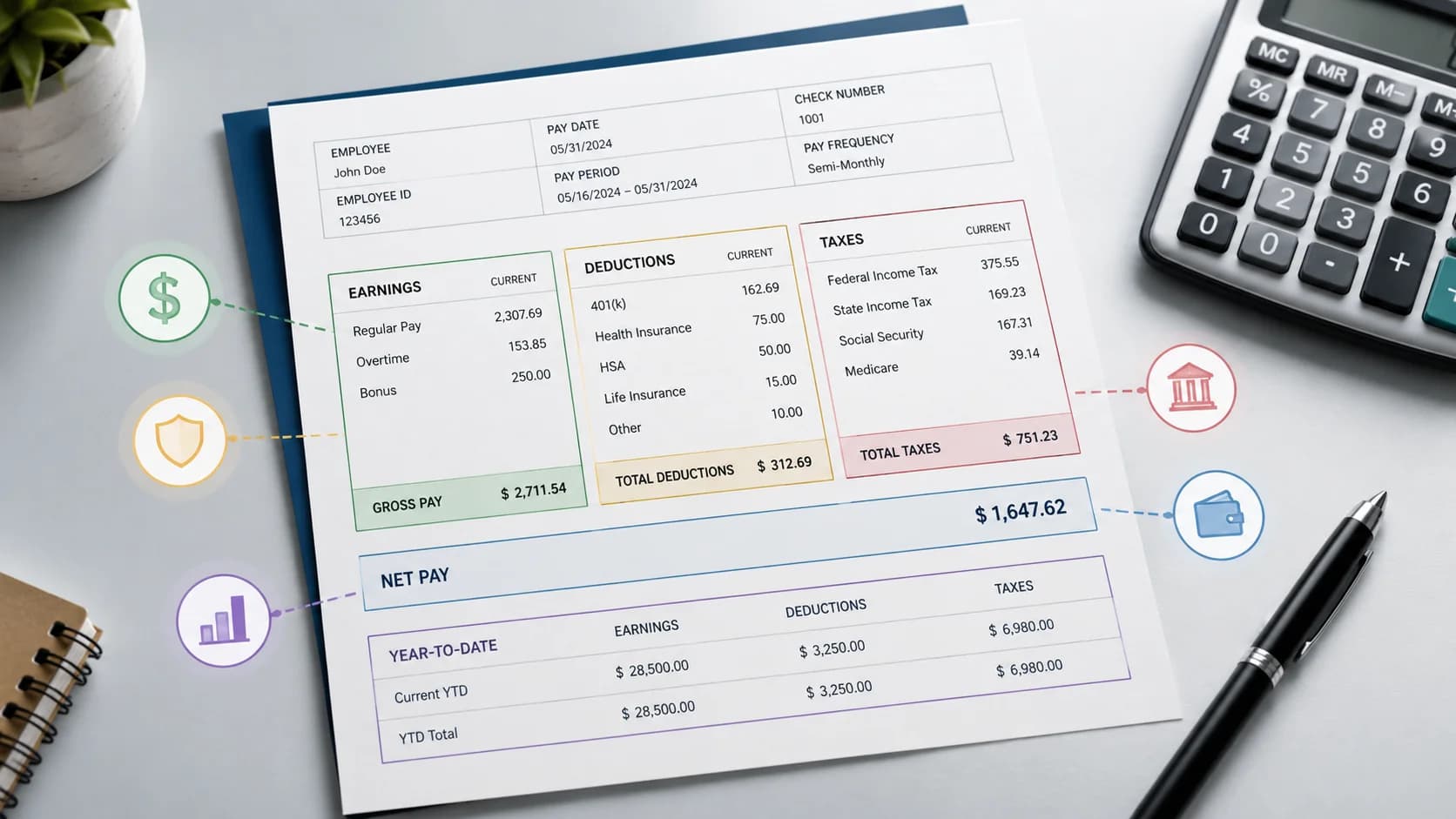
Your pay stub (also called a paycheck stub, earnings statement, or wage statement) is a detailed breakdown of how your employer calculated your paycheck. Every line item falls into one of four categories: earnings, taxes, deductions, and employer contributions.
Gross Pay vs. Net Pay: The Two Numbers That Matter Most
Gross pay is your total earnings before any deductions. For salaried employees, this is your annual salary divided by the number of pay periods (typically 26 for biweekly or 24 for semi-monthly). For hourly workers, it's hours worked × hourly rate, plus overtime.
Net pay (take-home pay) is what actually hits your bank account after all deductions. The average American loses 25–35% of gross pay to taxes, insurance, and retirement contributions. On a $60,000 salary, that means your take-home is roughly $40,000–$45,000.
How Overtime Is Calculated
Under the Fair Labor Standards Act (FLSA), non-exempt employees earn 1.5× their regular rate for hours worked beyond 40 in a workweek. Some states require overtime for hours worked beyond 8 in a single day (California, for example).
Common overtime errors to watch for:
Overtime calculated on base rate instead of regular rate (which should include shift differentials and non-discretionary bonuses)
Comp time offered instead of overtime pay (illegal for private-sector non-exempt employees)
Hours spread across multiple pay periods to avoid the 40-hour threshold
Understanding Tax Withholdings
The tax section of your pay stub typically shows 4–6 line items. Here's what each means:
Federal Income Tax
This is the amount your employer withholds for federal taxes based on your W-4 form. The amount depends on your filing status (single, married, head of household), number of dependents, and any additional withholding you've elected. The IRS uses marginal tax brackets — you don't pay one flat rate on all income.
For 2026, the federal tax brackets for single filers range from 10% on income up to $11,925 to 37% on income above $626,350. Most Americans fall in the 12% or 22% bracket.
State Income Tax
Forty-three states impose a state income tax. Rates range from a flat 3.07% (Pennsylvania) to a top rate of 13.3% (California). Nine states — Alaska, Florida, Nevada, New Hampshire, South Dakota, Tennessee, Texas, Washington, and Wyoming — have no state income tax.
FICA Taxes (Social Security + Medicare)
FICA stands for the Federal Insurance Contributions Act. It funds Social Security and Medicare and is split between you and your employer:
Social Security: 6.2% of wages up to the annual limit ($168,600 in 2025). Your employer pays another 6.2%.
Medicare: 1.45% of all wages (no cap). Employer matches 1.45%.
Additional Medicare: 0.9% on wages above $200,000 (employee only — employer doesn't match this).
Total FICA for most workers: 7.65% of gross pay. Self-employed individuals pay both halves (15.3%), which is why freelancers often owe more in taxes.
Common Pre-Tax Deductions
Pre-tax deductions reduce your taxable income, meaning you pay less in federal and state taxes. Common pre-tax deductions include:
Health Insurance Premiums
Most employer-sponsored health plans operate under a Section 125 cafeteria plan, making your premium contributions pre-tax. The average employee contribution is $1,401/year for individual coverage and $6,106/year for family coverage (Kaiser Family Foundation, 2025).
Retirement Contributions (401k/403b)
Traditional 401(k) contributions are pre-tax, reducing your current taxable income. In 2026, you can contribute up to $23,500 ($31,000 if age 50+). Roth 401(k) contributions are post-tax — they appear separately on your stub.
Flexible Spending Accounts (FSA)
Healthcare FSA ($3,200 limit in 2026) and Dependent Care FSA ($5,000 limit) are pre-tax. Remember: most FSAs have a "use it or lose it" rule, though some employers offer a $640 carryover or 2.5-month grace period.
Post-Tax Deductions
Post-tax deductions come from your paycheck after taxes are calculated. They don't reduce your tax bill but may provide other benefits:
Roth 401(k) contributions: Taxed now, but withdrawals in retirement are tax-free
Life insurance premiums (for coverage above $50,000 — employer-provided up to $50,000 is tax-free)
Disability insurance: Post-tax premiums mean benefits are tax-free if you file a claim
Wage garnishments: Court-ordered deductions for child support, student loans, or tax liens
Union dues: No longer tax-deductible for most employees after the 2017 Tax Cuts and Jobs Act
Employer Contributions (The "Hidden" Pay)
Many pay stubs show employer contributions — money your employer spends on your behalf that doesn't appear in your gross pay:
Employer 401(k) match: Typically 3–6% of salary. This is free money — always contribute enough to get the full match.
Employer FICA: Your employer pays 7.65% of your wages in FICA taxes on top of your salary.
Health insurance: Employers cover an average of 83% of individual premiums and 73% of family premiums.
Your true total compensation is often 20–40% higher than your salary when employer contributions are included.
How to Spot Payroll Errors
Check your pay stub for these common mistakes every pay period:
Hours discrepancy: Compare hours on stub vs. your personal time records
Rate changes: After a raise, verify the new rate appears on the next stub
Tax filing status: Make sure it matches your W-4 (marriage, divorce, and new dependents require updates)
Year-to-date totals: Should match the sum of all previous pay periods — discrepancies indicate a processing error
Benefit deductions: Compare against your benefits enrollment confirmation
Calculate Your Take-Home Pay
Use our free Paycheck Calculator to estimate your net pay after federal, state, and FICA taxes. Planning around tax season? Check the latest brackets with our Income Tax Calculator, or see how your salary compares across states with our Salary Calculator.
Frequently Asked Questions
What is the difference between gross pay and net pay?
Gross pay is your total earnings before any deductions. Net pay is what you actually receive after taxes, insurance, retirement contributions, and other deductions. The average American takes home 65–75% of their gross pay.
Why is my paycheck less than expected?
Common reasons include: federal and state tax withholding (typically 15–25%), FICA taxes (7.65%), health insurance premiums, retirement contributions, and any post-tax deductions like life insurance or wage garnishments.
How often should I check my pay stub?
Review your pay stub every pay period, especially after any changes — raises, tax form updates, benefit enrollment periods, or address changes. At minimum, compare your final December stub's YTD totals against your W-2 in January.
What should I do if I find a payroll error?
Contact your HR or payroll department immediately with specific details (pay period, line item, expected vs. actual amount). Under the FLSA, employers must correct underpayment errors promptly. Keep copies of all pay stubs as documentation.
What does YTD mean on a pay stub?
YTD stands for "Year-to-Date" — it's the cumulative total of each line item from January 1 through the current pay period. Your YTD gross pay should match (approximately) your W-2 wages at year end.
Related Articles on CalculatorApp.me
- Federal Income Tax Brackets 2026
- Tax Deductions and Credits 2026
- The 50/30/20 Budget Rule
- Retirement Planning: How Much Do You Need?
Paycheck & Tax Resources
Related Calculators
Try these free calculators related to this article:
In-Depth Guides
Dive deeper with our comprehensive guides on this topic:
Frequently Asked Questions
Our Methodology
All finance content on CalculatorApp.me is reviewed by subject-matter experts, cross-referenced with official sources, and updated regularly for accuracy. Our formulas and data are verified against industry standards and government publications.
Jordan Hayes
Verified AuthorPersonal Finance Content Strategist
Jordan is a personal finance content strategist with 9+ years writing about mortgages, retirement, tax strategy, and budgeting. Every guide is cross-referenced with IRS publications, Federal Reserve data, and CFPB guidance to make complex calculations accessible. Editor at CalculatorApp.me.
Found this helpful? Share it!
Stay Updated
Get notified when we launch new calculators and features.
No spam. Unsubscribe anytime.