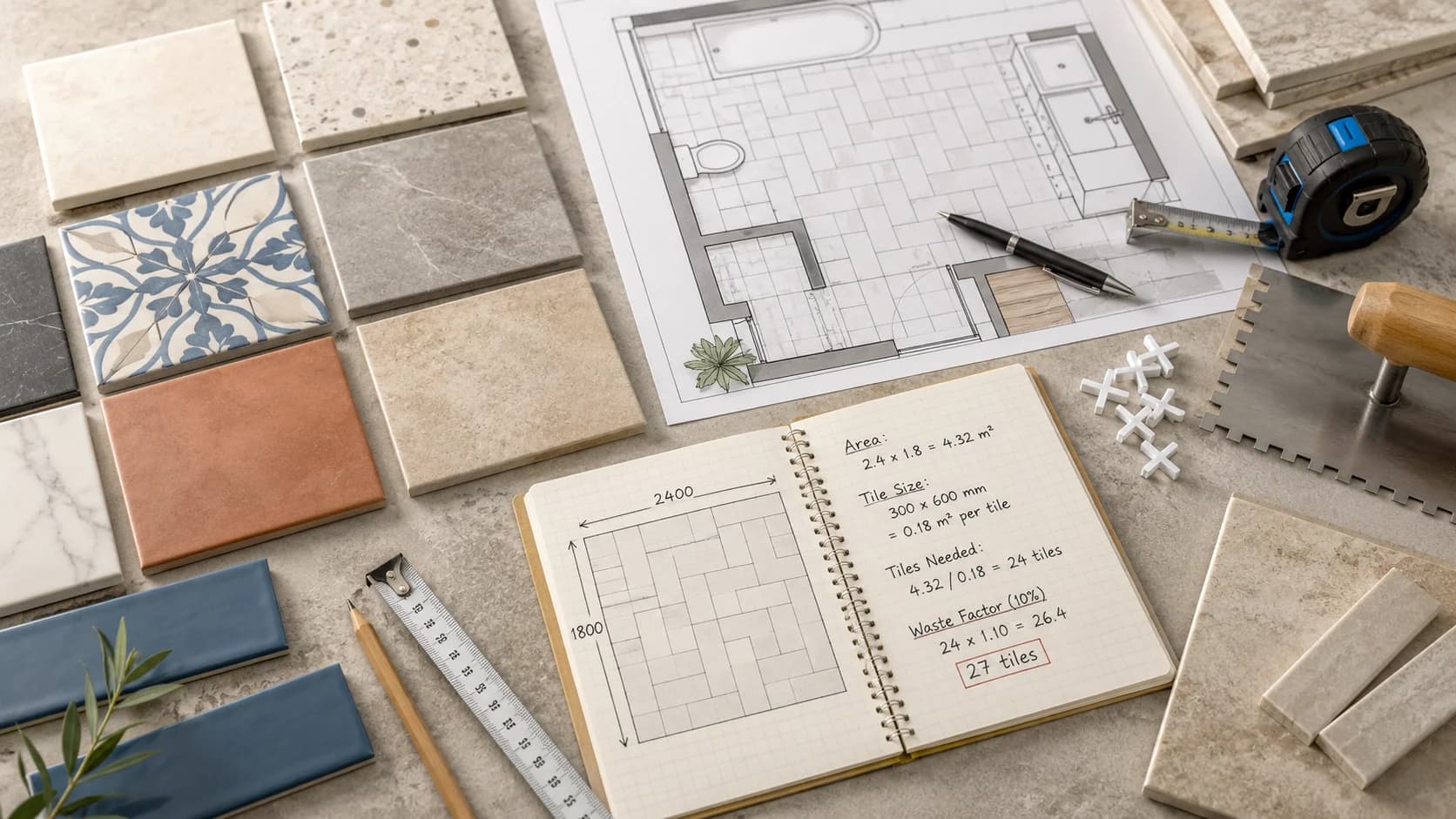
## The Number That Determines Whether You Run Out Mid-Job
Tiling a floor or wall looks straightforward until you're two rows from the finish line and realize you're short. Buying too few tiles is worse than buying too many — because tiles from a different production batch often don't match exactly in color and texture, even with the same product code.
Our [tile calculator](/category/construction/tile-quantity-calculator) gives you the right number with the right waste factor built in. This guide explains the math and shows you how to handle cuts, patterns, and irregular rooms.
---
## The Basic Formula
**Tiles needed = (Area to cover ÷ Tile area) × Waste factor**
### Step 1: Calculate the Area
For a rectangular room: length × width
For an L-shaped room: break it into two rectangles, calculate each, add them together.
### Step 2: Calculate Tile Area
Tile size is usually given in inches. Convert to feet for the calculation:
| Tile Size | Area in Sq Ft |
|-----------|---------------|
| 12×12 in | 1.00 sq ft |
| 18×18 in | 2.25 sq ft |
| 24×24 in | 4.00 sq ft |
| 12×24 in | 2.00 sq ft |
| 3×6 in (subway) | 0.125 sq ft |
| 4×4 in | 0.111 sq ft |
### Step 3: Apply Waste Factor
| Installation Type | Recommended Waste Factor |
|-------------------|-------------------------|
| Straight lay, rectangular room | 10% |
| Diagonal lay (45°) | 15% |
| Herringbone or complex pattern | 20% |
| Room with many cut edges (lots of angles) | 15% |
| Mosaic or small tiles | 10–15% |
### Worked Example: 12×15 ft Bathroom, 12×24 Tile, Straight Lay
- Room area: 12 × 15 = **180 sq ft**
- Tile area: (12 × 24) ÷ 144 = **2.0 sq ft per tile**
- Tiles before waste: 180 ÷ 2.0 = **90 tiles**
- With 10% waste: 90 × 1.10 = **99 tiles → buy 100**
[Run your own numbers in the tile calculator →](/category/construction/tile-quantity-calculator)
---
## Diagonal vs. Straight Lay: Why It Changes the Count
When tiles are laid at 45°, every edge of the room creates a row of triangular cuts. These cut pieces usually can't be reused elsewhere in the layout, so waste is higher.
**Straight lay (0°):** Cuts along two walls. Most cut pieces are at least half a tile.
**Diagonal lay (45°):** Cuts along all four walls at an angle. Nearly every perimeter tile is cut into a triangle that generates significant offcut waste.
For a 12×15 room using 12×12 tiles:
- Straight lay: 10% waste → **198 tiles**
- Diagonal lay: 15% waste → **207 tiles**
The diagonal pattern uses roughly 5% more tile and takes significantly longer to lay — but creates a classic, expansive look that makes small rooms appear larger.
---
## How Grout Joint Size Affects Coverage
Grout joints reduce your tile coverage per square foot slightly. For most residential tile work the difference is small, but for very large tiles or very wide joints it becomes meaningful.
| Joint Width | Coverage Reduction |
|-------------|-------------------|
| 1/16 in (rectified tile) | <1% |
| 1/8 in (standard floor) | ~1.5% |
| 3/16 in (stone or rustic tile) | ~2.5% |
| 1/4 in (wide joint) | ~4% |
For standard 1/8" joints, add this to your waste factor — or just round up to the next full box.
---
## Calculating Tiles for Walls
Wall tile coverage works the same as floor tile, with two important differences:
**1. Deduct openings.** Measure windows, doors, and shower niches. Subtract their area from the total wall area before calculating tiles.
**2. Account for partial tiles at top and bottom.** Unless your ceiling height is an exact multiple of the tile height, you'll have a cut row at the top (or bottom). This cut row increases waste, especially for larger format tiles.
### Shower Wall Example: 3 walls, 5×8 ft each, 3×6 subway tile
- Total wall area: 3 × (5 × 8) = **120 sq ft**
- Less shower niche (1×2 ft): −2 sq ft → **118 sq ft net**
- Tile area: (3 × 6) ÷ 144 = **0.125 sq ft per tile**
- Tiles before waste: 118 ÷ 0.125 = **944 tiles**
- With 10% waste: 944 × 1.10 = **1,038 tiles**
- Subway tiles are sold by the square foot, so: 1,038 × 0.125 = **130 sq ft to order**
---
## How Tile Is Sold: Boxes vs. Square Feet
Tile is typically sold by the box, with the box coverage stated in square feet. Divide your total required square footage by the box coverage to get box count — then always round up.
**Example:** You need 130 sq ft. Tile is sold in boxes of 15 sq ft each.
> 130 ÷ 15 = **8.67 → buy 9 boxes**
Never round down. A partial box wasted is cheap. A partial box missing mid-job is expensive (second delivery, batch mismatch risk).
---
## How Much Grout Do You Need?
Grout coverage depends on tile size, joint width, and tile thickness. A quick reference:
| Tile Size | Joint Width | Grout Coverage (per lb) |
|-----------|-------------|-------------------------|
| 4×4 in | 1/8 in | ~40 sq ft |
| 12×12 in | 3/16 in | ~60 sq ft |
| 12×24 in | 1/8 in | ~80 sq ft |
| 3×6 subway | 1/16 in | ~50 sq ft |
For a 180 sq ft floor with 12×12 tiles at 3/16" joints: 180 ÷ 60 = **3 lbs of grout**. Standard bags are 25 lbs, so you need **1 bag** with plenty to spare.
---
## How Much Tile Adhesive (Thinset)?
Thinset coverage varies by tile size and the notch size of your trowel:
- **Small tile (under 8 in)**: 1/4×1/4 notch → ~40–50 sq ft per 50-lb bag
- **Medium tile (8–16 in)**: 1/4×3/8 notch → ~30–40 sq ft per 50-lb bag
- **Large format (over 16 in)**: 1/2×1/2 notch → ~15–20 sq ft per 50-lb bag
For 180 sq ft of 12×24 tile: 180 ÷ 35 = **~5 bags of 50-lb thinset**. Buy 6.
---
## Common Tile Calculation Mistakes
**Not accounting for cuts at doorways.** Doorways often require a transition piece and specific cut tile heights on each side. Add 5–8 extra tiles for each door opening.
**Forgetting hearths, step risers, or built-ins.** Any horizontal or vertical surface that gets tiled needs its own area calculation — don't forget the front face of a fireplace hearth or the risers on tiled steps.
**Using nominal vs. actual tile size.** A "12×12" tile may be 11-7/8 × 11-7/8 inches actual. Use the actual dimension for the tile area calculation, not the nominal size.
**Ordering from different batches.** If your initial estimate is short and you reorder, you risk a dye lot mismatch. Always buy 10%+ waste upfront from a single batch.
---
## Related Construction Calculators
- [
Paint Coverage Calculator](/category/construction/paint-coverage-calculator) — gallons for walls, ceilings, and trim
- [Deck Calculator](/category/construction/deck-calculator) — boards, posts, and concrete for any deck
- [
Concrete Calculator](/category/construction/concrete-calculator) — bags for any pour
- [Drywall Calculator](/category/construction/drywall-calculator) — sheets and screws for any room
---
## Frequently Asked Questions
**How many tiles do I need for a 10×10 floor?**
A 10×10 room is 100 sq ft. With 12×12 tiles (1 sq ft each) and 10% waste: 100 × 1.10 = **110 tiles**. With 18×18 tiles (2.25 sq ft each): 100 ÷ 2.25 × 1.10 = **49 tiles**.
**How much extra tile should I buy for waste?**
For a straight-lay rectangular room: 10%. For diagonal patterns or rooms with many cut edges: 15%. For herringbone or complex mosaic patterns: 20%. Always round up to complete boxes — never round down.
**Do I need to include grout joints in my tile calculation?**
For practical purposes, no — the grout joint offset is small enough that the waste factor absorbs it. The tile calculator includes joint width as an optional refinement, but the 10% waste factor already accounts for this in most cases.
**What is the easiest tile pattern to install?**
A straight grid (0° offset) with large-format tile is the fastest and generates the least waste. The 1/3 offset (running bond) is nearly as easy and more visually interesting. Diagonal and herringbone patterns require more cuts and significantly more time.