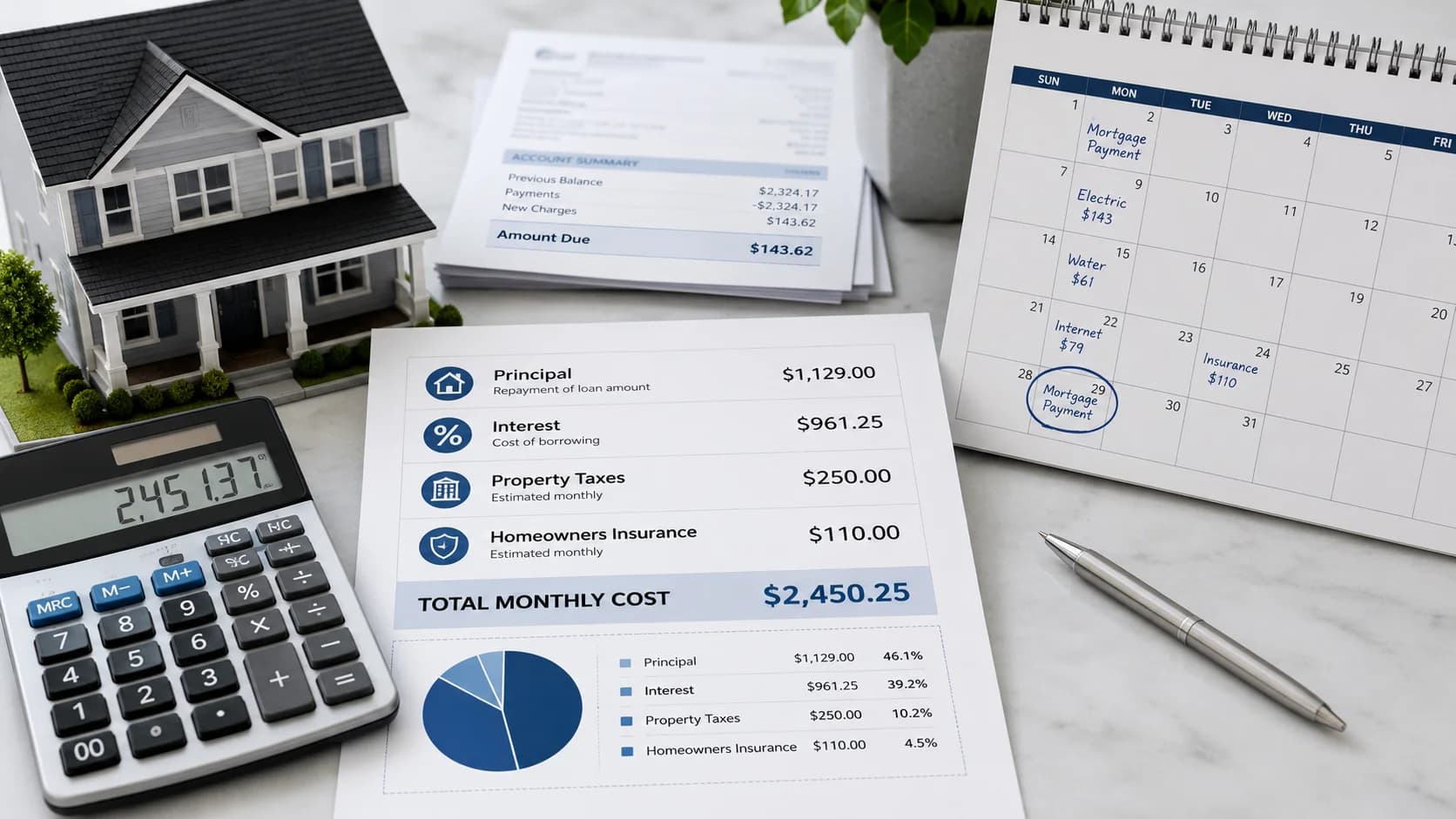
What a $400K Mortgage Actually Costs Month-by-Month (Real Numbers)
Free Calculator
Mortgage Calculator
Table of Contents
What a $400K Mortgage Actually Costs Month-by-Month (Real Numbers)

Photo: Pexels
Here's the number most lenders won't put in a headline: in the first payment on a $400K mortgage at 6.47%, roughly 83% of what you send in goes straight to interest. Not your loan balance. Interest. That's about $1,733 handed to the bank before a single dollar meaningfully chips away at what you owe.
The monthly payment alone — $2,520 for principal and interest at today's rate (Freddie Mac PMMS, June 18, 2026) — is just the starting point. Stack on property taxes, insurance, and PMI, and you're looking at $3,230 or more per month. Factor in Year 1 closing costs and your down payment, and the true first-year bill climbs to $65,000–$76,000. This article runs every number so you know exactly what you're signing up for.
Key Takeaways
- At today's 6.47% rate, a $400K mortgage costs $2,520/month in principal and interest alone (Freddie Mac, June 2026).
- Full PITI with PMI runs $3,230–$3,277/month — 28% higher than the P&I figure.
- Year 1 sends 83% of every payment to interest, not principal (Bankrate).
- The true first-year cost, including a 5% down payment and closing costs, is $65,788–$76,542.
- A 1.5% rate difference (6% vs. 7.5%) costs $143,640 extra over the life of the loan.
What Does a $400K Mortgage Actually Cost Per Month?
At the current 30-year fixed rate of 6.47% (Freddie Mac PMMS, June 18, 2026), a $400,000 loan carries a principal-and-interest payment of $2,520 per month. Over 30 years, you'll repay $626,010 total — meaning you pay $226,010 in interest on top of the $400,000 you borrowed (loanamortizationschedule.org).
That P&I number is what lenders advertise. It's not what you'll actually write a check for. Here's what a realistic monthly bill looks like once you add the costs that come with owning the home itself.
Bar chart showing Principal & Interest ($2,520), Property Tax ($367), Homeowners Insurance ($190), and PMI ($153) making up the $3,230 total monthly payment. Monthly PITI Breakdown — $400K Mortgage at 6.47% Total: $3,230/month Monthly Cost ($) $2,520 P & I $367 Prop. Tax $190 Insurance $153 PMI Sources: Freddie Mac, NerdWallet, appealdesk.com, AmeriSave (2026)Full PITI Breakdown (With PMI, 10% Down)
| Cost Component | Monthly Amount | Annual Amount | Source |
|---|---|---|---|
| Principal & Interest (6.47%) | $2,520 | $30,240 | loanamortizationschedule.org |
| Property Taxes (1.1% effective rate) | $367 | $4,400 | appealdesk.com, 2026 |
| Homeowners Insurance | $190 | $2,280 | NerdWallet, 2026 avg $2,490/yr |
| PMI (760+ credit score, 0.46% rate) | $153 | $1,836 | AmeriSave, 2026 |
| Total PITI with PMI | $3,230 | $38,760 | - |
| Total PITI without PMI (20% down) | $3,077 | $36,924 | - |
Want to plug in your exact rate, taxes, and down payment? The free mortgage calculator at CalculatorApp.me runs your full PITI breakdown in seconds.
How Does Your Rate Affect Your Monthly Payment?

Photo: Pexels
A 1.5% rate swing adds $399 to your monthly bill and $143,640 to your total repayment over 30 years. That's not a rounding error — it's a used car every few years, paid to the bank instead of kept in your pocket. At Money.com's June 17, 2026 daily rate of 6.55% (money.com), the payment is already $8 higher than the Freddie Mac benchmark.
Running every rate point from 6.0% to 7.5% against the same $400K loan shows how fast costs compound. Each 0.5% step adds roughly $130–$140 per month and $46,000–$50,000 over the loan's life.
Rate Sensitivity Table: $400K Mortgage, 30-Year Fixed
| Interest Rate | Monthly P&I | vs. 6.0% (monthly) | Extra Cost Over 30 Yrs | Source |
|---|---|---|---|---|
| 6.0% | $2,398 | baseline | baseline | Yahoo Finance |
| 6.47% (today) | $2,520 | +$122/mo | +$43,920 | Freddie Mac, June 2026 |
| 6.5% | $2,528 | +$130/mo | +$46,800 | Credible / romeconomics |
| 7.0% | $2,661 | +$263/mo | +$94,680 | Yahoo Finance / Finder |
| 7.5% | $2,797 | +$399/mo | +$143,640 | Credible |
Notice that moving from 6.47% to 7.0% — a half-point difference that can happen in just a few months of market swings — adds $141 a month. That's $1,692 a year, or a solid vacation budget, gone.
Also worth noting: at 7.0%, the total interest paid over 30 years jumps to $558,036 (Finder.com). That's $332,026 more in interest than the purchase price itself.
Curious how much a refinance could save? Try the loan calculator to compare scenarios side by side.
What Happens to Your Money in Year 1?
In Year 1 of a $400K mortgage at 6.5%, you'll pay $22,272 total in principal and interest. Of that, $20,735 goes to interest and only $1,537 reduces your loan balance (romeconomics). That's 83% interest, 17% principal — a ratio that shocks most first-time buyers (Bankrate).
This is the number that changes how people feel about their mortgage. When buyers see that the first payment sends $1,733 to interest and only $289 to their balance, they often ask if something went wrong. Nothing went wrong. That's just how amortization works at current rates.
How Your Payment Splits Over Time
| Payment / Period | Interest Portion | Principal Portion | % Going to Interest |
|---|---|---|---|
| Payment 1 (Month 1) | $1,733 | $289 | 86% |
| Year 1 (total $22,272) | $20,735 | $1,537 | 83% |
| Year 10 | ~63% | ~37% | 63% |
| Year 20 | ~28% | ~72% | 28% |
| Payment 349 (Year 29) | $127 | $1,896 | 6% |
| Final Payment | $11 | $2,012 | <1% |
Data: romeconomics (payment-level), Bankrate (Year 1 percentage). Rate: 6.5%.
The crossover point — where more of each payment goes to principal than interest — doesn't arrive until roughly Year 19 on a 6.5% loan. Most people move or refinance within 7-10 years, which means the average homebuyer at today's rates will never see a month where they're building equity faster than they're paying interest. That's not a reason not to buy. It is a reason to know the math going in.
Want to see how extra principal payments shift this curve? The compound interest calculator can model the long-run impact.
What Is the True First-Year Cost of a $400K Home?

Photo: Pexels
A 2026 buyer survey found that average first-year non-down-payment homeownership costs hit $31,502 (AOL Finance, January 2026). For a $400K purchase at today's rates, the honest first-year number is considerably higher once you include upfront costs. Buyers who plan only for the monthly payment regularly run short of cash in Year 1.
The table below uses a 5% down payment scenario ($20,000 down, $380,000 loan). P&I is recalculated on the $380,000 loan balance at 6.47%.
True First-Year Cost: 5% Down Scenario
| Cost Item | Low Estimate | High Estimate | Notes / Source |
|---|---|---|---|
| Down Payment (5%) | $20,000 | $20,000 | One-time, upfront |
| Closing Costs | $8,000 | $19,000 | 2-5% of loan; The Mortgage Reports / ClosingCorp |
| P&I (on $380K loan, 12 months) | $28,692 | $28,692 | ~$2,391/mo at 6.47% |
| Property Taxes (Year 1) | $4,400 | $4,400 | 1.1% effective rate; appealdesk.com, 2026 |
| Homeowners Insurance (Year 1) | $2,036 | $2,490 | NerdWallet 2026 avg: $2,490/yr |
| PMI (0.7% mid-range, Year 1) | $2,660 | $2,660 | ~$222/mo; AmeriSave range |
| Year 1 Total (incl. down payment) | $65,788 | $76,542 | - |
| Year 1 Total (excl. down payment) | $45,788 | $56,542 | Ongoing costs only |
The low/high spread is almost entirely driven by closing costs. Closing costs on a $380,000 loan range from $8,000 to $19,000 (2-5%), according to The Mortgage Reports and ClosingCorp data. Shopping lenders aggressively and negotiating seller concessions can pull you toward the lower end of that range.
How the Down Payment Changes Your Monthly Bill
| Down Payment | Loan Amount | PMI Required? | Est. Monthly PITI | Upfront Cash |
|---|---|---|---|---|
| 5% ($20,000) | $380,000 | Yes (~$222/mo) | ~$3,280 | $20K + closing costs |
| 10% ($40,000) | $360,000 | Yes (~$153/mo) | ~$3,095 | $40K + closing costs |
| 20% ($80,000) | $320,000 | No | ~$2,464 | $80K + closing costs |
The 20% down buyer saves $153–$222/month in PMI and gets a lower base payment on a smaller loan. But they also tie up $60,000 more in cash at closing compared to the 10% buyer. Whether that tradeoff makes sense depends entirely on your liquidity and the opportunity cost of that capital.
Does PMI Apply, and When Does It Go Away?
PMI is required any time your down payment is less than 20%, meaning your loan-to-value ratio exceeds 80%. At a 760+ credit score on a $400K loan, PMI costs roughly $153/month (0.46% annual rate) according to AmeriSave (2026). Lower credit scores push that cost toward $500/month — a number that can make or break affordability.
The good news: PMI is not permanent. The Homeowners Protection Act requires lenders to automatically cancel PMI when your loan balance reaches 78% of the original purchase price. You can request cancellation earlier — at 80% LTV — if you can document the drop in balance and the home hasn't declined in value. For a full guide on all PMI cancellation methods, see How to Get Rid of PMI Faster.
PMI Cost by Credit Score (0.46% to 1.5% Annual Rate)
| Credit Score Range | Approx. PMI Rate | Monthly PMI on $360K Loan |
|---|---|---|
| 760+ | 0.46% | ~$138/mo |
| 720-759 | ~0.65% | ~$195/mo |
| 680-719 | ~0.90% | ~$270/mo |
| Below 680 | up to 1.5% | up to $450/mo |
Source: AmeriSave rate ranges, 2026. Loan amount used: $360,000 (10% down on $400K home).
At 10% down on a $400K home, you start with a $360,000 balance. The 78% LTV threshold sits at $312,000. At 6.5%, reaching that threshold takes roughly 8.5 years of regular payments. Making extra principal payments accelerates that date and eliminates PMI sooner.
What Does $400K Actually Buy in 2026?
The NAR national median existing home price hit $429,300 in May 2026 (NAR, May 2026), which means a $400K budget puts you slightly below the national median. But that headline number hides enormous regional variation. Zillow's national home value index sat at $370,320 as of mid-2026, up 0.7% year-over-year (Zillow) — suggesting the median is pulled up by high-cost coastal markets.
What $400K Gets You by Region
| Region | 2026 Median Price (est.) | $400K Compared to Median | What You Can Expect |
|---|---|---|---|
| Northeast | $506,500 | Well below median (-21%) | Smaller homes, condos, or outer suburbs |
| West | $607,600 | Far below median (-34%) | Significant stretch; rural or inland markets only |
| South | ~$350,000-$380,000 | Near or above median | Solid mid-market home in most metros |
| Midwest | ~$290,000-$320,000 | Above median (+25-38%) | Move-up or newer construction in many cities |
Sources: NAR (Northeast, West medians, May 2026); Midwest/South estimates based on NAR regional data patterns. Regional medians are rounded.
If you're shopping in the Midwest or South, a $400K budget is genuinely competitive. In the Northeast or West, that same budget narrows your options considerably. Understanding what the monthly cost buys in your specific market is as important as the national averages.
What Are the Key Lessons From Running These Numbers?
The most consistent finding across every data point in this breakdown is that the advertised monthly payment understates the true cost of homeownership by 28% or more. A $2,520 P&I figure becomes a $3,230+ monthly obligation once you add taxes, insurance, and PMI. Knowing that gap in advance is the difference between a comfortable budget and a stretched one.
Here are the five most transferable lessons from this analysis:
- Budget for PITI, not P&I. The full payment with PMI is 28% higher than the principal-and-interest figure most lenders advertise. Base your affordability math on the full $3,230+, not $2,520.
- Rate matters more than purchase price in many cases. A 1.5% rate difference on the same $400K loan costs $143,640 extra over 30 years. Spending two weeks rate shopping is worth thousands.
- Year 1 equity growth is minimal. At 6.47%, you'll pay down roughly $3,900–$4,800 in principal in your first year while making $30,240 in P&I payments. Don't count on Year 1 home equity as a financial cushion.
- The true first-year bill is $65K–$76K. That's not a typo. Down payment plus closing costs plus 12 months of PITI and PMI adds up fast. Have reserves beyond your down payment.
- PMI isn't forever, but it takes years. At 10% down, you won't hit 78% LTV auto-cancellation for roughly 8-9 years at current rates. Accelerated principal payments can shorten that window.
Frequently Asked Questions
What is the monthly payment on a $400K mortgage at today's rate?
At the current 30-year fixed rate of 6.47% (Freddie Mac PMMS, June 18, 2026), the principal-and-interest payment on a $400,000 mortgage is $2,520 per month. Adding property taxes ($367), homeowners insurance ($190), and PMI ($153 for 760+ credit) brings the full PITI payment to approximately $3,230 per month (AmeriSave, NerdWallet, appealdesk.com, 2026).
Want to model your exact payment with your own numbers? Use the free mortgage calculator to run any rate, term, and down payment combination.
How much of a $400K mortgage payment goes to interest in Year 1?
In Year 1 at 6.5%, approximately 83% of every mortgage payment goes to interest, not principal (Bankrate). On a $400K loan, that means about $20,735 of the $22,272 in total annual P&I payments reduces the bank's interest income — and only $1,537 cuts into what you actually owe. The first individual payment splits roughly $1,733 interest vs. $289 principal (romeconomics).
How much do you need to earn to afford a $400K mortgage?
With a full PITI payment of $3,230/month and standard lending guidelines capping housing costs at 28% of gross monthly income, you'd need to earn roughly $138,430 per year ($11,536/month gross). At the commonly used 36% total-debt-to-income limit, minimum qualifying income drops slightly, but other debts reduce the room available. These are general benchmarks; individual lender requirements vary.
You can also model how different loan terms and extra payments affect total interest using the loan calculator and compound interest calculator. Both tools are free, no sign-up required.
Sources
- Freddie Mac Primary Mortgage Market Survey (PMMS), June 18, 2026: freddiemac.com/pmms
- Money.com Daily Mortgage Rates, June 17, 2026: money.com/current-mortgage-rates
- LoanAmortizationSchedule.org — $400K at 6.47% total interest and repayment: loanamortizationschedule.org
- Finder.com — $400K at 7.0% total interest ($558,036): finder.com
- Yahoo Finance — Monthly payments at 6.0% and 7.0%
- Credible / romeconomics — Monthly payments at 6.5% and 7.5%; Year 1 amortization detail
- Bankrate — Year 1 interest percentage (83%): bankrate.com
- NerdWallet — Average homeowners insurance 2026 ($2,490/yr): nerdwallet.com
- AmeriSave — PMI rate ranges by credit score, 2026: amerisave.com
- AppealDesk.com — Average effective property tax rate (1.1%), 2026: appealdesk.com
- The Mortgage Reports / ClosingCorp — Closing costs range (2-5%): themortgagereports.com
- AOL Finance — Average first-year homeownership costs, January 2026 ($31,502)
- NAR Existing Home Sales, May 2026 (national median $429,300; regional medians): nar.realtor
- Zillow Home Value Index, mid-2026 ($370,320, +0.7% YoY): zillow.com
Further Reading
Related Calculators
Try these free calculators related to this article:
In-Depth Guides
Dive deeper with our comprehensive guides on this topic:
Frequently Asked Questions
Our Methodology
All mortgage content on CalculatorApp.me is reviewed by subject-matter experts, cross-referenced with official sources, and updated regularly for accuracy. Our formulas and data are verified against industry standards and government publications.
Jordan Hayes
Verified AuthorPersonal Finance Content Strategist
Jordan is a personal finance content strategist with 9+ years writing about mortgages, retirement, tax strategy, and budgeting. Every guide is cross-referenced with IRS publications, Federal Reserve data, and CFPB guidance to make complex calculations accessible. Editor at CalculatorApp.me.
Found this helpful? Share it!
Stay Updated
Get notified when we launch new calculators and features.
No spam. Unsubscribe anytime.