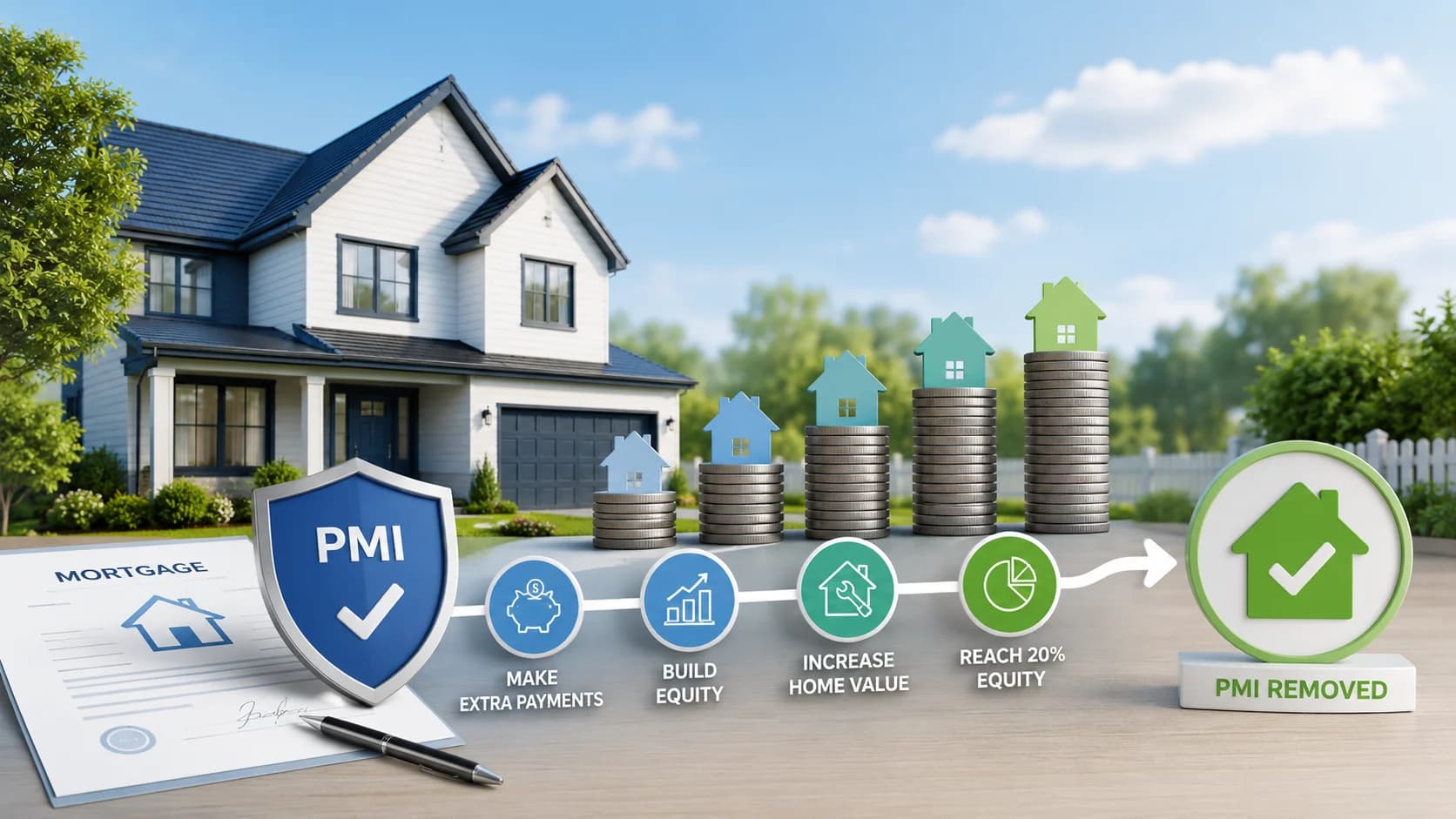
What Is PMI and How Do You Get Rid of It Faster?
Free Calculator
Mortgage Calculator
Table of Contents
What Is PMI and How Do You Get Rid of It Faster?

Photo: Pexels
Here's the number that catches most first-time buyers off guard: private mortgage insurance on a $300,000 mortgage can cost $375 a month if your credit score is below 620 (Bankrate, 2025). That's $4,500 a year for coverage that protects your lender, not you.
What is PMI? It's a mandatory fee attached to conventional mortgages when your down payment falls below 20%. In 2024, roughly 800,000 homeowners were assisted by private mortgage insurance, and about 65% of them were first-time buyers who simply couldn't hit that 20% threshold (USMI, 2024). The average first-time buyer put down just 9% in 2024 (NAR via Motley Fool, 2025), which means the majority entered homeownership with PMI attached. This guide covers exactly what PMI is, what it costs by credit score, and five concrete ways to remove it faster than your amortization schedule suggests.
Key Takeaways
- PMI protects the lender, not you, and costs 0.46%–1.5% of your loan per year (Bankrate, 2025).
- At a 7% rate with 10% down, PMI auto-cancels around Year 14 — but extra payments can cut that significantly.
- You can request cancellation at 80% LTV; your servicer must cancel automatically at 78% LTV under federal law.
- The PMI tax deduction was permanently restored for tax year 2026 under P.L. 119-21.
- Borrowers with 760+ scores pay as little as $115/month on a $300K loan vs. $375/month for scores below 620.
What Is PMI, Exactly?
Private mortgage insurance is a policy required by lenders on conventional loans when a borrower's down payment is less than 20%, meaning the loan-to-value ratio exceeds 80%. Despite the name, PMI protects the lender, not the borrower. If you default, the insurer compensates the lender for a portion of their loss. The legal framework governing when PMI must cancel is the Homeowners Protection Act (HPA), codified at 12 U.S.C. §4901 et seq., which Congress passed in 1998 specifically to stop lenders from collecting PMI indefinitely.
PMI is not the same as homeowners insurance, which protects you. It also differs from FHA mortgage insurance premiums (MIP), which we'll cover below. PMI is a pure risk-transfer product, and the moment your equity crosses the right threshold, federal law requires your servicer to remove it.
How Much Does PMI Cost?

Photo: Pexels
PMI costs between 0.46% and 1.5% of your loan amount per year, according to Urban Institute HFPC data cited by Experian. Freddie Mac puts it more concretely: expect to pay $30–$70 per month for every $100,000 you borrow (Freddie Mac, My Home, April 2026). On a $200,000 loan with 5% down, that works out to roughly $80.75 per month at a 0.51% rate.
Your credit score is the single biggest factor controlling where in that 0.46%–1.5% range you land. The gap between a 760+ score and a sub-620 score can triple your monthly PMI bill on the same loan. For a full monthly cost breakdown including PMI on a $400K purchase, see our real-numbers mortgage breakdown.
Monthly PMI Cost by Credit Score
| Loan Amount | 760+ (0.46%/yr) | 700-759 (~0.75%/yr) | 620-699 (~1.2%/yr) | Below 620 (~1.5%/yr) |
|---|---|---|---|---|
| $200,000 | $77/mo | $125/mo | $200/mo | $250/mo |
| $300,000 | $115/mo | $188/mo | $300/mo | $375/mo |
| $400,000 | $153/mo | $250/mo | $400/mo | $500/mo |
| $500,000 | $192/mo | $313/mo | $500/mo | $625/mo |
Source: Urban Institute HFPC rate ranges, confirmed by Bankrate and Experian. Monthly figures rounded to nearest dollar.
The $500,000 loan example is particularly striking. A borrower with a 760+ score pays $192 a month in PMI. A borrower with the exact same loan but a score below 620 pays $625. That's a $433 monthly difference — $5,196 a year — for identical loan protection.
Grouped bar chart showing PMI monthly costs at four credit score bands (760+, 700-759, 620-699, below 620) on a $300,000 loan: $115, $188, $300, and $375 per month respectively. Monthly PMI Cost by Credit Score — $300K Loan Monthly PMI ($) $115 760+ $188 700-759 $300 620-699 $375 Below 620 Credit Score Band Source: Urban Institute HFPC rates, confirmed by Bankrate and ExperianThe takeaway: improving your credit score before applying can reduce PMI costs by hundreds of dollars per month. Even moving from the 620-699 band to 700-759 cuts your PMI on a $300K loan from $300 to $188 monthly — a $1,344 annual saving.
Do You Actually Need PMI?
Not every low-down-payment loan carries PMI. Whether PMI applies depends on your loan type. Approximately 65% of private mortgage insurance purchasers in 2024 were first-time homebuyers (USMI, 2024), suggesting most buyers treat PMI as an unavoidable entry fee. But there are three routes that sidestep it entirely.
Conventional loans with less than 20% down require PMI. FHA loans carry a different product called Mortgage Insurance Premium (MIP). VA and USDA loans charge no mortgage insurance at all, though they do have funding fees. If a conventional loan is your path, a "piggyback" structure may also help.
Conventional PMI vs. FHA MIP: Side-by-Side
| Feature | Conventional PMI | FHA MIP |
|---|---|---|
| Who it protects | Lender | Lender |
| Required when | Down payment < 20% | All FHA loans |
| Upfront cost | None | 1.75% of loan amount |
| Annual cost | 0.46%–1.5%/yr | 0.55%–1.05%/yr (FHA 2024 reduction) |
| Can be cancelled? | Yes, at 80% LTV | Only if >10% down (after 11 years) |
| When does it end? | Auto-cancels at 78% LTV | Life of loan if <10% down |
| Tax deductible in 2026? | Yes (P.L. 119-21) | Yes (same law) |
The critical distinction: FHA MIP stays on the loan for life if you put down less than 10%. That means buyers using FHA with a 3.5% down payment will pay mortgage insurance every month for 30 years unless they refinance into a conventional loan later. Conventional PMI, by contrast, has a guaranteed exit under federal law.
The Piggyback Loan Option (80-10-10)
A piggyback loan structures your financing as 80% first mortgage, 10% second mortgage or HELOC, and 10% down payment. Because the first loan is exactly 80% LTV, no PMI is required on it. The trade-off: the second loan typically carries a higher interest rate, and you'll pay two sets of closing costs (Bankrate, Fairway).
Whether 80-10-10 beats paying PMI depends on the rate spread between your first and second loans. Run the numbers both ways before assuming a piggyback is cheaper.
When Does PMI Automatically Cancel?
Photo: Pexels
The Homeowners Protection Act sets two mandatory cancellation triggers. At 78% LTV (based on the original purchase price), your servicer must cancel PMI automatically without any action from you, provided your payments are current (NCUA HPA guide). A second safety net applies at the loan's midpoint: on a 30-year mortgage, PMI must end by month 180 regardless of your LTV, per CFPB guidance.
How long does it take to hit 78% LTV? That depends heavily on your interest rate. Higher rates mean more of each payment goes to interest and less to principal, which delays equity accumulation. The table below shows the dramatic effect of rate on auto-cancellation timing, assuming a 30-year loan with 10% down.
Years to Automatic PMI Cancellation (10% Down, 30-Year Loan)
| Interest Rate | Year PMI Auto-Cancels | Context |
|---|---|---|
| 3.0% | ~Year 9 | Historic low-rate era |
| 4.0% | ~Year 10 | Pre-2022 rate environment |
| 5.0% | ~Year 11 | Transitional period |
| 6.0% | ~Year 12 | 2022-2023 range |
| 7.0% | ~Year 14 | 2023-2024 peak rates |
Source: CFPB / NCUA HPA rules; standard amortization math. Assumes original purchase price as appraisal basis and no extra payments.
At 7%, a borrower with 10% down waits roughly 14 years for automatic cancellation. That same borrower at 3% would have seen PMI drop at Year 9. The difference in total PMI paid: potentially tens of thousands of dollars, depending on loan size and rate.
Citation Capsule: Under the Homeowners Protection Act (12 U.S.C. §4901 et seq.), lenders must automatically cancel private mortgage insurance when a conventional mortgage reaches 78% loan-to-value ratio based on the original purchase price, provided the borrower is current on payments. On a 30-year loan at 7%, that milestone arrives around Year 14 (CFPB / NCUA, standard amortization).
How long until your specific loan hits 78%? The free mortgage calculator can generate your full amortization schedule and show the exact month your PMI should automatically cancel.
How Do You Request PMI Cancellation Early?
You don't have to wait for automatic cancellation. The HPA lets you request PMI removal once your loan balance hits 80% LTV of the original purchase price, which arrives one to three years before the 78% automatic trigger. According to the CFPB, your servicer has 30 days to cancel after receiving a valid written request (CFPB). The process isn't automatic, but it's straightforward.
Here's how to request early PMI cancellation, step by step:
- Confirm your current LTV. Pull your most recent mortgage statement to find your outstanding principal balance. Divide it by your original purchase price. If the result is 0.80 or lower, you're eligible to request cancellation.
- Check your payment history. You must be current on your loan with no 30-day late payments in the past 12 months, and no 60-day late payments in the past 24 months. A history of on-time payments is required.
- Confirm no junior liens. Second mortgages or HELOCs on the property can disqualify a request. Check your records before contacting your servicer.
- Submit a written cancellation request. Send a letter or use your servicer's online portal. Include your loan number, current balance confirmation, and a statement that you meet the HPA criteria. Keep a copy with date of delivery.
- Provide evidence of value if required. For a standard payment-based request, no appraisal is needed. Your servicer must cancel within 30 days if you meet all criteria.
The Appraisal Route: Cancel Earlier Using Home Appreciation
What if your home's value has risen but your payments alone haven't yet reached 80% LTV? Federal rules allow appraisal-based early cancellation under specific conditions. If you've owned the home for at least 5 years, the property must reach 80% LTV based on the current appraised value. If you've owned it for at least 2 years, the bar is tighter: 75% LTV based on current value (NerdWallet).
A home appraisal costs $300–$500. If your home has appreciated enough to push your current LTV below 80% (or 75% at the two-year mark), paying for an appraisal to remove hundreds of dollars per month in PMI is almost always worth it.
How Can You Get Rid of PMI Even Faster?
Beyond the appraisal route, two strategies can meaningfully accelerate your timeline to PMI cancellation: extra principal payments and refinancing. Adding $200 a month in extra principal to a $300,000 loan at 6.5% can eliminate PMI approximately 18–24 months sooner, saving roughly $3,200–$5,400 in cumulative PMI payments. The math is simple but the impact is significant.
Extra Payment Acceleration Math
On a $380,000 loan at 7%, adding $500 a month in extra principal reaches 80% LTV approximately 2 years faster than standard payments alone. On a $300,000 loan at 6.5%, an extra $200 a month gets you to the same threshold 18–24 months earlier. The cumulative PMI savings at $188/month (700-759 credit score) over that 18 months: $3,384. Over 24 months: $4,512.
What's the right extra payment amount for your loan? The mortgage calculator lets you model different extra payment scenarios and see the exact month you'd cross the 80% LTV line. You can also use the loan calculator to compare total interest paid under different payoff timelines.
Refinancing to Remove PMI
Refinancing into a new loan resets the LTV calculation using the current appraised value. If your home has appreciated since purchase, the new loan may start at or below 80% LTV — meaning no PMI from day one. The catch: refinancing carries closing costs, typically 2%–5% of the new loan amount. You need a rate reduction or a PMI elimination large enough to justify those costs within a reasonable break-even period, usually 18–36 months.
Is PMI Tax Deductible in 2026?
Yes, and this is a development that very few mortgage articles have covered yet. The PMI tax deduction was permanently restored effective January 1, 2026, under the One Big Beautiful Bill Act, P.L. 119-21, signed July 4, 2025. This makes tax year 2026 (filed in spring 2027) the first year the deduction applies under the new permanent law (USMI).
The deduction is claimed on Schedule A as an itemized deduction, in the same section as mortgage interest. There is an income phase-out: the deduction begins to reduce at $100,000 adjusted gross income (AGI) and is fully eliminated at $110,000 AGI. For taxpayers above $110,000 AGI, the deduction provides no benefit.
Both conventional PMI and FHA MIP qualify under P.L. 119-21, so FHA borrowers can deduct their MIP premiums on the same terms. If you're on the income phase-out cusp, consult a tax professional about the specific calculation, as the reduction is prorated across the $10,000 AGI range.
Citation Capsule: The PMI tax deduction was permanently restored under the One Big Beautiful Bill Act, P.L. 119-21, effective January 1, 2026. Borrowers may deduct private mortgage insurance premiums on Schedule A, with a phase-out beginning at $100,000 AGI and full elimination at $110,000 AGI. Both conventional PMI and FHA MIP qualify (USMI, 2025).
Frequently Asked Questions
How long does PMI last on a 30-year mortgage?
At a 7% rate with 10% down, PMI auto-cancels around Year 14 based on standard amortization and HPA rules (CFPB / NCUA). At a 4% rate, you'd hit the same 78% LTV threshold around Year 10. You can request cancellation one to three years earlier by reaching 80% LTV and submitting a written request to your servicer.
Can my lender refuse to cancel PMI when I hit 80% LTV?
Your lender cannot refuse a valid cancellation request under the Homeowners Protection Act (12 U.S.C. §4901 et seq.). You must be current on payments, free of junior liens, and able to document the 80% LTV milestone. Once those conditions are met, the servicer has 30 days to cancel (CFPB). If they don't comply, you can file a complaint with the CFPB.
Is PMI worth it, or should I wait to buy?
In 2024, about 800,000 households used private mortgage insurance to buy homes they otherwise couldn't have purchased (USMI, 2024). PMI typically costs $115–$375 per month on a $300K loan (Bankrate, 2025). Whether that cost is worth entering the market sooner depends on local home price appreciation, your rental alternative, and how quickly you can reach 80% LTV through payments or appreciation.
You can also model extra payment scenarios and total interest cost with the loan calculator. Both tools are free, no sign-up required.
Sources
- USMI (U.S. Mortgage Insurers) — 800,000 homeowners assisted, 65% first-time buyers, $1.4 trillion in GSE mortgages with MI (2024): usmi.org
- USMI — PMI tax deductibility, P.L. 119-21: usmi.org/policy_priorities/mi-deductibility
- NAR via Motley Fool — First-time buyers averaged 9% down payment in 2024 (2025)
- Freddie Mac, My Home — PMI costs $30–$70/month per $100K borrowed; $80.75/month at 0.51% on $200K loan (April 2026): myhome.freddiemac.com/buying/breaking-down-pmi
- Bankrate — PMI $115–$375/month on $300K; $456/month vs. $119/month on $500K at 5% vs. 15% down (2025): bankrate.com/mortgages/basics-of-private-mortgage-insurance-pmi
- Urban Institute HFPC — Annual PMI rate range 0.46%–1.5% (via Experian)
- CFPB — Borrower-requested PMI cancellation at 80% LTV; 30-day servicer deadline; midpoint termination rule: consumerfinance.gov
- NCUA — HPA / PMI Cancellation Act compliance guide: ncua.gov
- NerdWallet — Appraisal-based early cancellation (75% LTV at 2 years; 80% LTV at 5 years); appraisal cost $300–$500; refinancing option: nerdwallet.com/mortgages/learn/how-to-cancel-private-mortgage-insurance
- Bankrate — Piggyback loan (80-10-10) structure and trade-offs: bankrate.com/mortgages/piggyback-loan
Further Reading
Related Calculators
Try these free calculators related to this article:
In-Depth Guides
Dive deeper with our comprehensive guides on this topic:
Frequently Asked Questions
Our Methodology
All PMI content on CalculatorApp.me is reviewed by subject-matter experts, cross-referenced with official sources, and updated regularly for accuracy. Our formulas and data are verified against industry standards and government publications.
Jordan Hayes
Verified AuthorPersonal Finance Content Strategist
Jordan is a personal finance content strategist with 9+ years writing about mortgages, retirement, tax strategy, and budgeting. Every guide is cross-referenced with IRS publications, Federal Reserve data, and CFPB guidance to make complex calculations accessible. Editor at CalculatorApp.me.
Found this helpful? Share it!
Stay Updated
Get notified when we launch new calculators and features.
No spam. Unsubscribe anytime.