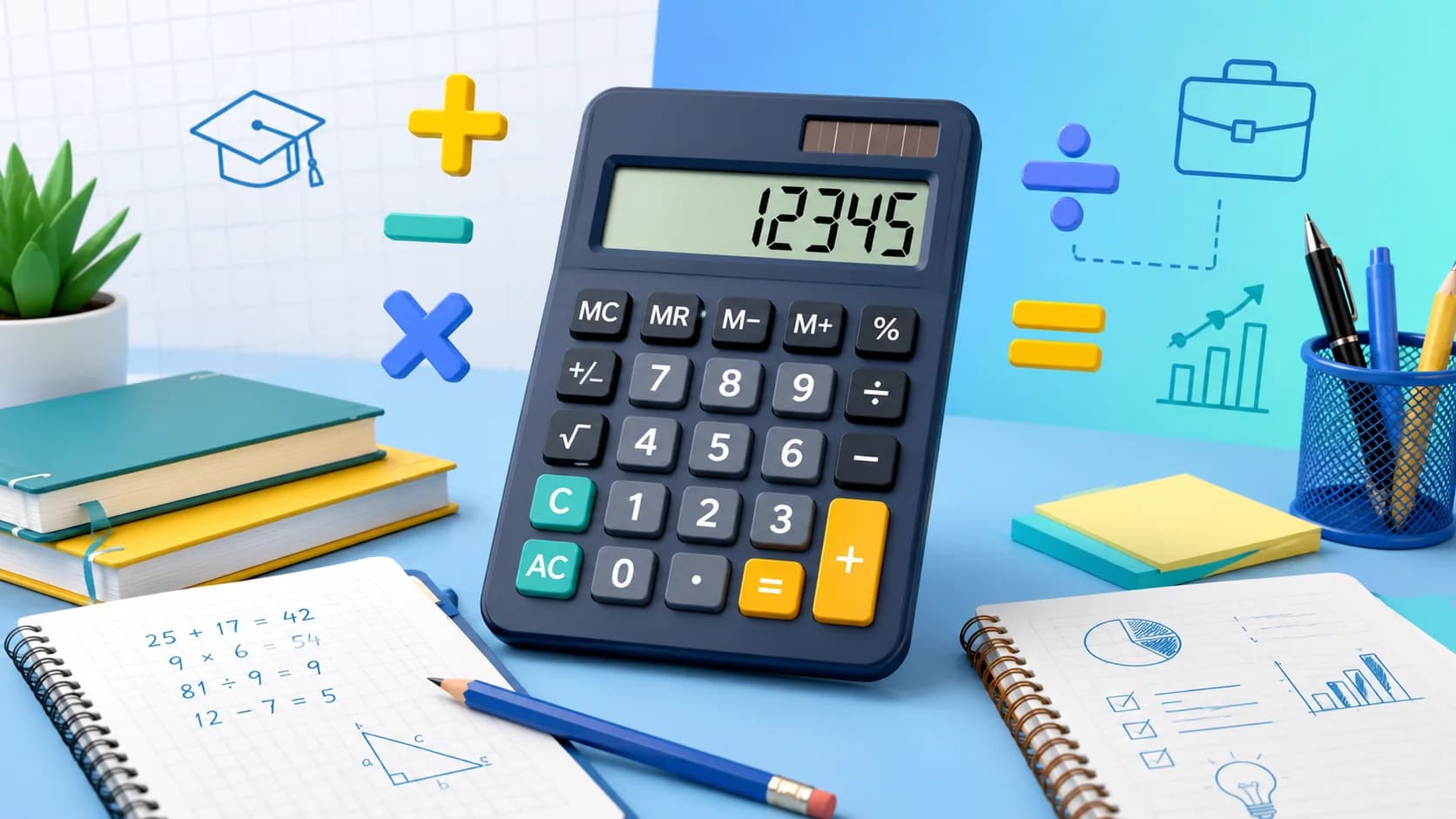
Basic Math Calculator for Students & Professionals
Free Calculator
Percentage Calculator
Table of Contents
Introduction
Whether you're a high school student tackling algebra homework, an engineering professional designing structures, or a business analyst crunching quarterly numbers, mathematics is fundamental to success. Yet even with strong mathematical knowledge, performing calculations manually or using outdated tools can lead to errors, waste precious time, and create unnecessary frustration.
This is where a modern math calculator becomes indispensable. Today's calculators aren't just simple addition machines—they're powerful computational tools designed specifically for students and professionals who need speed, accuracy, and reliability. According to research from the National Council of Teachers of Mathematics, proper use of technology enhances mathematical understanding.
In this comprehensive guide, we'll explore why investing in a quality math calculator is one of the smartest decisions you can make for your academic or professional journey.
Why Math Calculators Matter More Than Ever
The Evolution of Mathematical Tools
We live in an era of unprecedented computational power. From graphing calculators to sophisticated online calculation platforms, the tools available today would have amazed mathematicians from just a generation ago. Yet many students and professionals still rely on outdated methods or inadequate tools. Research from Khan Academy shows that technology-enhanced learning improves student outcomes when used strategically.
A comprehensive math calculator bridges the gap between theoretical knowledge and practical application. It allows you to focus on understanding concepts rather than getting bogged down in tedious arithmetic.
Accuracy Matters
One calculation error can cascade through an entire project. Whether you're:
- Solving a system of equations for engineering coursework
- Computing financial projections for stakeholders
- Analyzing statistical data for research
- Converting units for scientific experiments
A single mistake can undermine hours of work. Modern calculators virtually eliminate this risk through verified algorithms and multiple calculation checks.
Who Benefits From Math Calculators?
📚 Students
From algebra and calculus to statistics and discrete mathematics, students use calculators to verify homework, explore complex concepts, and check their work before submission.
👨💼 Professionals
Engineers, accountants, data analysts, and business professionals rely on calculators for precise computations that directly impact their decisions and deliverables.
🔬 Researchers
Scientists and academics use calculators for complex statistical analysis, unit conversions, and data interpretation in their research work.
💰 Business Users
Entrepreneurs and financial professionals need quick, accurate calculations for budgeting, forecasting, and financial analysis.
Essential Features of Modern Math Calculators
1. Comprehensive Function Library
A quality calculator with comprehensive functions should handle far more than basic arithmetic. Look for tools that support:
- Trigonometric functions (sine, cosine, tangent)
- Logarithmic and exponential calculations
- Matrix operations and determinants
- Polynomial solving
- Statistical functions (mean, median, standard deviation)
- Complex number operations
2. User-Friendly Interface
Even the most powerful calculator is useless if it's difficult to use. The best calculators feature intuitive interfaces that require minimal learning curve while remaining powerful for advanced users.
💡 Pro Tip
Look for calculators with a history feature that keeps track of your previous calculations. This helps you verify your work and maintain a record of your computational steps.
3. Multiple Input Modes
Modern calculators support various input methods:
- Standard notation: 2 + 2 = 4
- Scientific notation: For very large or small numbers
- Fractions: Direct fraction input and output
- Degrees and radians: Flexibility for trigonometry
4. Real-Time Visualization
The best calculators don't just give you answers—they show you the steps. Seeing the computational process helps you understand the mathematics better and catch potential input errors before they affect your final result.
5. Mobile and Desktop Accessibility
In our connected world, you need your calculator everywhere. Top-tier math calculators work seamlessly across smartphones, tablets, and computers, synchronizing your calculations whenever needed.
Common Use Cases and Applications
Academic Excellence
Research and Development
Researchers conduct statistical analyses, manage datasets, and perform complex mathematical modeling that would be impractical without sophisticated calculation tools.
Financial Planning
Calculate loan payments, investment returns, compound interest, and budget projections with confidence. A good calculator helps you make informed financial decisions.
Choosing the Right Math Calculator for Your Needs
For Students (All Levels)
Start with a calculator that covers your current curriculum with room for advanced functions you might need later. Look for tools that show step-by-step solutions—invaluable for learning. According to education research, calculators with visible working steps improve comprehension and problem-solving skills.
For Professional Users
Prioritize speed, accuracy, and specialized functions relevant to your field. A data analyst needs different features than an engineer, so choose accordingly. Visit our platform to explore specialized tools tailored to your industry.
For Specialized Fields
Some calculators excel in specific domains. Evaluate options based on whether you need:
- Scientific/engineering calculations
- Statistical analysis
- Financial computations
- Unit conversions
- Graphing capabilities
Beyond Basic Calculations: Advanced Benefits
Building Computational Confidence
When you know your calculations are accurate, you can focus on higher-order thinking—problem analysis, strategy development, and innovation. This is where real value emerges.
Saving Time Without Sacrificing Quality
Speed in calculation translates to more projects completed, more analyses conducted, and more time for strategic thinking. In professional settings, this efficiency directly impacts productivity and bottom-line results.
Error Prevention
Calculation errors are costly. One misplaced decimal point can invalidate weeks of work. Modern calculators prevent these costly mistakes through verification algorithms and clear result presentation.
The Future of Mathematical Calculation
Artificial intelligence and machine learning are revolutionizing how we approach calculations. Next-generation calculators offer:
- Intelligent problem interpretation
- Natural language input ("What's 15% of 200?")
- Contextual suggestions for related calculations
- Advanced graphing and visualization
- Integration with other productivity tools
As these technologies evolve, the line between simple calculators and advanced mathematical software continues to blur, creating opportunities for better problem-solving across all domains.
Ready to Transform Your Mathematical Workflow?
Experience the difference a modern, comprehensive math calculator can make for your studies or career.
Start Calculating Now →Frequently Asked Questions
Conclusion
In a world of increasing complexity and mathematical demands, the right tools make all the difference. A comprehensive math calculator isn't a crutch—it's a catalyst for better understanding, faster problem-solving, and more confident decision-making.
Whether you're a student seeking academic excellence, a professional pursuing career advancement, or a researcher pushing boundaries, a modern math calculator deserves a place in your toolkit.
The investment in a quality calculator pays dividends through improved accuracy, saved time, and enhanced confidence in your mathematical work. Don't let manual calculations hold you back from achieving your full potential.
Start exploring how our calculator can transform your approach to mathematics today.
About This Topic
Mathematical calculation is at the heart of education and professional success. Whether you're navigating algebra, engineering, finance, or data science, having reliable computational tools is essential. Our platform brings together comprehensive functionality, ease of use, and precision to serve students and professionals at every level.
Related Calculators
Try these free calculators related to this article:
In-Depth Guides
Dive deeper with our comprehensive guides on this topic:
Frequently Asked Questions
Our Methodology
All calculator content on CalculatorApp.me is reviewed by subject-matter experts, cross-referenced with official sources, and updated regularly for accuracy. Our formulas and data are verified against industry standards and government publications.
Jordan Hayes
Verified AuthorPersonal Finance Content Strategist
Jordan is a personal finance content strategist with 9+ years writing about mortgages, retirement, tax strategy, and budgeting. Every guide is cross-referenced with IRS publications, Federal Reserve data, and CFPB guidance to make complex calculations accessible. Editor at CalculatorApp.me.
Found this helpful? Share it!
Stay Updated
Get notified when we launch new calculators and features.
No spam. Unsubscribe anytime.