Concrete Calculator: How to Calculate Bags for Slabs, Columns & Footings
Free Calculator
Concrete Cost Calculator
Table of Contents
Why One Concrete Formula Does Not Fit All Projects
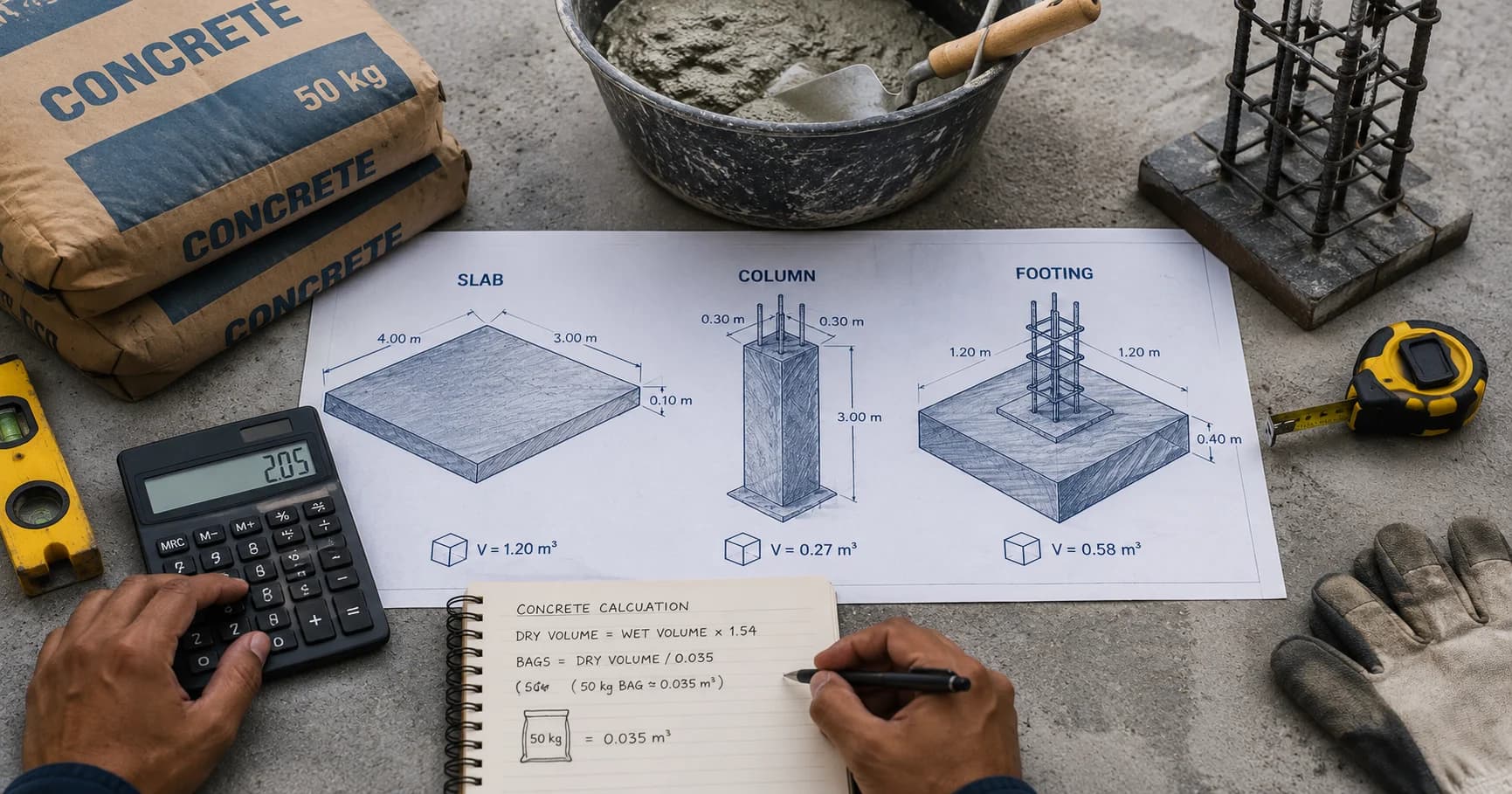
The single most common mistake on concrete projects is using the wrong formula for the job type. A slab is calculated differently from a column, which is calculated differently from a footing. Getting it wrong means running out of concrete mid-pour — or ordering expensive excess.
This guide walks through the exact calculation for each project type, the material quantities that result, and how to account for waste and overage. Use our Concrete Calculator to run the numbers for your specific dimensions.
The Core Principle: Volume in Cubic Metres (or Cubic Yards)
All concrete calculations start with volume. The shape of your project determines how you calculate that volume, but the unit is always cubic metres (m³) in metric or cubic yards (yd³) in imperial.
Once you have the volume, you convert to bags or ready-mix trucks using the yield of your concrete mix.
Standard bag yields:
- 20 kg bag → yields approximately 0.009 m³ (about 10 litres)
- 25 kg bag → yields approximately 0.011 m³
- 40 kg bag → yields approximately 0.018 m³
- 60 lb bag (imperial) → yields approximately 0.45 cubic feet
- 80 lb bag (imperial) → yields approximately 0.60 cubic feet
Ready-mix concrete is sold in cubic metres (metric) or cubic yards (imperial). One cubic yard = 0.765 m³.
How to Calculate Concrete for a Slab
Slabs are the most common pour — driveways, patios, floors, walkways.
Formula: Volume = Length × Width × Thickness
All measurements must be in the same unit. Work in metres for the metric formula.
Worked Example: 4m × 3m Patio Slab, 100mm Thick
Volume = 4 m × 3 m × 0.1 m = 1.2 m³
Add 10% for waste and overpour: 1.2 × 1.10 = 1.32 m³
Bags of 20 kg concrete mix needed: 1.32 ÷ 0.009 = 147 bags
Or order: 1.4 m³ of ready-mix (round up to next 0.25 m³ increment)
Standard Slab Thicknesses
| Application | Recommended Thickness |
|---|---|
| Pedestrian walkway | 75–100 mm (3–4 in) |
| Residential patio / driveway (light vehicles) | 100 mm (4 in) |
| Driveway with heavy vehicle access | 125–150 mm (5–6 in) |
| Garage floor | 100–125 mm (4–5 in) |
| Industrial floor (forklift traffic) | 150–200 mm (6–8 in) |
How to Calculate Concrete for a Column
Columns are cylindrical — fence posts, deck posts, structural columns. The formula uses π (pi).
Formula: Volume = π × r² × Height
Where r = radius (half the diameter). Use 3.14159 for π.
Worked Example: Round Fence Post Footing, 300mm Diameter, 600mm Deep
Radius = 0.15 m (300 mm ÷ 2)
Volume = 3.14159 × (0.15)² × 0.6
Volume = 3.14159 × 0.0225 × 0.6 = 0.042 m³ per post
For 10 fence posts: 0.042 × 10 = 0.42 m³
Add 10% waste: 0.42 × 1.10 = 0.46 m³
Bags of 20 kg mix: 0.46 ÷ 0.009 = 51 bags
Standard Column/Post Sizing
| Post Type | Typical Diameter | Typical Depth |
|---|---|---|
| Light fence post (1.2m fence) | 200–250 mm | 450–600 mm |
| Standard fence post (1.8m fence) | 250–300 mm | 600–750 mm |
| Deck post (single storey) | 300–400 mm | 600–900 mm |
| Structural column (two storey) | 400–600 mm | 900–1200 mm |
How to Calculate Concrete for a Foundation Footing
Footings are rectangular (or square) and support structural loads. They sit below grade and carry walls or columns.
Formula: Volume = Length × Width × Depth
For a continuous strip footing (running under a wall), treat it as one long slab with the footing width and depth as thickness.
Worked Example: Strip Footing for a 10m Wall, 450mm Wide, 300mm Deep
Volume = 10 m × 0.45 m × 0.30 m = 1.35 m³
Add 10% waste: 1.35 × 1.10 = 1.485 m³
Order 1.5 m³ of ready-mix
Worked Example: Square Pad Footing, 600mm × 600mm × 300mm Deep
Volume = 0.6 m × 0.6 m × 0.3 m = 0.108 m³
Add 10% waste: 0.108 × 1.10 = 0.12 m³
Bags of 20 kg mix: 0.12 ÷ 0.009 = 13 bags
How Much Waste to Add? The 10% Rule Explained
Always add a waste factor to your concrete order. The standard recommendation is 10% for slabs and footings, 15% for columns and complex shapes. Here is why:
- Excavation irregularity: Hand-dug trenches and post holes are never perfectly sized. A trench dug to 300mm is often 320–340mm in places.
- Formwork deflection: Timber formwork bows slightly under concrete pressure, adding volume.
- Spillage and overfill: Some concrete is lost during transit from mixer to pour.
- Finishing screed layer: Screeding removes excess but requires extra material to fill low spots.
For jobs smaller than 0.5 m³, add 15–20% because waste percentage is higher on small pours. For jobs over 5 m³ with accurate formwork, 7–8% is sufficient.
Concrete Mix Ratios: What Grade Do You Need?
| Application | Mix Ratio (cement:sand:aggregate) | Grade (MPa) |
|---|---|---|
| Non-structural: garden paths, small slabs | 1:3:6 | C15 (15 MPa) |
| Residential slabs and driveways | 1:2:4 | C20 (20 MPa) |
| Footings, lintels, retaining walls | 1:1.5:3 | C25 (25 MPa) |
| Structural columns, beams | 1:1:2 | C30 (30 MPa) |
| High-strength structural (engineered) | Design mix required | C35–C50 |
For most DIY projects — driveways, patios, fence posts — a C20 or pre-mixed 20 MPa bagged concrete is appropriate. For any structural application (load-bearing walls, foundations for multi-storey buildings), consult a structural engineer.
Imperial Conversion: Cubic Yards and 60/80 lb Bags
If you are in the US and working in imperial units:
Slab formula (imperial): Volume (cubic yards) = (Length ft × Width ft × Thickness ft) ÷ 27
Example: 12 ft × 16 ft slab, 4 inches (0.333 ft) thick
Volume = (12 × 16 × 0.333) ÷ 27 = 63.94 ÷ 27 = 2.37 cubic yards
Add 10%: 2.37 × 1.10 = 2.6 cubic yards
80 lb bags needed: 2.6 cubic yards × 27 cubic feet/yard ÷ 0.60 cubic feet/bag = 117 bags
Ready-Mix vs Bagged Concrete: When to Choose Each
| Volume | Recommended Approach | Reason |
|---|---|---|
| Under 0.3 m³ (under 0.4 yd³) | Bagged concrete | Ready-mix minimum orders typically 0.5–1.0 m³. Small pours cheaper with bags. |
| 0.3–1.0 m³ (0.4–1.3 yd³) | Bagged or mini-mix | Mini-mix trucks are available in some areas for small pours. Compare cost. |
| Over 1.0 m³ (over 1.3 yd³) | Ready-mix truck | More economical above this volume, better quality control, faster pour. |
| Over 5 m³ (over 6.5 yd³) | Ready-mix with pump | For large slabs or difficult access, a concrete pump truck saves significant labour. |
Use Our Concrete Calculators
- Concrete Calculator — Volume, bags, and mix for any shape
- Concrete Quantity Calculator — Bags, water, sand and aggregate breakdown
- Concrete Cost Calculator — Total project cost including labour and materials
- Foundation Size Estimator — Recommended footing dimensions by load
Related Calculators
Try these free calculators related to this article:
In-Depth Guides
Dive deeper with our comprehensive guides on this topic:
Frequently Asked Questions
Our Methodology
All construction content on CalculatorApp.me is reviewed by subject-matter experts, cross-referenced with official sources, and updated regularly for accuracy. Our formulas and data are verified against industry standards and government publications.
Jordan Hayes
Verified AuthorPersonal Finance Content Strategist
Jordan is a personal finance content strategist with 9+ years writing about mortgages, retirement, tax strategy, and budgeting. Every guide is cross-referenced with IRS publications, Federal Reserve data, and CFPB guidance to make complex calculations accessible. Editor at CalculatorApp.me.
Found this helpful? Share it!
Stay Updated
Get notified when we launch new calculators and features.
No spam. Unsubscribe anytime.