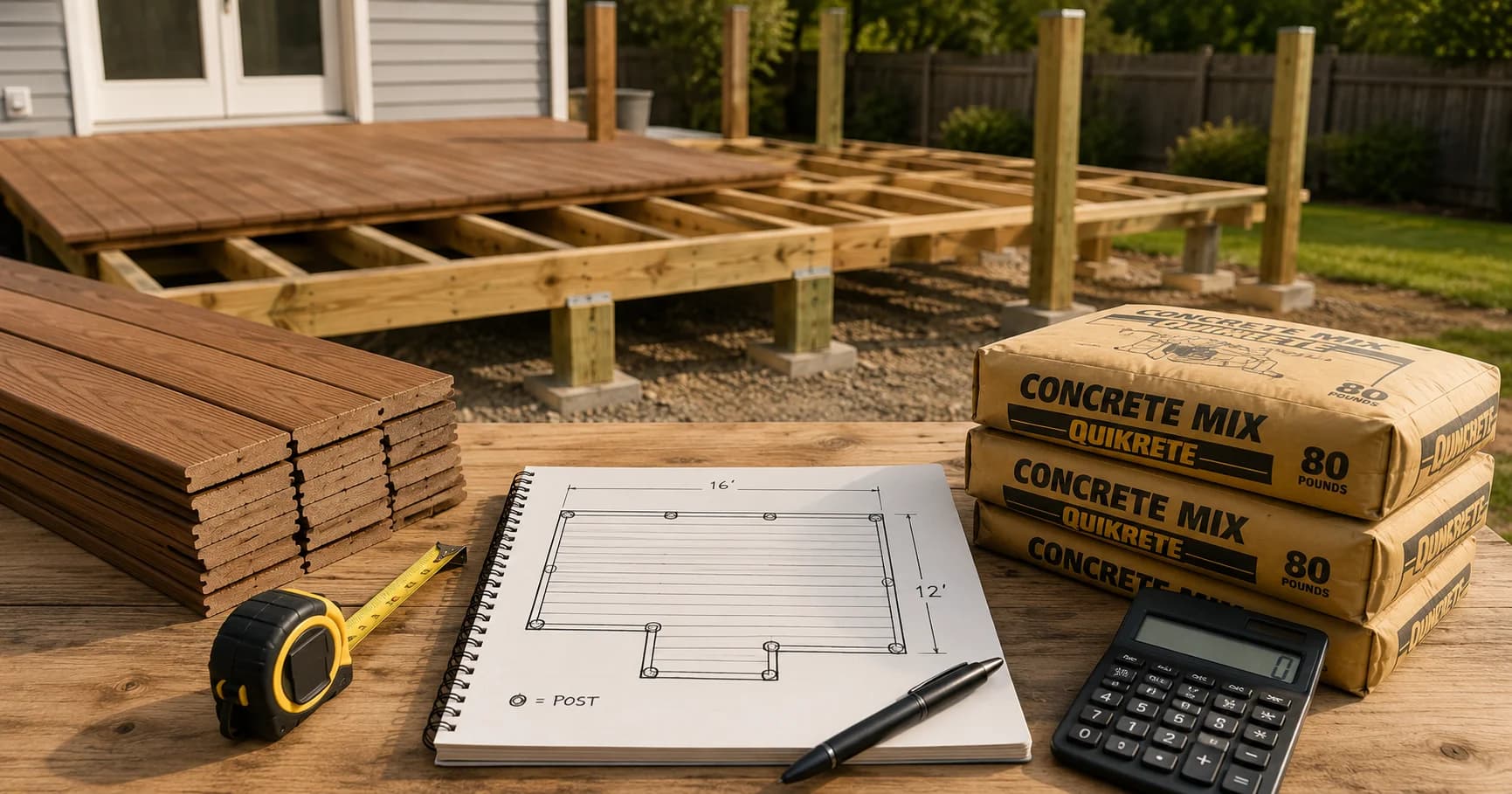
Deck Calculator: How Many Boards, Posts & Bags of Concrete Do You Need?
Free Calculator
Concrete Calculator
Table of Contents
The Calculation That Trips Up Every DIY Deck Builder
You measure the backyard, pick a deck size, and head to the lumber yard — then realize you have no idea how many boards to buy, how many posts you need, or how many bags of concrete it takes to keep it standing. Most people guess and end up making two extra trips.
Our deck calculator does all of this in one step. This guide explains the math behind it so you understand exactly what you're buying and why.
How Many Deck Boards Do You Need?
Deck boards are sold by linear foot, but you're covering square footage. The conversion depends on the actual face width of each board after spacing gaps are accounted for.
The Formula
Total linear feet = (Deck area ÷ Board face width) × Waste factor
For a 12×16 ft deck (192 sq ft) using 5/4×6 deck boards (actual face width: 5.5 inches = 0.458 ft):
192 ÷ 0.458 = 419 linear feet
Add 10% waste: 419 × 1.10 = 461 linear feet
With boards cut to 12 ft: 461 ÷ 12 = 39 boards → buy 40.
Waste Factor by Project Type
| Situation | Recommended Waste Factor |
|---|---|
| Straight run, clean cuts | 10% |
| One angle or notch cut | 12% |
| Multiple angles or complex shape | 15% |
| Picture-frame border design | 18–20% |
Board Spacing
Pressure-treated wood shrinks as it dries. Install green lumber tight and the boards will shrink to a natural 1/8" gap. For pre-dried boards, leave a deliberate 1/8" gap using a nail as a spacer. The deck calculator accounts for your spacing choice automatically.
How Many Deck Posts Do You Need?
Post spacing depends on the span rating of your joists and beams. Common guidelines:
- Deck boards: max 24" between joists (16" OC is safer for 5/4 boards)
- Joists: 2×8 joists can span up to 12 ft with posts 8 ft apart
- Beams: 4×8 beams can span 8–10 ft between posts
Post Count Example
For a 12×16 deck with joists running the 16-ft direction, 8-ft post spacing:
- Rows along 16 ft: (16 ÷ 8) + 1 = 3 rows
- Columns along 12 ft: (12 ÷ 6) + 1 = 3 columns
- Total: 9 posts (verify against your local span tables)
How Many Bags of Concrete Per Post?
Each post needs a concrete footing below the frost line. Frost line depth varies by location — get the requirement from your local building department.
| Frost Depth | Tube Diameter | Hole Depth | 60-lb Bags Per Footing |
|---|---|---|---|
| 0–12 in (South) | 8 in | 24 in | 1–2 bags |
| 12–24 in (Mid) | 10 in | 36 in | 2–3 bags |
| 24–42 in (North) | 12 in | 48 in | 3–5 bags |
Worked Example: 9 Posts, Midwest Frost Line
- Hole: 10-in diameter, 36 in deep
- Volume per hole: π × (5 in)² × 36 in = 2,827 cu in = 1.64 cu ft
- One 60-lb bag fills ~0.45 cu ft
- Bags per hole: 1.64 ÷ 0.45 = 3.6 → buy 4 bags per post
- Total for 9 posts: 36 bags of 60-lb concrete
Always buy 10% extra — running out mid-pour is a serious problem.
Deck Materials: Pressure-Treated vs Composite vs Hardwood
Choosing your decking material is one of the biggest decisions you'll make — it affects upfront cost, long-term maintenance, appearance, and lifespan. Here is how the three most popular options compare in 2026.
| Material | Cost per Sq Ft (installed) | Lifespan | Maintenance Level | Best For |
|---|---|---|---|---|
| Pressure-Treated Pine | $8–$15 | 15–25 years | Medium (seal every 2–3 years) | Budget builds, DIY projects |
| Composite (Trex, TimberTech) | $18–$38 | 25–50 years | Low (wash annually) | Low-maintenance, high-traffic decks |
| Hardwood (Ipe, Tigerwood) | $25–$50 | 40–75 years | Medium-High (oil every 1–2 years) | Premium aesthetics, coastal climates |
When to Choose Pressure-Treated Wood
Pressure-treated (PT) lumber is the go-to for most DIY deck builders. It is factory-infused with preservatives that resist rot, insects, and moisture. PT pine is widely available, easy to work with standard tools, and the least expensive option. The main trade-off is maintenance: you need to let new PT lumber dry for 6–12 months before applying a sealer, then reseal every 2–3 years to prevent checking and graying. PT lumber is also prone to warping if not properly stacked and stored before installation.
When to Choose Composite Decking
Composite decking — brands like Trex, TimberTech, and Fiberon — is made from a blend of recycled wood fiber and plastic. The higher upfront cost is offset by dramatically lower maintenance: no staining, no sealing, and no splinters. Composite boards come in realistic wood-grain colors and resist fading, staining, and mold. They are the best choice for families with children, high-traffic outdoor entertaining spaces, or homeowners who simply do not want to perform annual deck maintenance. Note that composite requires hidden fastener systems that add slightly to installation time and cost.
When to Choose Hardwood
Tropical hardwoods like Ipe (Brazilian Walnut), Cumaru, and Tigerwood are extraordinarily dense and durable — some species are rated to last 75+ years with proper care. They offer a rich, exotic appearance that composite cannot replicate. The downsides are cost, availability, and the need for specialized drill bits and pre-drilling (the wood is so hard it will split screws). Hardwoods also require annual or biannual oiling to maintain their color. For premium residential and commercial projects where aesthetics and longevity are the priority, hardwood is unmatched.
Joist Spacing and Span Tables
Joist spacing is not just a structural decision — it directly affects how many deck boards you need and how rigid the finished deck feels underfoot. Understanding span tables before you buy lumber can save hundreds of dollars and prevent structural failures.
16-Inch OC vs 12-Inch OC Spacing
16 inches on-center (OC) is the standard for most residential decks using 5/4×6 or 2×6 deck boards. It uses fewer joists and is code-compliant for the most common spans.
12 inches on-center is used when decking boards run at a 45-degree angle (diagonal installation requires closer joist spacing), or when using thinner composite boards that need additional support. Tighter spacing adds stiffness and reduces the "bounce" feeling on a large deck.
Maximum Joist Spans by Lumber Dimension (Southern Yellow Pine, #2 Grade)
| Lumber Size | Joist Spacing 12" OC | Joist Spacing 16" OC | Joist Spacing 24" OC |
|---|---|---|---|
| 2×6 | 10 ft 9 in | 9 ft 11 in | 8 ft 1 in |
| 2×8 | 14 ft 2 in | 12 ft 10 in | 10 ft 6 in |
| 2×10 | 17 ft 9 in | 16 ft 1 in | 13 ft 2 in |
Note: Spans are for visually graded lumber. Always verify against the IRC span tables or your local building code, which may differ by species and grade.
Why Joist Spacing Affects Board Count
If you switch from 16" OC to 12" OC joist spacing, you will need approximately 33% more joists for the same deck area. For a 12×16 ft deck:
- At 16" OC: approximately 13 joists (plus rim joists)
- At 12" OC: approximately 17 joists (plus rim joists)
Factor this into your materials list before purchasing. The deck calculator adjusts the joist count automatically based on your selected spacing and deck dimensions.
Deck Building Permit Requirements in 2026
Skipping a permit is one of the most common and costly mistakes DIY deck builders make. An un-permitted deck can cause problems when you sell your home — buyers' inspectors will flag it, and you may be required to tear it down or retroactively permit it at significant expense.
When Is a Permit Required?
Requirements vary by municipality, but the most common thresholds in 2026 are:
- Deck area greater than 200 sq ft — most jurisdictions require a permit above this size
- Deck height greater than 30 inches above grade — elevated decks almost universally require permits
- Attached decks — any deck ledger-bolted to a house structure typically requires a permit regardless of size
- Decks with roofs or enclosed areas — always require permits and often a separate electrical permit if lighting is involved
Small, freestanding ground-level platforms under 200 sq ft may be exempt in many areas — but always verify with your local building department before starting construction.
Typical Permit Costs
| Deck Size | Typical Permit Cost | Processing Time |
|---|---|---|
| Under 200 sq ft (if required) | $50–$100 | 1–2 weeks |
| 200–400 sq ft | $100–$200 | 2–4 weeks |
| 400–600 sq ft | $150–$300 | 3–6 weeks |
| 600+ sq ft or complex | $300+ | 4–8 weeks |
Setback and Height Rules
Setbacks are minimum distances your deck must maintain from property lines, easements, and existing structures. Common setbacks range from 5 to 15 feet from the property line. Check your property survey and local zoning ordinance before finalizing your deck placement.
Height limits vary. Most residential zones allow decks up to 30 inches above grade without a railing requirement, but taller decks require code-compliant railings (typically 36 inches high for decks under 30" and 42 inches for decks 30" and above).
Required inspections typically include: footing inspection (before concrete is poured), framing inspection (before decking is installed), and final inspection. Budget 2–4 weeks for permit approval before breaking ground.
How Much Does It Cost to Build a Deck in 2026?
Deck construction costs have remained elevated following post-pandemic lumber price volatility, though prices have stabilized somewhat in 2025–2026. Here is a realistic breakdown by deck size and build type.
Materials Cost Breakdown for a 12×16 Deck (192 sq ft)
| Material | Qty | Unit Cost | Total |
|---|---|---|---|
| 5/4×6×12 pressure-treated boards | 40 | $8–$14 | $320–$560 |
| 2×8×12 joists (16" OC) | 10 | $12–$18 | $120–$180 |
| 4×4×8 posts | 9 | $10–$15 | $90–$135 |
| Concrete (60-lb bags) | 36 | $5–$7 | $180–$252 |
| Post bases + hardware | 9 sets | $8–$15 | $72–$135 |
| Deck screws (5 lb box) | 2 | $25–$35 | $50–$70 |
| Total materials | $830–$1,330 |
Total Project Cost Examples by Deck Size (Materials + Labor)
| Deck Size | Sq Ft | DIY Material Cost | Contractor Total (Installed) |
|---|---|---|---|
| 10×10 | 100 sq ft | $450–$750 | $2,200–$4,500 |
| 12×16 | 192 sq ft | $830–$1,330 | $4,000–$8,500 |
| 16×20 | 320 sq ft | $1,400–$2,200 | $6,500–$14,000 |
Labor Cost Breakdown
Professional deck contractors in 2026 typically charge $15–$35 per square foot for the total installed project (materials plus labor). This wide range reflects:
- Material choice: PT pine is at the low end; composite or hardwood pushes cost to $35–$60/sq ft installed
- Deck height and complexity: Elevated decks with stairs, railings, or multi-level designs cost significantly more
- Regional labor markets: Contractors in major metro areas (NYC, LA, Chicago) charge 40–60% more than rural areas
- Permit and inspection fees: These are usually passed through to the homeowner at cost
DIY builders can save $3,000–$12,000 on a mid-size deck compared to hiring a contractor, but should budget extra time for permit approval, inspections, and the learning curve on framing and post-setting.
Use the deck calculator to get your personalized materials list and cost estimate →
Common Deck Calculation Mistakes
Forgetting the ledger board. If the deck attaches to your house, the house wall acts as one beam. You still need a ledger board lag-bolted to the rim joist, but you only need posts on the outer perimeter — not the house side.
Not checking span tables. Joist and beam spans depend on wood species and grade. Southern Yellow Pine spans differently than Douglas Fir. Your building permit office has the required span tables — get them before buying lumber.
Buying green lumber without accounting for shrinkage. Green pressure-treated lumber can be 25–30% moisture. It will shrink and warp. Buy kiln-dried if possible, or install tight joints and plan for a gap to develop.
Under-sizing the footing. A footing too shallow will heave in freeze-thaw cycles and eventually lift your posts. The frost depth rule is not optional — it's the #1 reason DIY decks fail long-term.
Deck Maintenance Checklist
A well-maintained deck lasts significantly longer than a neglected one. Use this annual checklist to catch problems early and extend the life of your investment.
Annual Inspection Items
- Check all fasteners: Look for popped screws, corroded nails, or loose hardware. Replace any fasteners showing rust — corrosion weakens holding power and can stain your boards.
- Inspect posts and footings: Look for post movement, concrete cracks, or signs of heaving. Press a screwdriver into the base of each post — soft or punky wood indicates rot.
- Test railings and stairs: Apply lateral force to railings — they should not flex or wobble. Check stair stringers for cracks at the notches, which are high-stress points.
- Examine the ledger connection: Look for gaps between the ledger and house, signs of moisture intrusion, or rust at the lag bolt locations. Water infiltration at the ledger is the #1 cause of deck collapses.
- Inspect decking boards: Check for cracks, splits, soft spots, cupping, or excessive warping. Individual boards can often be replaced without rebuilding the entire deck.
- Clear debris: Remove leaves, dirt, and debris from between boards. Trapped organic matter holds moisture and accelerates rot.
When to Seal or Stain vs. Replace Boards
Seal or stain when: The wood is still structurally sound but has grayed, is starting to crack on the surface, or water no longer beads on the surface (the water bead test). For pressure-treated decks, plan to seal every 2–3 years. For hardwood, apply penetrating oil annually. A quality deck sealant or stain costs $30–$60 per gallon and covers 200–400 sq ft per coat.
Replace boards when: Individual boards show deep cracks, soft spots, rot, or severe warping that creates a trip hazard. Spot replacement is cost-effective — you rarely need to replace the entire deck surface if the framing is sound.
Signs of Rot — Act Immediately
- Wood feels spongy or compresses easily under a screwdriver tip
- Discolored, dark patches that don't wash off
- Visible fungal growth (white, gray, or brown filaments)
- A musty or earthy smell when boards are disturbed
Surface rot can sometimes be treated with a wood hardener and fungicide, but structural rot in posts, beams, or joists requires full replacement of the affected members. Never attempt to paint or seal over rot — it will continue to spread beneath the finish.
5-Year and 10-Year Maintenance Milestones
- Year 5: Sand and refinish the deck surface; re-torque all lag bolts and through-bolts; consider re-flashing the ledger if not done during original build
- Year 10: Full structural inspection by a licensed contractor; replace any hardware showing significant corrosion; evaluate whether composite replacement boards make sense for sections with high wear
Related Construction Calculators
- Concrete Calculator — bags for any pour, not just footings
- Tile Calculator — coverage and waste for floor and wall tile
- Staircase Calculator — rise, run, and tread count for deck stairs
- Paint Coverage Calculator — gallons for any surface
Frequently Asked Questions
How many deck boards do I need for a 12×16 deck?
For a 12×16 ft deck (192 sq ft) using standard 5/4×6 pressure-treated boards, you need approximately 40 boards at 12 ft lengths, including a 10% waste allowance. If you use 16 ft boards, you'll need approximately 30. Always add 10–15% for waste, especially if you're cutting angles or a picture-frame border.
How deep do deck post footings need to be?
Deck post footings must extend below the local frost line. In southern states with frost depth under 12 inches, 24-inch-deep footings are common. In the Midwest, frost depth reaches 36–42 inches, requiring deeper footings. In northern regions like Minnesota or Maine, footings may need to be 48 inches or deeper. Check with your local building department for the required frost depth in your area — it is non-negotiable from a code standpoint.
Do I need a permit to build a deck?
Most jurisdictions require a permit for decks larger than 200 sq ft or more than 30 inches above grade. Attached decks (ledger-bolted to the house) nearly always require a permit regardless of size. Permit costs range from $50 to $300 depending on your municipality and deck size. Always check with your local building department before starting — un-permitted decks can create problems at resale.
What is the best joist spacing for a deck?
For standard 5/4×6 pressure-treated or composite deck boards running perpendicular to joists, 16 inches on-center is the most common and code-compliant spacing. Use 12 inches OC if you are installing boards diagonally (45°) or using thinner composite decking that requires more support. Closer spacing adds rigidity but increases your joist material cost by roughly 25–33%.
How many bags of concrete do I need per deck post?
The number of bags depends on your frost depth and tube diameter. For a Midwest climate with a 10-inch diameter tube at 36 inches deep, you need approximately 4 bags of 60-lb concrete per post. For southern climates with 8-inch tubes at 24 inches deep, 1–2 bags per post is typical. Always buy 10% extra — running short during a pour forces you to stop mid-footing, which weakens the concrete.
How long does pressure-treated decking last?
Quality pressure-treated pine decking typically lasts 15–25 years with proper installation and regular maintenance (sealing every 2–3 years). Ground-contact rated PT lumber (UC4B or UC4C) lasts longer in posts and ground-level applications. Composite decking extends the lifespan to 25–50 years with minimal maintenance. Tropical hardwoods like Ipe can last 40–75 years with annual oiling.
Summary
For a 12×16 ft deck with 5/4×6 pressure-treated boards:
- 40 boards (10% waste)
- 9 posts (8-ft spacing, 6-ft beam spans)
- 36 bags of concrete (Midwest frost depth)
- $830–$1,330 in materials (DIY)
- $4,000–$8,500 contractor-installed
Enter your own dimensions in the deck calculator to get exact numbers for your project.
Related Calculators
Try these free calculators related to this article:
In-Depth Guides
Dive deeper with our comprehensive guides on this topic:
Frequently Asked Questions
Our Methodology
All construction content on CalculatorApp.me is reviewed by subject-matter experts, cross-referenced with official sources, and updated regularly for accuracy. Our formulas and data are verified against industry standards and government publications.
Jordan Hayes
Verified AuthorPersonal Finance Content Strategist
Jordan is a personal finance content strategist with 9+ years writing about mortgages, retirement, tax strategy, and budgeting. Every guide is cross-referenced with IRS publications, Federal Reserve data, and CFPB guidance to make complex calculations accessible. Editor at CalculatorApp.me.
Found this helpful? Share it!
Stay Updated
Get notified when we launch new calculators and features.
No spam. Unsubscribe anytime.