How to Read an Amortization Schedule (And Use It to Save Money)
Free Calculator
Amortization Calculator
Table of Contents
Bottom line: An amortization schedule is a complete payment-by-payment breakdown of your mortgage — showing exactly how much of each monthly payment goes to principal (reducing your balance) vs. interest (going to the lender). In the early years of a 30-year mortgage, the split is striking: on a $300,000 loan at 7%, your first payment of $1,996 sends only $246 to principal and $1,750 to interest. Understanding this table helps you calculate the true cost of your loan, decide whether extra payments are worth making, and determine the right time to refinance. Use our loan amortization calculator to generate a full schedule for your specific loan.
Key Takeaways
- Every payment splits between principal (balance reduction) and interest (lender's fee) — the split shifts over time.
- In the early years, 80%+ of each payment goes to interest; this flips only around year 18–22 on a 30-year loan.
- Making one extra principal payment per year can cut 4–6 years off a 30-year mortgage.
- The total interest on a 30-year $300,000 loan at 7% is $418,527 — more than the original loan amount.
- Refinancing in the early years resets the amortization clock — you start paying mostly interest again.
- Use the amortization calculator to see any payment's exact split and your payoff date with extra payments.
What Is an Amortization Schedule?
Amortization is the process of paying off a debt through regular, scheduled payments over time. A mortgage amortization schedule is a table that lists every payment from month 1 through the final payment — showing for each payment:
- Payment number (month 1 through 360 for a 30-year loan)
- Payment date
- Total payment amount (same every month for a fixed-rate loan)
- Principal portion — how much reduces your loan balance
- Interest portion — how much the lender earns
- Remaining balance after this payment
With a fixed-rate mortgage, your total payment stays exactly the same every month. What changes is the split between principal and interest: early in the loan, interest dominates because the outstanding balance is high. As you pay down the balance, less interest accrues each month, so more of the same fixed payment goes to principal. This acceleration is called the amortization effect.
The Amortization Formula
Your monthly payment on a fixed-rate mortgage is calculated with the amortization formula:
M = P × [r(1+r)ⁿ] ÷ [(1+r)ⁿ − 1]
Where:
- M = monthly payment
- P = principal loan amount
- r = monthly interest rate (annual rate ÷ 12)
- n = total number of payments (years × 12)
For a $300,000 loan at 7% for 30 years: r = 7% ÷ 12 = 0.5833%, n = 360 payments. M = $300,000 × [0.005833 × (1.005833)³⁶⁰] ÷ [(1.005833)³⁶⁰ − 1] = $1,995.91 per month.
You do not need to calculate this manually — our loan amortization calculator does it instantly and generates the full schedule.
How the Principal/Interest Split Changes Over Time
Here is a snapshot of a $300,000 loan at 7% over 30 years (selected payments to show the progression):
| Payment # | Year | Total Payment | Principal | Interest | Remaining Balance |
|---|---|---|---|---|---|
| 1 | 1 | $1,996 | $246 | $1,750 | $299,754 |
| 12 | 1 | $1,996 | $260 | $1,736 | $296,993 |
| 60 | 5 | $1,996 | $316 | $1,680 | $279,406 |
| 120 | 10 | $1,996 | $431 | $1,565 | $252,185 |
| 180 | 15 | $1,996 | $587 | $1,409 | $218,060 |
| 216 | 18 | $1,996 | $744 | $1,252 | $198,712 |
| 240 | 20 | $1,996 | $859 | $1,137 | $181,540 |
| 264 | 22 | $1,996 | $993 | $1,003 | $163,044 |
| 300 | 25 | $1,996 | $1,259 | $737 | $125,005 |
| 336 | 28 | $1,996 | $1,596 | $400 | $66,158 |
| 360 | 30 | $1,984 | $1,973 | $11 | $0 |
The principal/interest crossover — where more of each payment goes to principal than interest — happens around payment 264, or year 22. For the first 21+ years, the lender receives more from each payment than goes to reducing your debt.
Total interest paid over 30 years: $418,527 on a $300,000 loan at 7%. You will pay the lender an amount greater than the original loan amount in interest alone.
Year-by-Year Summary: Equity Built vs. Interest Paid
| Year | Annual Principal Paid | Annual Interest Paid | Remaining Balance | Equity Built (cumulative) |
|---|---|---|---|---|
| 1 | $3,006 | $20,946 | $296,994 | $3,006 |
| 3 | $3,227 | $20,725 | $290,378 | $9,622 |
| 5 | $3,468 | $20,484 | $283,127 | $16,873 |
| 10 | $4,490 | $19,462 | $252,185 | $47,815 |
| 15 | $5,815 | $18,137 | $215,568 | $84,432 |
| 20 | $7,529 | $16,423 | $169,698 | $130,302 |
| 25 | $9,749 | $14,203 | $110,855 | $189,145 |
| 30 | $23,862 | $276 | $0 | $300,000 |
After 10 years of payments, you have paid $234,576 total but built only $47,815 in principal equity — the remaining $186,761 went to interest. This is why refinancing decisions require careful analysis: if you refinance a 10-year-old loan into a new 30-year term, you restart this slow-equity-building process.
How Extra Payments Change the Schedule
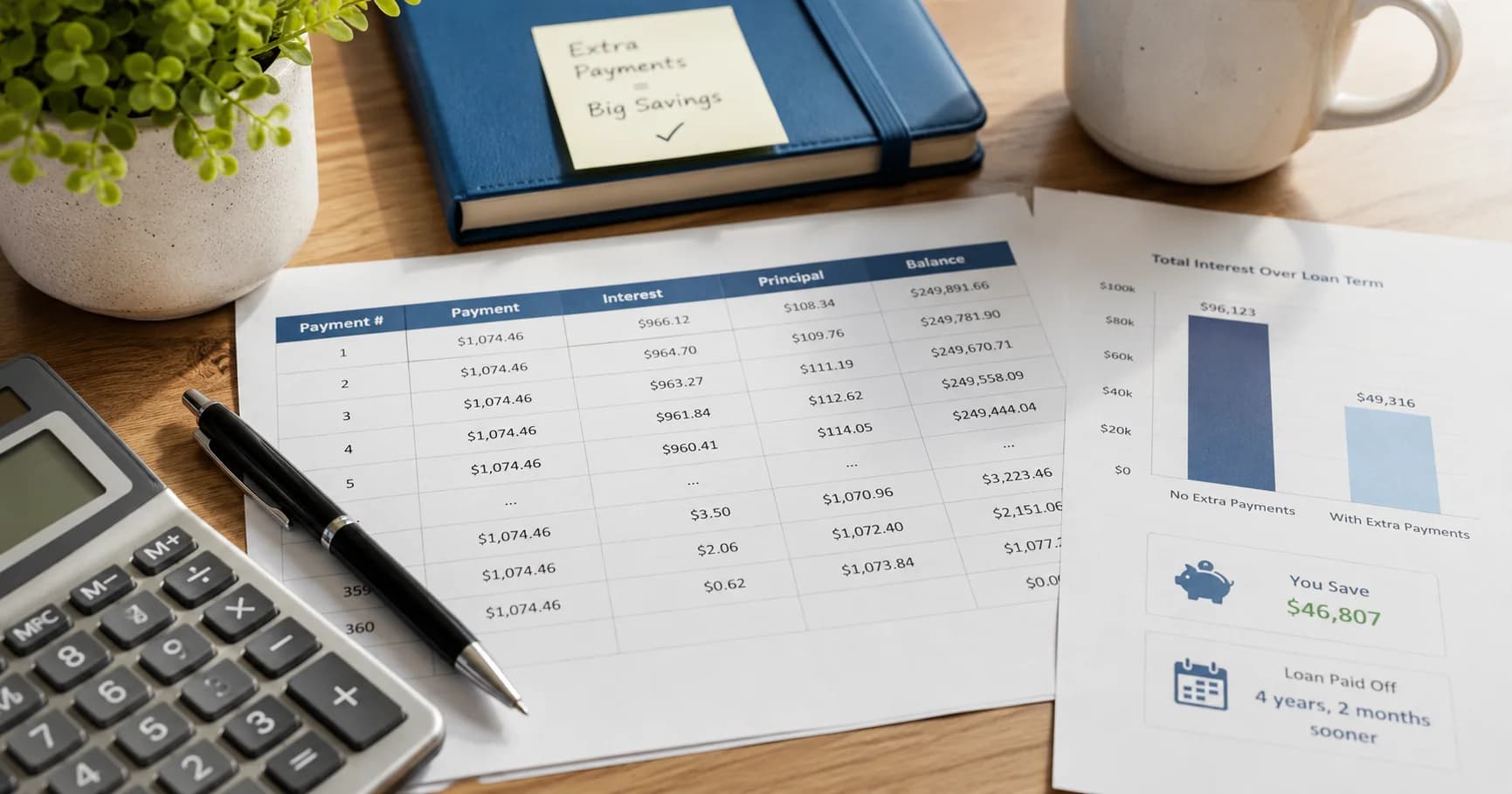
Extra principal payments are one of the most powerful tools available to a homeowner. Because extra payments reduce the balance immediately, they reduce interest accrued in every subsequent month — creating a compounding effect over time.
| Extra Monthly Payment | Payoff Time | Total Interest Paid | Interest Saved vs. No Extra |
|---|---|---|---|
| $0 (standard) | 30 years | $418,527 | — |
| $100/month extra | 26 yr 3 mo | $353,816 | $64,711 |
| $200/month extra | 23 yr 6 mo | $306,022 | $112,505 |
| $300/month extra | 21 yr 5 mo | $268,848 | $149,679 |
| $500/month extra | 18 yr 5 mo | $213,839 | $204,688 |
| 1 extra payment/year | 25 yr 8 mo | $351,441 | $67,086 |
Based on $300,000 loan at 7%, 30-year term. Extra payments applied to principal only.
Adding just $200/month in extra principal reduces the loan term by 6.5 years and saves $112,505 in interest. The one-extra-payment-per-year strategy (making 13 payments annually instead of 12) saves 4 years and $67,000 with minimal monthly budget impact.
Important: when making extra payments, instruct your servicer in writing to apply the extra amount to principal only, not to next month's payment. Without this instruction, some servicers treat extra payments as prepaid future payments, which does not reduce the principal balance immediately and eliminates the interest-saving benefit.
Using the Amortization Schedule to Make Refinancing Decisions
When you refinance, you replace your current loan with a new one. The new loan starts a fresh amortization schedule — meaning you begin paying mostly interest again from payment 1. This is why the refinancing break-even calculation matters:
Refinancing break-even = closing costs ÷ monthly payment savings
If refinancing costs $6,000 and saves you $200/month, break-even is 30 months. If you plan to stay in the home beyond 30 months, refinancing makes sense.
However, there is a hidden cost: resetting the amortization clock. If you have been paying for 8 years on a 30-year mortgage and refinance into a new 30-year term, you extend your total payment period to 38 years. Even with a lower rate, the additional 8 years of payments may cost more in total interest than the rate reduction saves. Refinancing into a 20-year or 15-year term solves this problem but raises the monthly payment.
Use our loan amortization calculator to compare your current amortization schedule against a proposed refinanced schedule side by side, including total interest under each scenario.
15-Year vs. 30-Year Amortization Compared
| Feature | 30-Year at 7.0% | 15-Year at 6.4% |
|---|---|---|
| Loan amount | $300,000 | $300,000 |
| Monthly payment | $1,996 | $2,602 |
| Total paid over life | $718,527 | $468,360 |
| Total interest | $418,527 | $168,360 |
| Interest saved vs. 30-yr | — | $250,167 |
| Extra monthly cost | — | $606 more/month |
| Equity at year 5 | $21,000 | $68,000 |
| Balance crossover (50% paid) | Year 22 | Year 8 |
The 15-year mortgage saves $250,000 in total interest but requires $606 more per month. If you can comfortably afford the higher payment, the 15-year term is the superior wealth-building choice. If the $606 difference would strain your budget, the 30-year with extra principal payments on good months is a flexible middle ground.
Frequently Asked Questions About Amortization
Why do I pay so much interest at the beginning of my mortgage?
Because interest accrues on the outstanding balance. When your balance is $299,000, you pay interest on $299,000. When it falls to $150,000, you pay interest on $150,000. Since the balance decreases slowly at first (with most of each payment going to interest), interest charges stay high for a long time. This is mathematically unavoidable with standard amortizing loans — it is not a trick by the lender.
Do extra payments change my monthly payment amount?
No. With a fixed-rate mortgage, your required monthly payment stays the same regardless of extra principal payments. Extra payments reduce your balance and therefore your total interest and loan term — but they do not lower your required monthly payment. Some lenders allow a recast (re-amortization): after a large lump-sum payment, they recalculate a lower required monthly payment on the remaining balance. This is different from refinancing and typically costs $150–$250.
How is amortization different for adjustable-rate mortgages (ARMs)?
ARMs have the same amortization structure, but the interest rate (and therefore the split between principal and interest) changes at each rate adjustment. If your ARM rate rises, more of your payment goes to interest and less to principal. Your amortization schedule for an ARM shows future payments as estimates until the rate is known at each adjustment period.
Can I see my exact amortization schedule from my lender?
Yes. Your lender is required to provide an amortization schedule at closing as part of the Truth in Lending Act (TILA) disclosures. You can also request it from your loan servicer at any time, or generate one instantly for any loan parameters with our free amortization calculator.
To see the formula step-by-step and understand how lenders calculate monthly payments, read our loan payment calculation guide.
Related Calculators
Try these free calculators related to this article:
In-Depth Guides
Dive deeper with our comprehensive guides on this topic:
Frequently Asked Questions
Our Methodology
All mortgage content on CalculatorApp.me is reviewed by subject-matter experts, cross-referenced with official sources, and updated regularly for accuracy. Our formulas and data are verified against industry standards and government publications.
Jordan Hayes
Verified AuthorPersonal Finance Content Strategist
Jordan is a personal finance content strategist with 9+ years writing about mortgages, retirement, tax strategy, and budgeting. Every guide is cross-referenced with IRS publications, Federal Reserve data, and CFPB guidance to make complex calculations accessible. Editor at CalculatorApp.me.
Found this helpful? Share it!
Stay Updated
Get notified when we launch new calculators and features.
No spam. Unsubscribe anytime.