Car Loan Calculator Guide: How to Save Thousands on Auto Financing
Free Calculator
Loan Calculator
Table of Contents
Car Loan Calculator: How Payments Are Calculated
Auto loans use the same amortization formula as mortgages: M = P[r(1+r)n]/[(1+r)n – 1]. For a $30,000 loan at 6.5% for 60 months, your monthly payment is $586.77, with $5,206 in total interest.
Unlike mortgages, cars depreciate — losing 20% of value in year one and 60% over five years. Stretching a loan to 72+ months means you owe more than the car is worth for most of the loan (called being "underwater").
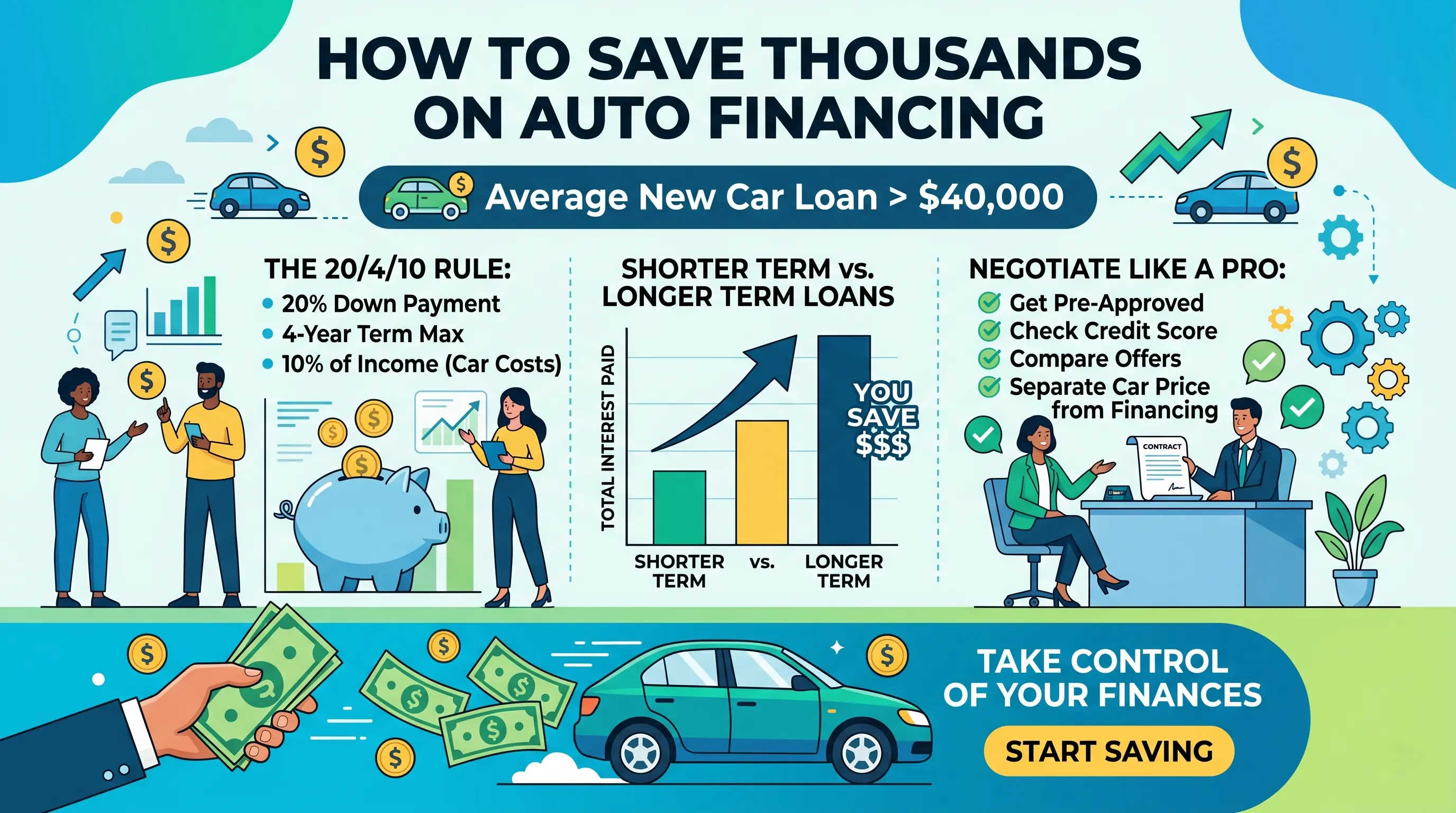
The 20/4/10 Rule
Financial experts recommend the 20/4/10 rule for car affordability:
20% minimum down payment — prevents negative equity from day one
4-year maximum loan term — limits total interest and keeps you above water
10% of gross income — total car costs (payment + insurance + gas + maintenance) shouldn't exceed 10%
On $6,000/month gross income, that's a maximum $600/month for all car expenses — not just the payment.
Why Shorter Terms Always Win
The same $35,000 loan at 7%:
48 months: $838/month, $4,400 total interest
60 months: $693/month, $6,600 total interest
72 months: $598/month, $8,600 total interest
The 72-month payment looks attractive ($240 less than 48-month), but you pay $4,200 more in interest — for a car that's worth $14,000 by month 72.
Dealership vs. Credit Union Financing
Dealership finance departments make profit by marking up the interest rate 1-2% above the bank's offer. The fix: get pre-approved from your bank or credit union before visiting the dealer.
Credit unions consistently offer the lowest auto loan rates (averaging 0.5-1.5% less than banks) due to their non-profit structure. Use your pre-approval as leverage — the dealer can try to beat it, and you win either way.
When to Refinance
Refinancing your car loan makes sense when:
Interest rates have dropped 1.5%+ since your original loan
Your credit score improved 50+ points
You want to shorten the term to save interest
Apply to 2-3 lenders within a 14-day window — credit bureaus count multiple auto loan inquiries as a single hard pull.
Hidden Costs to Watch For
Gap insurance: If you finance more than 80% of the car's value, standard insurance only covers market value in a total loss — not what you owe. Gap insurance covers the difference and costs $200-700.
Extended warranties: Dealerships mark up warranties 100-200%. If you want one, buy directly from the manufacturer or a third-party provider after the sale at 30-50% less.
Dealer add-ons: Paint protection, fabric coating, VIN etching — these provide minimal value and are pure profit for the dealer. Decline all of them.
Calculate Your Payment
Use our free Car Loan Calculator to compare loan terms and see the true cost of financing. Check your Debt-to-Income Ratio to ensure a car payment fits your budget, and explore Personal Loan options that may offer lower rates than dealer financing.
How Car Loan Interest Works: Simple vs Precomputed
Understanding how a car loan calculator estimates your costs starts with knowing how interest is charged. Most auto loans use simple interest, meaning interest is calculated on the remaining principal balance each month. As you pay down the loan, less of each payment goes to interest and more goes to principal.
Some subprime lenders use precomputed interest, where the total interest for the entire loan term is calculated upfront and added to the balance. With precomputed loans, paying early does not reduce total interest — a major disadvantage. Always confirm your loan uses simple interest before signing.
Monthly Payment Formula for Auto Loans
The car loan payment formula is identical to the mortgage formula: M = P × [r(1+r)^n] / [(1+r)^n – 1], where P is the loan amount, r is the monthly interest rate, and n is total months.
Example: A $28,000 car loan at 5.9% APR for 60 months calculates to a monthly payment of $540.35. Total interest paid over 5 years: $4,421.
New vs. Used Car Financing: Which Is Smarter?
The financing decision between new and used vehicles involves more than the sticker price. Here is a comprehensive comparison:
Interest rates: New car loans average 5.5–7.0% APR in 2026, while used car loans average 7.0–10.0% because used vehicles carry higher risk for lenders.
Depreciation: New cars lose 20-30% of their value in the first year and about 60% by year five. A $40,000 new car is worth roughly $16,000 after five years. Buying a 2-3 year old car lets someone else absorb the steepest depreciation.
Loan terms: New cars qualify for longer terms (72–84 months) but longer terms mean more interest. According to Experian's auto finance data, the average new car loan is now 69 months.
Total cost of ownership: A 3-year-old certified pre-owned vehicle often costs 40-50% less than new while still having warranty coverage and lower insurance premiums.
How to Negotiate a Better Car Loan Rate
The interest rate you receive has a massive impact on total cost. Follow these steps to secure the best deal:
Check your credit score first: A score above 720 qualifies for top-tier rates. If your score is below 680, consider spending 2-3 months improving it before purchasing — even a 2% rate reduction on a $30,000 loan saves $1,800+ over the loan term.
Get pre-approved from your bank or credit union: Credit unions typically offer rates 1-2% lower than dealership financing. Walk into the dealership with a pre-approval letter as leverage.
Keep the loan term to 48-60 months: While 72 and 84-month loans have lower payments, the extra interest adds up fast and you risk being underwater (owing more than the car is worth).
Make a 20% down payment: This reduces the financed amount, improves your loan-to-value ratio, and may qualify you for better rates. At minimum, put enough down to cover first-year depreciation.
Negotiate the car price before discussing financing: Dealers often lower the price but raise the interest rate, or vice versa. Negotiate each element separately.
Hidden Costs of Car Ownership Beyond the Monthly Payment
Your car loan calculator only shows the loan payment. The true cost of owning a vehicle includes several additional expenses that many buyers overlook:
Insurance: Average annual cost is $1,771 for full coverage according to the Insurance Information Institute. New and luxury vehicles cost significantly more to insure. Get insurance quotes before purchasing.
Fuel or charging: At $3.50/gallon and 12,000 miles/year, a 30 MPG car costs $1,400/year in fuel. An EV costs roughly $500-600/year in electricity.
Maintenance: Budget $800-1,200/year for routine maintenance on newer vehicles and $1,500-2,500 for vehicles over 100,000 miles.
Registration and taxes: Varies by state. Some states charge annual property tax on vehicles (Virginia charges 4.15% of assessed value).
Depreciation: The single largest cost. A $35,000 car depreciating at 15% per year loses $5,250 in just the first year — more than most annual fuel and maintenance costs combined.
Use our Auto Loan Calculator to model different loan scenarios and find the sweet spot between monthly payment and total cost.
When Should You Refinance Your Car Loan?
Refinancing replaces your current loan with a new one at better terms. Consider refinancing when:
Your credit score has improved by 50+ points since the original loan
Market rates have dropped by 1% or more
You are in the first half of your loan term (refinancing late saves less because most interest is front-loaded)
You want to shorten the term to pay off the car faster
Be aware of refinancing fees (typically $50-75) and ensure the new loan does not extend your payoff date significantly.
Frequently Asked Questions About Car Loans
How much car can I afford on my salary?
The 20/4/10 rule is the gold standard: put 20% down, finance for no more than 4 years, and keep total transportation costs (payment + insurance + fuel + maintenance) under 10% of gross income. On a $60,000 salary ($5,000/month), your total car expenses should not exceed $500/month.
Is 0% financing really free?
Dealers offering 0% APR typically do not negotiate on price. You often choose between a cash rebate ($2,000-$5,000) or 0% financing — not both. Calculate which saves more: if the rebate plus a low-rate loan costs less than 0% on the full price, take the rebate. A car loan calculator makes this comparison easy.
Should I pay off my car loan early?
If your loan uses simple interest and has no prepayment penalty, paying extra toward principal saves money. However, if your rate is below 5% and you have higher-interest debt or lack an emergency fund, prioritize those first. The mathematical answer is to always pay off the highest-interest debt first.
How does trade-in value affect your car loan?
Your trade-in reduces the amount you need to finance and can significantly lower your monthly payment. If you are buying a $32,000 car and your trade-in is worth $8,000, you finance only $24,000. However, many buyers make the mistake of rolling negative equity from their old loan into the new one. If you still owe $12,000 on a car worth $8,000, that $4,000 gap gets added to your new loan — meaning you start underwater on the new vehicle. Always check your payoff amount against Kelley Blue Book or Edmunds valuations before trading in. A car loan calculator can model both scenarios so you see the true cost difference. If you are significantly underwater, consider paying down the balance before trading in to avoid carrying negative equity forward.
Related Articles on CalculatorApp.me
Auto Loan Resources
Want to calculate the monthly payment formula by hand? Our loan payment formula guide walks through every variable with worked examples.
Related Calculators
Try these free calculators related to this article:
In-Depth Guides
Dive deeper with our comprehensive guides on this topic:
Frequently Asked Questions
Our Methodology
All finance content on CalculatorApp.me is reviewed by subject-matter experts, cross-referenced with official sources, and updated regularly for accuracy. Our formulas and data are verified against industry standards and government publications.
Jordan Hayes
Verified AuthorPersonal Finance Content Strategist
Jordan is a personal finance content strategist with 9+ years writing about mortgages, retirement, tax strategy, and budgeting. Every guide is cross-referenced with IRS publications, Federal Reserve data, and CFPB guidance to make complex calculations accessible. Editor at CalculatorApp.me.
Found this helpful? Share it!
Stay Updated
Get notified when we launch new calculators and features.
No spam. Unsubscribe anytime.