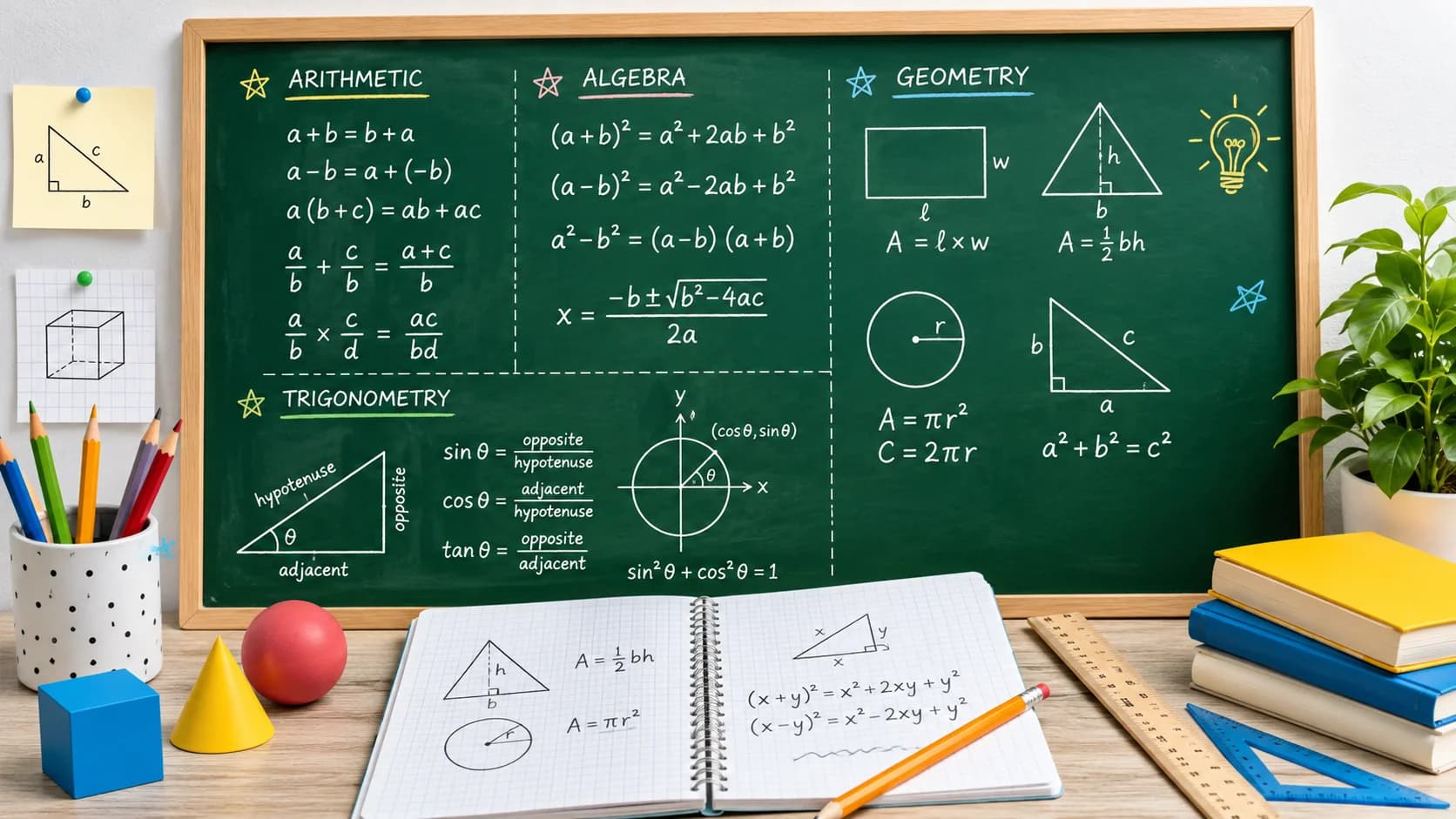
Essential Math Formulas Every Student Should Know
Free Calculator
Percentage Calculator
Table of Contents
Having a solid command of essential math formulas is the foundation of success in school, standardized tests, and countless real-world applications. Whether you're a high school student preparing for the SAT, a college freshman tackling calculus, or a working professional who needs quick reference for geometry or statistics, this comprehensive guide covers every critical formula you need to know. We've organized them by category — from basic arithmetic through algebra, geometry, trigonometry, and statistics — with clear explanations, examples, and tips for when and how to use each one.
Basic Arithmetic and Number Properties
All of mathematics builds on these fundamental operations and properties:
Order of Operations (PEMDAS/BODMAS)
The order in which you perform operations matters. Follow PEMDAS: Parentheses, Exponents, Multiplication/Division (left to right), Addition/Subtraction (left to right).
Example: 8 + 2 × 5² = 8 + 2 × 25 = 8 + 50 = 58 (not 250)
Properties of Numbers
- Commutative: a + b = b + a; a × b = b × a
- Associative: (a + b) + c = a + (b + c); (a × b) × c = a × (b × c)
- Distributive: a(b + c) = ab + ac
- Identity: a + 0 = a; a × 1 = a
- Inverse: a + (-a) = 0; a × (1/a) = 1 (where a ≠ 0)
Percentage Formulas
Percentages appear everywhere in daily life — from sales tax to test scores to investment returns. Master these three core formulas and you can solve any percentage problem:
- Find the percentage: Percentage = (Part ÷ Whole) × 100
- Find the part: Part = (Percentage × Whole) ÷ 100
- Percent change: % Change = ((New Value – Old Value) ÷ Old Value) × 100
Example — Percent Change: A stock price rises from $50 to $62. Percent change = ((62 – 50) ÷ 50) × 100 = 24% increase.
Practice these with our Percentage Calculator — enter any two values and get the third instantly.
Percentage Shortcuts for Mental Math
- 10% of any number: Move the decimal one place left (10% of 450 = 45)
- 5% of any number: Find 10%, then halve it (5% of 450 = 22.50)
- 15% tip: Find 10% + half of 10% (15% of $80 = $8 + $4 = $12)
- 25% of any number: Divide by 4 (25% of 200 = 50)
Algebra Formulas
Algebra is the bridge between arithmetic and higher mathematics. These formulas are used extensively in science, engineering, economics, and computer science.
Linear Equations
- Slope-intercept form: y = mx + b (m = slope, b = y-intercept)
- Point-slope form: y – y₁ = m(x – x₁)
- Slope formula: m = (y₂ – y₁) ÷ (x₂ – x₁)
- Standard form: Ax + By = C
Example: Find the equation of a line through (2, 5) with slope 3: y – 5 = 3(x – 2) → y = 3x – 1
Quadratic Equations
- Standard form: ax² + bx + c = 0
- Quadratic formula: x = (–b ± √(b² – 4ac)) ÷ 2a
- Discriminant: D = b² – 4ac (D > 0: two real roots; D = 0: one root; D < 0: no real roots)
- Vertex form: y = a(x – h)² + k (vertex at (h, k))
- Sum of roots: –b/a; Product of roots: c/a
The quadratic formula is one of the most widely tested math formulas on the SAT and ACT. According to the College Board's SAT Math section, problems involving quadratic equations appear in every test administration.
Exponent Rules
- x^a × x^b = x^(a+b)
- x^a ÷ x^b = x^(a–b)
- (x^a)^b = x^(ab)
- x^0 = 1 (where x ≠ 0)
- x^(–a) = 1/x^a
- (xy)^a = x^a × y^a
Logarithm Rules
- log_b(xy) = log_b(x) + log_b(y)
- log_b(x/y) = log_b(x) – log_b(y)
- log_b(x^n) = n × log_b(x)
- log_b(b) = 1; log_b(1) = 0
- Change of base: log_b(x) = log(x) ÷ log(b)
Geometry Formulas
Geometry formulas are essential for everything from construction and architecture to graphic design and physics. Here are the must-know formulas organized by shape:
2D Shapes — Area and Perimeter
| Shape | Area | Perimeter |
|---|---|---|
| Rectangle | A = l × w | P = 2(l + w) |
| Square | A = s² | P = 4s |
| Triangle | A = ½ × b × h | P = a + b + c |
| Circle | A = πr² | C = 2πr |
| Trapezoid | A = ½(a + b) × h | P = a + b + c + d |
| Parallelogram | A = b × h | P = 2(a + b) |
| Ellipse | A = πab | ≈ π(3(a+b) – √((3a+b)(a+3b))) |
Calculate any of these instantly with our Area Calculator.
3D Shapes — Volume and Surface Area
| Shape | Volume | Surface Area |
|---|---|---|
| Cube | V = s³ | SA = 6s² |
| Rectangular Prism | V = l × w × h | SA = 2(lw + lh + wh) |
| Sphere | V = (4/3)πr³ | SA = 4πr² |
| Cylinder | V = πr²h | SA = 2πr(r + h) |
| Cone | V = (1/3)πr²h | SA = πr(r + √(r² + h²)) |
| Pyramid | V = (1/3) × base area × h | Depends on base shape |
The Pythagorean Theorem
For any right triangle: a² + b² = c² (where c is the hypotenuse).
This is arguably the most famous math formula in history. Common Pythagorean triples worth memorizing: (3, 4, 5), (5, 12, 13), (8, 15, 17), (7, 24, 25).
The theorem extends to 3D as well: the space diagonal of a rectangular box is d = √(l² + w² + h²).
Distance and Midpoint Formulas
- Distance: d = √((x₂ – x₁)² + (y₂ – y₁)²)
- Midpoint: M = ((x₁ + x₂)/2, (y₁ + y₂)/2)
These formulas come directly from the Pythagorean theorem — the distance formula is just the hypotenuse of a right triangle formed by the horizontal and vertical differences between two points.
Trigonometry Formulas
Trigonometry connects angles to side lengths, essential for physics, engineering, navigation, and architecture.
Basic Trig Ratios (SOH-CAH-TOA)
- sin(θ) = Opposite ÷ Hypotenuse
- cos(θ) = Adjacent ÷ Hypotenuse
- tan(θ) = Opposite ÷ Adjacent
Key Trig Identities
- sin²(θ) + cos²(θ) = 1
- tan(θ) = sin(θ) ÷ cos(θ)
- sin(2θ) = 2sin(θ)cos(θ)
- cos(2θ) = cos²(θ) – sin²(θ)
- Law of Sines: a/sin(A) = b/sin(B) = c/sin(C)
- Law of Cosines: c² = a² + b² – 2ab·cos(C)
Common Angle Values
| Angle | sin | cos | tan |
|---|---|---|---|
| 0° | 0 | 1 | 0 |
| 30° | 1/2 | √3/2 | 1/√3 |
| 45° | √2/2 | √2/2 | 1 |
| 60° | √3/2 | 1/2 | √3 |
| 90° | 1 | 0 | undefined |
Memorizing these values is essential for the ACT and SAT, which test trigonometry extensively.
Statistics Formulas
Statistics formulas help you analyze data, understand distributions, and make informed decisions. The National Center for Education Statistics (NCES) offers free tools to practice these concepts.
Measures of Central Tendency
- Mean (average): x̄ = Σx ÷ n
- Median: Middle value when data is sorted (or average of two middle values)
- Mode: Most frequently occurring value
Measures of Spread
- Range: Maximum – Minimum
- Variance: σ² = Σ(x – x̄)² ÷ n
- Standard Deviation: σ = √(Σ(x – x̄)² ÷ n)
- Interquartile Range (IQR): Q3 – Q1
Standard deviation is one of the most important math formulas in data science and research. Use our Standard Deviation Calculator to compute it instantly from any dataset.
Probability Basics
- Probability of event: P(A) = favorable outcomes ÷ total outcomes
- Complement: P(not A) = 1 – P(A)
- Independent events: P(A and B) = P(A) × P(B)
- Mutually exclusive: P(A or B) = P(A) + P(B)
- General addition: P(A or B) = P(A) + P(B) – P(A and B)
- Permutations: nPr = n! ÷ (n – r)!
- Combinations: nCr = n! ÷ (r! × (n – r)!)
Financial Math Formulas
These formulas bridge math and real-world money decisions:
- Simple interest: I = P × r × t
- Compound interest: A = P(1 + r/n)^(nt)
- Monthly loan payment: M = P × [r(1+r)^n] ÷ [(1+r)^n – 1]
- ROI: ROI = ((Gain – Cost) ÷ Cost) × 100%
Explore these with our Compound Interest Calculator and ROI Calculator.
Tips for Memorizing Math Formulas
- Understand, don't just memorize: Know why a formula works. The area of a circle (πr²) derives from calculus, but understanding that it's related to the circumference (2πr) helps retention.
- Create flashcards: Write the formula on one side, a worked example on the other.
- Use mnemonics: SOH-CAH-TOA for trig, PEMDAS for order of operations, "Please Excuse My Dear Aunt Sally."
- Practice with real problems: Apply formulas to actual scenarios — calculate the area of your room, the interest on your savings, or the distance between two cities on a map.
- Group related formulas: Learn area formulas together, all trig identities together, etc.
Frequently Asked Questions
What math formulas do I need for the SAT?
The SAT provides some formulas (areas, volumes, special right triangles, circle properties) at the beginning of each math section. However, you should also know: slope formula, quadratic formula, percent change, mean/median/mode, probability basics, and exponent rules. Familiarity with these saves time during the test.
What is the most important math formula?
It depends on context, but the Pythagorean theorem (a² + b² = c²) is widely considered the most universally important math formula. It's the foundation of trigonometry, distance calculations, physics, engineering, and computer graphics.
How do I know which formula to use for a problem?
Identify what you're given and what you need to find. If you have a right triangle and need a side length, use Pythagorean theorem. If you have a rate and time, it's likely a percentage or interest problem. With practice, pattern recognition becomes automatic.
Are there math formulas I should memorize for everyday life?
Yes — percentage calculations (for tips, discounts, taxes), area formulas (for home improvement projects), and simple/compound interest (for financial decisions). Our Percentage Calculator and Area Calculator make these computations effortless.
What's the difference between a formula and an equation?
A formula is a general mathematical relationship that can be applied to solve various problems (e.g., A = πr²). An equation is a specific statement that two expressions are equal and typically needs to be solved for an unknown (e.g., 2x + 5 = 17). All formulas are equations, but not all equations are formulas.
Math Formulas in Real-World Careers
Students often ask "when will I ever use this?" Here's how these math formulas appear in popular careers:
- Software Engineering: Algorithms rely heavily on algebra, logarithms, and probability. Big-O notation uses logarithmic and exponential functions. Graphics programming requires trigonometry and linear algebra extensively.
- Medicine and Healthcare: Drug dosage calculations use proportions and percentages. BMI calculations use basic arithmetic. Epidemiologists use statistics (mean, standard deviation, probability) to track disease patterns and evaluate treatment effectiveness.
- Architecture and Construction: Area and volume formulas are used daily for material calculations. The Pythagorean theorem ensures walls are square. Trigonometry determines roof pitch angles and structural loads.
- Finance and Accounting: Compound interest, percentage change, and amortization formulas are the foundation of banking, investing, and financial planning. Every loan officer, financial advisor, and accountant uses these daily.
- Data Science and AI: Statistics formulas (standard deviation, variance, probability distributions) are the backbone of machine learning. Linear algebra powers neural networks. Every data scientist needs fluency in these mathematical foundations.
- Trades and Manufacturing: Electricians use Ohm's law (V = IR), plumbers calculate pipe flow rates, and machinists use geometry for precision cutting. Even carpentry relies on the Pythagorean theorem for framing.
Related Articles on CalculatorApp.me
- How to Calculate Standard Deviation
- How to Add, Subtract, Multiply, and Divide Fractions
- Area and Volume Formulas Cheat Sheet
- How to Calculate Your GPA
Free Resources for Practicing Math Formulas
Beyond our calculator tools, these free resources can help you build formula fluency:
- Khan Academy: Free video lessons and practice problems for every math topic from basic arithmetic through calculus and statistics
- Desmos Graphing Calculator: Free online graphing tool that helps visualize equations and functions — perfect for understanding how formulas behave
- Wolfram Alpha: Computational engine that can solve, explain, and graph virtually any mathematical expression
- Our Calculator Suite: Practice with real numbers using our full collection of math calculators
Practice Makes Perfect
The best way to master these math formulas is to use them regularly. Bookmark this page as your reference guide, and practice with our free online calculators: Percentage Calculator, Area Calculator, Standard Deviation Calculator, Fraction Calculator, and our full suite of Math Calculators. The more you practice, the more natural these formulas become — and that confidence translates directly into better test scores and professional performance.
Related Calculators
Try these free calculators related to this article:
In-Depth Guides
Dive deeper with our comprehensive guides on this topic:
Frequently Asked Questions
Our Methodology
All math content on CalculatorApp.me is reviewed by subject-matter experts, cross-referenced with official sources, and updated regularly for accuracy. Our formulas and data are verified against industry standards and government publications.
Jordan Hayes
Verified AuthorPersonal Finance Content Strategist
Jordan is a personal finance content strategist with 9+ years writing about mortgages, retirement, tax strategy, and budgeting. Every guide is cross-referenced with IRS publications, Federal Reserve data, and CFPB guidance to make complex calculations accessible. Editor at CalculatorApp.me.
Found this helpful? Share it!
Stay Updated
Get notified when we launch new calculators and features.
No spam. Unsubscribe anytime.