How to Calculate Your GPA: Weighted vs. Unweighted Explained
Free Calculator
Percentage Calculator
Table of Contents
How to Calculate GPA: The Formula
GPA (Grade Point Average) is a weighted average where the weights are credit hours: GPA = Σ(grade points × credit hours) ÷ Σ(total credit hours).
For grade conversion charts, recovery formulas, and admissions thresholds, see our complete GPA Calculator Guide.
Standard grade point values: A = 4.0, A− = 3.7, B+ = 3.3, B = 3.0, B− = 2.7, C+ = 2.3, C = 2.0, C− = 1.7, D+ = 1.3, D = 1.0, F = 0.0.
Step-by-Step Example
Suppose you took 4 courses this semester:
Biology (4 credits): A = 4.0 → 4 × 4.0 = 16.0 quality points
English (3 credits): B+ = 3.3 → 3 × 3.3 = 9.9 quality points
Calculus (4 credits): B = 3.0 → 4 × 3.0 = 12.0 quality points
History (3 credits): A− = 3.7 → 3 × 3.7 = 11.1 quality points
Total quality points: 16.0 + 9.9 + 12.0 + 11.1 = 49.0
Total credits: 4 + 3 + 4 + 3 = 14
Semester GPA: 49.0 ÷ 14 = 3.50
Weighted vs. Unweighted GPA
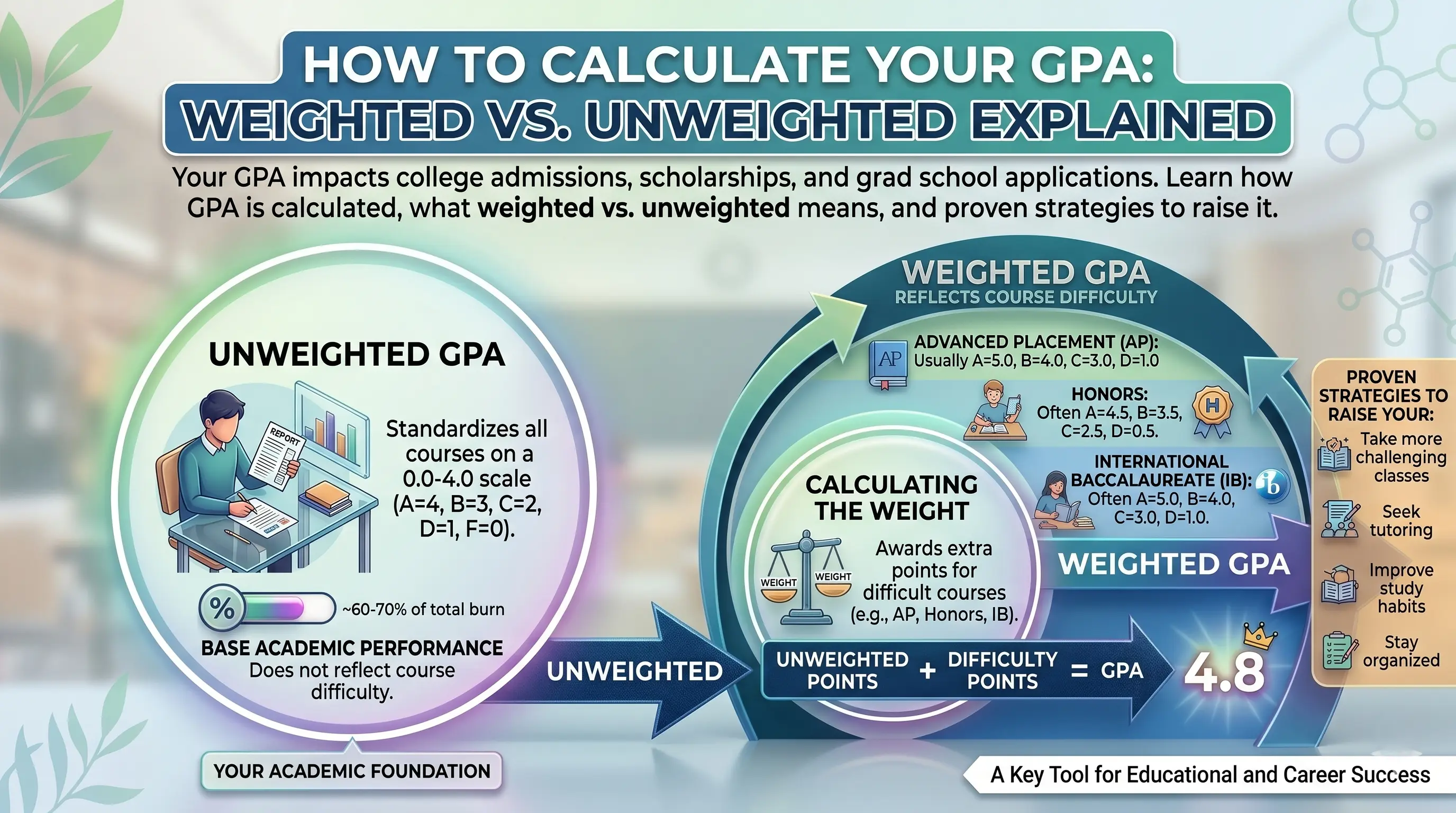
Unweighted GPA uses the standard 0.0-4.0 scale regardless of course difficulty. An A in regular Chemistry and an A in AP Chemistry both count as 4.0.
Weighted GPA adds bonus points for advanced courses:
AP/IB courses: +1.0 (A = 5.0, B = 4.0, etc.)
Honors courses: +0.5 (A = 4.5, B = 3.5, etc.)
This means weighted GPAs can exceed 4.0. A student taking 5 AP courses with all A's would have a 5.0 weighted GPA — demonstrating both high grades and academic rigor.
Which Do Colleges Use?
Most competitive colleges recalculate GPA on their own scale. However, they value course rigor heavily. A student with a 3.6 GPA in all AP/Honors classes is typically more competitive than one with a 4.0 in all regular classes.
The Outsized Impact of Early Grades
Early semesters affect your GPA disproportionately because they represent a larger fraction of your total credits. A freshman C in a 3-credit course is hard to offset later.
Math proof: If you have 30 credits at a 3.0 GPA (90 quality points) and earn a perfect 4.0 in one 15-credit semester (60 quality points), your new cumulative GPA is (90 + 60) ÷ 45 = 3.33 — not 3.5, and definitely not 4.0. Recovery is slow.
Conversely, a single F (0.0) in a 3-credit course drops a 3.5 GPA to approximately 3.27. It takes multiple A's across many credits to recover.
Strategies to Raise Your GPA
Prioritize high-credit courses: An A in a 4-credit course boosts GPA twice as much as in a 2-credit course. Focus your best effort where the credit weight is highest.
Retake courses: Many schools replace the old grade with the new one. Turning a C into an A in a 3-credit course adds 6 quality points to your total.
Use pass/fail strategically: If your school offers it, take electives outside your strength as pass/fail to protect your GPA.
Summer courses: Community college courses (verify credit transfer first) often have smaller class sizes and can boost GPA at lower cost.
Calculate Yours Now
Use our free GPA Calculator to compute your current GPA and model "what-if" scenarios for future semesters. Need to figure out what grade you need on finals? Try our Grade Calculator.
GPA Scales Around the World
Understanding how to calculate GPA becomes more complex when comparing academic systems across countries. While the 4.0 scale dominates in the United States and Canada, other countries use entirely different systems:
United States/Canada: 4.0 scale (A=4, B=3, C=2, D=1, F=0). Some schools use plus/minus modifiers (A−=3.7, B+=3.3).
United Kingdom: Degree classifications — First Class (70%+), Upper Second/2:1 (60-69%), Lower Second/2:2 (50-59%), Third (40-49%). No numeric GPA equivalent.
India: Percentage-based (0-100%) or CGPA on a 10-point scale. Many universities use absolute grading where 90%+ = O (Outstanding), 80-89% = A+, and so on.
Germany: 1.0-5.0 scale (inverted — 1.0 is best, 4.0 is minimum passing). Grade 1.0-1.5 = "Sehr gut" (Very Good).
Australia: 7-point scale — High Distinction (7), Distinction (6), Credit (5), Pass (4).
When applying to international programs, use World Education Services (WES) for official GPA conversion. Most US graduate schools expect a 3.0 minimum, which roughly corresponds to a 2:1 in the UK, 7.0 CGPA in India, or 2.5 in Germany.
How Graduate Schools and Employers Evaluate Your GPA
Your GPA is more than a number — admissions committees and recruiters interpret it within context:
Graduate School Admissions
Top-tier programs (Harvard, Stanford, MIT) typically expect GPAs above 3.5 for traditional applicants. However, graduate admissions is holistic — a strong GRE/GMAT score, compelling research experience, or relevant work history can compensate for a lower GPA. If your overall GPA is weak, highlight your major GPA (GPA in courses related to your field of study), which is often higher and more relevant.
Many programs also evaluate GPA trends. An upward trend (starting college with a 2.5 and finishing with a 3.8) demonstrates growth and resilience, while a downward trend raises concerns. Include a brief explanation in your personal statement if your GPA has a clear inflection point due to a major life event.
Employer Screening
According to a survey by the National Association of Colleges and Employers (NACE), approximately 67% of employers use GPA as a screening criterion for new graduates. The most common cutoff is 3.0, though competitive firms in finance and consulting often require 3.5+. After 2-3 years of work experience, GPA becomes largely irrelevant — your professional track record speaks louder. Most resumes drop GPA entirely after 5 years of experience.
Proven Strategies to Improve Your GPA
If your GPA is below your target, these evidence-based strategies can help you recover:
Prioritize high-credit courses: A 4-credit course has twice the GPA impact of a 2-credit course. Invest your study time proportionally. An A in a 4-credit course offsets a B in two 2-credit courses.
Use professor office hours: Students who regularly attend office hours earn, on average, half a letter grade higher. Professors provide hints about exam content, clarify confusing material, and are more likely to round borderline grades for students they recognize.
Study in spaced intervals: Cognitive science research consistently shows that distributed practice (studying 30 minutes daily for a week) produces better retention than massed practice (cramming for 3.5 hours the night before). Use the Pomodoro technique: 25 minutes of focused study followed by a 5-minute break.
Take strategic electives: If you need a GPA boost, choose electives where the subject matter aligns with your strengths. An art major might struggle in advanced statistics but excel in a philosophy elective.
Consider grade replacement: Many universities allow you to retake a course and replace the original grade. This is most impactful for courses where you earned a D or F. Check your school's specific policy, as some average both attempts while others replace entirely.
Form study groups: Teaching material to peers is one of the most effective learning techniques. Students who participate in structured study groups perform 5-15% better on exams than solo studiers.
Cumulative GPA vs. Semester GPA: What's the Difference?
Your semester GPA reflects performance in a single term, while your cumulative GPA is the weighted average across all semesters. Understanding the difference is important because cumulative GPA is what appears on your transcript and degree.
One bad semester has diminishing impact over time. If you have a 2.0 GPA after your first semester (30 credits) and then earn a 3.5 every subsequent semester, your cumulative GPA trajectory looks like this:
After Year 1 (60 credits): 2.75 cumulative
After Year 2 (90 credits): 3.00 cumulative
After Year 3 (120 credits): 3.125 cumulative
After Year 4 (150 credits): 3.20 cumulative
This demonstrates why learning how to calculate GPA matters for long-term planning. Each semester's GPA contribution is weighted by its credit hours. Use our GPA Calculator to model different scenarios and set realistic targets for each semester.
Frequently Asked Questions About GPA Calculation
Does a plus/minus grading system help or hurt GPA?
It depends on your grade distribution. If you tend to earn low A's (91-93%), a plus/minus system hurts because A− (3.7) is lower than a flat A (4.0). If you frequently earn high B's (87-89%), plus/minus helps because B+ (3.3) is higher than a flat B (3.0). Statistically, plus/minus grading lowers the average GPA at most institutions by 0.1-0.2 points.
Do pass/fail courses affect my GPA?
In most university systems, pass/fail (P/F) courses do not factor into GPA calculation. A "Pass" earns credit hours but no quality points, so it neither raises nor lowers your GPA. Taking a challenging elective pass/fail can be strategic if you want to explore a subject without risking GPA damage. However, some graduate programs view excessive P/F courses unfavorably.
What is a weighted GPA and how is it calculated?
Weighted GPAs, used primarily in U.S. high schools, give extra points for honors, AP, and IB courses. An A in a regular course earns 4.0, an A in honors earns 4.5, and an A in AP/IB earns 5.0. Weighted GPAs can exceed 4.0, with the top students at competitive high schools achieving 4.5-4.8. Colleges typically recalculate your GPA using their own weighting system during admissions review.
Related Articles on CalculatorApp.me
Academic & GPA Resources
For the full breakdown including college GPA scales and how to raise your GPA, read our GPA calculator guide.
Need to figure out what grade you need on your final? Our course grade calculation guide covers weighted averages and final exam score formulas.
Related Calculators
Try these free calculators related to this article:
In-Depth Guides
Dive deeper with our comprehensive guides on this topic:
Frequently Asked Questions
Our Methodology
All math content on CalculatorApp.me is reviewed by subject-matter experts, cross-referenced with official sources, and updated regularly for accuracy. Our formulas and data are verified against industry standards and government publications.
Jordan Hayes
Verified AuthorPersonal Finance Content Strategist
Jordan is a personal finance content strategist with 9+ years writing about mortgages, retirement, tax strategy, and budgeting. Every guide is cross-referenced with IRS publications, Federal Reserve data, and CFPB guidance to make complex calculations accessible. Editor at CalculatorApp.me.
Found this helpful? Share it!
Stay Updated
Get notified when we launch new calculators and features.
No spam. Unsubscribe anytime.