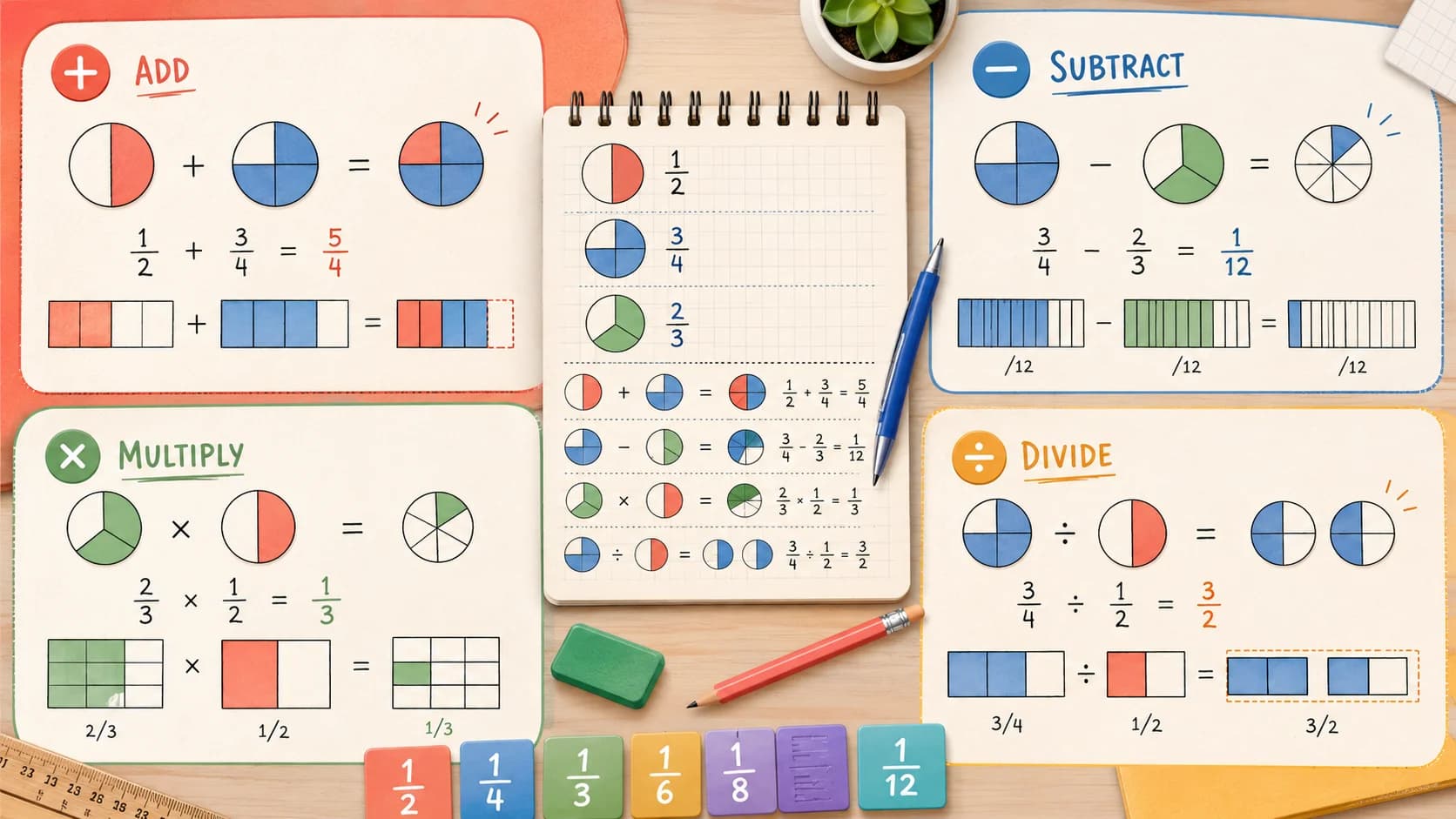
How to Add, Subtract, Multiply, and Divide Fractions: Complete Guide
Free Calculator
Fraction Calculator
Table of Contents
Fraction Basics: What Is a Fraction?
A fraction represents a part of a whole. It consists of a numerator (top number — how many parts you have) and a denominator (bottom number — how many equal parts the whole is divided into).
For example, 3/4 means "3 out of 4 equal parts." The denominator tells you the size of each piece, and the numerator tells you how many pieces you have.
How to Add Fractions
Same Denominator (Easy Case)
When fractions have the same denominator, simply add the numerators and keep the denominator:
2/7 + 3/7 = (2+3)/7 = 5/7
Different Denominators
You must first find a common denominator — a number both denominators divide into evenly.
Example: 1/3 + 1/4
- Find the LCD (Least Common Denominator): LCD of 3 and 4 = 12
- Convert each fraction: 1/3 = 4/12, 1/4 = 3/12
- Add: 4/12 + 3/12 = 7/12
How to Find the LCD
Method 1: List multiples until you find the smallest common one.
- Multiples of 3: 3, 6, 9, 12, 15, 18...
- Multiples of 4: 4, 8, 12, 16, 20...
- LCD = 12
Method 2: Prime factorization — take the highest power of each prime factor.
- 3 = 3¹, 4 = 2²
- LCD = 2² × 3¹ = 12
Another Example: 2/5 + 3/8
- LCD of 5 and 8 = 40
- Convert: 2/5 = 16/40, 3/8 = 15/40
- Add: 16/40 + 15/40 = 31/40
How to Subtract Fractions
Subtraction follows the same process as addition — find a common denominator, then subtract numerators.
Example: 5/6 − 1/4
- LCD of 6 and 4 = 12
- Convert: 5/6 = 10/12, 1/4 = 3/12
- Subtract: 10/12 − 3/12 = 7/12
How to Multiply Fractions
Multiplication is the simplest operation: multiply numerators together and denominators together. No common denominator needed.
a/b × c/d = (a×c) / (b×d)
Example: 2/3 × 4/5
= (2×4) / (3×5) = 8/15
Cross-Cancellation (Simplify First)
Before multiplying, cancel any common factors between a numerator and an opposite denominator to keep numbers small:
Example: 3/8 × 4/9
- 3 and 9 share a factor of 3: cancel to get 1/8 × 4/3
- 4 and 8 share a factor of 4: cancel to get 1/2 × 1/3
- Result: 1/6
Without cancellation you'd get 12/72, which simplifies to 1/6 — same answer, bigger numbers.
How to Divide Fractions
To divide fractions, multiply by the reciprocal (flip the second fraction):
a/b ÷ c/d = a/b × d/c
Example: 3/4 ÷ 2/5
- Flip the second fraction: 2/5 becomes 5/2
- Multiply: 3/4 × 5/2 = 15/8
- Convert to mixed number: 1 7/8
Working with Mixed Numbers
Converting Mixed Numbers to Improper Fractions
To perform operations with mixed numbers, convert to improper fractions first:
2 3/4 → (2 × 4 + 3) / 4 = 11/4
3 1/5 → (3 × 5 + 1) / 5 = 16/5
Example: 2 3/4 + 1 1/3
- Convert: 11/4 + 4/3
- LCD = 12: 33/12 + 16/12 = 49/12
- Convert back: 49 ÷ 12 = 4 1/12
How to Simplify Fractions
Divide both numerator and denominator by their Greatest Common Factor (GCF):
Example: Simplify 18/24
- Factors of 18: 1, 2, 3, 6, 9, 18
- Factors of 24: 1, 2, 3, 4, 6, 8, 12, 24
- GCF = 6
- 18/24 ÷ 6/6 = 3/4
Quick Reference: Fraction Rules
- Adding/Subtracting: Need common denominators. Add/subtract numerators only.
- Multiplying: Multiply straight across (numerator × numerator, denominator × denominator).
- Dividing: Flip the second fraction, then multiply.
- Simplifying: Divide top and bottom by GCF.
- Mixed to improper: (whole × denominator + numerator) / denominator.
- Improper to mixed: Divide numerator by denominator. Quotient = whole, remainder = new numerator.
Practice With Our Calculator
Check your work with our free Fraction Calculator — it handles add, subtract, multiply, divide, simplify, and mixed number conversions. For percentage conversions, try our Percentage Calculator.
Frequently Asked Questions
Why do I need a common denominator to add fractions?
Denominators represent the size of each piece. Adding 1/3 + 1/4 without a common denominator would be like adding 1 slice of a pizza cut into 3 pieces with 1 slice of a pizza cut into 4 pieces — the pieces are different sizes. A common denominator creates same-sized pieces so you can count them.
Can a fraction have zero as a denominator?
No. Division by zero is undefined in mathematics. A fraction like 5/0 has no meaning because you cannot divide something into zero equal parts.
What is a reciprocal?
The reciprocal of a fraction is that fraction flipped upside down. The reciprocal of 3/4 is 4/3. The reciprocal of 5 (which is 5/1) is 1/5. Multiplying a number by its reciprocal always equals 1.
How do I convert a fraction to a decimal?
Divide the numerator by the denominator. 3/4 = 3 ÷ 4 = 0.75. Some fractions produce repeating decimals: 1/3 = 0.333... (repeating).
What is the difference between a proper and improper fraction?
A proper fraction has a numerator smaller than the denominator (3/4, 2/7). An improper fraction has a numerator equal to or larger than the denominator (7/4, 9/5). Improper fractions can be converted to mixed numbers.
Related Articles on CalculatorApp.me
- Essential Math Formulas Every Student Should Know
- How to Calculate Standard Deviation
- Area and Volume Formulas Cheat Sheet
- Basic Math Calculator for Students
Math Education Resources
Related Calculators
Try these free calculators related to this article:
In-Depth Guides
Dive deeper with our comprehensive guides on this topic:
Frequently Asked Questions
Our Methodology
All math content on CalculatorApp.me is reviewed by subject-matter experts, cross-referenced with official sources, and updated regularly for accuracy. Our formulas and data are verified against industry standards and government publications.
Jordan Hayes
Verified AuthorPersonal Finance Content Strategist
Jordan is a personal finance content strategist with 9+ years writing about mortgages, retirement, tax strategy, and budgeting. Every guide is cross-referenced with IRS publications, Federal Reserve data, and CFPB guidance to make complex calculations accessible. Editor at CalculatorApp.me.
Found this helpful? Share it!
Stay Updated
Get notified when we launch new calculators and features.
No spam. Unsubscribe anytime.