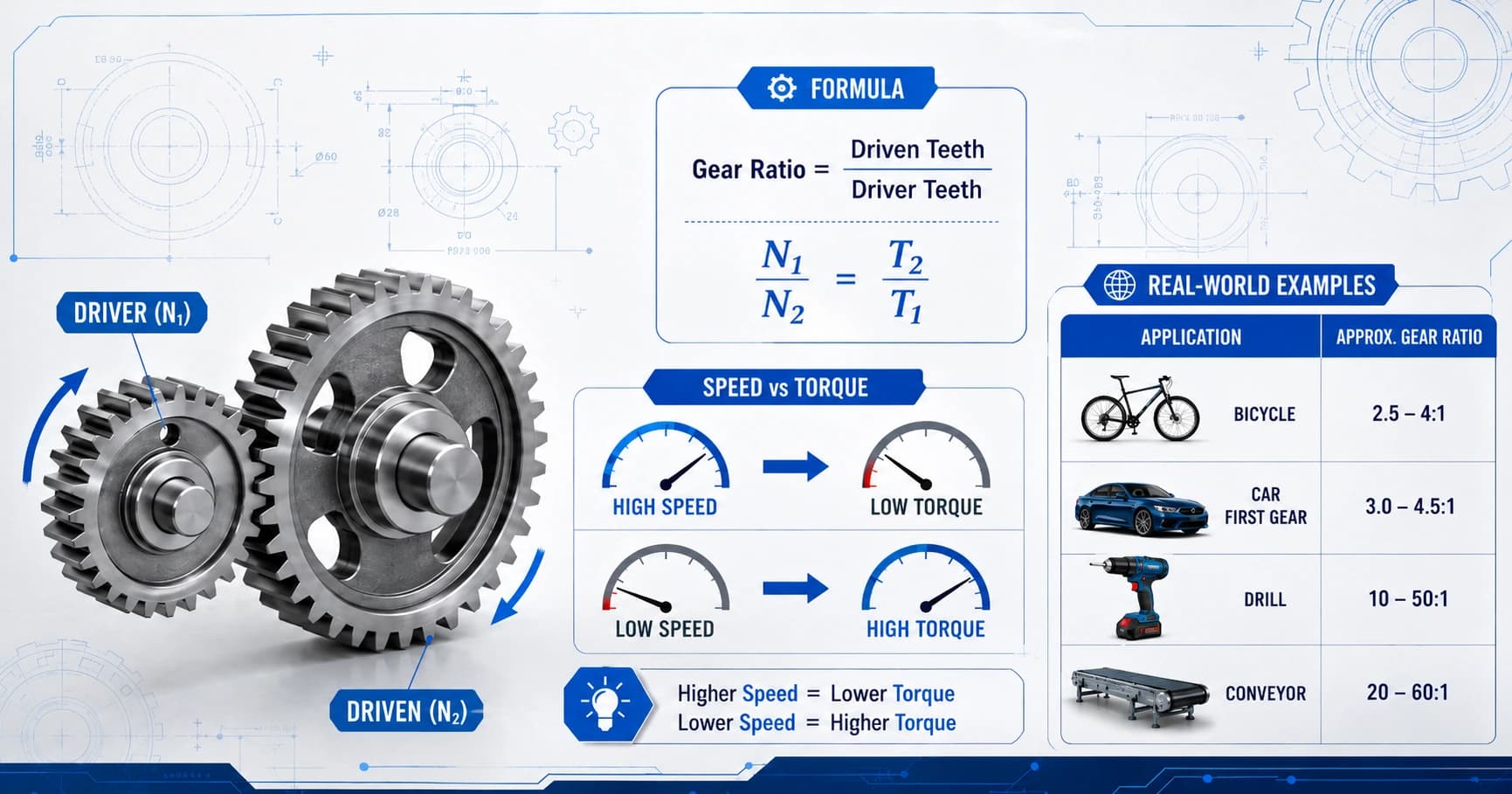
Gear Ratio Explained: Formula, Speed vs Torque, and Real-World Tables
Free Calculator
Proportion Calculator
Table of Contents
Every time you shift gears on a bicycle or a car changes gears automatically, a gear ratio calculation is happening. The principle is the same whether you are pedaling up a mountain or an engine is driving a wheel at 80 mph: a small gear driving a large gear trades speed for torque, and a large gear driving a small gear trades torque for speed.
This guide covers the formula, worked examples from scratch, bicycle and car ratio tables, and the practical tradeoffs that determine which ratio you want for which job.
Gear ratio = driver teeth divided by driven teeth — that's the whole formula
typical first-gear ratio in a 6-speed manual car transmission
highest road bicycle gear combination — approximately 4.8:1
output RPM when a smaller gear drives a larger one (speed reduction)
What Is a Gear Ratio?
A gear ratio describes the relationship between the number of teeth on two meshing gears — or, equivalently, the relationship between their rotational speeds and torques. It is always expressed as driver:driven or as a single decimal number (the result of dividing driver by driven).
Two gears meshing have a simple mechanical constraint: every tooth on the driver gear must move one tooth on the driven gear. This means:
- If the driver has 20 teeth and the driven has 40 teeth, the driver must rotate twice for every one rotation of the driven gear → gear ratio 2:1
- If the driver has 40 teeth and the driven has 20 teeth, the driver rotates once for every two rotations of the driven gear → gear ratio 0.5:1 (or 1:2 expressed the other way)
The same relationship applies to sprocket-and-chain systems (bicycles) and pulley-and-belt systems. The formula is identical; only the mechanism of power transfer differs.
The Gear Ratio Formula
The fundamental formula:
Gear Ratio = Tdriver ÷ Tdriven
Where T = number of teeth (or diameter, or radius — the ratio is the same either way).
From this single formula, three other quantities fall out immediately:
| Quantity | Formula | What It Tells You |
|---|---|---|
| Output RPM | Input RPM ÷ Gear Ratio | How fast the driven gear/shaft rotates |
| Output Torque | Input Torque × Gear Ratio | How much rotational force is delivered (ignoring friction) |
| Speed increase | Gear Ratio < 1 | Driver smaller than driven → output faster than input |
| Torque increase | Gear Ratio > 1 | Driver larger than driven → output has more torque than input |
The speed-torque tradeoff is a direct consequence of energy conservation. Ignoring friction losses, input power equals output power (Power = Torque × RPM). If a gear ratio multiplies torque by 3×, output RPM drops to 1/3 of input RPM. You never get more energy out than you put in — you only change the form it arrives in.
Worked Examples
Example 1 — Basic Gear Pair
A motor spins at 1,800 RPM with 10 Nm of torque. It drives a gear with 15 teeth. That gear meshes with a second gear that has 45 teeth.
- Gear ratio = 15 ÷ 45 = 0.333 (1:3)
- Output RPM = 1,800 ÷ 0.333 = 600 RPM (speed reduced)
- Output torque = 10 × 3 = 30 Nm (torque tripled)
This is a speed reduction — trading rotational speed for torque. Used in conveyor systems, winches, and first gear in vehicles where maximum pulling force is needed from a standstill.
Example 2 — Speed Increase
An engine output shaft turns at 3,000 RPM with 200 Nm of torque. It drives a 60-tooth gear meshing with an 20-tooth gear on the output shaft.
- Gear ratio = 60 ÷ 20 = 3:1
- Output RPM = 3,000 × 3 = 9,000 RPM (speed tripled)
- Output torque = 200 ÷ 3 = 66.7 Nm (torque reduced to 1/3)
This is a speed multiplier — sacrificing torque for higher rotational speed. Used in the final drive of high-speed spindles, some electric tools, and overdrive gears in transmissions at highway speeds.
Example 3 — Gear Train (Multiple Stages)
When gears are chained in sequence (a gear train), multiply the individual ratios:
Stage 1: 10-tooth driving 30-tooth → ratio 3:1
Stage 2: 30-tooth driving 15-tooth → ratio 0.5:1
Overall ratio = 3 × 0.5 = 1.5:1
A 1,000 RPM input becomes 667 RPM output with 1.5× the input torque. Gear trains allow very large ratios to be achieved in compact spaces — useful in clocks, gearboxes, and industrial reducers.
Bicycle Gear Ratios
A bicycle drivetrain uses a chainring (front, driver) and a cassette sprocket (rear, driven). The gear ratio determines how far the bike travels per pedal revolution — called the gear inches or development.
Development (metres per pedal stroke) = (Chainring ÷ Sprocket) × Wheel circumference
For a typical 700c road wheel (2.096m circumference):
Road Bicycle — Common Gear Combinations
| Chainring | Sprocket | Gear Ratio | Development (m/stroke) | Use Case |
|---|---|---|---|---|
| 53t | 11t | 4.82:1 | 10.1 m | Flat road, high speed descent |
| 53t | 17t | 3.12:1 | 6.5 m | Moderate flat riding |
| 53t | 25t | 2.12:1 | 4.4 m | Gentle climbs |
| 39t | 25t | 1.56:1 | 3.3 m | Sustained climbing |
| 39t | 32t | 1.22:1 | 2.6 m | Steep climbs |
| 34t | 34t | 1.00:1 | 2.1 m | Very steep grades (1:1 = "granny gear") |
| 34t | 36t | 0.94:1 | 2.0 m | Mountain bike extreme climbing |
The lowest usable ratio is typically around 1:1 on road bikes and 0.7:1 on mountain bikes. Below that, cadence becomes too high relative to forward progress to be efficient. Above 4.5:1, most cyclists cannot generate enough RPM (cadence) to sustain it.
Mountain Bike vs Road Bike — Ratio Ranges
| Bike Type | Lowest Ratio | Highest Ratio | Ratio Spread | Why |
|---|---|---|---|---|
| Road bike (2× groupset) | 1.1:1 | 4.8:1 | 4.4× | Primarily flat/rolling terrain; high cadence priority |
| Road bike (1× gravel) | 1.2:1 | 3.5:1 | 2.9× | Simpler drivetrain, narrower range |
| Mountain bike (1× 12-speed) | 0.7:1 | 3.6:1 | 5.1× | Steep technical terrain; torque multiplication needed |
| E-bike (mid-drive) | 0.5:1 | 3.2:1 | 6.4× | Motor torque reduces need for extremely low ratios |
Car Transmission Gear Ratios
A car transmission uses multiple gear ratios to match engine RPM to wheel speed across a wide range of driving conditions. First gear provides maximum torque for starting from rest; top gear (or overdrive) is optimized for fuel efficiency at highway speeds.
Typical 6-Speed Manual Transmission Ratios
| Gear | Typical Ratio | Output RPM at 3,000 RPM Input | Primary Use |
|---|---|---|---|
| 1st | 3.5:1 | 857 RPM | Starting from rest — maximum torque multiplication |
| 2nd | 2.2:1 | 1,364 RPM | Low-speed acceleration |
| 3rd | 1.5:1 | 2,000 RPM | Moderate speed/acceleration balance |
| 4th | 1.1:1 | 2,727 RPM | Urban cruising |
| 5th | 0.9:1 | 3,333 RPM | Highway — near 1:1 |
| 6th (OD) | 0.7:1 | 4,286 RPM | Overdrive — fuel-efficient highway cruising |
| Reverse | 3.8:1 | 789 RPM | Typically higher ratio than 1st for low-speed control |
These ratios are multiplied by the final drive ratio (axle ratio, typically 3.5:1–4.1:1) to give the total gear reduction from engine to wheel. A 1st gear of 3.5:1 combined with an axle ratio of 3.73:1 gives a total ratio of 13.1:1 — meaning the engine spins 13 times for every 1 wheel rotation.
How Automakers Choose Gear Ratios
The spread between first and top gear has grown significantly with 8-, 9-, and 10-speed automatic transmissions, which now commonly offer a ratio spread of 7:1 or more compared to 4:1 for older 4-speeds. Closer-spaced ratios keep the engine in its power band longer during acceleration, improving both performance and fuel economy.
Speed vs Torque — Choosing the Right Ratio
| Application | Priority | Typical Ratio | Why |
|---|---|---|---|
| Vehicle starting (1st gear) | Torque | 3:1 – 5:1 | Overcome static inertia and rolling resistance from rest |
| Highway cruising (top gear) | Speed / efficiency | 0.6:1 – 0.9:1 | Engine runs at low RPM for fuel economy; less torque needed |
| Electric motor (single speed) | Balance | 8:1 – 12:1 | Electric motors produce peak torque at 0 RPM; one ratio covers full range |
| Bicycle climbing | Torque | 0.8:1 – 1.2:1 | Low cadence sustainable; maximise mechanical advantage on grades |
| Bicycle flat sprint | Speed | 4:1 – 5:1 | High development converts pedalling cadence to maximum forward speed |
| Industrial conveyor | Torque | 10:1 – 50:1 | Move heavy loads at low speed; motor runs fast, output shaft runs slow |
| Wind turbine gearbox | Speed increase | 1:70 – 1:100 | Blades spin at 15–25 RPM; generator needs 1,500 RPM |
| Clock mechanism | Speed reduction | 1:3,600+ | Convert oscillations into precise second/minute/hour hand speeds |
Compound and Planetary Gear Systems
Compound Gear Trains
When a large ratio is needed in a small space, compound gear trains stack multiple gear pairs. The output shaft of each pair becomes the input shaft of the next, and the overall ratio is the product of all individual ratios.
A 3-stage compound train with ratios 4:1, 3:1, and 2:1 produces a total ratio of 4 × 3 × 2 = 24:1. This is how watches and clocks achieve ratios of thousands-to-one using small gears that fit in a wristwatch case.
Planetary (Epicyclic) Gear Systems
Automatic transmissions, hybrid vehicle drive systems, and electric vehicle single-speed reducers often use planetary gear sets rather than simple gear pairs. A planetary set consists of:
- Sun gear — at the centre
- Planet gears — 3–4 gears orbiting the sun
- Ring gear — outer gear that the planets mesh with
- Planet carrier — the arm holding the planet gears
By holding different members fixed (via clutches and brakes), the same planetary set produces different ratios. A Toyota-style automatic transmission uses three planetary sets to generate 6 forward ratios from a compact package that would require a much longer gear train if built from simple spur gears.
Frequently Asked Questions
How do you calculate gear ratio?
Gear ratio = number of teeth on the driver gear ÷ number of teeth on the driven gear. If you don't have tooth counts, you can use gear diameters or radii instead — the ratio is the same. Example: a 20-tooth driver meshing with a 60-tooth driven gear gives a ratio of 20 ÷ 60 = 0.333, or expressed as 1:3. The driven gear rotates once for every 3 rotations of the driver, but with 3× the torque.
What does a gear ratio of 3.5:1 mean?
A 3.5:1 gear ratio means the driver gear (or input shaft) rotates 3.5 times for every 1 rotation of the driven gear (or output shaft). The output delivers 3.5× the input torque, but spins at 1/3.5 = 29% of the input speed. This is a torque-multiplying reduction — common in first gear of car transmissions and industrial drives where high pulling force at low speed is needed.
What is the difference between gear ratio and speed ratio?
They are inverses of each other. If the gear ratio (driver:driven) is 4:1, the speed ratio (output:input) is 1:4 — the output spins at 25% of input speed. Speed ratio is sometimes used in contexts where the focus is on the output speed rather than torque multiplication. Both describe the same physical system; the choice of which to use is conventional in different industries.
Does a higher gear ratio mean more speed or more torque?
A higher gear ratio (e.g., 4:1 vs 2:1) means more torque multiplication and less output speed. The driver makes more rotations per output rotation, trading speed for force. A lower gear ratio (e.g., 0.5:1) means more output speed and less torque. In vehicles, lower numbered gears (1st, 2nd) have higher gear ratios for torque; higher numbered gears (5th, 6th) have lower ratios for speed and efficiency.
How do you calculate output RPM from a gear ratio?
Output RPM = Input RPM ÷ Gear Ratio. Example: if input is 1,200 RPM and gear ratio is 3:1, output RPM = 1,200 ÷ 3 = 400 RPM. If the gear ratio is less than 1 (speed increase), dividing by a fraction gives a larger number — e.g., input 1,000 RPM with a 0.5:1 ratio → output = 1,000 ÷ 0.5 = 2,000 RPM.
What is a good gear ratio for a bicycle?
It depends entirely on terrain and rider fitness. For flat roads at moderate speed, ratios of 2.5:1–3.5:1 suit most riders at a comfortable 80–90 RPM cadence. For climbing, ratios of 1:1–1.5:1 let you sustain pedalling without excessive force. For fast descents or sprinting, 4:1–5:1 ratios convert high cadence into maximum speed. Modern 11- and 12-speed groupsets provide 10+ steps across this range so you can find the right ratio for the moment.
Summary
The gear ratio formula — driver teeth divided by driven teeth — is the foundation of all mechanical power transmission. The key practical takeaways:
- Ratio > 1: driver larger than driven → torque multiplied, speed reduced (reduction drive)
- Ratio < 1: driver smaller than driven → speed multiplied, torque reduced (overdrive)
- Ratio = 1:1: direct drive — no mechanical advantage; speed and torque pass through unchanged
- Compound trains: multiply individual ratios to get overall ratio
- Energy is conserved: more torque always comes at the cost of less speed, and vice versa
Whether you are selecting a cassette for a mountain pass, diagnosing why a conveyor belt is running too slowly, or understanding why a car labours in too high a gear, the same arithmetic applies. Driver ÷ driven = ratio. Input RPM ÷ ratio = output RPM. Input torque × ratio = output torque.
Related Calculators
Try these free calculators related to this article:
In-Depth Guides
Dive deeper with our comprehensive guides on this topic:
Frequently Asked Questions
Our Methodology
All engineering content on CalculatorApp.me is reviewed by subject-matter experts, cross-referenced with official sources, and updated regularly for accuracy. Our formulas and data are verified against industry standards and government publications.
Marcus Webb
Verified AuthorEngineering & Applied Mathematics Specialist
Marcus specializes in structural analysis, fluid mechanics, and construction calculations, verifying every formula against ASCE standards, ACI codes, and published engineering handbooks. Content lead at CalculatorApp.me.
Found this helpful? Share it!
Stay Updated
Get notified when we launch new calculators and features.
No spam. Unsubscribe anytime.