How to Calculate Concrete Quantities: A Complete Estimating Guide
Free Calculator
Concrete Cost Calculator
Table of Contents
Concrete Volume Basics
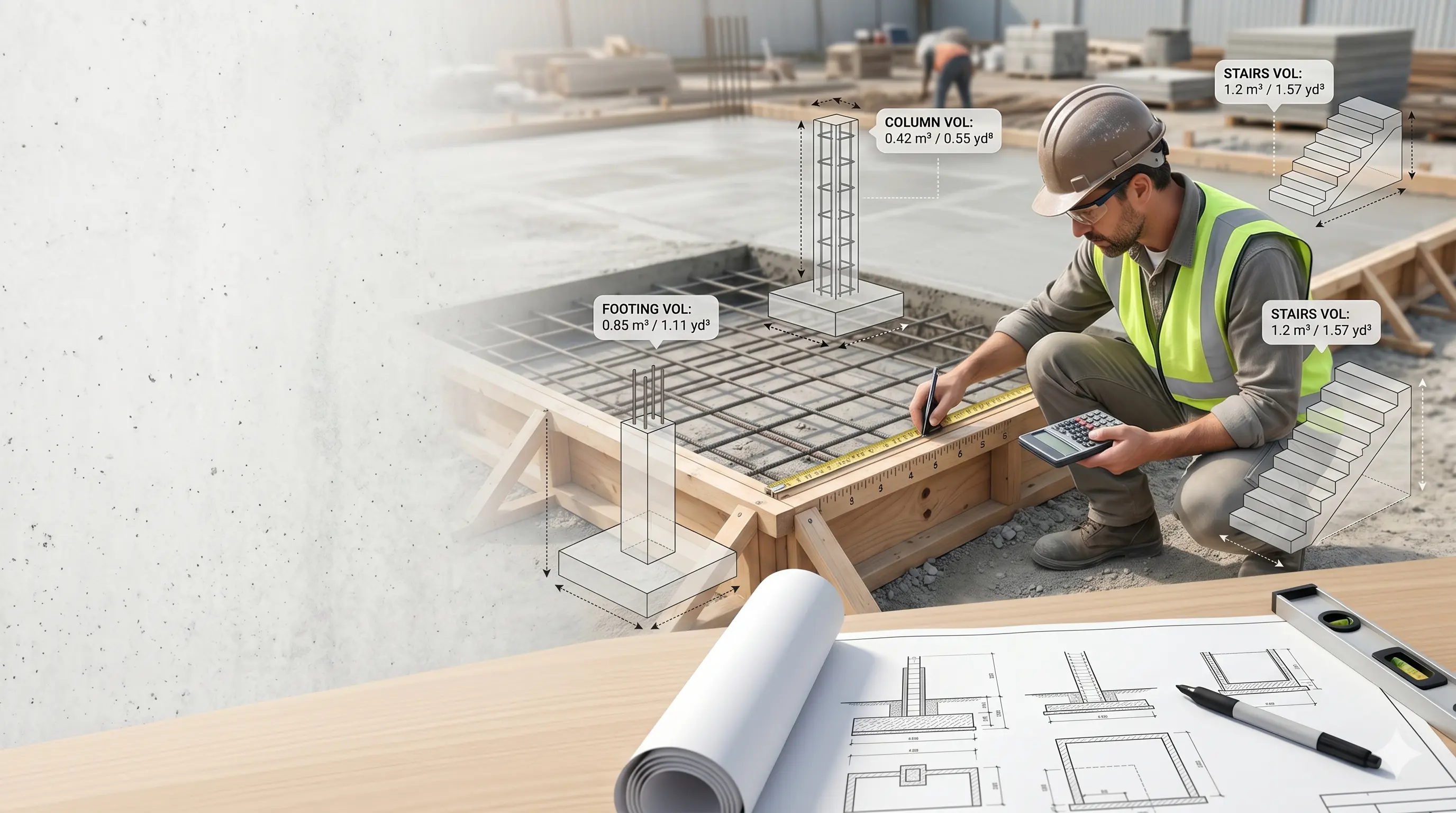
A concrete calculator simplifies the math. Concrete volume is measured in cubic yards (US) or cubic metres (metric). The fundamental formula is simple: Volume = Length × Width × Depth. But getting accurate real-world estimates requires accounting for irregular shapes, sub-base losses, and waste.
Unit Conversions
1 cubic yard = 27 cubic feet
1 cubic metre = 35.31 cubic feet = 1.308 cubic yards
A standard 80-lb bag of concrete yields ~0.6 cubic feet (0.022 cubic yards)
You need ~45 bags of 80-lb concrete mix per cubic yard
Slab Calculations
For a rectangular slab (the most common pour):
Example: 20' × 24' patio, 4 inches thick
Convert depth to feet: 4\" = 0.333 feet
Volume = 20 × 24 × 0.333 = 160 cubic feet
Convert to cubic yards: 160 ÷ 27 = 5.93 cubic yards
Add 10% waste: 5.93 × 1.10 = 6.52 cubic yards
Order 6.5-7 cubic yards
At an average delivered cost of $150-180 per cubic yard (2026 US averages), this pour costs approximately $975-$1,260 for material.
Footings and Foundations
Footings are typically rectangular trenches: Volume = Length × Width × Depth. For continuous footings (perimeter foundations), calculate the total linear footage first.
Example: 80 linear feet of 16\" wide × 8\" deep footing
Width: 16\" = 1.333 feet
Depth: 8\" = 0.667 feet
Volume = 80 × 1.333 × 0.667 = 71.1 cubic feet = 2.63 cubic yards
Add 10% waste: ~2.9 cubic yards
Columns and Cylinders
Round columns use the cylinder formula: V = π × r² × h.
Example: 12\" diameter column, 8 feet tall
Radius: 6\" = 0.5 feet
V = π × 0.5² × 8 = 6.28 cubic feet = 0.233 cubic yards
For multiple columns, multiply by the count. Ten such columns = 2.33 cubic yards + 10% waste = ~2.6 yards.
Waste Factors
Always order more than the calculated volume:
Slabs on grade: 5-10% extra (sub-grade irregularities, form bulging)
Footings: 10-15% extra (trench wall collapse, gravel absorption)
Walls: 5-10% extra
Columns/round forms: 8-12% extra
It is always better to have 0.25-0.5 yards too much than to run short during a pour. Concrete cannot be poured in separate stages without creating a "cold joint" — a structural weakness.
Ready-Mix vs. Bags
Bags (80-lb): Best for small jobs under 0.5 cubic yards. At ~$6.50/bag, a cubic yard from bags costs $290+ — nearly double the cost of ready-mix. But no minimum order and no time pressure.
Ready-mix truck: Most economical for jobs over 1 cubic yard. Typical minimum order: 1 yard. Short-load fees may apply for under 3-4 yards. You typically have 90 minutes from loading to complete placement.
Estimate Your Project
Use our free Concrete Calculator to estimate quantities for any shape. For larger projects, our Concrete Quantity Calculator handles multi-component estimates, and our Foundation Size Calculator helps determine proper footing dimensions based on soil bearing capacity and loads.
Types of Concrete Mixes and When to Use Each
Not all concrete is created equal. A concrete calculator gives you the volume, but choosing the right mix ensures the project lasts decades. Here are the most common types:
Standard Ready-Mix Concrete
Available in various compressive strengths measured in PSI (pounds per square inch):
2,500 PSI: General-purpose for sidewalks, patios, and non-structural flatwork. Adequate for foot traffic and light loads.
3,000 PSI: The most commonly specified residential mix. Suitable for driveways, garage floors, and foundations. Meets most building code requirements for residential construction.
3,500–4,000 PSI: Used for structural applications — footings, columns, load-bearing walls, and driveways that support heavy vehicles.
4,500+ PSI: Commercial and industrial applications — warehouse floors, parking structures, and bridge decks. Requires higher cement content and careful quality control.
Specialty Mixes
High-early-strength concrete: Reaches design strength in 1-3 days instead of the standard 28 days. Used when forms need to be removed quickly or for cold-weather pours.
Fiber-reinforced concrete: Contains polypropylene or steel fibers that reduce shrinkage cracking. Ideal for slabs-on-grade and thin overlays.
Air-entrained concrete: Contains microscopic air bubbles (4-7% of volume) that allow water to expand during freeze-thaw cycles without cracking. Essential in climates where concrete is exposed to freezing temperatures and deicing salts.
Self-leveling concrete: High-flow mix that fills forms without vibration. Used for leveling uneven floors and filling tight form spaces.
How Much Concrete to Order: The Waste Factor
A concrete calculator gives you the theoretical volume, but you should always order more to account for real-world conditions:
Standard waste factor: Order 5-10% extra for simple rectangular pours (slabs, footings).
Irregular shapes: Add 10-15% for curved forms, radius edges, and complex geometry.
Subgrade irregularities: If the ground beneath your slab is uneven, low spots will consume extra concrete. A 4-inch slab on ground that varies by 1 inch effectively requires 25% more concrete in the low areas.
Pump line prime and wash: If using a concrete pump, the pump operator needs approximately 0.5 cubic yards to prime the line, and some concrete is lost during cleanout.
For a 10 × 20 ft slab at 4 inches thick: base volume = (10 × 20 × 0.333) / 27 = 2.47 cubic yards. With a 10% waste factor: order 2.75 cubic yards (round up to the nearest quarter-yard, as that is the minimum increment for most ready-mix trucks).
Bagged Concrete vs. Ready-Mix Delivery
The choice between bags and truck delivery depends on project size and logistics:
Bagged Concrete (Quikrete, Sakrete)
Available in 40, 60, and 80-pound bags at any home improvement store.
An 80-pound bag yields approximately 0.6 cubic feet of mixed concrete.
Practical for projects under 1 cubic yard. For a 1 cubic yard project, you would need approximately 45 bags at 80 pounds each — that is 3,600 pounds of material to mix manually.
Cost: approximately $5-7 per 80-pound bag, totaling $225-315 per cubic yard (labor not included).
Ready-Mix Truck Delivery
Minimum order is typically 1 cubic yard, with short-load fees for orders under 3-5 yards.
Cost: approximately $130-175 per cubic yard plus delivery ($50-100) and short-load fees if applicable.
A standard mixer truck holds 8-10 cubic yards. For larger projects, multiple trucks can be scheduled in sequence.
Concrete begins hardening within 60-90 minutes of mixing. Plan your crew, forms, and finishing tools before the truck arrives.
The breakpoint is approximately 1 cubic yard — below that, bags are often easier and comparably priced. Above 1 yard, ready-mix is more economical and dramatically faster. Use our concrete calculator to determine whether bags or ready-mix is appropriate for your project.
Curing and Finishing: What Happens After the Pour
Proper curing is the difference between concrete that lasts 5 years and concrete that lasts 50 years. Curing maintains adequate moisture and temperature for the cement hydration reaction to complete.
Finishing timeline: After pouring, screed (level) the surface with a straight board, then let bleed water rise to the surface and evaporate (15-60 minutes depending on conditions). Float the surface to push aggregate down and bring paste up. Trowel for a smooth finish. Apply broom texture for outdoor surfaces that need slip resistance.
Curing methods: Cover with plastic sheeting, apply liquid curing compound (spray-on membrane), or keep the surface continuously wet with sprinklers for 7 days. The Portland Cement Association recommends moist curing for at least 7 days for standard concrete.
Temperature matters: Concrete should not freeze within the first 24-48 hours. In cold weather (below 50°F), use hot water in the mix, insulating blankets, and possibly heated enclosures. In hot weather (above 90°F), use ice in the mix water, schedule pours for early morning, and begin curing immediately to prevent rapid moisture loss.
Strength development: Concrete reaches approximately 50% of design strength in 3 days, 75% in 7 days, and 100% at 28 days. Avoid heavy loads on new concrete for at least 7 days (foot traffic after 24-48 hours).
Estimating Rebar and Reinforcement Needs
Most structural concrete projects require steel reinforcement to handle tensile loads (concrete is strong in compression but weak in tension):
Slabs: Use welded wire mesh (6×6 W2.9×W2.9) or #3 rebar on 18-inch centers for standard 4-inch residential slabs. Position the mesh in the upper third of the slab thickness for maximum crack resistance.
Footings: Typically require #4 or #5 rebar running longitudinally with stirrups per engineering specifications. Always follow your structural engineer's plans for footing reinforcement.
Walls: Foundation walls typically use horizontal and vertical #4 rebar on 12-16 inch centers both ways. Local building codes specify minimum reinforcement based on wall height and soil conditions.
Cover requirements: Rebar must have a minimum of 3 inches of concrete cover when in contact with soil (footings) and 1.5 inches for formed surfaces (walls). Insufficient cover leads to rebar corrosion and eventual structural failure.
Frequently Asked Questions About Concrete
Can I pour concrete in the rain?
Light drizzle after the concrete has been placed and initially set is generally not a problem. However, pouring during heavy rain is risky — excess water dilutes the surface paste, weakens the top layer, and creates surface defects (crazing, scaling, dusting). If rain is forecasted, have plastic sheeting ready to cover freshly poured concrete immediately. Never trowel bleed water or rainwater back into the surface.
How thick should a concrete slab be?
Standard thicknesses: sidewalks and patios (4 inches), residential driveways (4-5 inches), driveways for heavy vehicles and RVs (5-6 inches), garage floors (4-6 inches depending on loads), commercial floors (6-8 inches). Always pour on a compacted gravel base (4-6 inches of crushed stone) for proper drainage and to prevent soil shifting beneath the slab.
Why did my concrete crack?
All concrete cracks — the goal is controlling where and how. Common causes include insufficient control joints (cut every 8-12 feet for 4-inch slabs), too much water in the mix (reduces strength and increases shrinkage), inadequate curing (rapid moisture loss), lack of reinforcement, and tree root pressure from nearby trees. Control joints create planned weak points so cracks form in straight lines within the joints rather than randomly across the surface.
Related Articles on CalculatorApp.me
Construction & Building Resources
Related Calculators
Try these free calculators related to this article:
In-Depth Guides
Dive deeper with our comprehensive guides on this topic:
Frequently Asked Questions
Our Methodology
All construction content on CalculatorApp.me is reviewed by subject-matter experts, cross-referenced with official sources, and updated regularly for accuracy. Our formulas and data are verified against industry standards and government publications.
Jordan Hayes
Verified AuthorPersonal Finance Content Strategist
Jordan is a personal finance content strategist with 9+ years writing about mortgages, retirement, tax strategy, and budgeting. Every guide is cross-referenced with IRS publications, Federal Reserve data, and CFPB guidance to make complex calculations accessible. Editor at CalculatorApp.me.
Found this helpful? Share it!
Stay Updated
Get notified when we launch new calculators and features.
No spam. Unsubscribe anytime.