Metric vs Imperial: Complete Unit Conversion Guide 2026
Free Calculator
Unit Converter
Table of Contents
Metric vs Imperial: Complete Unit Conversion Guide 2026
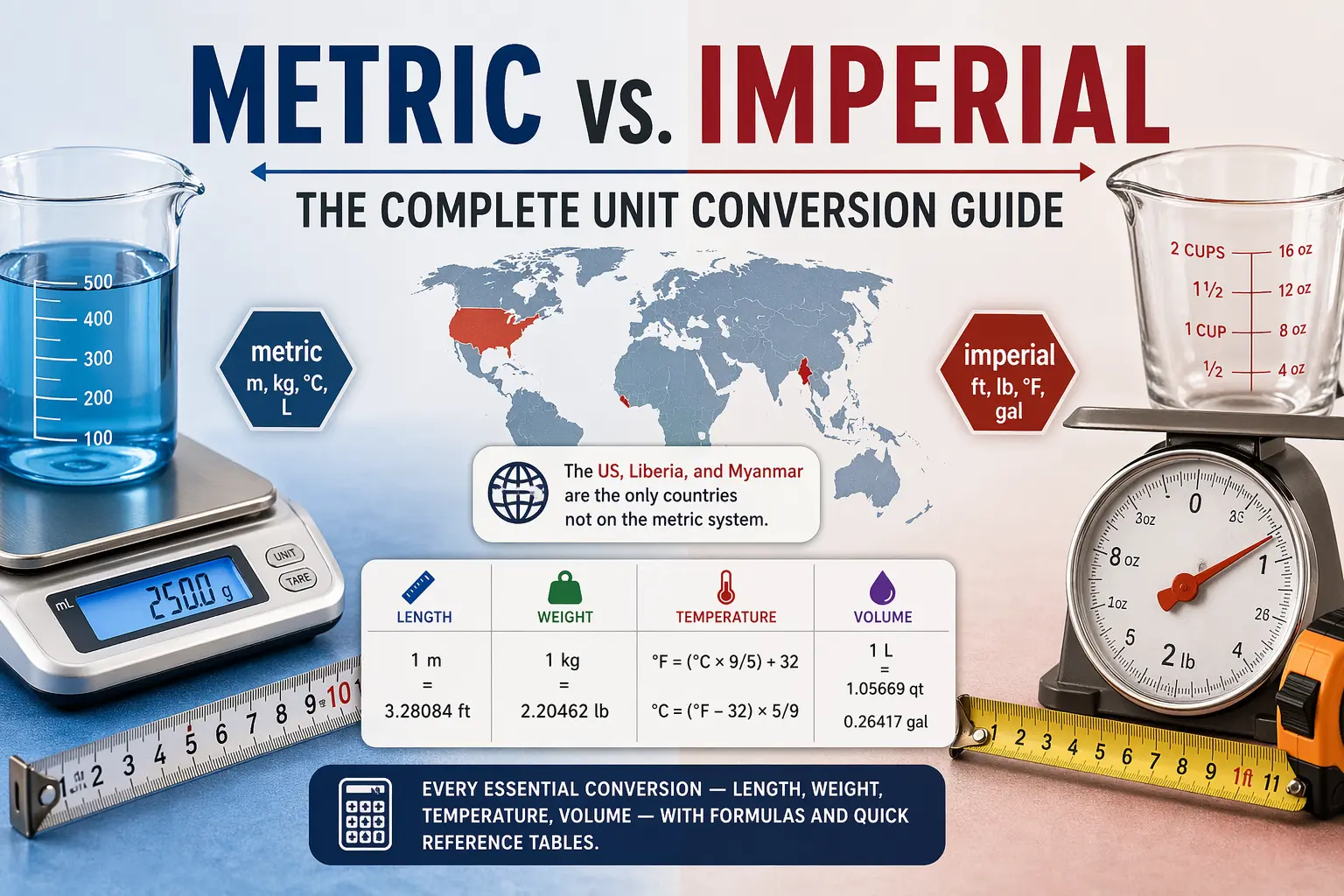
Metric and imperial are the world's two main measurement systems. Metric (SI) uses base-10 units — meters, kilograms, liters — while imperial uses historical British units — inches, pounds, gallons. The U.S. is the only major economy still using imperial for everyday measurements. This guide gives you every conversion table you need plus the formulas behind each one.
A Brief History of Both Systems
The Metric System
The metric system was formally adopted in France in 1795 following the French Revolution, which sought to replace the chaotic patchwork of regional measurements with a rational, decimal-based standard. By the 20th century, it became the International System of Units (SI) — now used as the official measurement standard in 195 of the world's ~196 countries.
The Imperial System
The British Imperial System was codified in the UK's Weights and Measures Act of 1824. It grew out of Anglo-Saxon and Roman units that had been in use across England for centuries. The U.S. adopted its own variant (U.S. customary units) before the British Act, which is why U.S. and UK gallons differ. The UK officially switched to metric in the 1970s–1990s for most purposes, though miles and pints persist culturally.
Length Conversions: Metric vs Imperial
| Metric | Imperial | Conversion Factor |
|---|---|---|
| 1 millimeter (mm) | 0.03937 inches | ÷ 25.4 |
| 1 centimeter (cm) | 0.3937 inches | ÷ 2.54 |
| 1 meter (m) | 3.281 feet / 1.094 yards | × 3.28084 |
| 1 kilometer (km) | 0.6214 miles | × 0.621371 |
| 1 inch (in) | 2.54 cm | × 2.54 |
| 1 foot (ft) | 30.48 cm / 0.3048 m | × 0.3048 |
| 1 yard (yd) | 0.9144 m | × 0.9144 |
| 1 mile (mi) | 1.609 km | × 1.60934 |
Quick memory trick: 1 inch = 2.54 cm exactly (this is the legal definition). Everything else derives from it.
Weight Conversions: Metric vs Imperial
| Metric | Imperial | Conversion Factor |
|---|---|---|
| 1 gram (g) | 0.03527 oz | ÷ 28.3495 |
| 100 grams | 3.527 oz | × 0.03527 |
| 1 kilogram (kg) | 2.2046 pounds (lb) | × 2.20462 |
| 1 metric ton (t) | 2,204.6 lb / 1.102 short tons | × 2204.62 |
| 1 ounce (oz) | 28.3495 g | × 28.3495 |
| 1 pound (lb) | 453.592 g / 0.4536 kg | × 0.453592 |
| 1 stone (st) | 6.35 kg / 14 lb | × 6.35029 |
Volume Conversions: Metric vs Imperial
| Metric | US Imperial | Conversion |
|---|---|---|
| 1 milliliter (mL) | 0.0338 fl oz | ÷ 29.5735 |
| 240 mL | 1 cup (US) | — |
| 1 liter (L) | 33.814 fl oz / 4.227 cups | × 33.814 |
| 1 liter | 0.2642 US gallons | × 0.264172 |
| 1 US fl oz | 29.5735 mL | × 29.5735 |
| 1 US cup | 236.588 mL | × 236.588 |
| 1 US pint | 473.176 mL / 0.473 L | × 473.176 |
| 1 US quart | 946.353 mL / 0.946 L | × 946.353 |
| 1 US gallon | 3.785 L | × 3.78541 |
| 1 UK gallon | 4.546 L | × 4.54609 |
Note: US and UK gallons differ significantly — 1 UK gallon = 1.201 US gallons. Always specify which gallon when cooking or fueling up internationally.
Temperature Conversions: Celsius vs Fahrenheit
Temperature is the conversion people get wrong most often. There are two formulas:
- °C to °F: (°C × 9/5) + 32 = °F
- °F to °C: (°F − 32) × 5/9 = °C
| Celsius (°C) | Fahrenheit (°F) | Reference Point |
|---|---|---|
| −40 | −40 | Both scales meet here |
| 0 | 32 | Water freezes |
| 20 | 68 | Room temperature |
| 37 | 98.6 | Body temperature |
| 100 | 212 | Water boils (sea level) |
| 180 | 356 | Oven moderate |
Quick estimate trick: Double the Celsius and add 30 to get a rough Fahrenheit (works well between 5°C–25°C).
Speed Conversions: km/h vs mph
| km/h | mph | Context |
|---|---|---|
| 30 | 18.6 | City speed limit (Europe) |
| 50 | 31.1 | Urban roads |
| 80 | 49.7 | Rural roads |
| 100 | 62.1 | Highway (most of Europe) |
| 120 | 74.6 | Motorway speed limit |
| 160 | 99.4 | US Interstate speed limit (some states) |
Formula: km/h × 0.621371 = mph | mph × 1.60934 = km/h
Quick-Reference Cheat Sheet
| To Convert | Multiply By |
|---|---|
| inches → cm | 2.54 |
| cm → inches | 0.3937 |
| feet → meters | 0.3048 |
| meters → feet | 3.2808 |
| miles → km | 1.60934 |
| km → miles | 0.62137 |
| lb → kg | 0.45359 |
| kg → lb | 2.20462 |
| US gallons → liters | 3.78541 |
| liters → US gallons | 0.26417 |
| mph → km/h | 1.60934 |
| km/h → mph | 0.62137 |
Free Conversion Tools on CalculatorApp.me
- Unit Converter — Instantly convert length, weight, volume, temperature, speed, area, and more
- Scientific Calculator — For complex calculations involving unit conversions in formulas
Frequently Asked Questions
Why doesn't the US use the metric system?
The U.S. has been legally metric since the Metric Conversion Act of 1975 — but the law made adoption voluntary. Switching costs, cultural familiarity, and infrastructure inertia (road signs, tools, building codes) have prevented a mandatory transition. Science, medicine, and the military all use metric in the U.S.
Which is more accurate — metric or imperial?
Neither is inherently more accurate. However, metric's base-10 structure makes calculations easier and reduces errors. That's why science, engineering, and medicine universally use SI units — decimal-based math has far fewer conversion steps and rounding errors.
How do I convert Celsius to Fahrenheit quickly in my head?
Use the shortcut: (°C × 2) + 30 ≈ °F. For example, 25°C × 2 = 50 + 30 = 80°F (actual is 77°F — close enough for weather forecasts). For precision, use the exact formula: (°C × 9/5) + 32.
What is 5'11" in centimeters?
5 feet 11 inches = 71 inches × 2.54 = 180.34 cm. A common rule of thumb: 6 feet ≈ 183 cm, 5'9" ≈ 175 cm.
Is 1 kg the same as 1 liter of water?
Yes — by definition. The metric system was designed so that 1 liter of pure water at 4°C weighs exactly 1 kilogram. This makes cooking, chemistry, and engineering calculations much simpler in metric than imperial.
Conclusion
Whether you're traveling internationally, following a recipe from a European cookbook, or reading a scientific paper, knowing your metric-to-imperial conversions is a practical daily skill. Bookmark this page as your quick-reference guide, and use CalculatorApp.me's free unit converter whenever you need a precise result instantly — no signup, no ads.
Related Calculators
Try these free calculators related to this article:
In-Depth Guides
Dive deeper with our comprehensive guides on this topic:
Frequently Asked Questions
Our Methodology
All tools content on CalculatorApp.me is reviewed by subject-matter experts, cross-referenced with official sources, and updated regularly for accuracy. Our formulas and data are verified against industry standards and government publications.
Jordan Hayes
Verified AuthorPersonal Finance Content Strategist
Jordan is a personal finance content strategist with 9+ years writing about mortgages, retirement, tax strategy, and budgeting. Every guide is cross-referenced with IRS publications, Federal Reserve data, and CFPB guidance to make complex calculations accessible. Editor at CalculatorApp.me.
Found this helpful? Share it!
Stay Updated
Get notified when we launch new calculators and features.
No spam. Unsubscribe anytime.