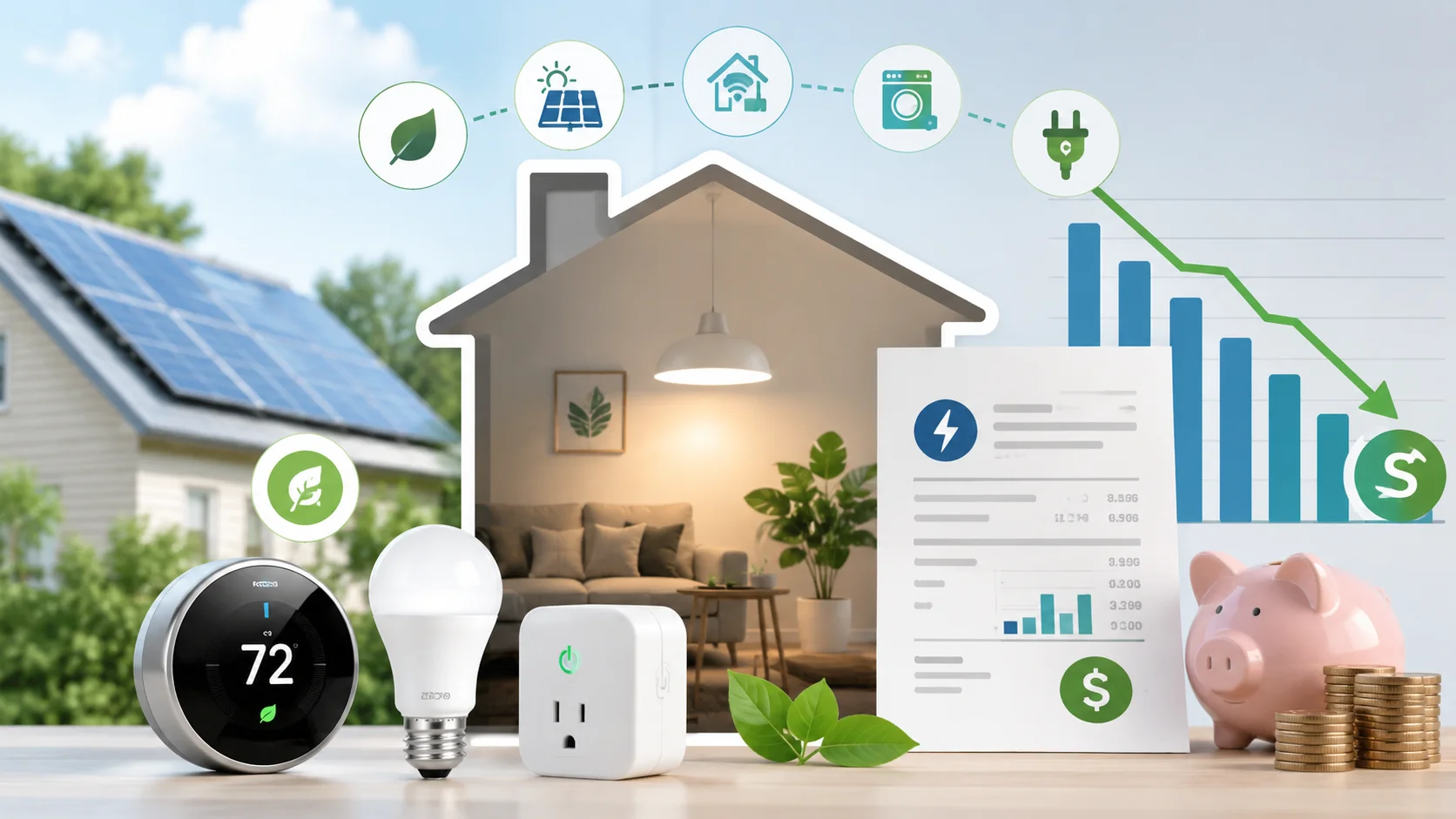
How to Reduce Your Electricity Bill: 20 Proven Strategies That Save $500+/Year
Free Calculator
Electricity Cost Calculator
Table of Contents
How to Reduce Your Electricity Bill: Understanding Your Usage
Wondering how to reduce electricity bill costs? The average American household uses 10,500 kWh per year and pays about $1,800 annually (at the national average of $0.17/kWh). But rates vary dramatically: Louisiana averages $0.12/kWh while Connecticut averages $0.29/kWh — the same usage costs $1,260 in Louisiana and $3,045 in Connecticut.
Your bill has two components: the energy charge (per kWh used) and fixed charges (delivery, infrastructure). You can only control the energy charge — and these 20 strategies target exactly that.
Quick Wins (Day 1 Savings)
1. Kill Phantom Loads ($100-200/year)
"Phantom" or "vampire" power is electricity drawn by devices that are off but still plugged in. The average home has 20-50 devices constantly drawing power: phone chargers, game consoles, cable boxes, microwaves with clocks, printers.
Phantom loads account for 5-10% of residential electricity use — roughly $100-200/year. Use smart power strips that cut power to devices when not in use, or unplug charges and devices you don't use daily.
2. Adjust Your Thermostat ($180/year)
Heating and cooling account for 46% of the average home's energy use. Every 1°F adjustment saves approximately 1-3% on your heating/cooling bill.
Summer: Set AC to 78°F when home, 85°F when away
Winter: Set heat to 68°F when home, 62°F when sleeping/away
A programmable/smart thermostat automates this and saves ~$180/year (EPA estimate)
3. Switch to LED Bulbs ($75/year)
If you still have incandescent bulbs, switching to LEDs provides the highest ROI of any energy upgrade. LEDs use 75% less electricity and last 25× longer.
Replacing 20 incandescent bulbs (60W each) with LEDs (9W each) saves approximately 1,020 kWh/year = $175/year. LED bulbs cost $2-5 each and pay for themselves in 2-3 months.
4. Optimize Water Heating ($50/year)
Water heating is the second-largest energy expense (18% of the average bill).
Lower your water heater from 140°F to 120°F (saves 4-22% of water heating costs)
Wash clothes in cold water (90% of washing machine energy goes to heating water)
Fix leaky faucets — a hot water leak of 1 drip/second costs $35/year
Medium-Impact Changes ($200-500 savings)
5. Seal Air Leaks ($200/year)
The average home has enough air leaks to equal a 2-foot-wide hole in the wall. Common leak locations: window frames, door frames, electrical outlets, attic hatches, recessed lights, plumbing penetrations.
A $20 tube of caulk and $10 pack of weatherstripping can save $200+/year. Use an incense stick near suspected leaks — if the smoke wavers, there's an air leak.
6. Use Ceiling Fans Correctly ($100/year)
Ceiling fans don't cool rooms — they cool people through wind chill effect (4-6°F perceived cooling). But only if used correctly:
Summer: Counterclockwise rotation (push air down) — lets you raise AC by 4°F without comfort loss
Winter: Clockwise on low speed (push warm air down from ceiling)
Turn off in empty rooms — fans don't cool rooms, only people
7. Upgrade to ENERGY STAR Appliances
When replacing old appliances, choose ENERGY STAR certified models. Average annual savings:
Refrigerator: $45/year (vs. a 15-year-old model)
Clothes washer: $45/year
Dishwasher: $35/year
Clothes dryer (heat pump): $100+/year
8. Use a Smart Power Strip ($50/year)
Advanced power strips detect when devices are in standby and cut power automatically. The best ones use infrared sensors (for TVs), current sensors (for computers), or timers (for chargers). $25-50 per strip, saving $50-100/year per entertainment or office setup.
9. Optimize Refrigerator Efficiency ($30/year)
Set refrigerator to 35-38°F and freezer to 0°F (colder = wasted energy)
Keep coils clean (vacuum every 6-12 months — dirty coils increase energy use by 30%)
Maintain ¾ full (thermal mass helps maintain temperature) but allow air circulation
Check door seals (close the door on a dollar bill — if it pulls out easily, replace the seal)
10. Run Appliances During Off-Peak Hours
If your utility offers time-of-use (TOU) pricing, shift high-energy tasks (laundry, dishwasher, EV charging) to off-peak hours (usually 9pm-7am). Off-peak rates can be 30-50% lower than peak rates.
High-Impact Investments ($300-1,000+ savings)
11. Install a Smart Thermostat ($180/year)
Smart thermostats like Nest and Ecobee learn your schedule and adjust automatically. The EPA estimates $180/year in savings. Many utilities offer $50-100 rebates, making the net cost $50-150.
12. Add Attic Insulation ($200+/year)
If your attic has less than 10-14 inches of insulation, you're losing significant heating/cooling through the roof. Adding insulation to R-49 (recommended for most climates) costs $1,500-2,500 and saves $200+/year — paying for itself in 7-12 years.
13. Upgrade Windows ($300/year)
If you have single-pane windows, upgrading to double-pane ENERGY STAR windows saves $200-400/year. Storm windows are a budget alternative ($80-200 per window) providing 70% of the benefit.
14. Heat Pump Water Heater ($300+/year)
Heat pump water heaters use 60-70% less electricity than traditional electric water heaters. A $1,200-2,000 upgrade saves $300+/year and qualifies for federal tax credits of up to $2,000.
15. Solar Panels ($1,000+/year)
A typical 6-8 kW residential solar system costs $12,000-18,000 after the 30% federal tax credit. It eliminates $100-200+/month in electricity costs and pays for itself in 6-10 years. After that, your electricity is essentially free for 15-20 more years.
Behavioral Changes (Free)
16. Air-Dry Clothes When Possible
Dryers use 3-5 kWh per load. Running 300 loads/year at $0.17/kWh costs $155-255. Air-drying half your loads saves $75-125/year.
17. Take Shorter Showers
A 10-minute shower uses 20 gallons of hot water. Reducing to 5 minutes cuts water heating by 50% for showers — saving $40-60/year for a family of four.
18. Use Natural Light
Open curtains during the day instead of turning on lights. In winter, south-facing windows also provide free solar heating. In summer, close curtains on sun-facing windows to reduce AC load.
19. Cook Efficiently
Microwaves use 80% less energy than ovens for reheating. Toaster ovens use 50% less than full ovens for small meals. Match the burner size to the pot (a 6-inch pot on an 8-inch burner wastes 40% of the heat).
20. Monitor Your Usage
Awareness alone reduces consumption by 5-15%. Check your smart meter daily, use your utility's app, or invest in a home energy monitor ($100-250) that shows real-time consumption by circuit.
Calculate Your Electricity Costs
Use our free Electricity Cost Calculator to estimate how much specific appliances cost to run. For heating and cooling calculations, try our BTU Calculator to right-size your HVAC system.
Frequently Asked Questions
What uses the most electricity in a home?
Heating and cooling (46%), water heating (18%), appliances (15%), lighting (9%), and electronics (12%). HVAC is by far the biggest target for savings.
Do smart power strips really save money?
Yes. They eliminate phantom loads, which cost the average home $100-200/year. A $30 smart power strip pays for itself in 2-4 months.
Is it cheaper to run AC all day or turn it on when I get home?
It's cheaper to raise the thermostat when you're away and cool down when you return. The energy to re-cool a warm house is less than the energy to maintain a cool house all day. A programmable thermostat automates this optimally.
How much can LED bulbs really save?
A single 60W-equivalent LED (9W) running 5 hours/day saves $8-10/year versus an incandescent bulb. Across 20 bulbs, that's $150-200/year. LEDs last 15,000-25,000 hours versus 1,000 hours for incandescents, so you also save on replacement costs.
Are solar panels worth it in 2026?
In most states, yes. With the 30% federal tax credit, average payback is 6-10 years. After that, electricity is essentially free for 15-20 more years. Solar is most cost-effective in states with high electricity rates and good sun exposure (California, Texas, Florida, Arizona, New York).
Related Articles on CalculatorApp.me
- The 50/30/20 Budget Rule
- How to Calculate Square Footage
- How Much Emergency Fund Do You Need?
- Metric vs. Imperial Unit Conversion Guide
Energy Saving Resources
Related Calculators
Try these free calculators related to this article:
In-Depth Guides
Dive deeper with our comprehensive guides on this topic:
Frequently Asked Questions
Our Methodology
All tools content on CalculatorApp.me is reviewed by subject-matter experts, cross-referenced with official sources, and updated regularly for accuracy. Our formulas and data are verified against industry standards and government publications.
Jordan Hayes
Verified AuthorPersonal Finance Content Strategist
Jordan is a personal finance content strategist with 9+ years writing about mortgages, retirement, tax strategy, and budgeting. Every guide is cross-referenced with IRS publications, Federal Reserve data, and CFPB guidance to make complex calculations accessible. Editor at CalculatorApp.me.
Found this helpful? Share it!
Stay Updated
Get notified when we launch new calculators and features.
No spam. Unsubscribe anytime.