How to Calculate a Loan Payment: Formula, Examples & Monthly Cost Breakdown
Free Calculator
Loan Calculator
Table of Contents
How to Calculate a Loan Payment: Formula, Examples & Monthly Cost Breakdown

Photo: Pexels
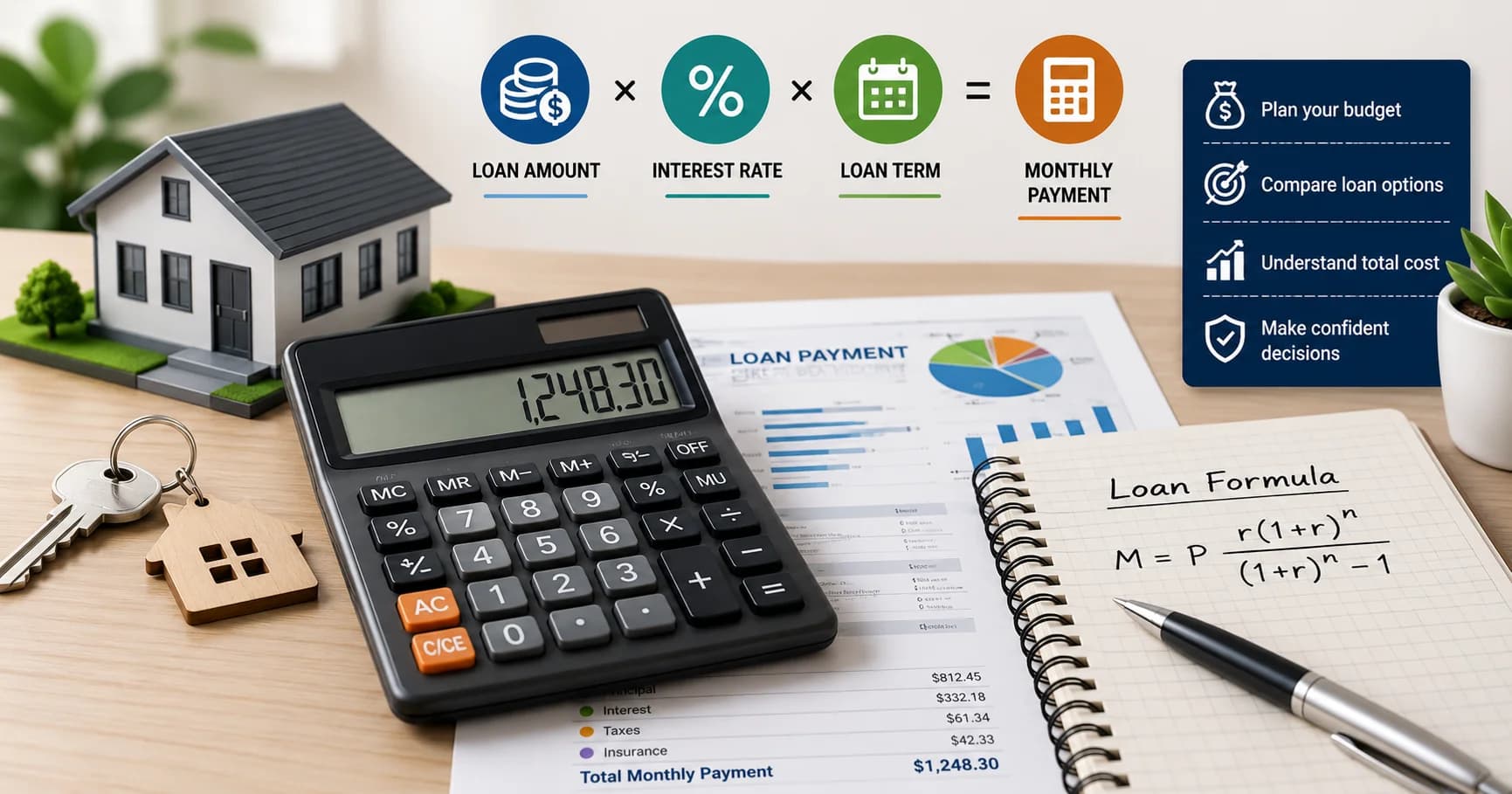
Before signing any loan, you need one number: your monthly payment. It determines whether you can afford the loan, how much the borrowing actually costs you, and which lender is offering the best deal. Lenders compute this with the amortization formula — the same math behind every mortgage, car loan, personal loan, and student loan.
This guide breaks down the loan payment formula, walks through real examples for common loan types, and shows you exactly how interest rate and loan term control what you pay each month — and in total over the life of the loan.
Key Takeaways
- The monthly payment formula is: M = P[r(1+r)ⁿ] ÷ [(1+r)ⁿ − 1], where P = principal, r = monthly rate, n = number of payments.
- Rate and term are the two levers — a lower rate saves money on every payment; a shorter term saves more in total interest.
- On a typical personal loan, 20–40% of total repayment goes to interest.
- Use our free Loan Calculator to compute your payment and full amortization schedule instantly.
The Loan Payment Formula
Every fixed-rate installment loan uses the same amortization formula to calculate the monthly payment:
M = P × [r(1 + r)ⁿ] ÷ [(1 + r)ⁿ − 1]
M = monthly payment
P = principal (the loan amount)
r = monthly interest rate (annual rate ÷ 12)
n = total number of payments (years × 12)
This formula produces a fixed payment that covers exactly the interest due each month and reduces the principal balance so that after n payments, the balance reaches exactly zero. It's the math behind every mortgage, personal loan, auto loan, and student loan in the US.
Step-by-Step Calculation Example
Let's calculate the monthly payment on a $15,000 personal loan at 8% APR for 3 years (36 months):
Step 1: Convert the annual rate to a monthly rate.
r = 8% ÷ 12 = 0.08 ÷ 12 = 0.006667
Step 2: Calculate the total number of payments.
n = 3 years × 12 months = 36
Step 3: Compute (1 + r)ⁿ.
(1 + 0.006667)³⁶ = (1.006667)³⁶ = 1.2702
Step 4: Apply the formula.
M = 15,000 × [0.006667 × 1.2702] ÷ [1.2702 − 1]
M = 15,000 × [0.008468] ÷ [0.2702]
M = 15,000 × 0.031335
M = $470.03 per month
Total repaid: $470.03 × 36 = $16,921. Of that, $15,000 is principal and $1,921 is interest — about 12.8% of the loan amount added in interest costs.
How Rate and Term Affect Your Payment
Two variables control both your monthly payment and total cost: the interest rate and the loan term. Here's what they look like in practice on a $15,000 personal loan:
| Rate | 2-Year Term | 3-Year Term | 5-Year Term |
|---|---|---|---|
| 6% APR | $665/mo $942 total interest |
$456/mo $1,416 total interest |
$290/mo $2,396 total interest |
| 10% APR | $692/mo $1,604 total interest |
$484/mo $2,423 total interest |
$319/mo $4,122 total interest |
| 15% APR | $727/mo $2,448 total interest |
$520/mo $3,714 total interest |
$357/mo $6,420 total interest |
The table illustrates two important patterns:
- Lower rate matters more than shorter term for total cost on long loans. Dropping from 15% to 6% APR on a 5-year loan saves $4,024 — almost as much as cutting from a 5-year to a 2-year term at 15%.
- Shorter terms reduce total interest dramatically but raise monthly payments. If budget allows, the 2-year option at any rate is the cheapest borrowing by far.
How Interest Is Calculated Each Month
Every loan payment splits into two parts: interest on the current balance and principal reduction. The split changes every month because the balance declines.
Monthly Interest = Remaining Balance × Monthly Rate
Monthly Principal = Monthly Payment − Monthly Interest
New Balance = Remaining Balance − Monthly Principal
On our $15,000 / 8% / 36-month example:
- Month 1: Interest = $15,000 × 0.006667 = $100.00. Principal = $470.03 − $100.00 = $370.03. New balance = $14,629.97.
- Month 18: Interest ≈ $46.60. Principal ≈ $423.43. Balance ≈ $6,976.
- Month 36: Interest ≈ $3.12. Principal ≈ $466.91. Balance = $0.
By the halfway point (Month 18), your payment is already directing ~90% to principal and only ~10% to interest. This is why the early months of a loan are the most expensive in interest terms — and why prepaying early saves the most money.
APR vs. Interest Rate: What You're Actually Paying
Lenders advertise both the interest rate (the base cost of borrowing) and the APR (Annual Percentage Rate). APR includes the interest rate plus all fees: origination fees, processing fees, and other loan costs.
The monthly payment formula uses the stated interest rate. But your true cost uses APR. A loan advertised at 8% interest with a 2% origination fee has an APR of roughly 10% on a 3-year term — and you receive only $14,700 in hand while repaying on the full $15,000.
Always compare loans using APR, not just the interest rate. The loan with the lowest interest rate isn't always the cheapest if it has higher fees.
The Effect of Extra Payments
Any amount you pay above the required monthly payment goes entirely to principal reduction. This shortens the loan term and reduces total interest.
On our $15,000 / 8% / 36-month loan ($470/month):
- Adding $50/month extra → pay off in 32 months, save approximately $180 in interest
- Adding $100/month extra → pay off in 28 months, save approximately $320 in interest
- Making one extra full payment per year → pay off approximately 4 months early
The savings on a personal loan are modest compared to a 30-year mortgage, but the same math principle applies. On larger, longer loans (mortgage, student loans), extra principal payments produce much more dramatic savings. The key rule: extra payments in the early months of any loan save the most interest because they reduce compounding over the most remaining months.
Loan Type Comparison: What Changes
The formula is identical for all installment loans. What changes is the typical rate, term, and purpose:
| Loan Type | Typical APR | Typical Term | Secured? |
|---|---|---|---|
| Personal Loan | 7–36% | 1–7 years | Usually not |
| Auto Loan | 5–15% | 2–7 years | Yes (car) |
| Mortgage | 6–8% | 15–30 years | Yes (home) |
| Student Loan (federal) | 5–8% | 10–25 years | No |
Secured loans (collateral backing them) consistently offer lower rates because the lender has less risk — they can repossess the asset if you default. Unsecured personal loans carry higher rates because the lender's only recourse is legal action.
Calculate Your Loan Payment
Use our free Loan Calculator to calculate your monthly payment, total interest, and full amortization schedule for any loan amount, rate, and term. For mortgage-specific calculations including property tax and insurance, see the Mortgage Calculator. Planning a car purchase? The Auto Loan Calculator factors in down payment and trade-in value.
Frequently Asked Questions
What is the formula for calculating a monthly loan payment?
M = P × [r(1+r)ⁿ] ÷ [(1+r)ⁿ − 1], where M is the monthly payment, P is the loan principal, r is the monthly interest rate (annual rate ÷ 12), and n is the total number of payments (years × 12).
How do I calculate the interest portion of my loan payment?
Monthly interest = remaining balance × monthly rate. In the first month, that's your full principal × (APR ÷ 12). Each subsequent month, the balance is lower so interest decreases and principal repayment increases.
Does a higher loan amount always mean a higher monthly payment?
Yes — for the same rate and term, the monthly payment scales directly with principal. A $20,000 loan at the same rate and term costs exactly twice what a $10,000 loan does per month.
How much does a 1% interest rate difference affect my payment?
On a $15,000, 3-year loan, a 1% rate increase adds roughly $7–8 per month and about $250 in total interest. On a $300,000 mortgage over 30 years, a 1% rate difference changes the monthly payment by roughly $170 and the total interest by over $60,000.
Should I choose a shorter or longer loan term?
Shorter terms mean higher monthly payments but less total interest. Longer terms lower monthly payments but increase total cost significantly. Choose the shortest term whose payment fits comfortably in your budget — typically no more than 15–20% of your monthly take-home pay.
Does making extra loan payments save money?
Yes. Any extra payment reduces principal, which reduces future interest charges. The savings depend on when you make the extra payment (earlier is better) and the remaining term. Even rounding your payment up to the nearest $50 can save meaningful interest on larger or longer loans.
What is the difference between APR and interest rate on a loan?
The interest rate is the base cost of borrowing. APR (Annual Percentage Rate) includes the interest rate plus all lender fees — origination fees, points, and closing costs — spread over the loan term. APR is a more accurate comparison tool when evaluating competing loan offers.
Related Calculators
Try these free calculators related to this article:
In-Depth Guides
Dive deeper with our comprehensive guides on this topic:
Frequently Asked Questions
Our Methodology
All loan calculator content on CalculatorApp.me is reviewed by subject-matter experts, cross-referenced with official sources, and updated regularly for accuracy. Our formulas and data are verified against industry standards and government publications.
Jordan Hayes
Verified AuthorPersonal Finance Content Strategist
Jordan is a personal finance content strategist with 9+ years writing about mortgages, retirement, tax strategy, and budgeting. Every guide is cross-referenced with IRS publications, Federal Reserve data, and CFPB guidance to make complex calculations accessible. Editor at CalculatorApp.me.
Found this helpful? Share it!
Stay Updated
Get notified when we launch new calculators and features.
No spam. Unsubscribe anytime.