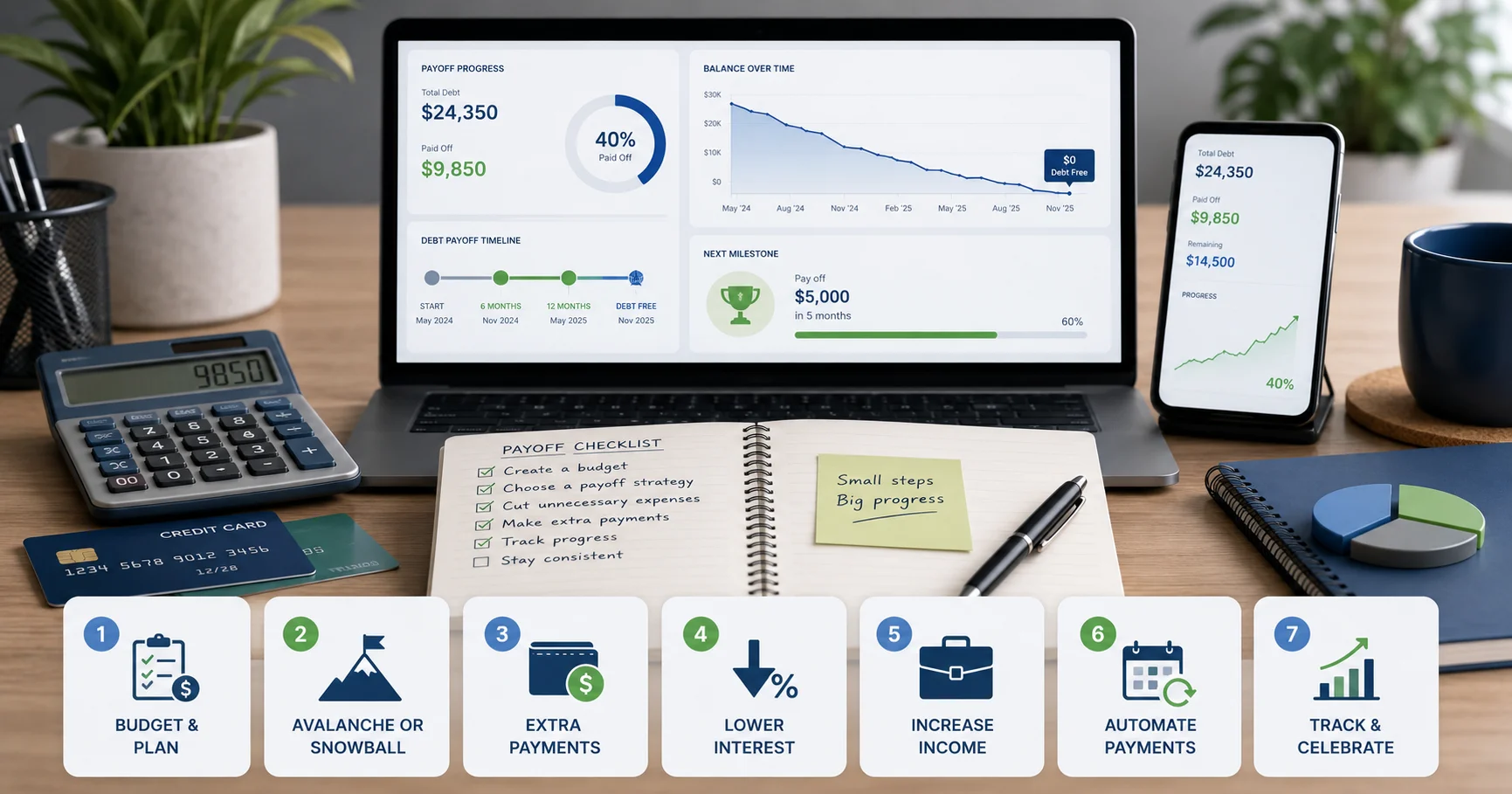
How to Pay Off Debt Fast: 7 Proven Strategies for 2026
Free Calculator
Credit Card Payoff Calculator
Table of Contents
How to Pay Off Debt Fast: 7 Proven Strategies for 2026

TL;DR: The two fastest proven methods are the debt avalanche (pay highest interest first — saves the most money) and the debt snowball (pay smallest balance first — builds momentum). In 2026, the average American carries $104,215 in total debt (Experian, 2024) with credit card rates averaging 21.76% APR (Federal Reserve, Q4 2024). The right strategy depends on your balances, interest rates, and psychology — but the most important factor is starting now.
Why Paying Off Debt Fast Matters More Than Ever in 2026
Consumer debt in the United States reached a record $17.94 trillion in Q3 2024, according to the New York Federal Reserve Household Debt and Credit Report. Credit card balances alone hit $1.17 trillion — the highest level ever recorded. With the average credit card APR at 21.76% in Q4 2024 per Federal Reserve data, carrying $10,000 in card debt costs approximately $2,176 in interest annually even if you make no additional purchases. Use our credit card payoff calculator to see exactly how long it will take to become debt-free and how much interest you will pay under your current payment plan.
Strategy 1: The Debt Avalanche Method (Mathematically Optimal)
The debt avalanche prioritizes paying off the debt with the highest interest rate first, while making minimum payments on all others. Once the highest-rate debt is eliminated, you redirect those payments to the next highest rate. A 2012 analysis in the Journal of Marketing Research found the avalanche method saves 15–25% more in total interest compared to random extra payments. For someone with $30,000 in mixed debt, the savings can exceed $5,000.
Example — Debt Avalanche in action:
- Credit card A: $8,000 at 24% APR → pay this first
- Credit card B: $5,000 at 19% APR → pay this second
- Personal loan: $12,000 at 11% APR → pay this last
Best for: People motivated by numbers who want to minimize total interest paid. Requires discipline to stay on track when the first payoff takes a long time.
Strategy 2: The Debt Snowball Method (Psychologically Powerful)
The debt snowball prioritizes paying off the smallest balance first regardless of interest rate, building psychological momentum through quick wins. A 2016 Journal of Consumer Research study found snowball users were 14% more likely to become debt-free than those using an avalanche approach, despite paying more total interest — because they stuck with the plan longer. The snowball is especially effective for people who have previously abandoned debt payoff plans due to discouragement.
Best for: People who need early wins to stay motivated; those with many small debts that can be eliminated quickly.
Strategy 3: Debt Consolidation
Debt consolidation combines multiple high-interest debts into a single loan at a lower interest rate. In 2026, personal loan rates for borrowers with good credit (670+ FICO) average 11.6% APR per LendingTree data, compared to the 21.76% average credit card rate. Consolidating $15,000 in credit card debt at that rate saves approximately $1,524 per year in interest, accelerating payoff significantly.
Balance transfer cards with 0% promotional periods — typically 12–21 months — are particularly powerful if you can pay off the balance during the promotional window. The key risk: balances remaining after the promotional period typically revert to 25%+ APR. Our loan calculator can model different consolidation scenarios and show total interest savings versus your current situation.
Best for: People with good credit who qualify for significantly lower rates and have the discipline not to accumulate new debt during the payoff period.
Strategy 4: Increase Your Income Through Temporary Sprints
Accelerating debt payoff requires spending less, earning more, or both. The Federal Reserve's 2024 Report on Economic Well-Being found that 36% of Americans engaged in gig or freelance work to supplement income, with median additional monthly earnings of $465. Specific options in 2026 include delivery driving ($15–25/hour after expenses per Gridwise 2024 data), freelance writing or design ($25–75/hour on Upwork), and selling unused items on eBay or Facebook Marketplace.
The critical rule: every dollar of additional income goes directly to your highest-priority debt. Use our budget planner to build a system that keeps extra earnings separated from discretionary spending.
Strategy 5: Cut Expenses and Redirect the Savings
The most sustainable debt acceleration comes from permanent expense reductions. The 2026 Federal Reserve Survey of Consumer Finances found the average U.S. household spends 14.7% of take-home pay on non-essential discretionary categories. High-impact cuts that rarely reduce quality of life significantly include:
- Subscriptions audit: Cutting from 4.5 to 2 streaming services (Kantar, 2024 average) saves $25–40/month
- Food costs: Reducing restaurant meals from 5 to 2 per week saves $200–400/month for a two-person household (USDA, 2024)
- Insurance review: Shopping annually saves an average of $357 per year (J.D. Power, 2024)
- Utility reduction: Simple behavioral changes reduce electricity bills by 5–15% (U.S. Department of Energy, 2023)
Our budget planner helps you categorize spending and identify where your money goes — the first step to redirecting it toward debt freedom.
Strategy 6: Apply Windfalls and Lump Sums
Tax refunds, work bonuses, and other windfalls are powerful but underutilized. The IRS reported the average 2024 federal tax refund was $3,011 — enough to eliminate a small credit card balance entirely. A 2019 Journal of Public Economics paper found only 19% of tax refunds were used for debt repayment, despite 62% of respondents saying pre-refund that they intended to. Pre-commit your windfalls before they arrive: establish a rule that any one-time income over $500 goes 100% toward debt. This single decision can shave months off your payoff timeline.
Strategy 7: Negotiate Lower Interest Rates
Credit card issuers will often lower your interest rate simply if you ask. A 2020 CreditCards.com survey found that 76% of cardholders who called and requested a lower APR received one, with an average reduction of 6 percentage points. On a $10,000 balance, a 6-point rate reduction from 24% to 18% saves $600 per year in interest — equivalent to $50 per month in additional principal payments. Also consider negotiating medical debt (hospitals routinely settle for 40–60 cents on the dollar) and utility bills.
Our paycheck calculator can help you understand exactly how much of your take-home pay is available for accelerated payments once a plan is in place.
Building Your Personal Debt Payoff Plan
A complete debt payoff plan has four components: a full inventory of all debts (balance, APR, minimum payment), a chosen strategy (avalanche or snowball), a fixed monthly amount above minimums to put toward debt, and a timeline to track progress. Even $100–200 extra per month compounds significantly. On a $10,000 balance at 20% APR, adding $150 per month above the minimum cuts payoff from 74 months to 31 months and saves $3,421 in interest.
Run the numbers with our credit card payoff calculator. For building the budget that frees up extra payment capacity, read our 50/30/20 budget rule guide.
Frequently Asked Questions
What is the fastest way to pay off debt?
The mathematically fastest method is the debt avalanche: pay the maximum possible toward your highest-interest debt while making minimum payments on everything else. Combining this with extra income and expense cuts accelerates the timeline further. A credit card payoff calculator can show you exactly when you will become debt-free under different payment amounts.
Should I use the snowball or avalanche method?
The avalanche saves more money in total interest — often thousands of dollars. The snowball provides faster psychological wins by eliminating individual accounts. Research by the Journal of Consumer Research found snowball users are more likely to complete their payoff plan. Choose the avalanche if you are disciplined and data-driven; choose the snowball if you have struggled to sustain financial plans in the past.
Is debt consolidation a good idea?
Debt consolidation is effective if it genuinely lowers your interest rate and you do not add new debt during repayment. The biggest risk is continuing to use credit cards after consolidating — leaving you with the consolidation loan plus new balances. Consolidation works best paired with a budget that prevents new debt. Compare your current weighted average interest rate to consolidation loan rates before proceeding.
How much extra should I pay toward debt each month?
Pay as much as possible while maintaining a small cash buffer of about 1 month of essential expenses. Even modest extra payments have a large impact: adding $100/month to an $8,000 credit card at 22% APR reduces payoff time from 62 months to 28 months — a saving of 34 months and approximately $2,900 in interest. Use a payoff calculator to find your own numbers based on your actual balance and APR.
Should I pay off debt or save an emergency fund first?
Most financial planners recommend building a small emergency buffer of $1,000 before aggressively attacking debt. Without any cash reserve, unexpected expenses go directly onto a credit card, negating your payoff progress. Once you have $1,000 saved, redirect everything to high-interest debt. After high-interest debt is cleared, build the full 3–6 month emergency fund before shifting to lower-rate debt or investments.
Related Calculators
Try these free calculators related to this article:
In-Depth Guides
Dive deeper with our comprehensive guides on this topic:
Frequently Asked Questions
Our Methodology
All calculator content on CalculatorApp.me is reviewed by subject-matter experts, cross-referenced with official sources, and updated regularly for accuracy. Our formulas and data are verified against industry standards and government publications.
Jordan Hayes
Verified AuthorPersonal Finance Content Strategist
Jordan is a personal finance content strategist with 9+ years writing about mortgages, retirement, tax strategy, and budgeting. Every guide is cross-referenced with IRS publications, Federal Reserve data, and CFPB guidance to make complex calculations accessible. Editor at CalculatorApp.me.
Found this helpful? Share it!
Stay Updated
Get notified when we launch new calculators and features.
No spam. Unsubscribe anytime.