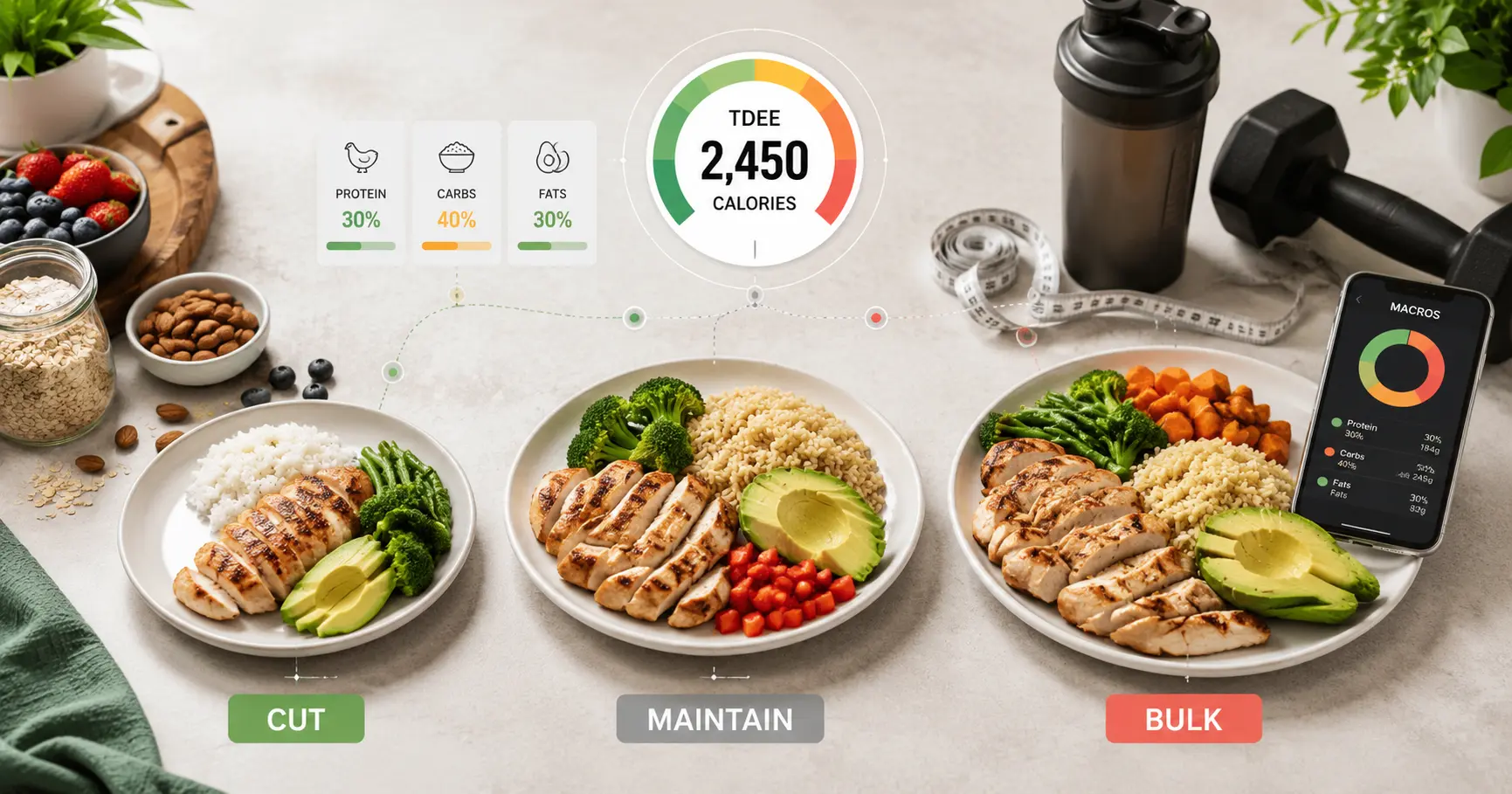
How to Set Your Macros Based on TDEE: Cut, Bulk & Maintain
Free Calculator
TDEE Calculator
Table of Contents
How to Set Your Macros Based on TDEE: Cut, Bulk & Maintain

You have heard "track your macros" a hundred times. But nobody explains the math behind it — how many grams of protein, fat, and carbs actually belong on your plate given your body, your activity level, and your specific goal. That is what this guide fixes.
TL;DR
The International Society of Sports Nutrition (ISSN) recommends 1.4–2.0 g of protein per kg of body weight for active individuals — higher during a deficit (ISSN, Journal of the International Society of Sports Nutrition, 2017).
For fat loss, a 500 kcal daily deficit from TDEE produces roughly 0.45 kg (1 lb) of weight loss per week without significant muscle loss.
Carbs fill the gap after protein and fat are set — they are not optional filler; they fuel training performance and recovery.
What Is TDEE and Why Does It Come First?
Your TDEE is the total number of calories your body burns in a 24-hour period, and every macro calculation starts here. According to the Academy of Nutrition and Dietetics Evidence-Based Nutrition Practice Guidelines (2023), TDEE includes basal metabolic rate (BMR), the thermic effect of food (roughly 10% of calories), and physical activity.
Activity Level | Multiplier |
|---|---|
Sedentary (desk job, minimal movement) | BMR × 1.2 |
Lightly active (1–3 workouts/week) | BMR × 1.375 |
Moderately active (3–5 workouts/week) | BMR × 1.55 |
Very active (6–7 hard workouts/week) | BMR × 1.725 |
Extremely active (physical job + daily training) | BMR × 1.9 |
Start with our TDEE Calculator to get your number in under 60 seconds. Cross-check with the BMR Calculator for the raw metabolic baseline.
How to Set Your Calorie Target for Each Goal
The ISSN Position Stand on Diets and Body Composition (Aragon et al., Journal of the International Society of Sports Nutrition, 2017) recommends a deficit of 500–1,000 kcal/day for fat loss, a surplus of 250–500 kcal/day for muscle gain, and no adjustment for maintenance.
Goal | Calorie Adjustment | Expected Weekly Change |
|---|---|---|
Cut (fat loss) | TDEE − 300 to 500 kcal | −0.3–0.5 kg/week |
Maintain | TDEE ± 0–100 kcal | No change |
Lean bulk | TDEE + 250–350 kcal | +0.1–0.25 kg/week |
Standard bulk | TDEE + 350–500 kcal | +0.25–0.45 kg/week |
Use our Calorie Deficit Calculator to plug in your TDEE and target and get a clean daily calorie number.
How to Split Macros: The Order of Operations
Set macros in this order: protein first, fat second, carbs last.
Step 1 — Set Protein
Practical targets: Cutting: 1.8–2.4 g/kg of body weight; Bulking: 1.6–2.2 g/kg; Maintenance: 1.4–2.0 g/kg. Every gram of protein provides 4 kcal.
Step 2 — Set Fat
The Dietary Guidelines for Americans (2020–2025) recommend fat at 20–35% of total calories. Every gram of fat provides 9 kcal.
Step 3 — Fill with Carbs
Subtract protein and fat calories from your total daily target. The remainder goes to carbs. Every gram of carbs provides 4 kcal. Use our Macro Calculator to run this math automatically.
Worked Example: 80 kg Male, Moderately Active, Goal = Cut
BMR = (10 × 80) + (6.25 × 178) − (5 × 30) + 5 = 1,767.5 kcal/day
TDEE = 1,767.5 × 1.55 = 2,740 kcal/day
Target = 2,740 − 500 = 2,240 kcal/day
Protein = 80 × 2.0 = 160 g = 640 kcal
Fat = 0.25 × 2,240 = 560 kcal ÷ 9 = 62 g
Carbs = (2,240 − 640 − 560) ÷ 4 = 260 g
Macro | Daily Grams | Calories |
|---|---|---|
Protein | 160 g | 640 kcal |
Fat | 62 g | 560 kcal |
Carbs | 260 g | 1,040 kcal |
Total | — | 2,240 kcal |
Verify your protein target with the Protein Calculator.
Frequently Asked Questions
What is the difference between TDEE and BMR?
BMR is calories burned at complete rest. TDEE adds activity on top — exercise, daily movement, and thermic effect of food. TDEE is always higher and is the correct starting point. Use our BMR Calculator then our TDEE Calculator.
How much protein do I need to preserve muscle while cutting?
The ISSN recommends 1.8–2.7 g of protein per kg of body weight during an energy deficit (Stokes et al., 2018). At 80 kg, that is 144–216 g per day.
Can I set macros without tracking TDEE first?
You can, but studies show people underestimate daily calorie intake by 12–54% (Dhurandhar et al., 2015). Without a TDEE baseline, your macro targets will be off.
Should I eat the same macros on rest days as training days?
Consistent daily targets work for most people. If carb cycling, keep protein and fat fixed; only adjust carbs up or down by 50–80 g depending on training demand.
How often should I recalculate my macros?
Recalculate every 5–7 kg of weight change or every 8–12 weeks. Use our Macro Calculator each time.
Sources
Aragon et al., Journal of the International Society of Sports Nutrition, 2017.
Morton et al., British Journal of Sports Medicine, 2018.
Helms et al., Journal of the International Society of Sports Nutrition, 2014.
U.S. DHHS, Dietary Guidelines for Americans 2020–2025.
Stokes et al., Nutrients, 2018.
Academy of Nutrition and Dietetics, Evidence-Based Nutrition Practice Guidelines, 2023.
Related Calculators
Try these free calculators related to this article:
In-Depth Guides
Dive deeper with our comprehensive guides on this topic:
Frequently Asked Questions
Our Methodology
All health content on CalculatorApp.me is reviewed by subject-matter experts, cross-referenced with official sources, and updated regularly for accuracy. Our formulas and data are verified against industry standards and government publications.
Jordan Hayes
Verified AuthorPersonal Finance Content Strategist
Jordan is a personal finance content strategist with 9+ years writing about mortgages, retirement, tax strategy, and budgeting. Every guide is cross-referenced with IRS publications, Federal Reserve data, and CFPB guidance to make complex calculations accessible. Editor at CalculatorApp.me.
Found this helpful? Share it!
Stay Updated
Get notified when we launch new calculators and features.
No spam. Unsubscribe anytime.