Pregnancy Due Date Calculator: How Doctors Estimate Your Baby's Arrival
Free Calculator
Pregnancy Calculator
Table of Contents
Pregnancy Due Date Calculator: How Due Dates Are Calculated
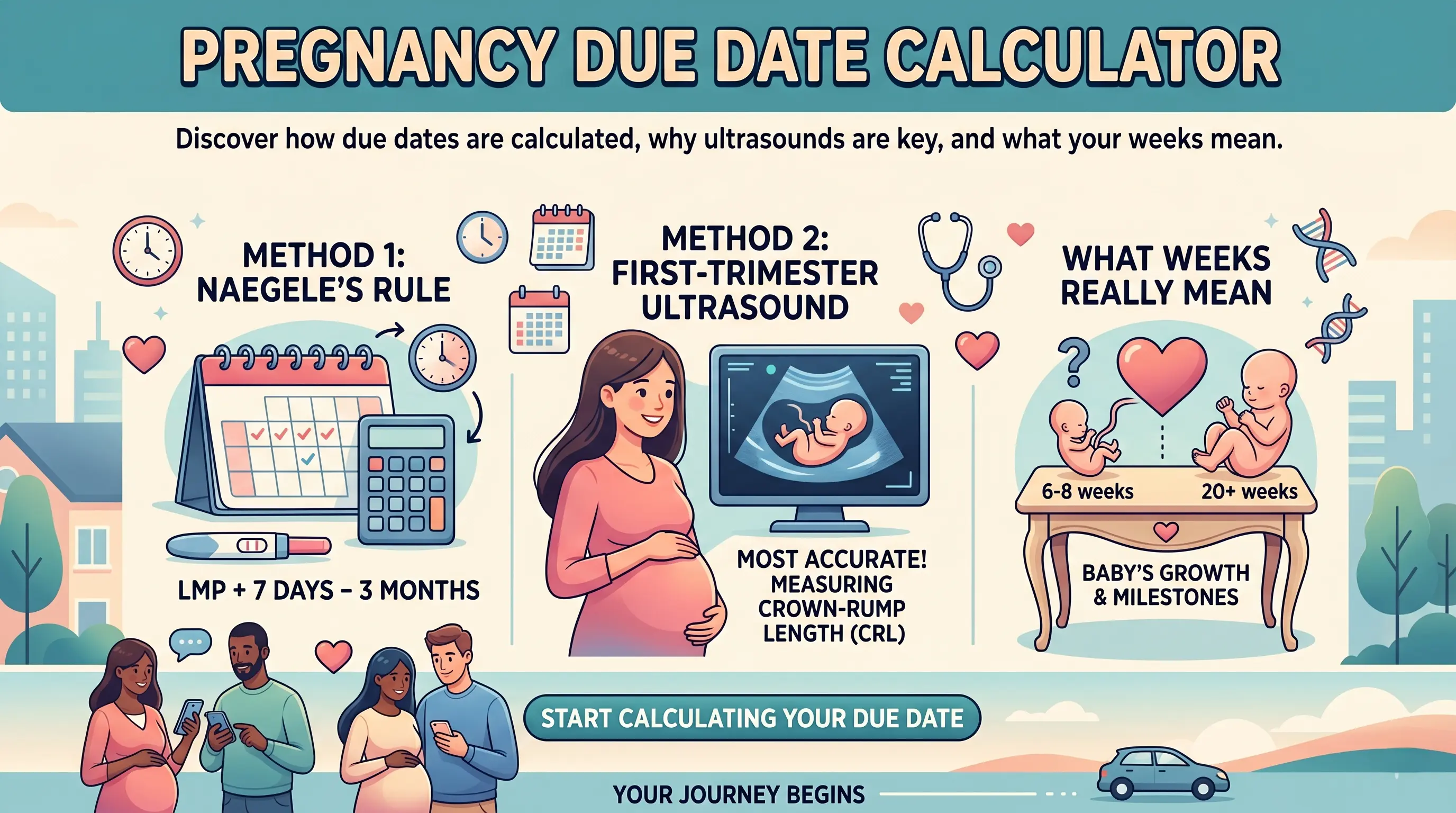
The estimated due date (EDD) is calculated using Naegele's rule: add 280 days (40 weeks) to the first day of your last menstrual period (LMP). This method, developed by German obstetrician Franz Naegele in 1812, assumes a 28-day cycle with ovulation on day 14.
For irregular cycles, a first-trimester ultrasound (measuring crown-rump length) is more accurate — typically within ±5 days versus ±14 days for LMP-based estimates.
Only 5% of Babies Arrive on Time
Despite the precision of due date calculations, only about 5% of babies are born on their exact due date. Most arrive within a 2-week window (38-42 weeks). This is why obstetricians call it an estimated due date — it's a midpoint of a normal delivery range, not a prediction.
Understanding Pregnancy Trimesters
Pregnancy is divided into three trimesters, each with distinct developmental milestones:
First Trimester (Weeks 1-12)
Major organ formation occurs during this critical period. The heart begins beating by week 6, and all major organs are forming by week 8. By the end of the first trimester, the fetus is about 3 inches long. This is also when morning sickness peaks (around week 9) and the risk of miscarriage is highest.
Second Trimester (Weeks 13-26)
Often called the "golden period" — morning sickness typically subsides, and energy returns. The anatomy scan at 18-20 weeks checks all major structures. Baby begins moving (quickening) around weeks 16-22 for first pregnancies. By week 24, the baby is viable outside the womb with intensive medical care.
Third Trimester (Weeks 27-40)
Rapid weight gain — baby gains roughly ½ pound per week. Lung maturation continues until weeks 36-37. The baby settles into head-down position near week 36. Full-term is considered 39-40 weeks, with 37-38 weeks classified as "early term."
Ovulation and Fertility Windows
Understanding ovulation is key to both conception planning and due date accuracy. Ovulation typically occurs 14 days before your next period begins — not 14 days after it starts. For a 28-day cycle, that's day 14. For a 32-day cycle, it's day 18.
The fertile window spans 6 days: 5 days before ovulation (sperm survive up to 5 days in the reproductive tract) and the day of ovulation itself (the egg is viable for only 12-24 hours). Timing intercourse within this window maximizes the chance of conception.
Tracking Methods
Basal body temperature (BBT): Rises 0.2-0.5°F after ovulation
Cervical mucus: Becomes clear and stretchy (like egg whites) near ovulation
Ovulation predictor kits (OPKs): Detect the LH surge 24-36 hours before ovulation
Prenatal Care Timeline
According to the American College of Obstetricians and Gynecologists (ACOG), a standard prenatal schedule includes monthly visits in the first and second trimesters, biweekly visits from weeks 28-36, and weekly visits from weeks 36-40.
Key screening milestones include the first-trimester screening (weeks 11-14), anatomy scan (weeks 18-22), glucose tolerance test (weeks 24-28), and Group B Strep test (weeks 35-37).
Calculate Your Due Date
Use our free Pregnancy Calculator to estimate your due date, track trimester milestones, and see weekly development updates. Planning for conception? Try our Ovulation Calculator to predict your fertile window, or track your cycle with our Period Calculator.
How Due Dates Are Calculated: Naegele's Rule Explained
Most pregnancy due date calculator tools use Naegele's Rule, developed by German obstetrician Franz Naegele in 1812. The formula adds 280 days (40 weeks) to the first day of your last menstrual period (LMP). This assumes a 28-day cycle with ovulation occurring on day 14.
The formula in practice: take your LMP date, subtract 3 months, add 7 days, and add 1 year. For example, if your LMP was March 10, 2026: subtract 3 months (December 10, 2025), add 7 days (December 17, 2025), add 1 year = December 17, 2026.
When Naegele's Rule May Be Inaccurate
Naegele's Rule assumes a textbook 28-day cycle, but only about 13% of women have exactly 28-day cycles. If your cycle is consistently 35 days, you likely ovulated on day 21 rather than day 14, making your due date about a week later than Naegele predicts. Irregular cycles, recent use of hormonal contraceptives, and breastfeeding while conceiving can all shift the calculation.
This is why the American College of Obstetricians and Gynecologists (ACOG) recommends using first-trimester ultrasound measurements to confirm or adjust the due date. Crown-to-rump length measured between 8 and 13 weeks is accurate to within ±5 days.
Trimester-by-Trimester Development Milestones
Your pregnancy is divided into three trimesters, each approximately 13 weeks long. Here is what to expect:
First Trimester (Weeks 1–13)
Weeks 1-4: Fertilization and implantation. The embryo is smaller than a grain of rice. Hormonal changes begin — you may notice fatigue, breast tenderness, and nausea.
Weeks 5-8: The heart begins beating around day 22. All major organs start forming. The embryo grows from 2mm to about 16mm (size of a kidney bean). Morning sickness typically peaks around week 8.
Weeks 9-13: The embryo is now called a fetus. Fingers, toes, and facial features are forming. By week 12, the fetus is about 2.5 inches long. The risk of miscarriage drops significantly after week 12.
Second Trimester (Weeks 14–27)
Weeks 14-18: Energy returns as morning sickness typically fades. The fetus develops fingerprints and starts making facial expressions. Many women begin showing visibly around week 16.
Weeks 18-22: You may feel the first movements (quickening), usually around weeks 18-20 for first pregnancies and earlier for subsequent ones. The anatomy scan ultrasound is typically scheduled between weeks 18 and 22.
Weeks 23-27: The fetus weighs about 1-2 pounds and can hear sounds. Viability outside the womb begins around week 24, though outcomes improve dramatically with each additional week.
Third Trimester (Weeks 28–40)
Weeks 28-32: Rapid brain development and fat accumulation. The fetus practices breathing movements. You may notice Braxton Hicks contractions (practice contractions).
Weeks 33-36: The fetus settles into a head-down position in preparation for birth. Lungs are maturing rapidly. Babies born at 34+ weeks generally do well with minimal NICU time.
Weeks 37-40: The fetus is considered full term at 39 weeks. Average newborn weight is 7.5 pounds (3.4 kg). Only about 5% of babies arrive on their exact due date.
Factors That Affect Your Actual Delivery Date
A pregnancy due date calculator gives an estimate, not a guarantee. Several factors influence when labor actually begins:
First pregnancies: First-time mothers go past their due date more often. The average first birth occurs at 40 weeks and 5 days.
Genetics: If your mother or sisters tended to deliver early or late, you may follow a similar pattern.
Multiple pregnancies: Twins average delivery at 36 weeks, triplets at 32 weeks.
Maternal age: Women over 35 are more likely to be induced and have slightly shorter gestations on average.
Medical conditions: Preeclampsia, gestational diabetes, and placental issues may necessitate early delivery.
According to the National Institute of Child Health and Human Development, full-term delivery (39-40 weeks) gives babies the best outcomes for brain development, liver function, and lung maturity.
Frequently Asked Questions About Pregnancy Due Dates
How accurate are pregnancy due date calculators?
LMP-based calculators are accurate to within about ±2 weeks. Only 4-5% of babies are born on the exact due date. Approximately 80% of babies arrive between 38 and 42 weeks. First-trimester ultrasound dating narrows the window to ±5 days and is considered the most reliable method.
What does "40 weeks pregnant" really mean?
Pregnancy is counted from the first day of your last menstrual period, which is typically about 2 weeks before conception. So at "4 weeks pregnant," the embryo has only been developing for about 2 weeks. This convention dates back centuries and persists because most women know their LMP date but not their exact ovulation date.
Can my due date change after an ultrasound?
Yes. If a first-trimester ultrasound shows a due date that differs from your LMP calculation by more than 7 days, your provider will typically adjust the due date to match the ultrasound. In the second trimester, the threshold is 10-14 days. After 22 weeks, ultrasound dating becomes less accurate and due dates are rarely changed.
What happens if I go past my due date?
Pregnancies that extend beyond 41 weeks are considered late-term, and those beyond 42 weeks are post-term. Most providers recommend induction between 41 and 42 weeks because the risk of complications (reduced amniotic fluid, placental deterioration, and stillbirth) increases after 42 weeks. The WHO recommends induction by 41 weeks for women with uncomplicated pregnancies.
IVF and assisted reproduction: how are due dates different?
For pregnancies conceived through in vitro fertilization (IVF) or other assisted reproductive technologies, due dates are calculated differently than with natural conception. With IVF, the exact date of embryo transfer is known, eliminating the guesswork of ovulation timing. For a Day 5 blastocyst transfer, the due date is calculated as the transfer date plus 261 days (or minus 19 days from the LMP-equivalent date). For a Day 3 embryo transfer, add 263 days. IVF due dates are generally more accurate than LMP-based calculations because the conception timing is precisely known. A pregnancy due date calculator that accepts IVF transfer dates provides the most reliable estimate for assisted conception. Your fertility specialist will typically provide a due date at your first appointment that accounts for the specific type of transfer you had.
Related Articles on CalculatorApp.me
Pregnancy & Prenatal Resources
Related Calculators
Try these free calculators related to this article:
In-Depth Guides
Dive deeper with our comprehensive guides on this topic:
Frequently Asked Questions
Our Methodology
All health content on CalculatorApp.me is reviewed by subject-matter experts, cross-referenced with official sources, and updated regularly for accuracy. Our formulas and data are verified against industry standards and government publications.
Jordan Hayes
Verified AuthorPersonal Finance Content Strategist
Jordan is a personal finance content strategist with 9+ years writing about mortgages, retirement, tax strategy, and budgeting. Every guide is cross-referenced with IRS publications, Federal Reserve data, and CFPB guidance to make complex calculations accessible. Editor at CalculatorApp.me.
Found this helpful? Share it!
Stay Updated
Get notified when we launch new calculators and features.
No spam. Unsubscribe anytime.