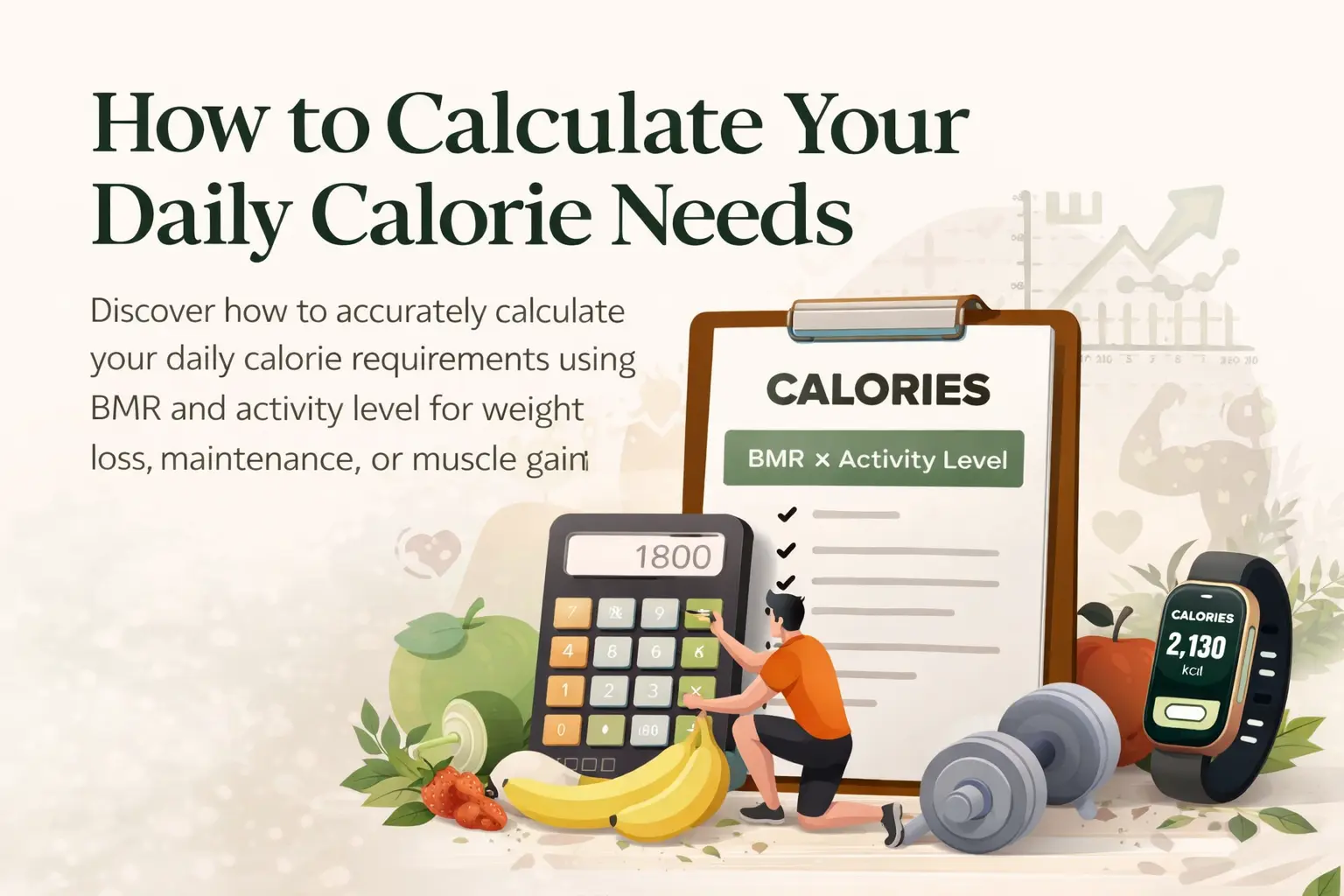
How to Calculate Your Daily Calorie Needs
Free Calculator
BMI Calculator
Table of Contents
Understanding your daily calorie needs is the single most important step toward reaching any health or fitness goal. Whether you want to lose stubborn belly fat, maintain a healthy weight, or build lean muscle, knowing exactly how many calories your body requires each day removes the guesswork from nutrition. In this comprehensive guide, we break down the science behind calorie calculations, walk you through both the Mifflin-St Jeor and Harris-Benedict equations, explain activity multipliers, and give you a practical action plan you can start using today.
What Are Calories and Why Do They Matter?
A calorie is a unit of energy. Specifically, one kilocalorie (kcal)—what we commonly call a "calorie" on food labels—is the amount of energy needed to raise one kilogram of water by one degree Celsius. Every process in your body, from your heartbeat to digestion to thinking, requires energy measured in calories.
According to the National Institute of Diabetes and Digestive and Kidney Diseases (NIDDK), energy balance—the relationship between calories consumed and calories burned—is the primary determinant of weight change. Consume more than you burn, and you gain weight; consume less, and you lose weight.
Understanding Basal Metabolic Rate (BMR)
Your Basal Metabolic Rate (BMR) represents the number of calories your body burns at complete rest to maintain vital functions like breathing, blood circulation, cell production, and temperature regulation. BMR typically accounts for 60–75% of your total daily calorie expenditure, making it the largest component of your energy needs.
Several factors influence your BMR:
Age: BMR decreases roughly 1–2% per decade after age 20 due to muscle loss
Sex: Males generally have higher BMR due to greater muscle mass
Body composition: More muscle tissue = higher BMR
Genetics: Some individuals naturally have faster metabolisms
Hormones: Thyroid function significantly impacts metabolic rate
Use our BMR Calculator to find your personal basal metabolic rate in seconds.
The Mifflin-St Jeor Equation (Most Accurate)
The Mifflin-St Jeor equation, published in 1990 and validated by the American Dietetic Association as the most accurate predictive equation, calculates BMR as follows:
Men: BMR = (10 × weight in kg) + (6.25 × height in cm) – (5 × age) + 5
Women: BMR = (10 × weight in kg) + (6.25 × height in cm) – (5 × age) – 161
Example: A 30-year-old male weighing 80 kg and standing 178 cm tall would have a BMR of: (10 × 80) + (6.25 × 178) – (5 × 30) + 5 = 800 + 1,112.5 – 150 + 5 = 1,767.5 kcal/day.
The Harris-Benedict Equation (Classic Method)
The original Harris-Benedict equation from 1919 (revised in 1984) is another widely used formula:
Men: BMR = 88.362 + (13.397 × weight in kg) + (4.799 × height in cm) – (5.677 × age)
Women: BMR = 447.593 + (9.247 × weight in kg) + (3.098 × height in cm) – (4.330 × age)
While both equations are reliable, the Mifflin-St Jeor equation is generally preferred for its higher accuracy in modern populations, according to research published in the Journal of the American Dietetic Association.
Calculating Total Daily Energy Expenditure (TDEE)
Your TDEE is the total number of calories you burn in a day, combining your BMR with your physical activity level. The formula is straightforward:
TDEE = BMR × Activity Multiplier
The standard activity multipliers used by nutrition professionals are:
Activity Level | Description | Multiplier |
|---|---|---|
Sedentary | Desk job, little or no exercise | 1.2 |
Lightly Active | Light exercise 1–3 days/week | 1.375 |
Moderately Active | Moderate exercise 3–5 days/week | 1.55 |
Very Active | Hard exercise 6–7 days/week | 1.725 |
Extra Active | Athlete or very physical job + exercise | 1.9 |
Example: Using our previous BMR of 1,767.5 kcal for a moderately active male: 1,767.5 × 1.55 = 2,740 kcal/day. This is his maintenance calorie level.
Try our TDEE Calculator for an instant personalized estimate.
Adjusting Calories for Your Specific Goal
Once you know your TDEE, you can adjust your intake based on your objective:
For Weight Loss
Create a calorie deficit of 500–1,000 calories per day below your TDEE. This produces a safe, sustainable weight loss of 0.5–1 kg (1–2 lbs) per week. The Centers for Disease Control and Prevention (CDC) recommends this gradual approach for long-term success.
Moderate deficit (500 kcal): Lose ~0.5 kg/week — easier to sustain, preserves muscle
Aggressive deficit (1,000 kcal): Lose ~1 kg/week — harder to maintain, risk of muscle loss
Never go below 1,200 kcal (women) or 1,500 kcal (men) without medical supervision
Use our Calorie Deficit Calculator to find your optimal deficit.
For Weight Maintenance
Eat at your TDEE. Track your weight weekly and adjust by ±100 kcal if you notice gradual gains or losses. Natural fluctuations of 1–2 kg due to water retention are normal.
For Muscle Gain (Bulking)
Consume 250–500 calories above your TDEE combined with a structured strength training program. This caloric surplus provides the energy needed for muscle protein synthesis. Aim for 0.25–0.5 kg of weight gain per week to minimize fat accumulation.
Macronutrient Breakdown: Beyond Just Calories
While total calories determine weight change, the macronutrient composition of your diet affects body composition, energy levels, and satiety:
Protein (4 kcal/g): Aim for 1.6–2.2 g/kg of bodyweight for active individuals. Protein preserves muscle during deficits and supports growth during surpluses.
Fats (9 kcal/g): Keep at 20–35% of total calories. Essential for hormone production, vitamin absorption, and brain health.
Carbohydrates (4 kcal/g): Fill the remaining calories. Carbs fuel high-intensity exercise and support recovery.
Check out our Macro Calculator to get your personalized macronutrient targets.
The Thermic Effect of Food (TEF)
Your body burns calories digesting food—this is called the Thermic Effect of Food (TEF). Different macronutrients have different TEF values:
Protein: 20–30% of calories consumed are burned during digestion
Carbohydrates: 5–10% burned during digestion
Fats: 0–3% burned during digestion
This is one reason high-protein diets are effective for weight loss—they naturally increase your calorie expenditure through digestion alone.
Non-Exercise Activity Thermogenesis (NEAT)
NEAT represents all the calories you burn through daily movements that are not formal exercise: walking, fidgeting, standing, typing, cooking, and even chewing gum. Research shows NEAT can vary by up to 2,000 calories per day between individuals, making it a hugely underrated factor in weight management.
Simple ways to increase your NEAT:
Take walking meetings or calls
Use a standing desk for part of the day
Park farther from entrances
Take stairs instead of elevators
Set a reminder to walk 5 minutes every hour
Common Mistakes When Calculating Calorie Needs
Even with the right formulas, many people get their calorie estimates wrong. Here are the most frequent pitfalls:
Overestimating activity level: Most desk workers are "sedentary" even if they exercise 3x/week. Be honest with your activity multiplier.
Ignoring liquid calories: Coffee drinks, smoothies, alcohol, and juices can add 300–800 untracked calories daily.
Not accounting for weekends: A 500-calorie deficit on weekdays can be erased by weekend overeating.
Cutting calories too aggressively: Very low calorie diets slow your metabolism (adaptive thermogenesis) and increase muscle loss.
Forgetting to recalculate: As you lose weight, your BMR decreases. Recalculate every 4–6 weeks.
How to Track Your Calorie Intake Effectively
Knowing your daily calorie needs is only useful if you can track what you eat. Here's a systematic approach:
Use a food scale: Portion estimation is notoriously inaccurate. A digital kitchen scale costs under $15 and dramatically improves accuracy.
Log everything: Track all food, drinks, oils, and condiments. Even a tablespoon of olive oil adds 120 kcal.
Pre-log your meals: Plan and log meals before eating to stay within your budget.
Review weekly averages: Daily fluctuations are normal; focus on your weekly average intake.
Special Considerations by Population
Athletes and Highly Active Individuals
Athletes may need 3,000–6,000+ calories per day depending on sport, training volume, and body size. The American College of Sports Medicine (ACSM) recommends athletes never drop below 1,800 kcal (women) or 2,000 kcal (men) even when cutting weight.
Older Adults (50+)
BMR declines with age due to muscle loss (sarcopenia). Older adults should focus on protein-rich diets (1.0–1.2 g/kg) and resistance training to maintain metabolic rate, while reducing total calories by approximately 200 kcal per decade after 50.
Pregnant and Breastfeeding Women
Calorie needs increase during pregnancy (~340 extra kcal/day in the second trimester, ~450 in the third) and breastfeeding (~330–400 extra kcal/day). Always consult a healthcare provider for personalized guidelines.
Frequently Asked Questions
How many calories should I eat to lose weight?
To lose weight safely, eat 500 calories below your TDEE. For most adults, this means 1,500–2,200 calories per day, depending on your size, age, sex, and activity level. Use our Calorie Deficit Calculator for a personalized number.
What is a good BMR for my age?
Average BMR ranges from 1,400–1,800 kcal for adult women and 1,600–2,000 kcal for adult men. BMR decreases with age: a 25-year-old typically has a BMR 100–200 kcal higher than a 55-year-old of the same size. Check yours with our BMR Calculator.
Is 1,200 calories a day enough?
For most adults, 1,200 calories is the absolute minimum and should not be maintained long-term without medical supervision. Very low-calorie diets can cause nutrient deficiencies, muscle loss, metabolic slowdown, and gallstones.
How accurate are calorie calculators?
BMR equations like Mifflin-St Jeor are accurate within ±10% for most people. The biggest source of error is usually the activity multiplier. Treat any calculator result as a starting point, then adjust based on your actual weight changes over 2–4 weeks.
Should I eat back exercise calories?
If you used the activity multiplier to calculate your TDEE, your exercise calories are already included—do not eat them back. If you calculated based on a sedentary multiplier and add exercise separately, eat back approximately 50% of estimated exercise calories (since trackers often overestimate by 30–50%).
How often should I recalculate my calorie needs?
Recalculate every 4–6 weeks, or whenever you lose/gain 5 kg (10 lbs). As your weight changes, your BMR changes proportionally, meaning your calorie targets need adjustment.
Metabolic Adaptation: Why Your Calorie Needs Change Over Time
One of the most misunderstood aspects of daily calorie needs is metabolic adaptation — your body's natural response to prolonged calorie restriction or surplus. When you consistently eat below your TDEE, your body gradually becomes more efficient, burning fewer calories at rest and during activity. This phenomenon, sometimes called "adaptive thermogenesis," can reduce your BMR by 5–15% beyond what weight loss alone would predict.
Metabolic adaptation explains why many dieters hit frustrating plateaus after weeks of steady progress. The solution is not to slash calories further, but to implement strategic approaches:
Diet breaks: Every 8–12 weeks of dieting, spend 1–2 weeks eating at maintenance calories to partially restore metabolic rate
Refeed days: One day per week at maintenance (focusing on carbohydrates) can boost leptin levels and support thyroid function
Reverse dieting: After reaching your goal weight, gradually increase calories by 50–100 kcal/week rather than jumping back to maintenance
Prioritize strength training: Resistance exercise preserves and builds muscle, which is metabolically active tissue that keeps your BMR elevated
Research from the National Institutes of Health has shown that contestants on extreme weight loss programs experienced BMR reductions of up to 500 kcal/day even years after the program ended — highlighting why moderate, sustainable deficits are far superior to crash diets.
Calorie Needs by Life Stage: A Quick Reference
The Dietary Guidelines for Americans (2020–2025) provide general calorie ranges by age and activity level:
Group | Sedentary | Moderate | Active |
|---|---|---|---|
Women 19–30 | 1,800–2,000 | 2,000–2,200 | 2,400 |
Women 31–50 | 1,800 | 2,000 | 2,200 |
Women 51+ | 1,600 | 1,800 | 2,000–2,200 |
Men 19–30 | 2,400–2,600 | 2,600–2,800 | 3,000 |
Men 31–50 | 2,200–2,400 | 2,400–2,600 | 2,800–3,000 |
Men 51+ | 2,000–2,200 | 2,200–2,400 | 2,400–2,800 |
These ranges are general guidelines. Your individual daily calorie needs depend on your specific BMR, activity level, body composition, and health goals. Always use a calculator for personalized numbers.
Your Action Plan: Getting Started Today
Step 1: Calculate your BMR using our BMR Calculator
Step 2: Determine your TDEE with our TDEE Calculator
Step 3: Set your calorie target based on your goal (deficit, maintenance, or surplus)
Step 4: Break down calories into macros using our Macro Calculator
Step 5: Track intake for 2 weeks, then adjust based on real-world results
Remember: the best calorie plan is one you can stick to consistently. Start with moderate adjustments, track your progress, and fine-tune as you go. Your body is your best feedback mechanism.
Related Articles on CalculatorApp.me
Related Calculators
Try these free calculators related to this article:
In-Depth Guides
Dive deeper with our comprehensive guides on this topic:
Frequently Asked Questions
Our Methodology
All health content on CalculatorApp.me is reviewed by subject-matter experts, cross-referenced with official sources, and updated regularly for accuracy. Our formulas and data are verified against industry standards and government publications.
Jordan Hayes
Verified AuthorPersonal Finance Content Strategist
Jordan is a personal finance content strategist with 9+ years writing about mortgages, retirement, tax strategy, and budgeting. Every guide is cross-referenced with IRS publications, Federal Reserve data, and CFPB guidance to make complex calculations accessible. Editor at CalculatorApp.me.
Found this helpful? Share it!
Stay Updated
Get notified when we launch new calculators and features.
No spam. Unsubscribe anytime.