## Why Converting Salary to Hourly Actually Matters
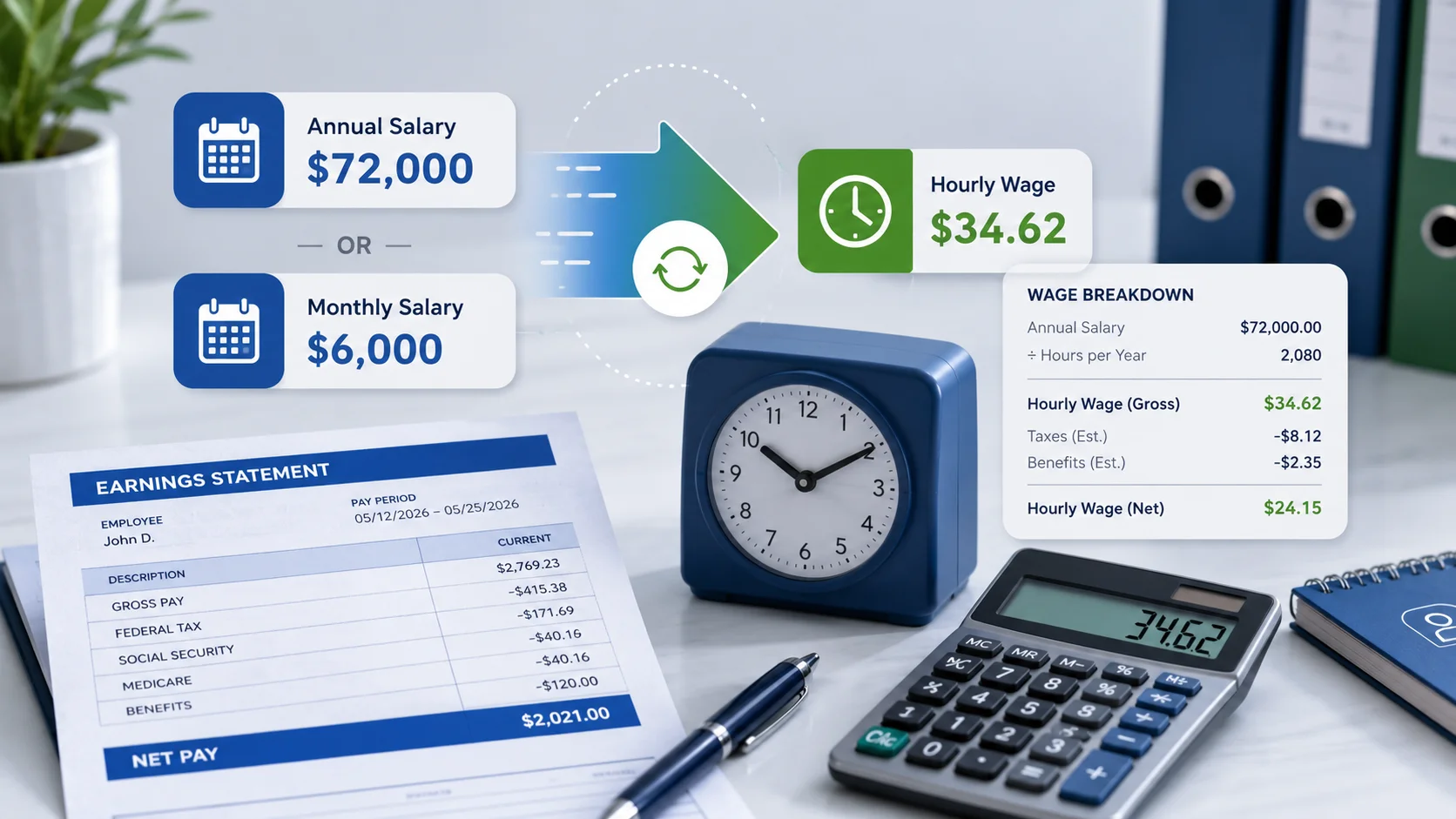
Most job offers quote an annual salary. But whether you're comparing two offers, calculating your real hourly rate after unpaid overtime, or figuring out if a contractor rate beats a full-time salary, you need to know the hourly equivalent.
Our [salary to hourly calculator](/category/finance/hourly-wage-calculator) handles the conversion instantly. This guide explains the math and covers the scenarios where it really matters.
---
## The Basic Formula
**Hourly rate = Annual salary ÷ Hours worked per year**
For a standard 40-hour week, 52 weeks:
> 40 × 52 = **2,080 hours per year**
So a $60,000 salary = $60,000 ÷ 2,080 = **$28.85/hour**
Simple. But the real number is more interesting.
---
## Quick Salary-to-Hourly Reference Table (2026)
| Annual Salary | Standard Hourly (2,080 hrs) | Biweekly Paycheck (before tax) |
|--------------|----------------------------|---------------------------------|
| $35,000 | $16.83/hr | $1,346 |
| $45,000 | $21.63/hr | $1,731 |
| $50,000 | $24.04/hr | $1,923 |
| $60,000 | $28.85/hr | $2,308 |
| $75,000 | $36.06/hr | $2,885 |
| $80,000 | $38.46/hr | $3,077 |
| $100,000 | $48.08/hr | $3,846 |
| $120,000 | $57.69/hr | $4,615 |
| $150,000 | $72.12/hr | $5,769 |
These are gross (before tax) figures. Federal income tax, state tax, Social Security, and Medicare will reduce your take-home by roughly 25–35% depending on your bracket and state.
---
## The Real Hourly Rate: Accounting for Unpaid Hours
Salaried employees are often expected to work more than 40 hours without extra pay. When you factor in real hours worked, the effective hourly rate drops:
### Example: $80,000 Salary, 50 Hours Per Week
> Actual hours/year: 50 × 52 = **2,600 hours**
> Real hourly rate: $80,000 ÷ 2,600 = **$30.77/hour**
Compared to the standard rate of $38.46/hour — that's **20% less** than the advertised rate.
### Example: $80,000 Salary, 55 Hours Per Week
> Actual hours/year: 55 × 52 = **2,860 hours**
> Real hourly rate: $80,000 ÷ 2,860 = **$27.97/hour**
Now you're earning less per hour than someone making $58,000 at a standard 40-hour job. This calculation is eye-opening when evaluating "high-paying" jobs in demanding industries like finance, law, or tech startups.
---
## Salary vs. Contractor Rate: Which Pays More?
If you're considering freelance or contract work, the comparison is more complex. Contractors pay their own benefits and taxes, so the rate needs to be higher to be equivalent.
### Full-Time Employee vs. Contractor Comparison
Full-time job offer: $90,000/year salary
**Employer-provided benefits value:**
| Benefit | Typical Annual Value |
|---------|---------------------|
| Health insurance (employer share) | $6,000–$15,000 |
| 401(k) match (3–6%) | $2,700–$5,400 |
| Paid time off (15 days) | ~$5,190 (at $90K) |
| Payroll tax (employer FICA) | $6,885 |
| **Total benefits value** | **$20,775–$32,475** |
Equivalent contractor rate: ($90,000 + $26,000 avg benefits) ÷ 2,000 billable hours = **$58/hour**
As a rough rule: **multiply your full-time hourly rate by 1.5–2x** to get the contractor rate you need to break even.
[Run the contractor vs. salary comparison →](/category/finance/hourly-wage-calculator)
---
## Part-Time and Non-Standard Hours
Not everyone works 2,080 hours. The formula adjusts:
| Schedule | Hours/Year | $50,000 Equivalent Rate |
|----------|-----------|-------------------------|
| 20 hrs/week (part-time) | 1,040 | $48.08/hr |
| 30 hrs/week | 1,560 | $32.05/hr |
| 40 hrs/week (standard) | 2,080 | $24.04/hr |
| 45 hrs/week | 2,340 | $21.37/hr |
| 50 hrs/week | 2,600 | $19.23/hr |
This matters when comparing a 30-hour role at $45,000 to a 40-hour role at $55,000 — the shorter-hour job pays $28.85/hour while the longer job pays only $26.44/hour.
---
## How Often Are You Paid? Biweekly vs. Semimonthly
This confuses many people:
- **Biweekly** (every 2 weeks): 26 paychecks/year → annual salary ÷ 26
- **Semimonthly** (twice a month): 24 paychecks/year → annual salary ÷ 24
- **Weekly**: 52 paychecks/year → annual salary ÷ 52
- **Monthly**: 12 paychecks/year → annual salary ÷ 12
On a biweekly schedule, two months of the year have three paydays instead of two — these feel like "bonus" months but are simply the math of 26 pay periods in 12 months.
---
## The IRS Mileage Rate and Hourly Cost of Commuting
If you're comparing a remote job to an in-office role at higher salary, factor in commute cost:
**Example: 40-mile round trip, 5 days/week**
- Annual miles: 40 × 250 = 10,000 miles
- IRS mileage rate (2026): ~$0.70/mile
- **Annual commute cost: $7,000**
- Plus commute time: 1 hour/day × 250 days = 250 hours/year
A remote job at $90,000 effectively competes with an in-office job at $97,000+ (including your time at minimum wage). The salary-to-hourly calculator lets you subtract commute hours from net working time to get the true hourly rate.
---
## Related Finance Calculators
- [Income Tax Calculator](/category/finance/income-tax-calculator) — see your actual take-home pay
- [
Mortgage Calculator](/category/finance/mortgage-calculator) — how much house can you afford at your income
- [
Compound Interest Calculator](/category/finance/compound-interest-calculator) — what your savings can become
- [Overtime Calculator](/category/finance/overtime-calculator) — how overtime pay is calculated
---
## Frequently Asked Questions
**How do I convert $25/hour to an annual salary?**
$25/hour × 2,080 hours = **$52,000/year**. If you work overtime, the calculation changes — multiply your regular hours at $25 and overtime hours at $37.50 (1.5x) separately.
**What is $60,000 a year per hour?**
$60,000 ÷ 2,080 hours = **$28.85/hour** (standard 40-hour week). If you actually work 45 hours per week, the effective rate drops to $25.64/hour.
**How much is $20/hour annually?**
$20 × 2,080 = **$41,600/year** before taxes. After federal income tax, Social Security, and Medicare, take-home is roughly $33,000–$35,000/year depending on your deductions.
**Is $50,000 a year a good salary?**
Context matters enormously. $50,000/year ($24.04/hour) goes much further in rural Mississippi than in San Francisco. The Bureau of Labor Statistics median individual wage is around $56,000/year. Use the income tax calculator to see your actual take-home, then compare to your local cost of living.