TDEE Explained: How to Calculate Your Total Daily Energy Expenditure
Free Calculator
TDEE Calculator
Table of Contents
What Is TDEE?
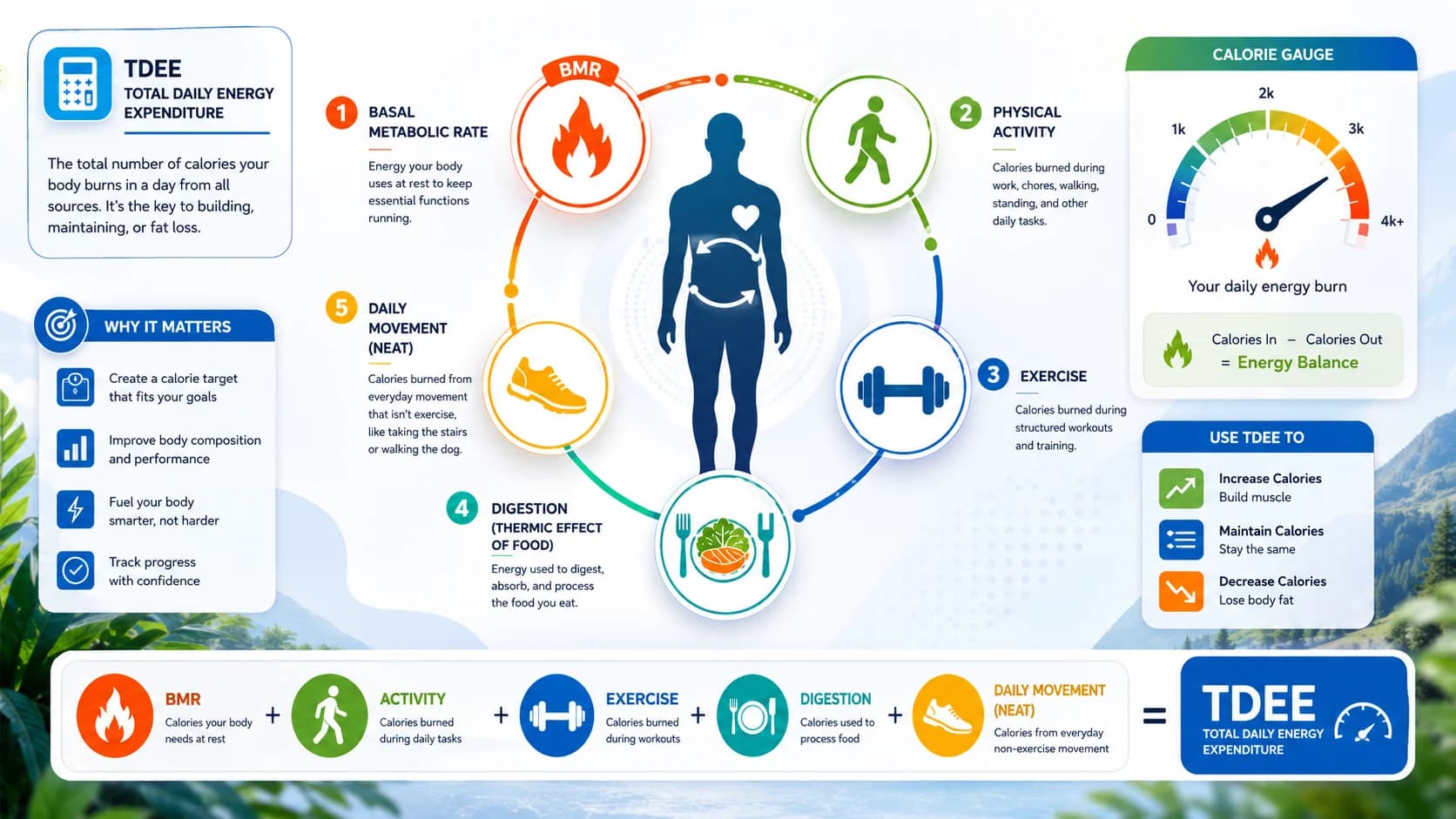
A TDEE calculator estimates your Total Daily Energy Expenditure — the total number of calories your body burns in a 24-hour period. It accounts for everything: breathing, digesting food, walking, exercising, and even fidgeting. TDEE is the foundation of all weight management — to lose weight, eat below it; to gain weight, eat above it.
The 4 Components of TDEE
Your total daily energy expenditure is made up of four components:
1. BMR — Basal Metabolic Rate (60-70% of TDEE)
BMR is the energy your body needs to perform basic life-sustaining functions while at complete rest: breathing, circulating blood, cell production, nutrient processing, and brain function. This is the largest component of TDEE for most people.
The most accurate BMR equation is the Mifflin-St Jeor formula:
- Men: BMR = 10 × weight(kg) + 6.25 × height(cm) − 5 × age − 5
- Women: BMR = 10 × weight(kg) + 6.25 × height(cm) − 5 × age − 161
Example: 30-year-old male, 180 lbs (81.6 kg), 5'10" (177.8 cm):
BMR = 10(81.6) + 6.25(177.8) − 5(30) − 5 = 816 + 1,111 − 150 − 5 = 1,772 calories
2. TEF — Thermic Effect of Food (8-15% of TDEE)
Your body burns calories just digesting food. Different macronutrients require different amounts of energy to process:
- Protein: 20-35% of calories consumed are used for digestion
- Carbohydrates: 5-15%
- Fat: 0-5%
This is one reason high-protein diets aid weight loss — you burn significantly more calories digesting protein than fat or carbs.
3. EAT — Exercise Activity Thermogenesis (5-10% of TDEE)
The calories burned during intentional exercise: running, weight training, swimming, sports, etc. Despite what gym machines display, this is typically a smaller component than most people think.
Approximate calorie burn per 30 minutes for a 175-lb person:
- Running (6 mph): ~365 calories
- Cycling (moderate): ~295 calories
- Weight training: ~225 calories
- Walking (3.5 mph): ~150 calories
- Yoga: ~140 calories
4. NEAT — Non-Exercise Activity Thermogenesis (15-30% of TDEE)
All movement that isn't formal exercise: walking to the store, taking stairs, fidgeting, standing, cooking, cleaning, and even typing. NEAT varies enormously between individuals — a construction worker's NEAT might be 2,000+ calories, while a desk worker's might be 200.
Research from the Mayo Clinic found that NEAT can vary by up to 2,000 calories/day between individuals of similar size. This is often the hidden factor behind "I eat the same as my friend but they stay thin."
How to Calculate Your TDEE
The standard method multiplies your BMR by an activity factor:
- Sedentary (desk job, little exercise): BMR × 1.2
- Lightly Active (light exercise 1-3 days/week): BMR × 1.375
- Moderately Active (moderate exercise 3-5 days/week): BMR × 1.55
- Very Active (hard exercise 6-7 days/week): BMR × 1.725
- Extremely Active (athlete or very physical job + exercise): BMR × 1.9
Our example (BMR 1,772, moderately active): 1,772 × 1.55 = 2,747 calories/day
Using TDEE for Weight Goals
Weight Loss
Create a caloric deficit by eating below your TDEE. A 500-calorie daily deficit produces approximately 1 pound of fat loss per week (since 1 lb of fat ≈ 3,500 calories).
Recommended deficit: 20-25% below TDEE for sustainable fat loss. For our example (TDEE 2,747): 2,747 × 0.75 = ~2,060 calories/day for fat loss.
Never go below your BMR for extended periods. Under-eating slows metabolism (adaptive thermogenesis) and risks muscle loss, nutrient deficiency, and hormonal disruption.
Weight Gain / Muscle Building
Create a caloric surplus by eating above your TDEE. For lean muscle gain, a 250-500 calorie surplus is recommended (paired with resistance training).
For our example: 2,747 + 350 = ~3,100 calories/day for lean bulking.
Weight Maintenance
Eat at your TDEE. In practice, this means within ±100 calories — your body self-regulates within a range. Daily weight fluctuations of 1-3 lbs are normal (water, food volume, glycogen).
Why TDEE Calculators Aren't Perfect
TDEE calculations are estimates, typically within ±200-300 calories. Factors that affect accuracy:
- Genetics: Two people of identical size and activity can have BMRs differing by 200+ calories
- Body composition: Muscle burns ~6 cal/lb/day vs. fat at ~2 cal/lb/day
- Adaptive thermogenesis: Your metabolism adjusts when you're in a prolonged deficit
- Activity overestimation: Most people overestimate their activity level (choose one level below what you think)
Use your calculated TDEE as a starting point, then adjust based on 2-3 weeks of real-world tracking. If you're not losing weight at your calculated deficit, reduce by 200 calories and reassess.
Calculate Your TDEE
Use our free TDEE Calculator for an instant estimate based on your stats and activity level. Break down your daily calorie needs further with our Calorie Calculator, or find your baseline metabolic rate with our BMR Calculator.
Frequently Asked Questions
What is a good TDEE?
There's no "good" or "bad" TDEE — it depends on your size, age, sex, and activity level. Average TDEEs range from 1,600–2,400 for women and 2,000–3,200 for men. Athletes and very active individuals can exceed 4,000.
What's the difference between TDEE and BMR?
BMR is the calories your body burns at complete rest (just to stay alive). TDEE includes BMR plus all activity — exercise, walking, digestion, and daily movement. TDEE is always higher than BMR.
Should I eat at my BMR or TDEE to lose weight?
Neither exactly. Eat 20-25% below your TDEE for sustainable fat loss. Never eat below your BMR for long periods, as this can slow metabolism, cause muscle loss, and create nutritional deficiencies.
How many calories should I cut to lose 1 pound per week?
Approximately 500 calories below your TDEE per day creates a ~3,500-calorie weekly deficit, which equals roughly 1 pound of fat loss. A 750-calorie deficit produces ~1.5 lbs/week. Go no more than 1,000 below (2 lbs/week max).
Does my TDEE change over time?
Yes. TDEE decreases with age (~2-3% per decade after 20), weight loss (smaller body = less energy needed), and reduced activity. Recalculate every 10-15 lbs of weight change or every 3-6 months.
Related Articles on CalculatorApp.me
- How to Calculate Your Daily Calorie Needs
- What Is Basal Metabolic Rate (BMR)?
- How Many Calories Do You Really Need?
- Best Free Calorie Calculator in 2026
TDEE & Nutrition Science Resources
- NIH Body Weight Planner
- CDC – Nutrition Information
- PubMed – Mifflin-St Jeor Equation Study
- USDA Dietary Guidelines for Americans
To put your TDEE into action, read our step-by-step guide on how to create a calorie deficit for weight loss.
Related Calculators
Try these free calculators related to this article:
In-Depth Guides
Dive deeper with our comprehensive guides on this topic:
Frequently Asked Questions
Our Methodology
All health content on CalculatorApp.me is reviewed by subject-matter experts, cross-referenced with official sources, and updated regularly for accuracy. Our formulas and data are verified against industry standards and government publications.
Jordan Hayes
Verified AuthorPersonal Finance Content Strategist
Jordan is a personal finance content strategist with 9+ years writing about mortgages, retirement, tax strategy, and budgeting. Every guide is cross-referenced with IRS publications, Federal Reserve data, and CFPB guidance to make complex calculations accessible. Editor at CalculatorApp.me.
Found this helpful? Share it!
Stay Updated
Get notified when we launch new calculators and features.
No spam. Unsubscribe anytime.