How Many Calories Do You Really Need? TDEE and BMR Explained
Free Calculator
Calorie Deficit Calculator
Table of Contents
How Many Calories Do I Need? Understanding Basal Metabolic Rate (BMR)
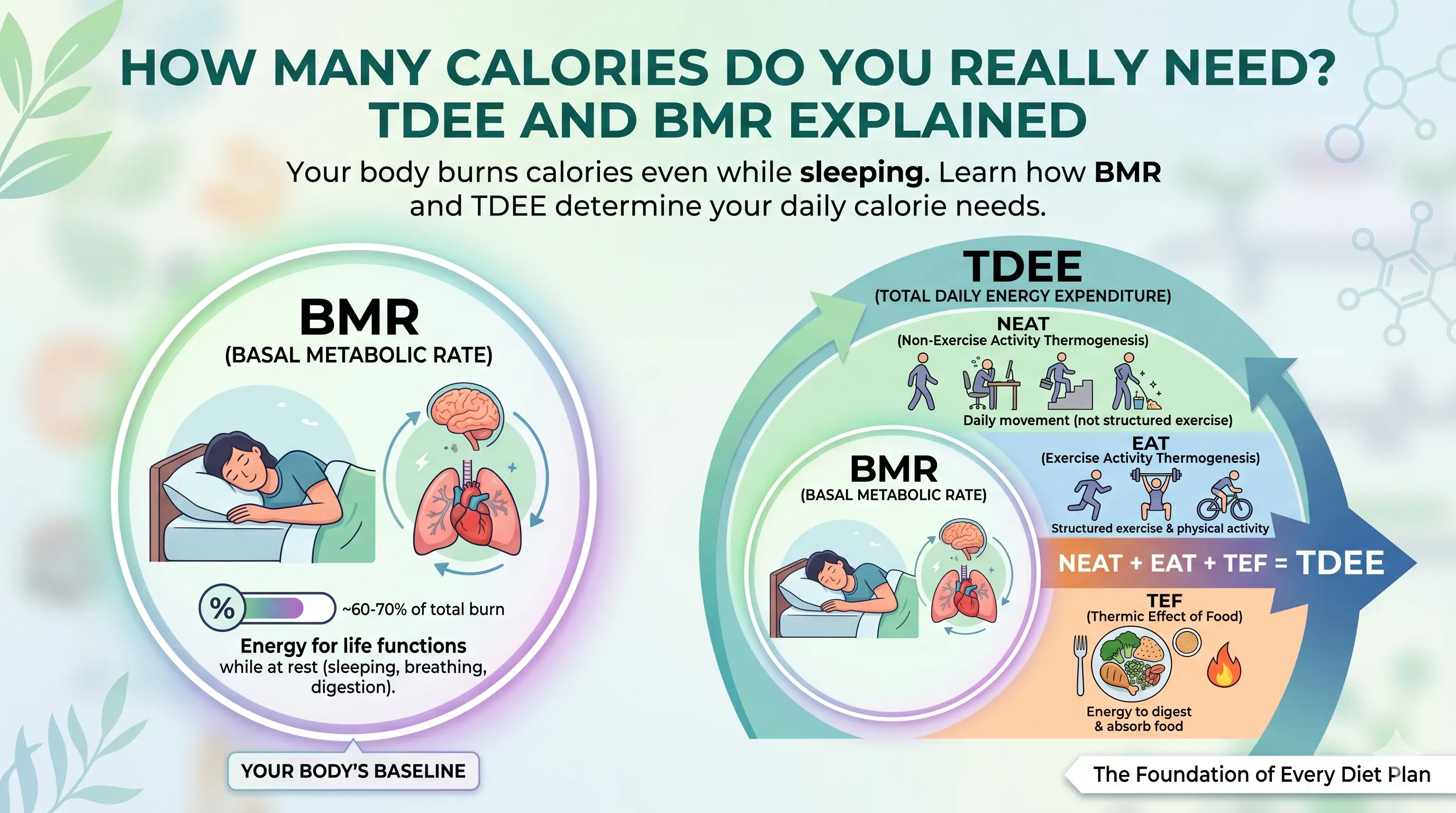
Your Basal Metabolic Rate (BMR) is the number of calories your body burns at complete rest — just to keep your heart beating, lungs breathing, brain functioning, and cells regenerating. BMR accounts for 60-75% of total daily calorie burn, making it the single largest component of your metabolism.
The most widely used formula is the Mifflin-St Jeor equation, which research shows is the most accurate for most adults:
Men: BMR = (10 × weight in kg) + (6.25 × height in cm) − (5 × age) + 5
Women: BMR = (10 × weight in kg) + (6.25 × height in cm) − (5 × age) − 161
For a 30-year-old man, 5'10" (178 cm), 180 lbs (82 kg): BMR = (10 × 82) + (6.25 × 178) − (5 × 30) + 5 = 1,787 calories/day. That's what he burns doing absolutely nothing.
From BMR to TDEE: Adding Activity
Total Daily Energy Expenditure (TDEE) = BMR × Activity Multiplier. The activity multiplier accounts for everything beyond resting metabolism:
Sedentary (desk job, no exercise): BMR × 1.2
Lightly active (1-3 days/week exercise): BMR × 1.375
Moderately active (3-5 days/week): BMR × 1.55
Very active (6-7 days/week intense): BMR × 1.725
Extra active (athlete/physical job): BMR × 1.9
For our example: 1,787 × 1.55 (moderately active) = 2,770 calories/day to maintain current weight.
The Three Components of Daily Burn
Your total daily calorie expenditure has three parts: BMR (60-75%), the Thermic Effect of Food (TEF, ~10% — the energy cost of digesting food), and Activity Thermogenesis (15-30% — exercise plus daily movement like walking, fidgeting, and standing).
Setting Calorie Goals
Weight loss: A deficit of 500 calories/day = ~1 pound/week loss. A 750-calorie deficit = ~1.5 lbs/week. Never go below BMR for extended periods — this triggers metabolic adaptation (your body slows its metabolism to conserve energy).
Weight gain: A surplus of 300-500 calories/day supports muscle growth when combined with resistance training. Without training, excess calories are stored as fat regardless of macronutrient composition.
Maintenance: Eat at your TDEE to maintain current weight. Track your weight weekly for 2-3 weeks to verify your TDEE estimate is accurate.
Why Most Calorie Estimates Are Wrong
The #1 error is overestimating activity level. Walking 30 minutes, 3 days a week is "lightly active" — not moderately active. The #2 error is underestimating food intake: studies show people underreport calories by 30-50% on average. Weighing food for even one week reveals how much visual estimation misses.
Calculate Your Numbers
Start with our BMR Calculator to find your baseline metabolism using the Mifflin-St Jeor equation. Then estimate your total daily needs with our Calorie Calculator. Planning a weight loss goal? Our Calorie Deficit Calculator shows exactly how long it will take to reach your target weight.
Understanding the Factors That Affect How Many Calories You Need
Determining how many calories you need is not a one-size-fits-all calculation. Your daily calorie requirement depends on several interconnected factors that change throughout your life.
Basal Metabolic Rate (BMR): Your Body's Baseline
BMR represents the energy your body needs for basic functions at complete rest — breathing, circulation, cell production, and temperature regulation. BMR accounts for 60-75% of total daily energy expenditure for most people. The two most commonly used formulas are:
Mifflin-St Jeor (most accurate for most people): Men: 10 × weight(kg) + 6.25 × height(cm) − 5 × age − 5. Women: 10 × weight(kg) + 6.25 × height(cm) − 5 × age − 161.
Harris-Benedict (original 1919, revised 1984): Slightly less accurate but still widely used in clinical settings.
For a 30-year-old man weighing 180 lbs (81.6 kg) at 5'10" (177.8 cm), the Mifflin-St Jeor BMR is: 10(81.6) + 6.25(177.8) − 5(30) − 5 = 1,777 calories/day.
The Thermic Effect of Food (TEF)
Your body uses energy to digest, absorb, and metabolize food. This process, called the thermic effect of food, accounts for about 10% of total calories consumed. Protein has the highest TEF (20-30%), meaning a high-protein diet slightly increases your metabolism. Carbohydrates have a TEF of 5-10%, and fats have the lowest at 0-3%.
Non-Exercise Activity Thermogenesis (NEAT)
NEAT encompasses all the calories you burn through daily activities that are not intentional exercise — walking, fidgeting, typing, standing, cooking, and even chewing gum. NEAT can vary by 2,000 calories per day between individuals with similar body compositions. A desk worker may burn 300 NEAT calories daily while an active construction worker burns 2,000+.
How to Accurately Track Your Calorie Intake
Knowing how many calories you need is only useful if you can accurately track consumption. Research from the National Institute of Diabetes and Digestive and Kidney Diseases shows that people underestimate their calorie intake by 30-50% on average.
Use a food scale for the first 2 weeks: Weighing portions is far more accurate than estimating. A "tablespoon" of peanut butter can vary from 90 to 190 calories depending on how generously you scoop.
Log everything immediately: Waiting until the end of the day leads to forgetting snacks, condiments, and cooking oils — which can add 300-500 untracked calories.
Account for cooking oils and sauces: A tablespoon of olive oil adds 120 calories. Restaurant meals typically use 2-4 tablespoons of butter or oil that you cannot see.
Be honest about portion sizes: A "serving" of cereal is typically 3/4 cup — most bowls hold 2-3 servings.
Calorie Myths That Sabotage Weight Goals
Several persistent myths about how many calories you need can lead to frustration and failed diets:
Myth: Eating fewer than 1,200 calories speeds up weight loss. Very low-calorie diets trigger metabolic adaptation — your body reduces BMR by 15-25% to conserve energy. This is why extremely restrictive diets lead to rebound weight gain. A moderate deficit of 300-500 calories below TDEE is sustainable and effective.
Myth: All calories are equal. While a calorie is a unit of energy regardless of source, 200 calories of chicken breast affects satiety, blood sugar, and muscle retention very differently than 200 calories of candy. Food quality determines whether you feel full or hungry an hour later.
Myth: You must eat breakfast to boost metabolism. Meal timing has minimal impact on total daily metabolism. What matters is total daily intake and macronutrient balance, not when you eat. Intermittent fasting works for some people precisely because skipping a meal reduces total intake.
Myth: Exercise is the main driver of weight loss. Exercise contributes only 5-15% of total daily calorie burn for most people. A 30-minute jog burns approximately 300 calories — less than a single bagel with cream cheese. Weight loss is primarily driven by dietary changes, while exercise is critical for health, muscle retention, and cardiovascular fitness.
Adjusting Calories for Specific Goals
For Weight Loss
Create a deficit of 300-500 calories below your TDEE. At 500 calories/day deficit, expect to lose about 1 pound per week. Do not exceed 1% of body weight lost per week to preserve muscle mass. Increase protein intake to 0.8-1.0g per pound of body weight during a deficit to protect against muscle loss.
For Muscle Gain
A calorie surplus of 200-400 calories above TDEE is optimal for building muscle without excessive fat gain. Protein needs increase to 0.9-1.2g per pound of body weight. Pair the surplus with progressive resistance training. Without training stimulus, extra calories are stored primarily as fat.
For Maintenance
Eat at your TDEE. Track your weight weekly (same time, same conditions) and adjust by 100-200 calories if your weight trends up or down over 2-3 weeks. Weight fluctuates 2-5 pounds daily from water, glycogen, and food volume — look at the trend, not daily numbers. Use our Calorie Calculator to find your personalized TDEE.
Frequently Asked Questions About Daily Calorie Needs
How many calories does the average person need per day?
According to the Dietary Guidelines for Americans, adult women generally need 1,600-2,400 calories per day and adult men need 2,000-3,000 calories per day. The exact number depends on age, height, weight, and activity level. Sedentary adults need the lower end while very active adults need the upper end.
Why do men need more calories than women?
Men typically have more lean muscle mass and less body fat than women of similar height and weight. Muscle tissue burns approximately 6 calories per pound per day at rest, while fat tissue burns only 2 calories per pound. This difference in body composition means men generally have a BMR that is 5-10% higher than women of similar size.
How do I know if I am eating enough calories?
Signs of undereating include constant fatigue, persistent hunger, difficulty concentrating, irritability, hair loss, poor exercise performance, feeling cold frequently, and loss of menstrual periods in women. If you experience these symptoms, gradually increase calorie intake by 100-200 calories per week until symptoms resolve.
Related Articles on CalculatorApp.me
Calorie & Metabolism Resources
Learn how to translate your TDEE into a sustainable plan with our guide on creating a calorie deficit for weight loss.
Related Calculators
Try these free calculators related to this article:
In-Depth Guides
Dive deeper with our comprehensive guides on this topic:
Frequently Asked Questions
Our Methodology
All health content on CalculatorApp.me is reviewed by subject-matter experts, cross-referenced with official sources, and updated regularly for accuracy. Our formulas and data are verified against industry standards and government publications.
Jordan Hayes
Verified AuthorPersonal Finance Content Strategist
Jordan is a personal finance content strategist with 9+ years writing about mortgages, retirement, tax strategy, and budgeting. Every guide is cross-referenced with IRS publications, Federal Reserve data, and CFPB guidance to make complex calculations accessible. Editor at CalculatorApp.me.
Found this helpful? Share it!
Stay Updated
Get notified when we launch new calculators and features.
No spam. Unsubscribe anytime.