How to Calculate Mortgage Payments: Formula, Examples & Calculator 2026
Free Calculator
Mortgage Calculator
Table of Contents
How to Calculate Mortgage Payments: Formula, Examples & Calculator 2026
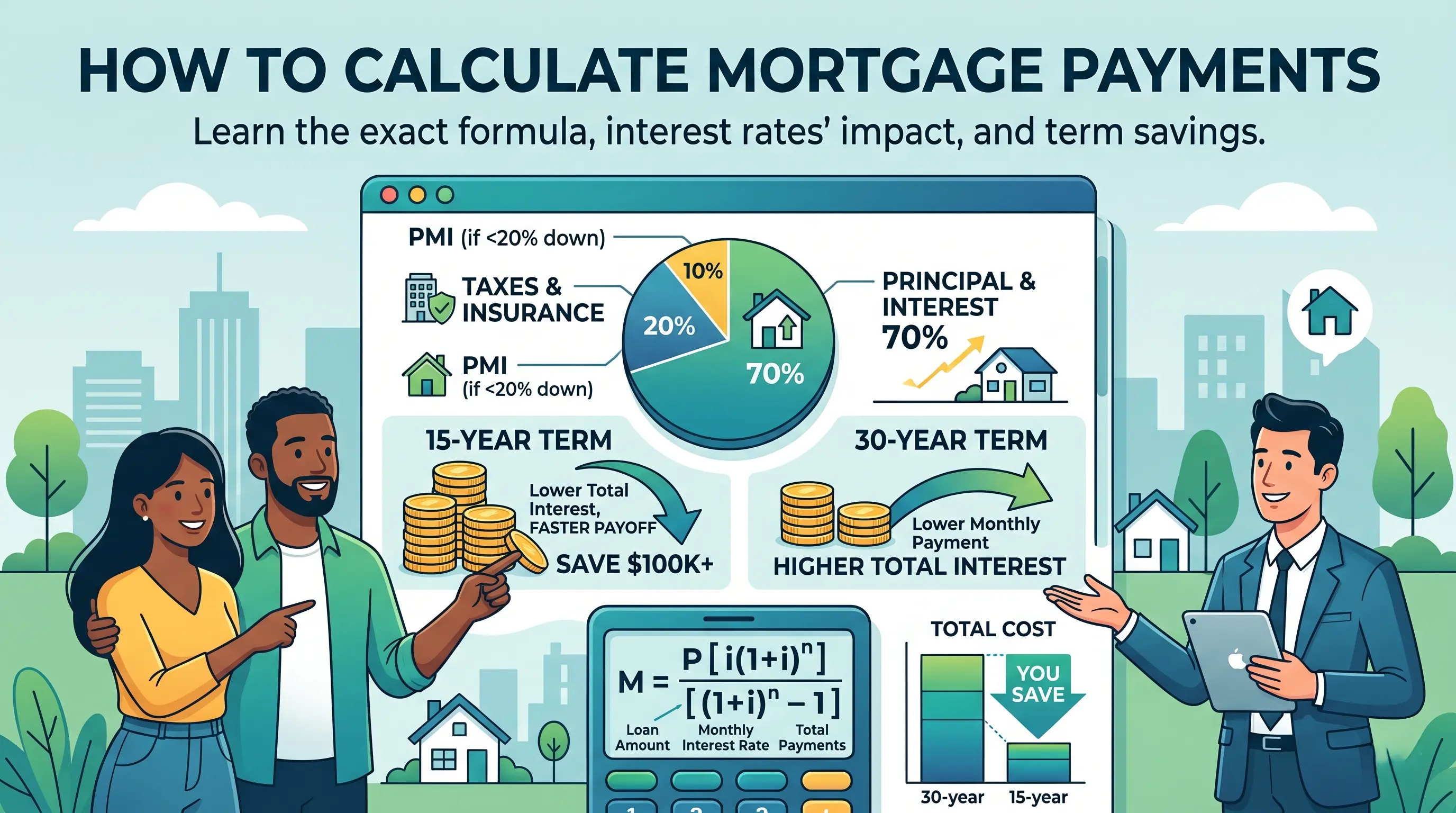
Your monthly mortgage payment is calculated using the PMT formula: M = P[r(1+r)^n] / [(1+r)^n − 1]. For a $300,000 loan at 7% for 30 years, this equals $1,996/month in principal and interest. This guide explains the full formula, walks through worked examples, shows your first-year amortization schedule, and covers how down payment, loan term, and extra payments change what you owe.
The Mortgage Payment Formula Explained
The standard mortgage payment formula (also called the PMT or annuity formula) is:
M = P × [r(1+r)^n] / [(1+r)^n − 1]
Where:
- M = Monthly payment (what you're solving for)
- P = Principal loan amount (total borrowed)
- r = Monthly interest rate = Annual rate ÷ 12
- n = Total number of payments = Loan term in years × 12
This formula calculates a fixed payment that pays off both principal and interest completely over the loan term — called a fully amortizing loan.
Worked Example: $300,000 at 7% for 30 Years
Step-by-step calculation:
- P = $300,000
- Annual rate = 7.00% → r = 7.00% ÷ 12 = 0.5833% = 0.005833
- n = 30 × 12 = 360 payments
- (1 + r)^n = (1.005833)^360 = 8.1165
- Numerator: r × (1+r)^n = 0.005833 × 8.1165 = 0.047347
- Denominator: (1+r)^n − 1 = 8.1165 − 1 = 7.1165
- M = 300,000 × (0.047347 / 7.1165) = 300,000 × 0.006653 = $1,996/month
Over the full 30-year term:
- Total paid: $1,996 × 360 = $718,560
- Total interest: $718,560 − $300,000 = $418,560
First-Year Amortization Schedule
In early payments, most of your money goes to interest. Here are the first 12 months on the $300,000 / 7% / 30-year example:
| Month | Payment | Principal | Interest | Balance |
|---|---|---|---|---|
| 1 | $1,996 | $246 | $1,750 | $299,754 |
| 2 | $1,996 | $247 | $1,748 | $299,507 |
| 3 | $1,996 | $249 | $1,747 | $299,258 |
| 4 | $1,996 | $250 | $1,746 | $299,008 |
| 5 | $1,996 | $251 | $1,745 | $298,757 |
| 6 | $1,996 | $253 | $1,743 | $298,504 |
| 7 | $1,996 | $254 | $1,742 | $298,250 |
| 8 | $1,996 | $256 | $1,740 | $297,994 |
| 9 | $1,996 | $257 | $1,739 | $297,737 |
| 10 | $1,996 | $258 | $1,738 | $297,479 |
| 11 | $1,996 | $260 | $1,736 | $297,219 |
| 12 | $1,996 | $261 | $1,734 | $296,958 |
After 12 months of payments ($23,952 total paid), your balance has dropped by only $3,042 — the rest went to interest. This is why extra principal payments early in a mortgage are so powerful.
How Down Payment Affects Your Monthly Payment
| Home Price | Down Payment | Loan Amount | Monthly P&I (7%, 30yr) | PMI (est.) | Total Monthly |
|---|---|---|---|---|---|
| $375,000 | 5% ($18,750) | $356,250 | $2,370 | $185 | $2,555 |
| $375,000 | 10% ($37,500) | $337,500 | $2,245 | $140 | $2,385 |
| $375,000 | 20% ($75,000) | $300,000 | $1,996 | $0 | $1,996 |
| $375,000 | 25% ($93,750) | $281,250 | $1,871 | $0 | $1,871 |
Hitting the 20% down payment threshold eliminates PMI ($100–$200/month) and reduces the loan amount — a double saving worth planning for if you're on the edge.
15-Year vs 30-Year Mortgage: Side-by-Side Comparison
| Loan: $300,000 at 6.5% | 30-Year | 15-Year |
|---|---|---|
| Monthly Payment (P&I) | $1,896 | $2,613 |
| Monthly Difference | — | +$717 |
| Total Interest Paid | $382,560 | $170,340 |
| Interest Savings | — | $212,220 |
| Equity at Year 10 | ~$60,000 | ~$180,000 |
The 15-year mortgage saves over $212,000 in interest but requires $717 more per month. Many financial planners suggest the 30-year with disciplined extra payments as a middle path — you get lower required payments but accelerate payoff when cash flow allows.
Impact of Extra Payments
| Extra Monthly Payment | Loan Payoff | Total Interest | Interest Saved |
|---|---|---|---|
| $0 (standard) | 30 years | $418,560 | — |
| $100/month | 26 yrs 1 mo | $354,900 | $63,660 |
| $250/month | 23 yrs 2 mo | $299,200 | $119,360 |
| $500/month | 20 yrs 4 mo | $240,800 | $177,760 |
| 1 extra payment/year | 26 yrs 8 mo | $356,700 | $61,860 |
Based on $300,000 / 7% / 30-year loan.
Use Our Free Mortgage Calculators
- Mortgage Calculator — Calculate your monthly payment, full amortization schedule, and extra payment savings instantly
- Loan Calculator — Works for any loan type: auto, personal, student, HELOC
- Best Free Mortgage Calculators 2026 — Compare the top tools and features side by side
Frequently Asked Questions
What is the monthly payment on a $300,000 mortgage at 7%?
On a 30-year fixed mortgage at 7.00%, a $300,000 loan has a monthly principal and interest payment of $1,996. Add property taxes (~$300–$500/month depending on location), homeowner's insurance (~$100–$150), and PMI if your down payment was under 20%, and your total PITI payment will typically be $2,400–$2,700.
How is the mortgage payment formula derived?
The PMT formula is derived from the present value of an annuity equation. A mortgage is essentially an annuity — you receive a lump sum (the loan) and repay it in equal periodic payments. The formula M = P[r(1+r)^n]/[(1+r)^n−1] solves for the fixed payment that exactly depletes the loan balance to zero after n payments, given monthly interest rate r.
Does a higher credit score lower mortgage payments?
Yes, significantly. A credit score of 760+ typically qualifies for the best rates — potentially 0.5%–1.0% lower than scores in the 620–639 range. On a $300,000 loan over 30 years, 1% lower rate reduces monthly payment by about $175 and saves over $63,000 in total interest.
What happens to my mortgage payment if rates drop and I refinance?
Refinancing replaces your current loan with a new one at a lower rate. Your new monthly payment is calculated using the same PMT formula but with a lower rate (r) and the remaining balance as the new principal (P). The catch: refinancing resets your amortization clock, meaning early payments again go mostly to interest. Run the numbers with our mortgage calculator to see if refi savings outweigh the reset cost.
How much mortgage can I afford?
The standard guideline is the 28/36 rule: your mortgage payment (PITI) should not exceed 28% of gross monthly income, and all debt payments (mortgage + car + student loans) should not exceed 36%. On a $8,000/month gross income, that's a maximum PITI of $2,240. Use our mortgage calculator to find what loan amount hits that target payment at current rates.
Conclusion
The mortgage payment formula M = P[r(1+r)^n]/[(1+r)^n−1] is the mathematical core of every home loan. Understanding it reveals why early payments are interest-heavy, why extra principal payments are so effective, and why a 15-year mortgage saves dramatically over a 30-year despite a higher payment. Use CalculatorApp.me's mortgage calculator to run your own numbers with a full amortization schedule — and see exactly where every dollar of your payment goes.
Related Calculators
Try these free calculators related to this article:
In-Depth Guides
Dive deeper with our comprehensive guides on this topic:
Frequently Asked Questions
Our Methodology
All finance content on CalculatorApp.me is reviewed by subject-matter experts, cross-referenced with official sources, and updated regularly for accuracy. Our formulas and data are verified against industry standards and government publications.
Jordan Hayes
Verified AuthorPersonal Finance Content Strategist
Jordan is a personal finance content strategist with 9+ years writing about mortgages, retirement, tax strategy, and budgeting. Every guide is cross-referenced with IRS publications, Federal Reserve data, and CFPB guidance to make complex calculations accessible. Editor at CalculatorApp.me.
Found this helpful? Share it!
Stay Updated
Get notified when we launch new calculators and features.
No spam. Unsubscribe anytime.