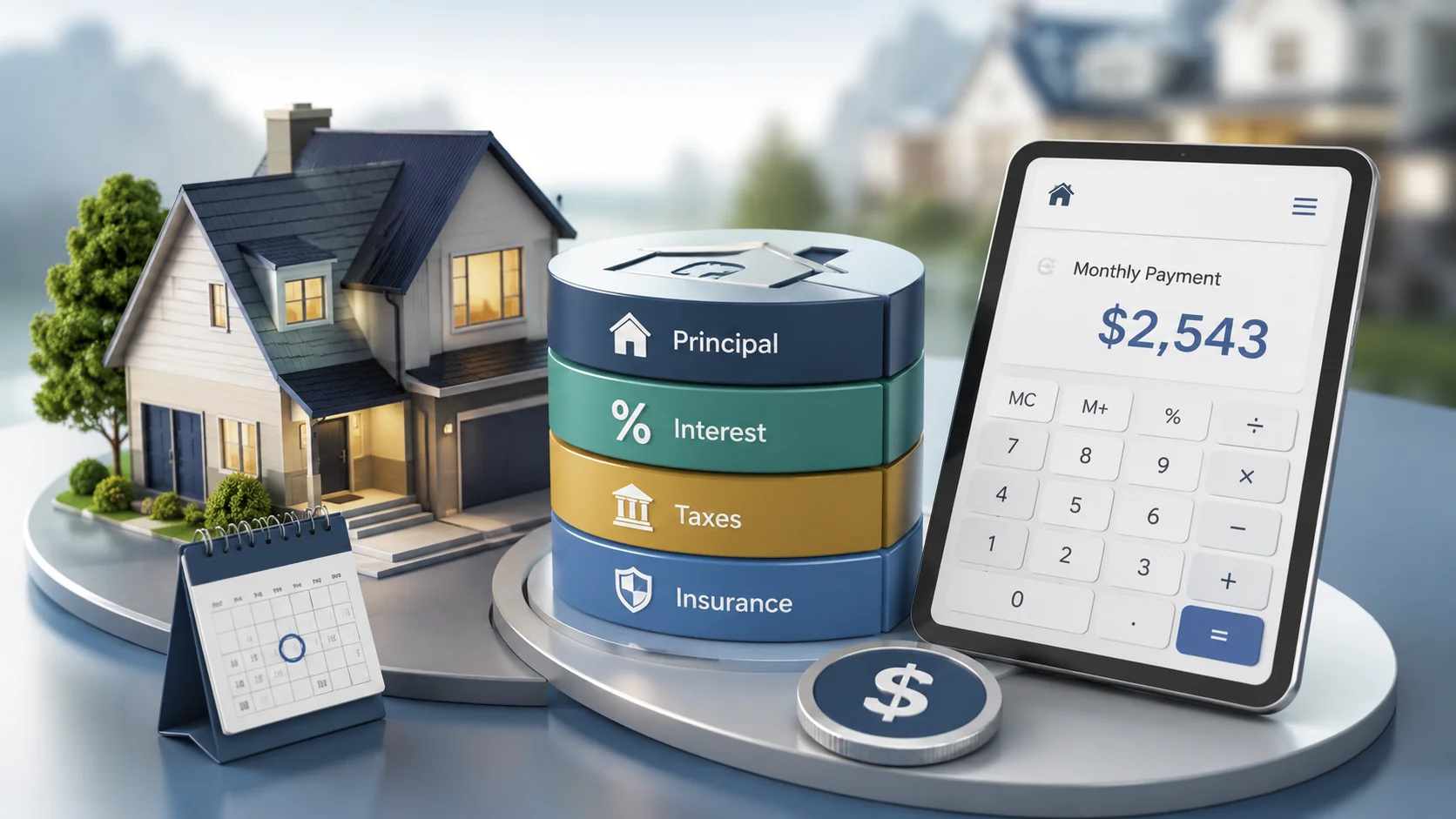
Mortgage Calculator: Understanding Your Home Loan Payments
Free Calculator
Mortgage Calculator
Table of Contents
A mortgage calculator is the essential first tool every homebuyer should use before stepping into a bank or contacting a real estate agent. Whether you're a first-time buyer trying to figure out how much house you can afford or a homeowner considering refinancing, understanding how mortgage payments are calculated gives you the power to make financially sound decisions. In this complete guide, we explain every component of a mortgage payment, walk through the math behind amortization, compare loan types, and show you strategies that can save tens of thousands of dollars over the life of your loan.
What Is a Mortgage and How Does It Work?
A mortgage is a secured loan used to purchase real estate, where the property itself serves as collateral. The borrower makes regular payments over a set term (typically 15 or 30 years) until the loan is fully repaid. If the borrower defaults, the lender can foreclose on the property.
According to the Consumer Financial Protection Bureau (CFPB), understanding your mortgage terms before signing can save you thousands of dollars and prevent financial distress. Their "Owning a Home" toolkit is an excellent free resource for first-time buyers.
The Four Components of a Mortgage Payment (PITI)
Your monthly mortgage payment consists of four parts, commonly abbreviated as PITI:
1. Principal
The principal is the portion of your payment that goes toward reducing the outstanding loan balance. In the early years of a mortgage, very little of your payment goes toward principal—most goes to interest. As you progress through the loan, this ratio reverses.
2. Interest
Interest is the cost of borrowing money, expressed as an annual percentage rate (APR). On a $300,000 mortgage at 6.5% over 30 years, you would pay approximately $382,633 in total interest—more than the original loan amount. This is why even a 0.25% rate difference matters enormously.
3. Property Taxes
Property taxes are assessed by your local government based on your home's assessed value. In the United States, property tax rates vary widely by location—from 0.31% in Hawaii to 2.23% in New Jersey, according to the Tax Foundation. Most lenders collect taxes monthly via an escrow account.
4. Insurance
Homeowners insurance protects against damage, theft, and liability. If your down payment is less than 20%, you'll also pay Private Mortgage Insurance (PMI), which typically costs 0.5–1.5% of the loan amount annually. PMI protects the lender (not you) if you default.
The Mortgage Payment Formula Explained
The standard formula for calculating a fixed-rate monthly mortgage payment is:
M = P × [r(1+r)^n] / [(1+r)^n – 1]
Where:
- M = Monthly payment
- P = Principal (loan amount)
- r = Monthly interest rate (annual rate ÷ 12)
- n = Total number of payments (years × 12)
Example: For a $350,000 loan at 6.5% over 30 years:
- r = 0.065 / 12 = 0.005417
- n = 30 × 12 = 360 payments
- M = 350,000 × [0.005417 × (1.005417)^360] / [(1.005417)^360 – 1]
- M = $2,212.24 per month (principal + interest only)
Skip the math and use our Mortgage Calculator to get instant results with taxes and insurance included.
Understanding Amortization
Amortization is the process of spreading loan payments over time. An amortization schedule shows exactly how much of each payment goes toward principal vs. interest for every month of the loan.
Here's what a typical 30-year mortgage amortization looks like:
- Year 1: About 80% of each payment goes to interest, 20% to principal
- Year 15: Roughly 50/50 split between interest and principal
- Year 25+: About 80% goes to principal, 20% to interest
This front-loading of interest is why extra principal payments in the early years have such a dramatic impact. Explore this in detail with our Amortization Calculator.
Fixed-Rate vs. Adjustable-Rate Mortgages (ARM)
Fixed-Rate Mortgages
A fixed-rate mortgage locks in the same interest rate for the entire loan term. Your principal and interest payment never changes, providing predictable budgeting. The most common terms are:
- 30-year fixed: Lower monthly payments, more total interest paid
- 15-year fixed: Higher monthly payments, significantly less total interest
- 20-year fixed: A middle ground between the two
Adjustable-Rate Mortgages (ARM)
ARMs offer a lower initial rate for a fixed period (typically 5, 7, or 10 years), after which the rate adjusts periodically based on a market index. A "5/1 ARM" means the rate is fixed for 5 years, then adjusts annually.
When an ARM makes sense: If you plan to sell or refinance within the fixed-rate period, an ARM's lower initial rate can save money. However, if rates rise sharply, your payments could increase significantly.
The Federal Reserve Board provides a comprehensive consumer handbook on adjustable-rate mortgages worth reading before choosing this option.
How Much House Can You Afford?
Lenders typically use two ratios to determine your borrowing capacity:
- Front-end ratio (28% rule): Your total housing costs (PITI) should not exceed 28% of your gross monthly income
- Back-end ratio (36% rule): Total debt payments (housing + car loans + student loans + credit cards) should not exceed 36% of gross monthly income
Example: With a household income of $100,000/year ($8,333/month):
- Maximum housing payment: $8,333 × 0.28 = $2,333/month
- Maximum total debt: $8,333 × 0.36 = $3,000/month
Strategies to Save Money on Your Mortgage
- Improve your credit score before applying: A score of 740+ typically qualifies you for the best rates. Even a 0.5% rate reduction on a $300,000 loan saves ~$30,000 over 30 years.
- Make a 20% down payment: This eliminates PMI, saving $125–$375/month on a $300,000 home.
- Choose a 15-year term: You'll pay roughly half the total interest compared to a 30-year mortgage, though monthly payments will be ~40% higher.
- Make biweekly payments: Paying half your monthly payment every two weeks results in 26 half-payments (13 full payments) per year instead of 12, shaving ~4 years off a 30-year mortgage.
- Make extra principal payments: Even an extra $100/month toward principal on a $300,000 loan at 6.5% saves ~$56,000 in interest and pays off the loan 4.5 years early.
- Compare at least 3 lenders: According to the CFPB, shopping around can save borrowers an average of $1,500 over the loan's life.
- Consider buying points: One "point" costs 1% of the loan and typically reduces your rate by 0.25%. This makes sense if you plan to stay 5+ years.
Refinancing: When Does It Make Sense?
Refinancing replaces your existing mortgage with a new one, typically to get a lower rate, change the term, or cash out equity. The general rule of thumb:
- Refinance if you can reduce your rate by 0.75–1%+
- Calculate the break-even point: Divide closing costs by monthly savings. If you'll stay in the home longer than the break-even period, refinancing makes financial sense.
- Avoid "restarting the clock": Refinancing from year 10 of a 30-year mortgage into a new 30-year mortgage resets amortization, potentially costing more in total interest despite a lower rate.
Run the numbers with our Mortgage Calculator comparing your current and potential new terms.
2026 Mortgage Rate Outlook
As of early 2026, the average 30-year fixed mortgage rate sits around 6.2–6.8%, down from the 2023 peak of ~7.8%. Experts anticipate rates may gradually decrease through 2026 as inflation continues to moderate, though they're unlikely to return to the sub-3% levels of 2020–2021.
Key factors affecting 2026 rates include Federal Reserve policy decisions, inflation trends, employment data, and global economic conditions. Regardless of market conditions, using a mortgage calculator to model different rate scenarios helps you prepare for any outcome.
Frequently Asked Questions
How much is a monthly payment on a $300,000 mortgage?
At 6.5% interest over 30 years, the principal and interest payment on a $300,000 mortgage is approximately $1,896/month. Adding property taxes (~$250/month) and insurance (~$100/month) brings the total to roughly $2,246/month. Use our Mortgage Calculator for exact figures based on your rate and location.
What credit score do I need for a mortgage?
Minimum credit scores vary by loan type: FHA loans require 580+ (or 500 with 10% down), conventional loans typically require 620+, and the best rates go to borrowers with 740+. Check and improve your score at AnnualCreditReport.com (free, federally authorized).
Is a 15-year or 30-year mortgage better?
A 15-year mortgage has higher monthly payments but saves dramatically on interest. On a $300,000 loan at 6%: a 30-year costs $347,515 in interest; a 15-year costs $156,108—a savings of $191,407. Choose 15 years if the higher payments fit your budget comfortably.
How much should I put down on a house?
While 20% is ideal (eliminates PMI), many programs allow 3–5% down. FHA requires just 3.5%, and VA loans offer 0% down for eligible veterans. The trade-off: smaller down payments mean higher monthly costs and more total interest paid.
What are closing costs and how much should I expect?
Closing costs typically range from 2–5% of the loan amount and include appraisal fees, title insurance, attorney fees, origination charges, and prepaid taxes/insurance. On a $300,000 mortgage, expect $6,000–$15,000 in closing costs.
Government Programs for First-Time Homebuyers
Several government-backed programs can make homeownership more accessible, especially for first-time buyers:
- FHA Loans: Backed by the Federal Housing Administration, these require just 3.5% down with a credit score of 580+. Ideal for buyers with limited savings or lower credit scores. However, FHA loans require mortgage insurance premiums (MIP) for the life of the loan in most cases.
- VA Loans: Available to eligible military service members, veterans, and surviving spouses. VA loans offer 0% down payment, no PMI requirement, and competitive interest rates — one of the best mortgage products available.
- USDA Loans: For buyers in eligible rural and suburban areas, USDA loans offer 0% down payment and below-market interest rates. Income limits apply based on your area's median income.
- Conventional 97: Backed by Fannie Mae, this program allows just 3% down for first-time buyers with a credit score of 620+.
Visit HUD.gov for a complete list of homebuyer assistance programs available in your state.
Common Mortgage Mistakes to Avoid
Even with a mortgage calculator in hand, many buyers make costly errors:
- Only looking at monthly payment: A lower monthly payment doesn't always mean a better deal — it often means a longer term and more total interest paid. Always compare total cost of the loan.
- Waiving the home inspection: In competitive markets, some buyers skip inspections. This can lead to surprise repair costs of $10,000–$50,000+ after closing.
- Maxing out your budget: Just because a lender approves you for $400,000 doesn't mean you should borrow that much. Aim for housing costs at 25% of take-home pay (not 28% of gross).
- Forgetting about closing costs: Budget 2–5% of the purchase price for closing costs on top of your down payment.
- Not getting pre-approved: Pre-approval strengthens your offer and locks in a rate for 60–90 days, protecting you from rate increases during your home search.
- Making large purchases before closing: Buying a car or furniture on credit between pre-approval and closing can change your debt-to-income ratio and jeopardize your mortgage approval.
Understanding Your Loan Estimate and Closing Disclosure
Federal law requires lenders to provide two standardized documents that help you comparison shop:
- Loan Estimate (LE): You'll receive this within 3 business days of applying. It details your estimated interest rate, monthly payment, closing costs, and total cost over the loan term. Compare Loan Estimates from multiple lenders side by side.
- Closing Disclosure (CD): Provided at least 3 business days before closing, this final document confirms all loan terms. Compare it carefully against your Loan Estimate — any significant changes may warrant renegotiation or delay.
The CFPB provides sample documents and explanations on their website to help you understand every line item on these critical forms.
Building Equity: Your Mortgage as an Investment
Unlike rent payments that build wealth for a landlord, mortgage payments gradually build your equity — the difference between your home's market value and your remaining loan balance. Equity grows in two ways: through principal payments reducing your loan balance, and through property appreciation increasing your home's value.
Historically, U.S. home prices have appreciated approximately 3–5% annually over the long term. Combined with mortgage paydown, a homeowner who purchased a $350,000 home with 20% down could accumulate over $250,000 in equity within 10 years, depending on appreciation rates. This equity can be accessed through home equity loans, HELOCs, or by selling — making homeownership one of the most reliable wealth-building tools available to middle-class Americans.
Take the Next Step
Understanding mortgage calculations empowers you to negotiate better terms, avoid costly mistakes, and build wealth through homeownership. Start by running your numbers through our free Mortgage Calculator, explore different scenarios with our Amortization Calculator, and check your Loan Calculator for comparing different loan structures. The more scenarios you model, the more confident you'll be when making one of life's biggest financial decisions.
Related Articles on CalculatorApp.me
Related Calculators
Try these free calculators related to this article:
In-Depth Guides
Dive deeper with our comprehensive guides on this topic:
Frequently Asked Questions
Our Methodology
All finance content on CalculatorApp.me is reviewed by subject-matter experts, cross-referenced with official sources, and updated regularly for accuracy. Our formulas and data are verified against industry standards and government publications.
Jordan Hayes
Verified AuthorPersonal Finance Content Strategist
Jordan is a personal finance content strategist with 9+ years writing about mortgages, retirement, tax strategy, and budgeting. Every guide is cross-referenced with IRS publications, Federal Reserve data, and CFPB guidance to make complex calculations accessible. Editor at CalculatorApp.me.
Found this helpful? Share it!
Stay Updated
Get notified when we launch new calculators and features.
No spam. Unsubscribe anytime.