BMI vs. Body Fat Percentage: Which Health Metric Actually Matters?
Free Calculator
BMI Calculator
Table of Contents
BMI vs Body Fat Percentage: What Is BMI?
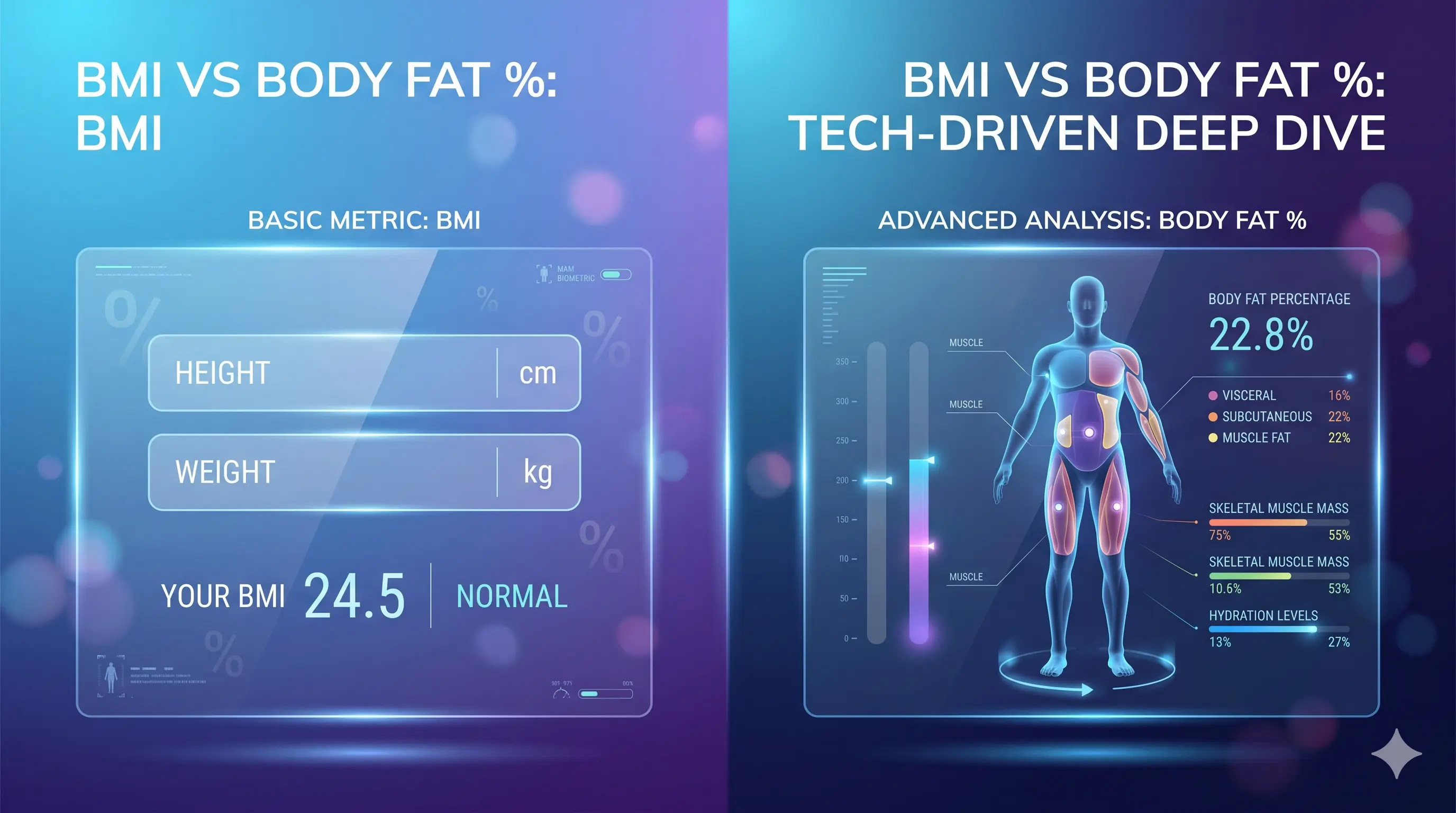
Body Mass Index (BMI) is a simple ratio of weight to height: BMI = weight (kg) / height² (m²). Developed by Adolphe Quetelet in 1832 for population-level statistics, Quetelet never designed it as an individual health diagnostic tool.
BMI categories (per WHO standards): Underweight < 18.5, Normal 18.5-24.9, Overweight 25.0-29.9, Obese ≥ 30.0.
BMI's Fundamental Flaw
BMI cannot distinguish between muscle and fat. A 6'2\", 265-lb athlete with 8% body fat has a BMI of 34.0 — "obese" by BMI standards. Meanwhile, a sedentary person at 5'6\", 150 lbs has a "normal" BMI of 24.2 despite carrying 35% body fat (a clinically concerning level).
Research published in the International Journal of Obesity found that BMI misclassifies 54 million Americans — labeling metabolically healthy people as unhealthy and missing metabolically unhealthy people with normal weight.
What Is Body Fat Percentage?
Body fat percentage measures what proportion of your total body weight is fat tissue. Unlike BMI, it measures body composition — the actual health-relevant variable.
Healthy body fat ranges by gender and age:
Men (20-39): 8-19% (athletes: 6-13%)
Men (40-59): 11-21%
Women (20-39): 21-32% (athletes: 14-20%)
Women (40-59): 23-33%
Essential fat (minimum needed for organ function): ~3% for men, ~12% for women.
How It's Measured
DEXA scan: Gold standard. X-ray-based, ±1-2% accuracy. $75-200 per scan.
Hydrostatic weighing: Underwater displacement. ±1.5% accuracy.
Bioelectrical impedance (BIA): Scales and handheld devices. ±3-5% accuracy. Affected by hydration, meals, and exercise timing.
Skinfold calipers: ±3-4% accuracy when done by trained technicians.
US Navy method: Uses neck and waist circumference. ±3% accuracy. Free and accessible.
When to Use Each Metric
BMI is useful for:
Population-level health screening
Quick risk assessment when no body composition data is available
Tracking weight trends over time in average-build individuals
Insurance and medical eligibility thresholds (where it remains the standard)
Body fat percentage is better for:
Athletes and muscular individuals (BMI overestimates their risk)
Tracking fitness progress (you can lose fat and gain muscle without weight changing)
Identifying "skinny fat" — normal BMI but high body fat
Setting specific body composition goals
The Bottom Line
For the average person, BMI is a reasonable screening tool — it's fast, free, and correlates with health outcomes at the population level. But for individual health assessment, body fat percentage is the superior metric. Track both: use BMI as a quick check and body fat percentage for the real picture.
Measure Both
Check your BMI instantly with our BMI Calculator and estimate your body fat percentage with our Body Fat Calculator (uses the US Navy method). For a complete picture, also calculate your Ideal Weight and Basal Metabolic Rate.
Beyond BMI and Body Fat: Other Body Composition Metrics
While the BMI vs body fat percentage debate dominates fitness discussions, several other metrics provide additional insight into health and disease risk:
Waist-to-Hip Ratio (WHR)
Measure your waist circumference at the narrowest point (usually at the navel) and divide by hip circumference at the widest point. A WHR above 0.90 for men or 0.85 for women indicates central obesity and increased risk of cardiovascular disease, type 2 diabetes, and metabolic syndrome. Research published in The Lancet found that WHR predicts heart attack risk better than BMI.
Waist-to-Height Ratio
An even simpler metric: your waist circumference should be less than half your height. A 6-foot (72 inch) tall person should aim for a waist under 36 inches. This ratio correlates with visceral fat levels and cardiometabolic risk across all ethnic groups, making it more universally applicable than BMI, which has known accuracy issues for certain populations.
Waist Circumference Alone
The National Heart, Lung, and Blood Institute identifies increased disease risk at waist circumferences above 40 inches for men and 35 inches for women. This single measurement captures abdominal visceral fat — the type closely linked to chronic disease — without any calculation.
Visceral Fat vs. Subcutaneous Fat: Why Location Matters
When comparing BMI vs body fat percentage, neither metric tells you where your fat is stored — and location matters for health outcomes.
Subcutaneous fat: Stored directly under the skin (the fat you can pinch). While excess subcutaneous fat contributes to body weight and aesthetic concerns, it is less metabolically active and poses lower health risks. Subcutaneous fat produces beneficial hormones, including leptin (appetite regulation) and adiponectin (insulin sensitivity).
Visceral fat: Stored around internal organs in the abdominal cavity (liver, intestines, pancreas). Visceral fat is metabolically active and releases inflammatory cytokines, free fatty acids, and hormones that promote insulin resistance, chronic inflammation, and atherosclerosis. You can have a normal BMI and still carry dangerous amounts of visceral fat — a condition doctors call "skinny fat" or metabolically obese normal weight (MONW).
DEXA scans and some advanced bioelectrical impedance devices can estimate visceral fat levels. As an alternative, waist circumference serves as an effective proxy — if your waist is expanding while your weight stays constant, you may be gaining visceral fat while losing muscle.
Body Composition Goals by Sport and Activity Level
Athletes and active individuals should evaluate BMI vs body fat percentage in the context of their sport, as optimal composition varies by sport:
Marathon runners: 5-10% body fat (men), 12-18% (women). Low body fat minimizes weight carried over 26.2 miles, but going too low impairs performance and immune function.
Swimmers: 8-12% (men), 15-22% (women). Slightly higher fat than runners because some buoyancy is beneficial and the sport does not penalize extra weight as much.
Powerlifters and strongmen: 15-25% (men), 22-30% (women). Extra body mass (both fat and muscle) contributes to force production. BMI is meaningless for these athletes — many have BMIs of 30-40 while being in peak condition.
Recreational fitness: 10-20% (men), 18-28% (women). Focus on sustainable body composition that supports your activities and health rather than chasing elite athlete levels.
General health: Maintaining body fat below 25% (men) or 32% (women) correlates with lower disease risk. The fitness level (14-17% men, 21-24% women) offers a good balance between health, aesthetics, and sustainability.
How to Track Body Composition Changes Over Time
Whether you use BMI, body fat percentage, or other metrics, consistency in measurement is more important than absolute accuracy:
Measure at the same time: Body composition fluctuates throughout the day. Measure first thing in the morning, after using the bathroom, before eating or drinking. This gives the most consistent baseline.
Use the same method: If you use a bioelectrical impedance scale, use the same scale every time. Different devices give different absolute readings but track trends consistently. Do not compare a DEXA scan result to a bathroom scale's body fat reading.
Track multiple metrics: The best approach combines: (1) scale weight (weekly average, not daily), (2) waist circumference, (3) progress photos (same lighting, angle, time of day), and (4) strength benchmarks. If your weight stays the same but your waist shrinks and strength increases, you are recomposing — losing fat and gaining muscle at once.
Measure monthly, not daily: Body composition changes slowly. Meaningful changes in body fat percentage require 4-8 weeks of consistent training and nutrition to detect. Measuring more frequently introduces noise and anxiety without providing actionable data.
The Bottom Line: Which Metric Should You Use?
The BMI vs body fat percentage debate has a clear answer: use both, plus waist circumference.
BMI is useful as a quick population-level screening tool and is free to calculate. If your BMI is 18.5-24.9 AND your waist circumference is within guidelines, you are likely at low metabolic risk.
Body fat percentage gives a more accurate individual picture but requires equipment or professional measurement. Track trends rather than obsessing over absolute numbers.
Waist circumference is the strongest predictor of metabolic health risk, requires only a tape measure, and works across all body types and fitness levels.
For most people, the best approach is: check BMI for a quick sanity check, measure waist circumference monthly, and get body fat tested 2-4 times per year to track trends. Use our BMI Calculator and Body Fat Calculator to track both metrics side by side.
Frequently Asked Questions About BMI and Body Fat
Is BMI accurate for very muscular people?
No. BMI overestimates obesity risk in muscular individuals. A 5'10" man who weighs 210 lbs with 12% body fat has a BMI of 30.1 ("obese") despite being in excellent health. If you regularly strength train and carry above-average muscle mass, body fat percentage and waist circumference are more relevant metrics than BMI.
Can you be healthy at a high body fat percentage?
Research on "metabolically healthy obesity" shows that some individuals with elevated body fat maintain normal blood pressure, blood sugar, cholesterol, and inflammatory markers. However, long-term studies suggest that metabolically healthy obesity is often a transitional state — the risk of developing metabolic problems increases with age even if current markers are normal. Body fat within recommended ranges reduces lifetime disease risk more reliably.
How fast can I safely lose body fat?
A safe rate of fat loss is 0.5-1.0% of body weight per week. For a 180-pound person, that is 0.9-1.8 pounds per week. Faster weight loss increases the risk of muscle loss, metabolic slowdown, gallstones, and nutrient deficiencies. Athletes and leaner individuals should target the lower end (0.5%) to preserve muscle, while those with more fat to lose can safely lose at the higher end (1.0%) initially. Never drop below essential fat levels (3% men, 12% women).
Related Articles on CalculatorApp.me
Body Composition Resources
Related Calculators
Try these free calculators related to this article:
In-Depth Guides
Dive deeper with our comprehensive guides on this topic:
Frequently Asked Questions
Our Methodology
All health content on CalculatorApp.me is reviewed by subject-matter experts, cross-referenced with official sources, and updated regularly for accuracy. Our formulas and data are verified against industry standards and government publications.
Jordan Hayes
Verified AuthorPersonal Finance Content Strategist
Jordan is a personal finance content strategist with 9+ years writing about mortgages, retirement, tax strategy, and budgeting. Every guide is cross-referenced with IRS publications, Federal Reserve data, and CFPB guidance to make complex calculations accessible. Editor at CalculatorApp.me.
Found this helpful? Share it!
Stay Updated
Get notified when we launch new calculators and features.
No spam. Unsubscribe anytime.