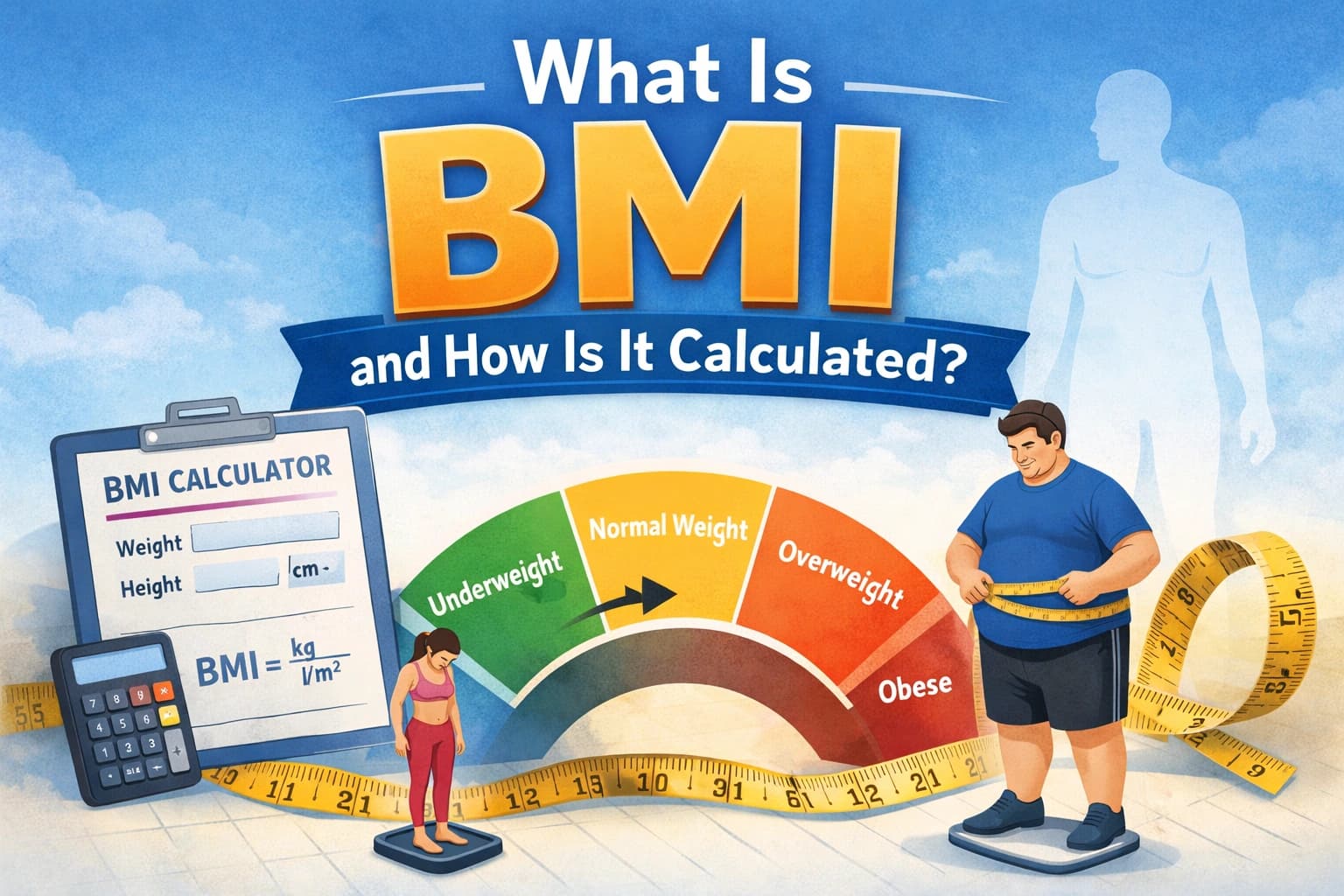
What Is BMI and How Is It Calculated?
Free Calculator
BMI Calculator
Table of Contents
What Is BMI?
Body Mass Index (BMI) is a critical numerical value that reveals your weight-to-height ratio in seconds. Doctors and health experts worldwide rely on this powerful, proven screening tool to instantly classify individuals into weight status categories — from dangerously underweight to severely obese. BMI stands as one of the most essential metrics driving global public health decisions and preventive medicine today.
Belgian mathematician Adolphe Quetelet pioneered this groundbreaking formula in the 1830s, originally calling it the Quetelet Index. Physiologist Ancel Keys later popularized the modern term "Body Mass Index" in 1972. Today, both the World Health Organization (WHO) and the U.S. Centers for Disease Control and Prevention (CDC) officially endorse BMI as the gold-standard population-level screening measure.
"BMI is a simple, inexpensive, and noninvasive surrogate measure of body fat that is used to screen for weight categories that may lead to health problems." — World Health Organization
You must understand from the outset: BMI is a powerful screening tool, not a definitive diagnostic instrument. An elevated BMI immediately flags you as potentially at risk — but it does not confirm disease or poor health on its own. Your physician will always evaluate BMI alongside other critical clinical indicators.
Ready to discover your number? Use our free BMI Calculator — get instant, accurate results for both metric and imperial units, absolutely no sign-up required.
How Is BMI Calculated?
Calculating your BMI demands just two simple measurements: weight and height. The proven formula comes in two versions depending on your unit system — both deliver the exact same unitless number.
Metric Formula (kg / m²)
BMI = Weight (kg) ÷ Height² (m²)
Example: Weight = 72 kg, Height = 1.78 m
BMI = 72 ÷ (1.78 × 1.78) = 72 ÷ 3.168 = 22.7 → Normal Weight ✓
Imperial Formula (lbs / in²)
BMI = (Weight (lbs) × 703) ÷ Height² (in²)
Example: Weight = 160 lbs, Height = 5′10″ = 70 inches
BMI = (160 × 703) ÷ (70 × 70) = 112,480 ÷ 4,900 = 22.9 → Normal Weight ✓
The constant 703 in the imperial formula acts as a precise unit conversion factor that bridges pounds/inches² to the metric kg/m² base. Both formulas produce identical BMI values for the same person. You then compare your result against standardized cut-off thresholds to determine your exact weight status.
💡 Essential height conversion tip: Always convert feet and inches to total inches first. For example, 5′8″ = (5 × 12) + 8 = 68 inches total before squaring.
Skip the math entirely — our BMI Calculator instantly handles metric and imperial conversions for you. Also discover your Ideal Weight to find a clinically-validated healthy target weight for your height.
BMI Categories & Ranges
The WHO establishes the following definitive BMI categories for adults aged 20 and older. These critical cut-offs apply universally regardless of age or sex for adults, though ethnic-specific adjustments are addressed below.
BMI Range | Category | Associated Health Risk |
|---|---|---|
Below 18.5 | Underweight | Moderate — triggers nutritional deficiency, accelerates bone density loss, weakens immune defense |
18.5 – 24.9 | Normal Weight | Low — represents the healthiest, most protective range for most adults |
25.0 – 29.9 | Overweight | Increased — demands immediate lifestyle monitoring and metabolic marker checks |
30.0 – 34.9 | Obese — Class I | High — sharply elevates cardiovascular, diabetes, and joint disease risk |
35.0 – 39.9 | Obese — Class II | Very High — creates serious comorbidity risk; urgent medical evaluation advised |
40.0 and above | Obese — Class III | Extremely High — causes severe, life-threatening health consequences |
BMI for Children & Teenagers (Ages 2–19)
Children and adolescents require a fundamentally different assessment because their body composition transforms dramatically during development. Pediatric BMI must be plotted as a percentile on age- and sex-specific growth charts rather than using fixed adult cut-offs:
Below 5th Percentile — Underweight: signals a possible nutritional or growth concern requiring immediate attention
5th – 84th Percentile — Healthy weight: confirms appropriate development for age and sex
85th – 94th Percentile — Overweight: demands a thorough lifestyle review and dietary assessment
95th Percentile or Above — Obese: requires prompt pediatrician consultation and intervention
The CDC standardized growth charts remain the authoritative reference tool for pediatric BMI assessment in the United States.
Need to check a child's BMI? Our BMI Calculator instantly assesses weight status for both adults and children with clinical-grade accuracy.
Why Does BMI Matter?
Despite its remarkable simplicity, BMI remains the cornerstone of public health surveillance and clinical decision-making for three compelling reasons:
Population Research & Disease Correlation
Decades of rigorous epidemiological research consistently prove that higher BMI dramatically increases risk of type 2 diabetes, hypertension, coronary artery disease, stroke, sleep apnea, osteoarthritis, and several deadly cancers (colorectal, breast, and endometrial). A landmark 2006 New England Journal of Medicine study analyzing over 500,000 adults conclusively confirmed robust associations between excess BMI and all-cause mortality.
Clinical Decision-Making
BMI thresholds directly drive critical clinical judgments on medication dosing, bariatric surgery eligibility, insurance risk stratification, and national health policy. Most major screening programs use BMI as the essential entry point that triggers more detailed cardiometabolic assessment and intervention.
Tracking Global Obesity Trends
Because BMI requires only a scale and a measuring tape, researchers have recorded it reliably across decades and cultures worldwide. This unmatched consistency makes BMI absolutely indispensable for tracking the global obesity crisis — the WHO reports that obesity rates have nearly tripled worldwide since 1975, a devastating finding that depends entirely on standardized BMI surveillance.
Key Limitations of BMI
⚠️ Critical Warning: BMI functions as a population-level screening tool — not a definitive diagnostic test. A high BMI does not automatically confirm poor health, and a "normal" BMI never guarantees good health. Always consult a qualified healthcare provider for a comprehensive, personalized assessment.
Does Not Distinguish Fat From Muscle
BMI completely fails to differentiate fat mass from lean muscle mass. A professional athlete carrying significant muscle density may register as "overweight" while maintaining exceptionally low body fat. Conversely, a sedentary person may fall within the "normal" BMI range while harboring dangerous excess body fat and poor metabolic health — a deceptive condition known as normal-weight obesity or "skinny fat."
Ignores Fat Distribution
Where your body stores fat matters just as much as how much fat you carry. Visceral fat — dangerously packed around internal organs in the abdomen — poses far greater metabolic danger than subcutaneous fat beneath the skin. Two people with identical BMIs can face vastly different health profiles based solely on fat distribution. BMI remains completely blind to this life-altering distinction.
Ethnic & Racial Variation
People of South Asian, East Asian, and Southeast Asian descent face metabolic complications at significantly lower BMI values than standard thresholds suggest. The WHO Expert Consultation on BMI and Asian Populations urgently recommends adjusted thresholds — overweight starting at BMI ≥ 23 and obese at BMI ≥ 27.5 — for many Asian populations to prevent missed diagnoses.
Age & Sex Differences
Body fat percentage inevitably increases with age as muscle mass steadily declines — older adults frequently carry substantially more fat at the same BMI compared to younger individuals. Women also typically maintain 5–10% higher body fat than men at any given BMI. Standard BMI cut-offs originated largely from studies of white European males, which severely limits their universal accuracy across diverse populations.
Not Applicable During Pregnancy
Standard BMI thresholds must never be applied during pregnancy. Gestational weight gain recommendations rely exclusively on pre-pregnancy BMI and follow specific clinical guidelines. Always consult your obstetrician — see Mayo Clinic: Pregnancy and Obesity for expert, evidence-based guidance.
Research & Further Reading
NIH / PubMed Central — Critical Limitations of BMI as a Health Indicator
NEJM (2006) — Landmark BMI and Mortality Study in 500,000 Adults
Beyond BMI: Essential Complementary Health Metrics
For a truly comprehensive health picture, expert clinicians pair BMI with one or more of these powerful complementary measures:
Waist Circumference
A waist measurement exceeding 88 cm (35 in) for women or 102 cm (40 in) for men immediately signals substantially elevated cardiometabolic risk — even in individuals who maintain a normal BMI. Waist circumference stands as arguably the single most practical and revealing supplement to BMI in clinical screening today.
Discover your risk level now — try our Waist-to-Hip Ratio Calculator to assess abdominal obesity with far greater precision than BMI alone.
Body Fat Percentage
Measured via DEXA scan, hydrostatic weighing, air-displacement plethysmography, or bioelectrical impedance, body fat percentage delivers the most direct, accurate measure of true adiposity. Healthy ranges span approximately 10–20% for men and 18–28% for women, varying by age. Instantly estimate yours with our Body Fat Calculator.
Waist-to-Height Ratio (WHtR)
Dividing your waist circumference by your height — and keeping it below 0.5 ("keep your waist to less than half your height") — is rapidly gaining recognition as a superior predictor of cardiovascular risk that naturally adjusts for body size and proves highly effective across different ethnicities worldwide.
Metabolic Biomarkers
Blood markers — fasting glucose, HbA1c, LDL/HDL cholesterol ratio, triglycerides, and blood pressure — deliver the most actionable, clinically definitive picture of your cardiometabolic health. These essential tests must accompany all anthropometric measurements during every routine health assessment.
Unlock our complete health toolkit: Calorie Deficit Calculator · Body Fat Calculator · BMR Calculator · Macro Calculator
Frequently Asked Questions
What is a healthy BMI for adults?
The WHO defines a healthy BMI range as 18.5 to 24.9 for most adults. However, this range originated from studies on Western European populations and may not apply equally to all ethnic groups. Asian populations, for example, benefit significantly from using 23 as the upper threshold of healthy weight. Always evaluate your complete health profile alongside your BMI number for the most accurate assessment.
Can I have a high BMI and still be healthy?
Absolutely. Athletes who carry substantial muscle mass frequently register BMIs in the "overweight" range while maintaining exceptionally low body fat and demonstrating excellent metabolic health markers. BMI serves as a population screening tool and cannot diagnose individual health. A thorough assessment with a qualified healthcare provider — including comprehensive blood tests, blood pressure monitoring, and waist measurements — reveals a far more accurate and actionable health picture.
How accurate is BMI as a measure of body fat?
BMI correlates moderately with body fat percentage at the population level (correlation ~0.7–0.8), but performs poorly for individual-level assessment. For precision body composition analysis, DEXA scanning or hydrostatic weighing deliver significantly superior accuracy — though they demand specialist equipment and carry higher costs.
Is BMI used differently for children?
Yes — fundamentally. For children aged 2–19, clinicians plot BMI on age- and sex-specific percentile growth charts instead of applying fixed adult cut-offs. A child at or above the 95th percentile qualifies as obese; at or below the 5th percentile signals underweight. Use our BMI Calculator for correct, clinically-validated age-adjusted results.
How often should I calculate my BMI?
Leading health organizations recommend checking your BMI at least annually during a routine health assessment. If you are actively managing a weight-related condition, your healthcare provider will likely recommend more frequent monitoring — typically every 1–3 months alongside other critical clinical measurements to track your progress effectively.
What is the difference between BMI and BMR?
BMI (Body Mass Index) measures your weight relative to height to screen for weight status. BMR (Basal Metabolic Rate) is an entirely different metric — it calculates the precise number of calories your body burns at rest to sustain basic life functions. Discover your personal metabolic baseline with our BMR Calculator for expert-level nutrition planning.
Calculate Your BMI Now
Free, instant, clinically-accurate results. Metric and imperial. Absolutely no sign-up required.
🧮 BMI Calculator — Check Your Score Now · ⚖️ Ideal Weight Calculator — Find Your Target
Related Articles on CalculatorApp.me
Related Calculators
Try these free calculators related to this article:
In-Depth Guides
Dive deeper with our comprehensive guides on this topic:
Frequently Asked Questions
Our Methodology
All calculator content on CalculatorApp.me is reviewed by subject-matter experts, cross-referenced with official sources, and updated regularly for accuracy. Our formulas and data are verified against industry standards and government publications.
Jordan Hayes
Verified AuthorPersonal Finance Content Strategist
Jordan is a personal finance content strategist with 9+ years writing about mortgages, retirement, tax strategy, and budgeting. Every guide is cross-referenced with IRS publications, Federal Reserve data, and CFPB guidance to make complex calculations accessible. Editor at CalculatorApp.me.
Found this helpful? Share it!
Stay Updated
Get notified when we launch new calculators and features.
No spam. Unsubscribe anytime.