How to Create a Calorie Deficit for Weight Loss: Complete 2026 Guide
Free Calculator
BMI Calculator
Table of Contents
How to Create a Calorie Deficit for Weight Loss: Complete 2026 Guide

TL;DR: A calorie deficit means consuming fewer calories than your body burns. A deficit of 500 calories per day produces roughly 1 pound of fat loss per week, per the National Institutes of Health. The safest approach: calculate your Total Daily Energy Expenditure (TDEE), subtract 500–750 calories, and track consistently. Deficits larger than 1,000 calories per day risk muscle loss and metabolic adaptation.
What Is a Calorie Deficit?
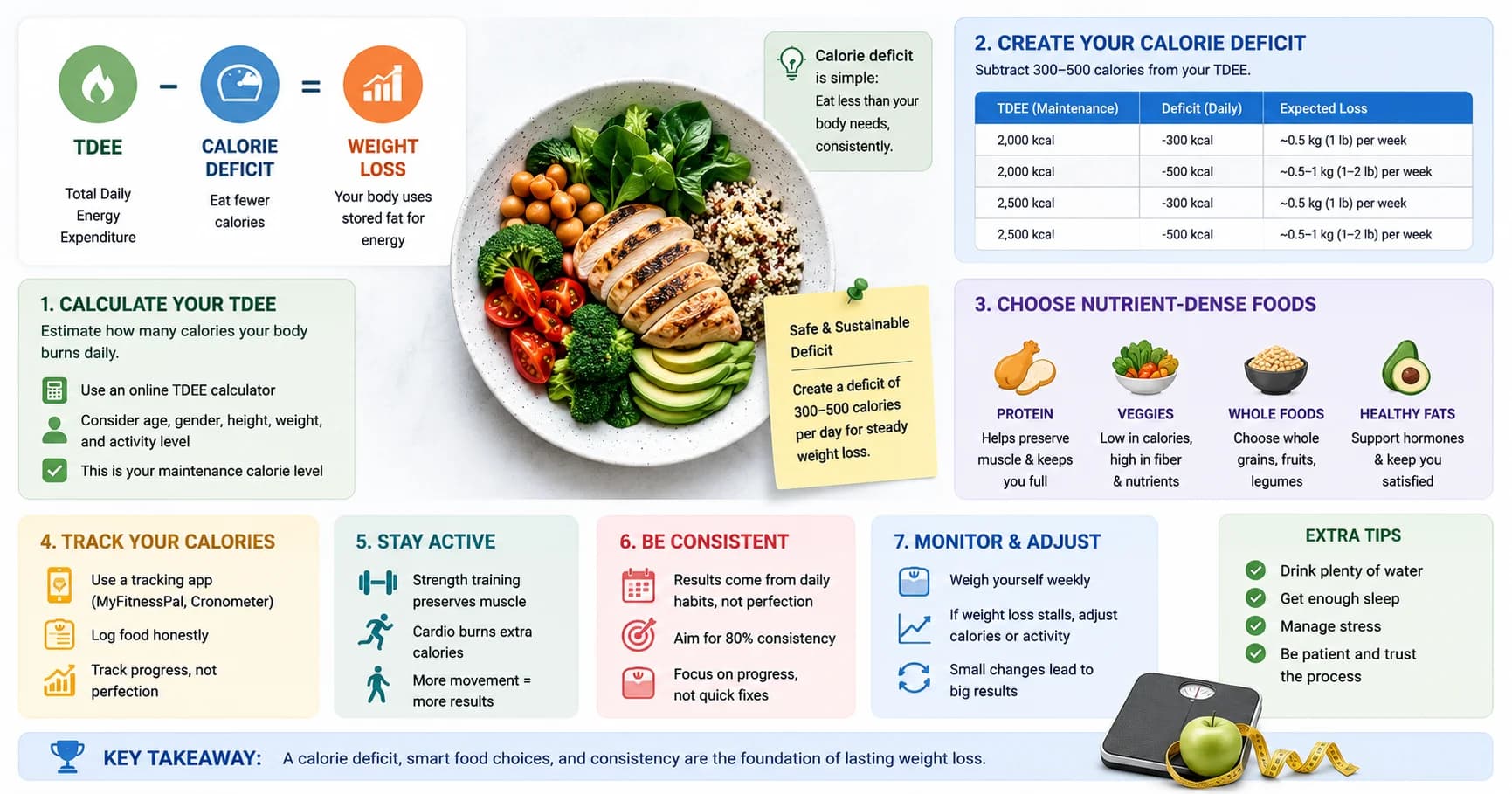
A calorie deficit occurs when you consume fewer calories than your body expends. Your body must then draw on stored energy — primarily body fat — to make up the shortfall. According to the Centers for Disease Control and Prevention (CDC), a deficit of 500–1,000 calories per day typically produces 0.5–2 pounds of weight loss per week, classified as a safe and sustainable rate. The concept is simple, but applying it accurately requires knowing your personal calorie needs. Use our calorie deficit calculator to get a personalized number in under 60 seconds.
Step 1: Calculate Your TDEE (Total Daily Energy Expenditure)
Your TDEE is the total calories your body burns in 24 hours, including your basal metabolic rate (BMR) plus energy used for physical activity and digestion. The Mifflin-St Jeor equation — identified by the Academy of Nutrition and Dietetics as the most accurate for estimating BMR — calculates resting metabolic rate as follows:
- Men: BMR = (10 × weight kg) + (6.25 × height cm) − (5 × age) + 5
- Women: BMR = (10 × weight kg) + (6.25 × height cm) − (5 × age) − 161
Your BMR is then multiplied by an activity factor:
- Sedentary (desk job, little exercise): BMR × 1.2
- Lightly active (1–3 days/week exercise): BMR × 1.375
- Moderately active (3–5 days/week): BMR × 1.55
- Very active (6–7 days/week hard exercise): BMR × 1.725
- Extra active (physical job + daily exercise): BMR × 1.9
For a 35-year-old woman weighing 75 kg (165 lbs) and standing 165 cm (5'5") with moderate activity, TDEE is approximately 2,150 calories per day. Our TDEE calculator computes this automatically and accounts for all activity levels.
Step 2: Choose the Right Deficit Size
Once you know your TDEE, you create a deficit by eating less, exercising more, or both. The size of the deficit determines your rate of weight loss — but bigger is not always better.
The 500-calorie rule: One pound of fat contains approximately 3,500 calories. A 500-calorie daily deficit therefore produces roughly 1 pound of fat loss per week (500 × 7 = 3,500). This is validated by a 2014 meta-analysis in the Journal of the Academy of Nutrition and Dietetics reviewing 29 studies on calorie restriction.
| Daily Deficit | Weekly Loss | Best For |
|---|---|---|
| 250 calories | ~0.5 lbs | Very gradual loss, maintenance |
| 500 calories | ~1 lb | Standard sustainable fat loss |
| 750 calories | ~1.5 lbs | Faster loss with strong adherence |
| 1,000 calories | ~2 lbs | Maximum recommended; requires care |
The National Institutes of Health recommends against sustained deficits exceeding 1,000 calories per day. Deficits this large risk lean muscle tissue loss, nutrient deficiencies, hormonal disruption, and metabolic adaptation — where the body lowers its BMR in response to reduced intake.
Step 3: Never Eat Below Your BMR
Your Basal Metabolic Rate represents the minimum calories your body needs to sustain vital organ function at complete rest. Eating below your BMR risks muscle catabolism, immune suppression, and hormonal imbalances. Use our BMR calculator to find your personal floor. For most adults, the Mayo Clinic guidelines place the minimum at 1,200–1,500 calories for women and 1,500–1,800 calories for men. Below these thresholds, medical supervision is required.
Step 4: Prioritize Protein to Protect Muscle
In a calorie deficit, your body can break down muscle tissue for energy if protein intake is insufficient. Research published in the American Journal of Clinical Nutrition (2020) shows that 1.6–2.4 grams of protein per kilogram of body weight during a deficit preserves lean muscle mass significantly better than lower-protein approaches. For a 75 kg person, that is 120–180 grams of protein daily.
High-protein foods also have a high thermic effect — your body burns more calories digesting them, naturally increasing your effective deficit. Use our protein calculator for your personal target, and our macro calculator to build a complete macronutrient plan.
Step 5: Combine Diet and Exercise for the Best Results
Combining dietary reduction with increased physical activity produces superior outcomes. A 2012 JAMA Cardiology study found that diet-plus-exercise interventions produced 20% more fat loss than diet alone over 12 months, with significantly better preservation of lean muscle. A 155-pound person burns approximately 372 calories in a 30-minute moderate-intensity run (Harvard Health Publishing, 2021). Check our calories burned calculator to see how different activities affect your daily energy expenditure.
A practical split: create 60–70% of your deficit through reduced calorie intake and 30–40% through exercise. This is more sustainable than large dietary cuts alone and helps maintain metabolic rate.
Common Calorie Deficit Mistakes to Avoid
Underestimating calorie intake. A 2012 New England Journal of Medicine study found people consistently underestimate their calorie consumption by 30–47%. Using a food scale and tracking app for the first 4–8 weeks significantly improves accuracy.
Overestimating exercise calories burned. Cardio equipment readouts overestimate calorie burn by 19–93% per a 2017 study in the Journal of Personalized Medicine. Use conservative estimates.
Setting too large a deficit. NIH Nutrition Research Program data shows participants on very-low-calorie diets experienced a 23% reduction in resting metabolic rate over 6 months — making further fat loss progressively harder.
Neglecting sleep. A 2010 Annals of Internal Medicine study found sleep-deprived dieters lost 55% less fat and 60% more muscle compared to well-rested controls on identical calorie deficits.
How Long Until You See Results?
Most people notice measurable weight loss within 1–2 weeks. The first week often shows a larger drop (2–5 lbs) due to glycogen depletion and associated water loss — not pure fat. True fat loss at a 500-calorie deficit proceeds at roughly 1 pound per week thereafter. If the scale has not moved over a 3-week period despite consistent tracking, your TDEE may have adapted downward. Our TDEE and BMR guide covers metabolic adaptation and how to reset your calorie targets.
Frequently Asked Questions
How many calories should I eat to lose 1 pound per week?
To lose 1 pound of fat per week, you need a daily calorie deficit of approximately 500 calories, because one pound of body fat contains roughly 3,500 calories (NIH). If your TDEE is 2,200 calories, eating 1,700 calories per day creates the needed deficit. Use our calorie deficit calculator to find your personalized TDEE and recommended intake.
Is a 1,000 calorie deficit per day safe?
A 1,000-calorie daily deficit is at the upper limit of what clinical guidelines consider safe, producing roughly 2 pounds of weight loss per week. It is generally only recommended for people with obesity under medical supervision. For most people, a 500–750 calorie deficit is more sustainable, preserves more muscle, and avoids metabolic adaptation associated with severe restriction.
Can I create a calorie deficit without counting calories?
Yes. Eating whole foods, eliminating ultra-processed foods, reducing portion sizes, and prioritizing protein and fiber naturally reduce calorie intake without strict tracking. A 2019 JAMA Internal Medicine study found that a whole-foods approach produced similar weight loss to calorie counting over 12 months. That said, tracking for at least 4–8 weeks helps calibrate your awareness of portions and calorie density.
Why am I not losing weight even with a calorie deficit?
The most common reasons are underreporting food intake (studies show 30–47% underestimation), overestimating exercise burn, water retention masking fat loss on the scale, or metabolic adaptation after a prolonged large deficit. If you have tracked accurately for 3+ weeks with no change, try increasing protein, adding resistance training, or taking a 1–2 week diet break at maintenance calories before resuming the deficit.
How does exercise help with a calorie deficit?
Exercise increases your TDEE, which allows you to eat more while maintaining the same deficit — or achieve a larger deficit with the same food intake. Resistance training is particularly valuable during a deficit because it signals the body to preserve muscle tissue, improving body composition as weight drops. The American College of Sports Medicine recommends 150–250 minutes of moderate-intensity exercise per week for effective weight management.
Related Calculators
Try these free calculators related to this article:
In-Depth Guides
Dive deeper with our comprehensive guides on this topic:
Frequently Asked Questions
Our Methodology
All calculator content on CalculatorApp.me is reviewed by subject-matter experts, cross-referenced with official sources, and updated regularly for accuracy. Our formulas and data are verified against industry standards and government publications.
Priya Sharma
Verified AuthorHealth Science Researcher
Priya is a health science researcher with 10+ years translating clinical research into practical health tools. She oversees the accuracy of health, fitness, and nutrition calculators on CalculatorApp.me, cross-referencing CDC guidelines, WHO recommendations, and NIH research. Fact-checker at CalculatorApp.me.
Found this helpful? Share it!
Stay Updated
Get notified when we launch new calculators and features.
No spam. Unsubscribe anytime.