Heart Rate Training Zones: The Science of Smarter Workouts
Free Calculator
BMI Calculator
Table of Contents
The 5 Heart Rate Training Zones
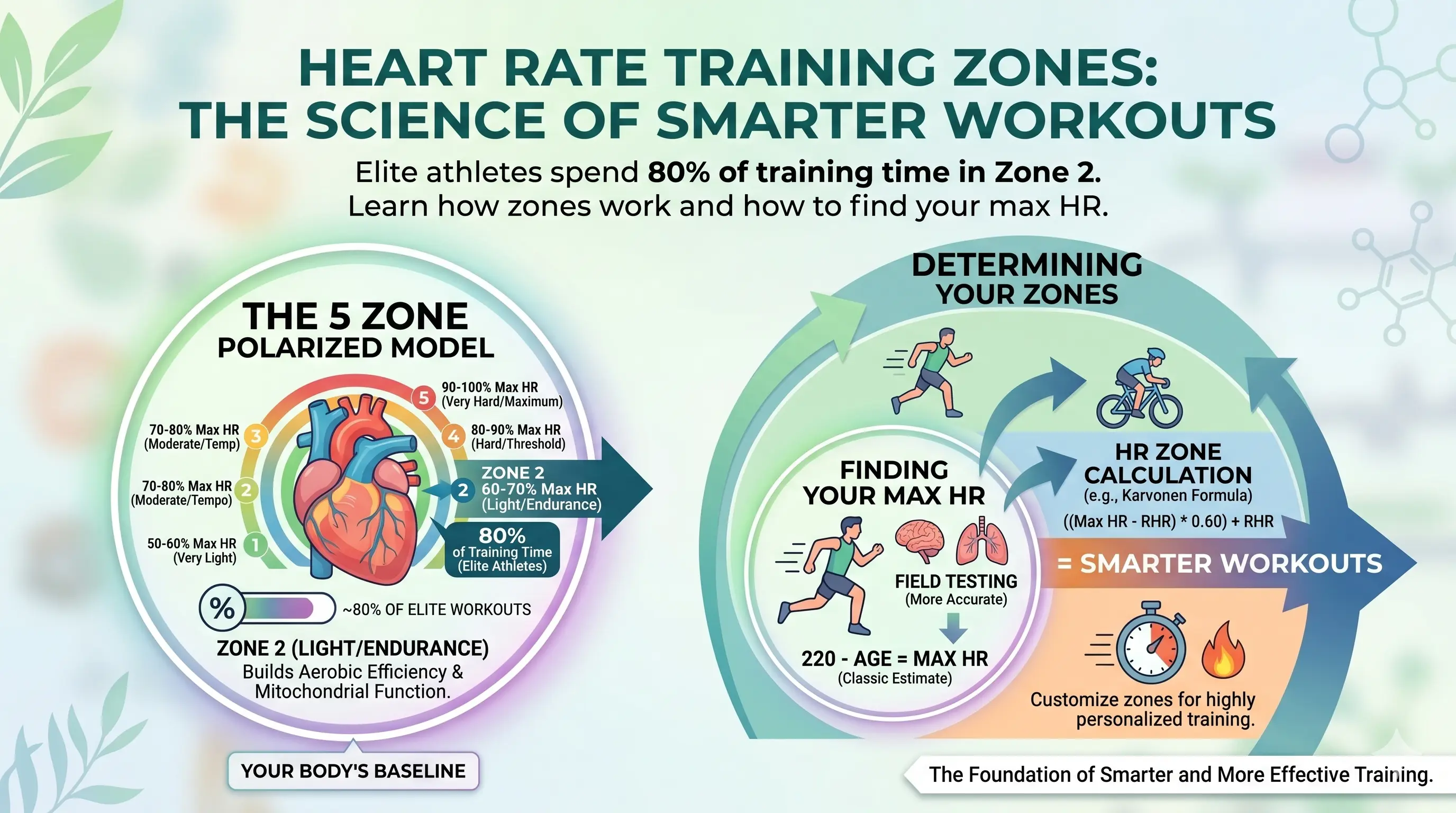
Heart rate zones are percentages of your maximum heart rate (MHR). Training in different zones produces different physiological adaptations — from fat burning to VO2max improvement. Here's what each zone does:
Zone 1 (50-60% MHR): Warm-up and recovery. Easy conversation pace. Used between hard sessions to promote blood flow and recovery.
Zone 2 (60-70% MHR): The aerobic base zone. You can still hold a conversation, but it's slightly harder. This is where endurance is built. 80% of your weekly training should be here.
Zone 3 (70-80% MHR): Tempo zone. Conversation becomes difficult. Improves lactate threshold but creates more fatigue than Zone 2 with only moderate additional benefit.
Zone 4 (80-90% MHR): Anaerobic threshold. Speaking is limited to short phrases. Intervals in Zone 4 improve VO2max — your body's maximum oxygen processing capacity.
Zone 5 (90-100% MHR): Maximum effort. Can only sustain for 30-90 seconds. Reserved for sprint training and competition.
Finding Your Maximum Heart Rate
The simplest formula is 220 − age, but it's imprecise (error margin of ±10-12 bpm). The Tanaka formula is more accurate for adults: 208 − (0.7 × age).
For a 35-year-old:
Simple formula: 220 − 35 = 185 bpm
Tanaka formula: 208 − (0.7 × 35) = 183.5 bpm
These are estimates. The gold standard is a graded exercise test supervised by a doctor, which measures your true maximum under controlled conditions. Fitness watches that estimate MHR from workouts can also provide reasonable data after several hard efforts.
Why Zone 2 Training Is King
Zone 2 training improves mitochondrial density (the power plants of your cells), teaches your body to burn fat as fuel, builds cardiovascular efficiency, and creates the endurance base that makes all other training more effective.
Research from Dr. Stephen Seiler shows that 80% of elite endurance athletes' training is in Zone 2, with only 20% in high-intensity zones (4-5). This "polarized" model — lots of easy training with some very hard efforts and almost nothing in the middle — outperforms threshold-focused training across every endurance sport studied.
The 80/20 Polarized Model
For someone training 5 hours per week:
4 hours (80%) in Zone 2: Easy runs, steady cycling, or conversational-pace swimming
1 hour (20%) in Zones 4-5: Interval training (e.g., 4×4 minutes at Zone 4 with 3-minute recovery)
Zone 3: Minimize time here — it's fatiguing but produces less adaptation than Zone 2 or Zone 4
Practical Application
Use a heart rate monitor (chest strap is most accurate, wrist optical is convenient) and follow these training guidelines:
Easy days must be easy: Stay in Zone 2, even if it feels slow. This is where adaptation happens.
Hard days should be hard: During intervals, push into Zone 4-5. Don't hold back.
Don't live in Zone 3: "Moderately hard" every day leads to overtraining without maximum benefit.
Calculate Your Zones
Use our Heart Rate Calculator to find your max heart rate and get personalized zone ranges. Pair it with our Calories Burned Calculator to see how zone intensity affects energy expenditure, and create a balanced weekly plan with our Workout Generator.
How to Accurately Determine Your Maximum Heart Rate
Heart rate training zones are only useful if your maximum heart rate (MHR) estimate is accurate. The classic formula 220 minus age is widely known but can be off by 10-20 beats per minute for many individuals. Here are better approaches:
Formula-Based Estimates
220 − age (Fox formula, 1971): Simple but has a standard deviation of ±10-12 bpm. A 40-year-old could have a true MHR anywhere from 168 to 192.
Tanaka formula (2001): 208 − (0.7 × age). Validated across larger populations and considered more accurate, especially for older adults. For a 40-year-old: 208 − 28 = 180 bpm.
Gulati formula (women, 2010): 206 − (0.88 × age). Developed specifically for women using data from the St. James Women Take Heart Study. For a 35-year-old woman: 206 − 30.8 = 175 bpm.
Field Test Method
The most accurate non-clinical method is a graded field test. After a thorough warm-up, run three consecutive 2-minute hill repeats or track intervals at maximum sustainable effort. Your peak heart rate during the final interval is a reliable approximation of your MHR. Always perform field tests with a training partner and ensure you are well-rested and hydrated.
Zone Training Methods: Polarized vs. Threshold
Understanding heart rate training zones enables two primary training philosophies that produce different results:
Polarized Training (80/20 Method)
Research from the Journal of Applied Physiology shows that elite endurance athletes spend approximately 80% of training time in Zones 1-2 (easy) and 20% in Zones 4-5 (hard), with minimal time in Zone 3 (moderate). This counterintuitive approach maximizes aerobic adaptation while allowing sufficient recovery. Most recreational athletes make the mistake of training in Zone 3 too often — too hard to recover from, too easy to trigger high-intensity adaptations.
Threshold Training
This approach focuses on improving your lactate threshold — the intensity at which lactate accumulates faster than your body can clear it (approximately Zone 4). Threshold workouts include tempo runs (20-40 minutes at threshold pace), cruise intervals (repeated 5-10 minute efforts at threshold with short recovery), and progressive runs. Threshold training is effective for improving race times over 10K to marathon distances.
Which Approach Is Better?
For beginners and recreational athletes, polarized training produces better results with lower injury risk. For competitive athletes preparing for specific events, a periodized approach that includes both methods throughout the training cycle is optimal. Regardless of method, heart rate training zones ensure you are training at the right intensity for each session.
Heart Rate Monitors: Chest Strap vs. Wrist-Based
Accurate zone training requires reliable heart rate data. The two main sensor types have important differences:
Chest strap monitors (Polar H10, Garmin HRM-Pro): Use ECG-level electrical signals to detect heartbeats. Accuracy is within ±1 bpm even during high-intensity intervals. The gold standard for serious training but less convenient for all-day wear.
Optical wrist sensors (Apple Watch, Garmin, Fitbit): Use LED lights to detect blood flow changes through your skin. Accuracy is good at rest and during steady-state exercise but can lag during intervals and produce erratic readings during activities with wrist movement (cycling, rowing). Darker skin tones and tattoos can also reduce accuracy.
Arm band sensors (Polar Verity Sense, Wahoo TICKR FIT): Optical sensors worn on the upper arm or forearm offer a compromise — more comfortable than a chest strap with better accuracy than wrist sensors because the forearm has less movement artifact.
For zone-based training, invest in a chest strap if you do interval work. A wrist sensor is adequate for steady-state cardio and general fitness tracking.
Sample Training Plans by Goal Using Heart Rate Zones
For Fat Loss (4 sessions/week)
2 × 45-60 min in Zone 2 (easy conversational pace — maximize fat oxidation)
1 × 30 min with 6-8 intervals of 30 seconds in Zone 4-5 with 90 seconds recovery in Zone 1-2
1 × 30-40 min in Zone 3 (moderate effort — tempo)
Zone 2 training maximizes the percentage of calories from fat, while high-intensity intervals boost post-exercise calorie burn (excess post-exercise oxygen consumption or EPOC).
For 5K/10K Performance (5 sessions/week)
3 × 40-50 min in Zone 2 (aerobic base building)
1 × Threshold workout: 3 × 10 min in Zone 4 with 3 min recovery
1 × VO2max session: 5 × 3 min in Zone 5 with 3 min recovery
Recovery and Overtraining: What Your Heart Rate Tells You
Your resting heart rate is a powerful indicator of recovery status. Track it each morning before getting out of bed. A resting heart rate that is elevated 5+ bpm above your baseline indicates incomplete recovery, illness, or overtraining. Other warning signs include: inability to reach Zone 4-5 during hard workouts, elevated perceived effort at normal paces, persistent fatigue, disturbed sleep, and increased illness frequency.
Heart rate variability (HRV) — the variation in time between heartbeats — is an even more sensitive recovery metric. Higher HRV generally indicates better recovery and readiness to train. Many modern watches and chest straps track HRV automatically, giving you objective data to decide whether today's workout should be hard or easy.
Frequently Asked Questions About Heart Rate Training Zones
Why can't I get my heart rate into Zone 5?
If your calculated Zone 5 seems unreachable, your estimated maximum heart rate is likely too high. Use a field test to determine your actual MHR rather than relying on 220 minus age. Alternatively, medications like beta-blockers artificially limit heart rate and require adjusted zone calculations — consult your physician.
Is Zone 2 training really enough to improve fitness?
Yes. Zone 2 training builds mitochondrial density, improves fat oxidation, strengthens the heart's stroke volume, and develops the capillary network in muscles. Elite marathoners and cyclists spend the majority of their training volume in Zone 2. The key is consistency — 150-300 minutes per week of Zone 2 exercise produces significant cardiovascular improvements over 8-12 weeks.
Do heart rate zones change as I get fitter?
Your maximum heart rate stays relatively stable (it is primarily determined by genetics and age), but your performance at each zone improves dramatically. A beginner might run a 12-minute mile in Zone 2, while a trained runner covers the same distance in 8 minutes at the same heart rate. This is the beauty of zone training — the zones stay the same but the speed at each zone increases as your cardiovascular system adapts.
Related Articles on CalculatorApp.me
Heart Rate & Fitness Resources
Related Calculators
Try these free calculators related to this article:
In-Depth Guides
Dive deeper with our comprehensive guides on this topic:
Frequently Asked Questions
Our Methodology
All health content on CalculatorApp.me is reviewed by subject-matter experts, cross-referenced with official sources, and updated regularly for accuracy. Our formulas and data are verified against industry standards and government publications.
Jordan Hayes
Verified AuthorPersonal Finance Content Strategist
Jordan is a personal finance content strategist with 9+ years writing about mortgages, retirement, tax strategy, and budgeting. Every guide is cross-referenced with IRS publications, Federal Reserve data, and CFPB guidance to make complex calculations accessible. Editor at CalculatorApp.me.
Found this helpful? Share it!
Stay Updated
Get notified when we launch new calculators and features.
No spam. Unsubscribe anytime.