How to Calculate Your Macros for Weight Loss, Muscle Gain, or Maintenance
Free Calculator
Protein Calculator
Table of Contents
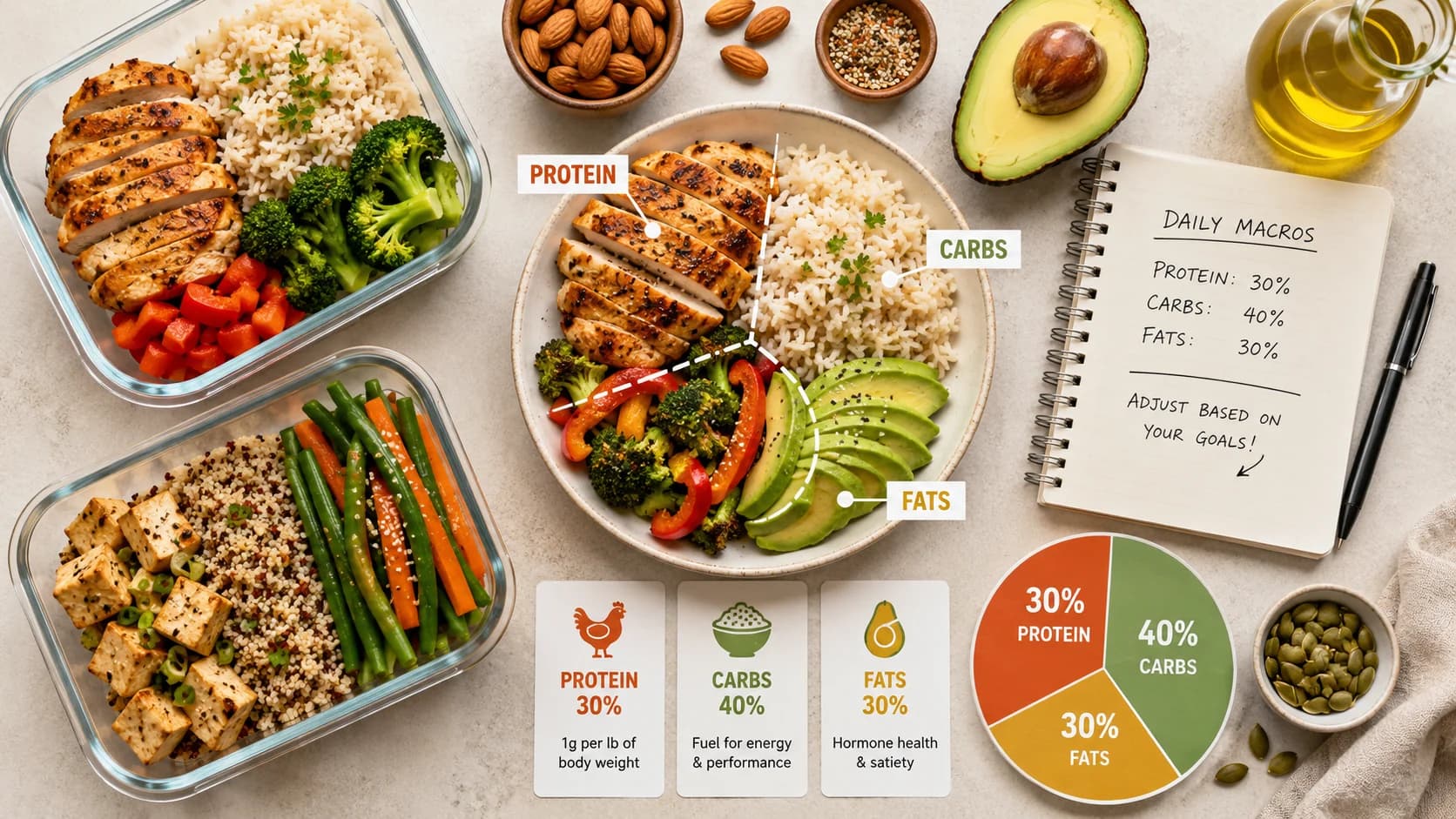
Bottom line: "Counting macros" means tracking your daily intake of protein, carbohydrates, and fat in grams — not just total calories. The right macro split depends on your goal: fat loss, muscle gain, or maintenance. A common starting point for fat loss is 40% protein / 30% carbs / 30% fat; for muscle gain, 30% protein / 45% carbs / 25% fat. But macros only work once you know your total daily calorie target. Start with our TDEE calculator for your calorie baseline, then use our macro calculator to set your exact protein, carb, and fat targets in grams.
Key Takeaways
- Protein: 4 cal/g — the most important macro for body composition; builds muscle and preserves it during fat loss.
- Carbohydrates: 4 cal/g — the body's preferred fuel for high-intensity exercise; supports performance and muscle glycogen.
- Fat: 9 cal/g — essential for hormones, fat-soluble vitamins, and satiety; never go below 0.3g per lb of body weight.
- Protein intake is the most critical variable: research supports 0.7–1.0g per lb of body weight for most active people.
- Total calories matter most for weight change; macro ratios matter for body composition quality (muscle vs. fat ratio).
- Use the macro calculator to get your exact grams per day based on your TDEE and goal.
What Are Macros?
Macronutrients (macros) are the three categories of nutrients that provide calories: protein, carbohydrates, and fat. Every food you eat contains some combination of these three, and tracking them in grams gives you far more control over body composition than tracking calories alone.
Why macros matter beyond calories: two people eating 2,000 calories per day can have very different body composition outcomes depending on macro split. 2,000 calories of mostly protein and moderate carbs supports muscle growth and satiety. 2,000 calories of mostly refined carbs and fat at low protein drives fat storage and hunger.
Step 1 — Calculate Your TDEE (Calorie Baseline)
Before setting macros, you need your Total Daily Energy Expenditure (TDEE) — the number of calories your body burns in a day including all activity. This is your maintenance calorie level.
Use our TDEE calculator to find yours. The calculation uses your Basal Metabolic Rate (BMR) — calories burned at rest — multiplied by an activity factor:
- Sedentary (desk job, no exercise): BMR × 1.2
- Lightly active (light exercise 1–3 days/week): BMR × 1.375
- Moderately active (exercise 3–5 days/week): BMR × 1.55
- Very active (hard exercise 6–7 days/week): BMR × 1.725
- Extremely active (athlete, physical job): BMR × 1.9
See our full explanation of TDEE and how it's calculated for more detail on choosing the right activity multiplier.
Step 2 — Set Your Calorie Target Based on Goal
| Goal | Calorie Adjustment | Expected Result |
|---|---|---|
| Fat loss | TDEE − 300 to −500 | 0.5–1 lb fat loss per week |
| Aggressive fat loss | TDEE − 500 to −750 | 1–1.5 lbs/week (risk muscle loss) |
| Maintenance | TDEE ± 0 | Weight stable |
| Lean bulk (muscle gain) | TDEE + 200 to +350 | 0.25–0.5 lb muscle/week |
| Aggressive bulk | TDEE + 350 to +500 | More fat gain alongside muscle |
Use our calorie deficit calculator to find the right deficit for your body weight and fat loss goals.
Step 3 — Set Protein First
Protein is the most important macro to set first. Research consistently supports:
- During fat loss: 0.8–1.2g per lb of body weight (or lean body mass for very overweight individuals) to preserve muscle while in deficit
- For muscle gain: 0.7–1.0g per lb of body weight to support muscle protein synthesis
- For maintenance/general health: 0.6–0.8g per lb of body weight
- Older adults (50+): 0.9–1.1g per lb to counteract age-related muscle loss (sarcopenia)
Our protein calculator gives you a personalized daily protein target in grams based on weight, goal, and activity level. See our guide on how much protein you actually need for the full science behind these recommendations.
Step 4 — Set Fat (Minimum Floor)
Dietary fat is essential for hormone production (testosterone, estrogen, cortisol), absorption of fat-soluble vitamins (A, D, E, K), and brain function. Never go below:
- 0.3–0.4g per lb of body weight as the daily minimum for hormonal health
- This is roughly 20–30% of total calories for most people
For a 170 lb person, the minimum is 51–68g of fat per day. Going below this on aggressive crash diets suppresses testosterone and estrogen, slows metabolism, impairs mood, and reduces workout performance.
Step 5 — Fill Remaining Calories with Carbohydrates
Once protein and fat minimums are set, carbohydrates fill the remaining calorie allowance. Carbs are not essential in the way protein and fat are — the body can function on low-carb diets — but they are the preferred fuel for high-intensity exercise and support glycogen replenishment after training.
Remaining calories for carbs = Total calorie target − (protein grams × 4) − (fat grams × 9), then divide by 4 to get carb grams.
Macro Split Examples by Goal
| Goal | Calories | Protein | Carbs | Fat |
|---|---|---|---|---|
| Fat loss (180 lb man, TDEE 2,500) | 2,000 | 180g (36%) | 175g (35%) | 56g (25%) |
| Fat loss (140 lb woman, TDEE 1,900) | 1,500 | 140g (37%) | 119g (32%) | 47g (28%) |
| Muscle gain (180 lb man, TDEE 2,500) | 2,800 | 180g (26%) | 315g (45%) | 78g (25%) |
| Maintenance (150 lb woman, TDEE 2,000) | 2,000 | 120g (24%) | 225g (45%) | 67g (30%) |
Macro Tracking: Do You Have to Weigh Everything?
Precise macro tracking requires a food scale and a tracking app (MyFitnessPal, Cronometer, Carb Manager). This level of precision is valuable when starting out or when progress has stalled. Over time, most people develop an accurate intuitive sense of portion sizes and macro content of common foods.
A practical middle ground: weigh and track for 4–8 weeks to build food literacy, then transition to intuitive eating using the portion sizes you learned. This approach is more sustainable long-term than permanent precise tracking.
Frequently Asked Questions About Macros
Do macros matter more than calories?
Calories determine whether you gain or lose weight — no macro split can override an energy surplus or deficit. But macros determine body composition quality: the same calorie deficit with high protein preserves more muscle than a low-protein deficit. Both matter — total calories for weight change direction, macros for the muscle-to-fat ratio of that change.
What happens if I eat too little protein?
Insufficient protein during a calorie deficit causes muscle loss (along with fat loss) — lowering your metabolic rate and making future fat loss harder. During a calorie surplus, insufficient protein means more of the extra calories go to fat storage rather than muscle. In both scenarios, 0.7–1.0g per lb of body weight is the research-supported protective minimum.
Can I build muscle on a high-carb diet?
Yes — as long as protein is adequate (0.7–1.0g/lb), carbohydrate intake has no direct muscle-building effect but supports it indirectly by fueling training sessions, replenishing glycogen, and supporting recovery. Higher-carb diets typically support better training performance and slightly faster muscle recovery.
Is there an ideal macro split for everyone?
No. The optimal macro split depends on your goal, training intensity, food preferences, and metabolic responses. The key constraint is protein minimum (0.7g/lb+) and fat minimum (0.3g/lb+). Within those constraints, the carb-to-fat ratio can be adjusted based on preference, performance needs, and how your body responds. Use our macro calculator for a personalized starting point.
How many calories are in each macro?
Protein: 4 calories per gram. Carbohydrates: 4 calories per gram. Fat: 9 calories per gram. Alcohol (a fourth macro): 7 calories per gram, with no nutritional value and significant fat storage promotion. This caloric density difference means fat-heavy foods are calorie-dense even in small quantities — 1 tablespoon of olive oil is 120 calories vs. 25 calories for 1 tablespoon of sugar.
Related Calculators
Try these free calculators related to this article:
In-Depth Guides
Dive deeper with our comprehensive guides on this topic:
Frequently Asked Questions
Our Methodology
All macros content on CalculatorApp.me is reviewed by subject-matter experts, cross-referenced with official sources, and updated regularly for accuracy. Our formulas and data are verified against industry standards and government publications.
Jordan Hayes
Verified AuthorPersonal Finance Content Strategist
Jordan is a personal finance content strategist with 9+ years writing about mortgages, retirement, tax strategy, and budgeting. Every guide is cross-referenced with IRS publications, Federal Reserve data, and CFPB guidance to make complex calculations accessible. Editor at CalculatorApp.me.
Found this helpful? Share it!
Stay Updated
Get notified when we launch new calculators and features.
No spam. Unsubscribe anytime.