TDEE Calculator: How to Find Your True Daily Calorie Burn (2026 Guide)
Free Calculator
TDEE Calculator
Table of Contents
What Is TDEE and Why Does It Matter More Than BMI?
BMI tells you where your weight sits relative to your height. TDEE tells you how many calories your body actually burns every day. For anyone trying to lose fat, gain muscle, or simply maintain a healthy weight, TDEE is the number that drives real results — not BMI, not a generic "2,000 calorie" guideline.
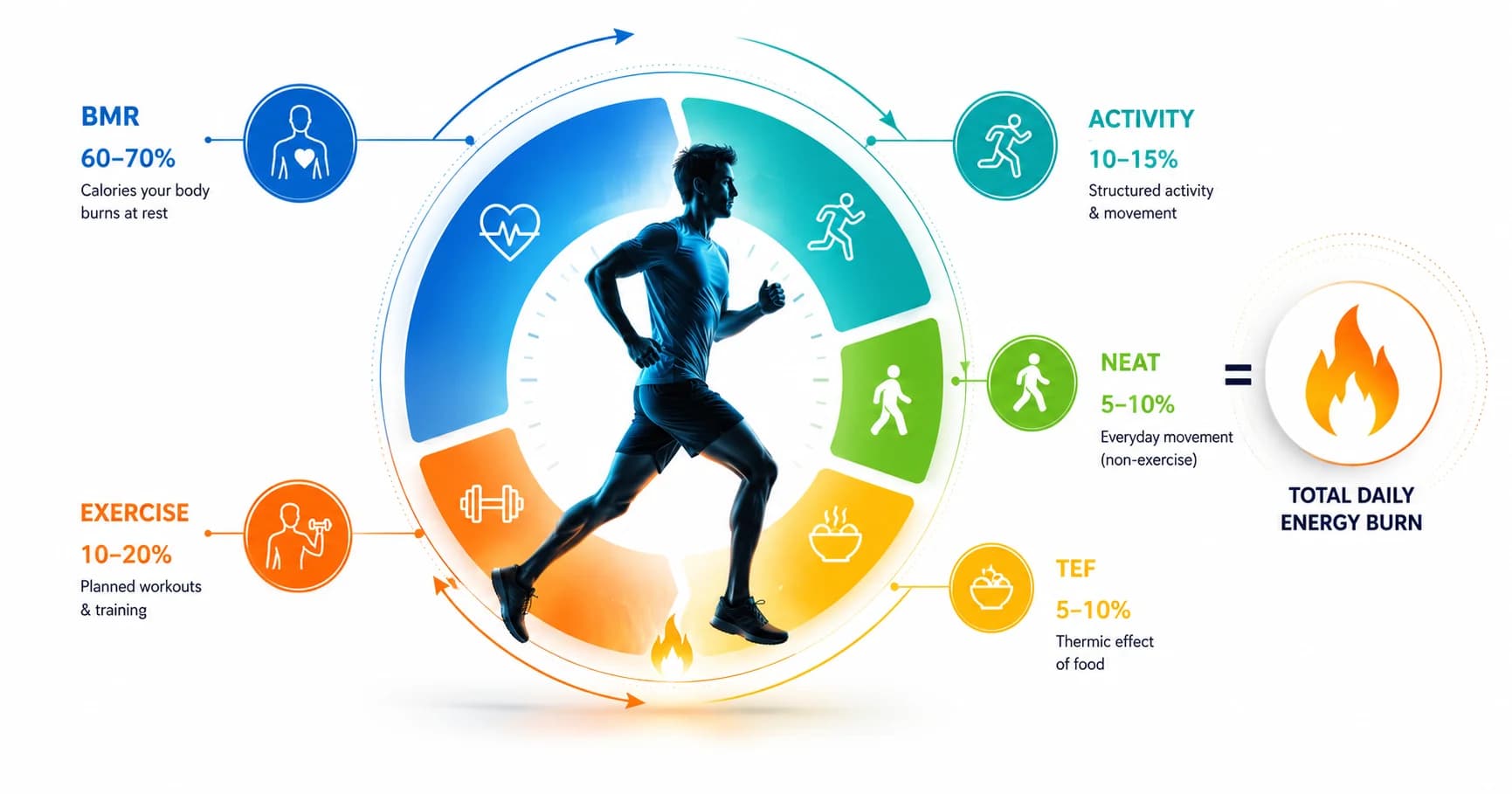
Total Daily Energy Expenditure (TDEE) is the sum of four components:
- BMR (Basal Metabolic Rate): Calories burned at complete rest — keeping your heart beating, lungs breathing, cells functioning. This is 60–70% of TDEE for most people.
- TEF (Thermic Effect of Food): Calories burned digesting what you eat. Protein digestion burns ~25–30% of its calories; carbs burn ~6–8%; fat burns ~2–3%. About 10% of TDEE.
- EAT (Exercise Activity Thermogenesis): Calories burned during intentional exercise. Varies enormously — from 100 to 800+ calories depending on duration and intensity.
- NEAT (Non-Exercise Activity Thermogenesis): Calories burned through all movement that is not formal exercise — walking to your car, fidgeting, standing, doing laundry. This is the most variable and underestimated component, ranging from 200 to 900+ calories/day between sedentary and active individuals.
The total of these four components is your TDEE. Calculate your TDEE now and come back to understand what the number means.
The Four TDEE Formulas Compared
There is no single universally agreed TDEE formula. Different equations make different trade-offs between accuracy and simplicity. Here are the four most widely used:
1. Mifflin-St Jeor (Most Accurate for Most People)
Published in 1990, this formula is the most validated for the general population and is recommended by the Academy of Nutrition and Dietetics.
Men: BMR = (10 × weight in kg) + (6.25 × height in cm) − (5 × age) + 5
Women: BMR = (10 × weight in kg) + (6.25 × height in cm) − (5 × age) − 161
Then multiply BMR by an activity factor to get TDEE (see activity multipliers below).
2. Harris-Benedict (Revised 1984)
The original 1919 formula was revised by Roza and Shizgal. Slightly overestimates calories compared to Mifflin-St Jeor, particularly in overweight individuals.
Men: BMR = 88.362 + (13.397 × weight kg) + (4.799 × height cm) − (5.677 × age)
Women: BMR = 447.593 + (9.247 × weight kg) + (3.098 × height cm) − (4.330 × age)
3. Katch-McArdle (Best for Athletes and Lean Individuals)
Uses lean body mass instead of total weight, making it more accurate for people with known body fat percentage — athletes, bodybuilders, and highly trained individuals.
BMR = 370 + (21.6 × lean mass in kg)
You need to know your body fat percentage to use this formula. Use our Body Fat Calculator to estimate it.
4. Cunningham (High-Performance Athletes)
Similar to Katch-McArdle but calibrated for elite athletes. BMR = 500 + (22 × lean mass in kg). If you train 10+ hours per week, this formula may be more accurate for you.
Activity Multipliers: The Biggest Source of Error
The formula calculates BMR. To get TDEE, you multiply by an activity factor. This is where most people go wrong — they choose "moderately active" because it sounds reasonable, when their real activity level is closer to sedentary or lightly active.
| Activity Level | Multiplier | What This Actually Means |
|---|---|---|
| Sedentary | × 1.2 | Desk job, no intentional exercise, less than 5,000 steps/day |
| Lightly Active | × 1.375 | Light exercise 1–3 days/week, or 5,000–7,500 steps/day |
| Moderately Active | × 1.55 | Moderate exercise 3–5 days/week AND an active job, or 7,500–10,000 steps/day |
| Very Active | × 1.725 | Hard exercise 6–7 days/week, physical job, or 10,000–15,000 steps/day |
| Extra Active | × 1.9 | Elite athletes, physical labour jobs, or training twice daily |
The most common mistake: Choosing "moderately active" when you are sedentary at work and exercise 3× per week for 30–45 minutes. This overestimates TDEE by 200–400 calories, which completely negates a calorie deficit.
A more accurate approach: if your only exercise is gym sessions, start with Sedentary × 1.2 for your base, then add the actual calories burned per workout separately.
Worked Example: TDEE Calculation for a 35-Year-Old Woman
Let us walk through a real calculation.
Profile: Female, 35 years old, 68 kg, 165 cm, desk job, gym 3× per week (45 min sessions)
Step 1 — Mifflin-St Jeor BMR:
BMR = (10 × 68) + (6.25 × 165) − (5 × 35) − 161
BMR = 680 + 1031.25 − 175 − 161 = 1,375 calories/day
Step 2 — Activity multiplier:
Desk job = sedentary base. Add gym 3× but do not inflate the multiplier.
TDEE (sedentary base) = 1,375 × 1.2 = 1,650 calories/day
+ Gym sessions (~250 cal each × 3 per week / 7 days) = +107 cal/day
Adjusted TDEE ≈ 1,757 calories/day
What this means for her goals:
- To maintain weight: eat ~1,757 cal/day
- To lose 0.5 kg/week: eat ~1,257 cal/day (500 cal deficit)
- To gain muscle: eat ~1,957 cal/day (200 cal surplus)
How TDEE Changes With Age (What Nobody Tells You)
TDEE declines with age — but not primarily because metabolism slows down. A 2021 paper in Science analysed 6,421 people aged 8–95 and found that metabolic rate per unit of lean mass stays remarkably stable from age 20 to 60. The decline in TDEE from middle age onward is largely driven by loss of lean mass, not a slowing of metabolism itself.
Practical implication: the most effective way to maintain TDEE as you age is to preserve muscle mass through resistance training — not to "boost metabolism" with supplements or exotic diets.
TDEE does measurably slow in infancy through young adulthood, and again after age 60 when actual metabolic rate per lean mass begins to drop. The 20–60 window is where lifestyle — not aging — explains most TDEE variation.
TDEE for Weight Loss: Using the Deficit Correctly
A 500-calorie daily deficit produces roughly 0.5 kg (1 lb) of fat loss per week under controlled conditions. In practice, the relationship is not perfectly linear for two reasons:
- Adaptive thermogenesis: Your body reduces TDEE in response to sustained calorie restriction — NEAT drops, BMR decreases slightly. This is why fat loss slows after 4–6 weeks even with consistent eating.
- Water and glycogen fluctuations: Scale weight changes by 1–3 kg from day to day based on hydration, sodium, and carbohydrate intake. Do not evaluate fat loss from day-to-day weight — use a 7-day rolling average.
Calculate your starting calorie target with our Calorie Deficit Calculator, which accounts for your goal rate of loss and bodyweight.
TDEE for Muscle Gain: The Lean Bulk Approach
Muscle gain requires a calorie surplus, but the size of the surplus matters. Beginners can build muscle more aggressively; advanced lifters need a much smaller surplus to avoid excessive fat gain.
| Training Level | Recommended Surplus | Expected Rate of Muscle Gain |
|---|---|---|
| Beginner (0–1 year) | 250–500 cal/day above TDEE | 0.9–1.4 kg/month |
| Intermediate (1–3 years) | 150–250 cal/day above TDEE | 0.5–0.9 kg/month |
| Advanced (3+ years) | 75–150 cal/day above TDEE | 0.2–0.5 kg/month |
From TDEE to a Complete Health Picture
TDEE tells you how much to eat. These tools help you decide what to eat and how to move:
- Macro Calculator — Split your TDEE calories into protein, carbs, and fat targets
- Protein Calculator — How much protein you actually need per kg of bodyweight
- Calories Burned Calculator — Estimate what your specific workouts add to TDEE
- BMI Calculator — Where your weight sits relative to height (context for TDEE goals)
Related: Build the Full Health Picture
- New BMI Formula (Trefethen) — Start here to understand BMI before using TDEE for calorie planning.
- BMI by Age — Age-adjusted BMI ranges, because the standard chart treats a 25-year-old and a 65-year-old identically.
- What Is Basal Metabolic Rate (BMR)? — BMR is the foundation of TDEE. Learn how it is calculated and what affects it.
Related Calculators
Try these free calculators related to this article:
In-Depth Guides
Dive deeper with our comprehensive guides on this topic:
Frequently Asked Questions
Our Methodology
All health content on CalculatorApp.me is reviewed by subject-matter experts, cross-referenced with official sources, and updated regularly for accuracy. Our formulas and data are verified against industry standards and government publications.
Jordan Hayes
Verified AuthorPersonal Finance Content Strategist
Jordan is a personal finance content strategist with 9+ years writing about mortgages, retirement, tax strategy, and budgeting. Every guide is cross-referenced with IRS publications, Federal Reserve data, and CFPB guidance to make complex calculations accessible. Editor at CalculatorApp.me.
Found this helpful? Share it!
Stay Updated
Get notified when we launch new calculators and features.
No spam. Unsubscribe anytime.